









What Is Association Management Software?
Association management software (AMS) is a comprehensive platform that combines all the operational tools membership organizations need into one integrated system. Instead of paying for separate membership databases, event registration platforms, email marketing services, payment processors, and website builders, an AMS brings everything together under a single login.
The defining characteristic of an AMS is native integration. When a member registers for an event, their member record updates automatically. When they renew, the correct email sequences trigger. When they update their profile, the member directory reflects the change. No manual data entry. No sync errors. No CSV exports and imports.
An AMS Typically Includes:
- Member database with unlimited contact records
- Event registration for conferences, webinars, and meetings
- Email marketing with segmentation and automation
- Payment processing for dues, events, and purchases
- Website builder with member-only content areas
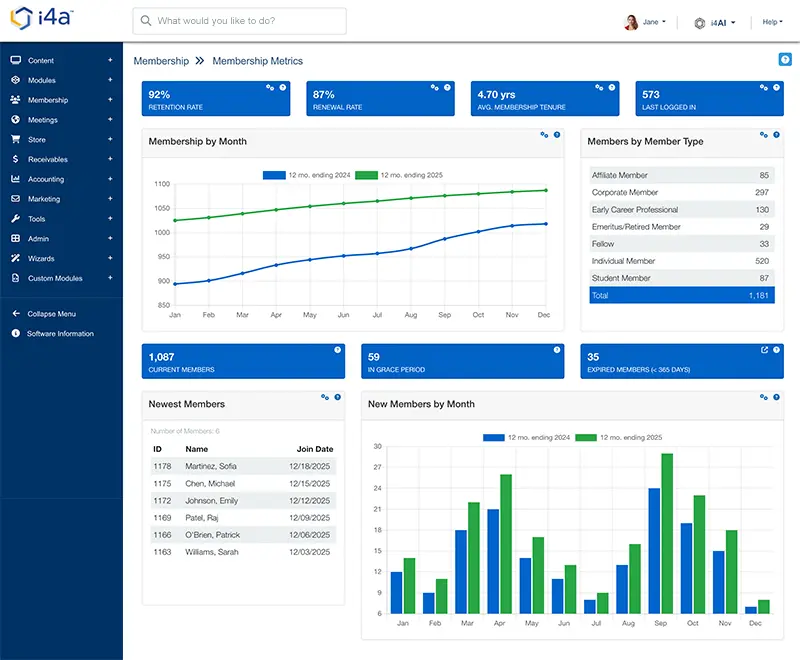
- Reporting dashboards for retention and revenue metrics
- Member portal for self-service profile updates and renewals
Modern association management software platforms are cloud-based (SaaS), meaning your data is accessible from anywhere, updates happen automatically, and you don't need IT staff to maintain servers. This cloud-based AMS approach has become the industry standard.
How an AMS Works: Platform Architecture
Association management software platform architecture — all AMS modules connected to a central database
Who Uses Association Management Software?
Association management software platforms serve membership-based organizations across virtually every industry. If your organization collects dues, manages members, and hosts events, an AMS can help streamline operations and improve member engagement. See the types of organizations we serve.
Industries served by i4a AMS including trade, professional, medical, education, nonprofits, and AMCs
Professional Associations
Bar associations, CPA societies, engineering groups, and other licensed professions. These organizations typically manage continuing education credits, professional credentials, and member certifications.
Trade Associations
Industry groups representing companies rather than individuals. Trade associations manage company memberships with multiple contacts per organization, tiered dues structures, and advocacy initiatives.
Medical & Healthcare Associations
Medical societies, nursing associations, and healthcare professional groups. These organizations require CME/CEU credit tracking, professional credentialing, and secure member data management.
Education Organizations
Teacher associations, school administrator groups, and educational societies. These organizations manage professional development events, certification tracking, and chapter networks.
Nonprofit Membership Organizations
501(c)(3) and 501(c)(6) organizations with membership programs. These groups need affordable solutions that handle dues collection, event registration, and member communications.
Association Management Companies (AMCs)
Firms that manage multiple client associations need a platform with separate databases and custom branding per client, plus consistent workflows so staff train once and apply the same processes across all clients.
Membership Organizations
Hobby clubs, social organizations, alumni associations, religious groups, and special interest societies. Any organization that collects membership dues and manages a member community.
What Problems Does Association Management Software Solve?
Association management software addresses the operational challenges that membership organizations face daily. Without a unified AMS platform, associations struggle with:
- Data silos — Member info scattered across spreadsheets, email tools, payment systems, and event platforms that don't connect
- Manual renewal processes — Staff spending hours sending reminder emails, processing payments, and updating records manually
- Poor member experience — Members can't update their own profiles, view their history, or renew online
- Unpredictable software costs — Per-member pricing that increases as your organization grows
- Integration headaches — Constant CSV exports and imports between systems, with sync errors and duplicate records
- Limited visibility — No clear picture of retention rates, revenue trends, or member engagement
- Staff burnout — Administrative tasks consuming time that should go toward member programs and strategic initiatives
- Fragmented communications — No way to segment members or personalize messages based on membership status, event attendance, or interests
- Event registration friction — Separate registration systems that don't recognize existing members or apply member pricing automatically
- Reporting challenges — Pulling data from multiple systems to create board reports or track organizational health
Core Features of Association Management Software
Comprehensive association management software includes integrated modules that share a common member database. Here are the core AMS features to look for when evaluating platforms:
Association management software features including membership, events, portal, directory, email, and integrations
Membership Management
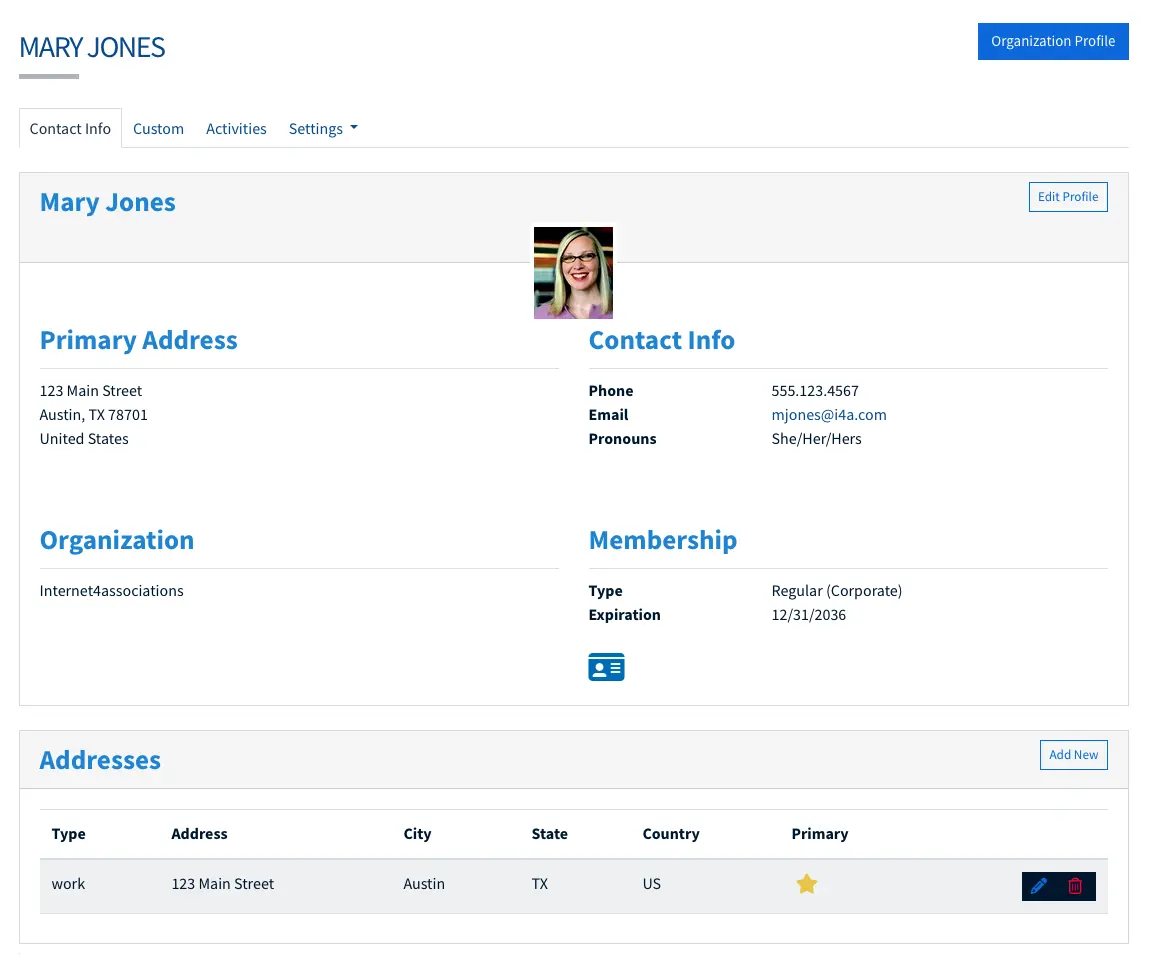
The foundation of any AMS. Store unlimited member records, configure multiple membership types and dues structures, automate renewal reminders, and track member activity over time. Look for platforms that include member self-service portals where members can update profiles, renew online, and manage their accounts without staff intervention.
Conference & Event Registration
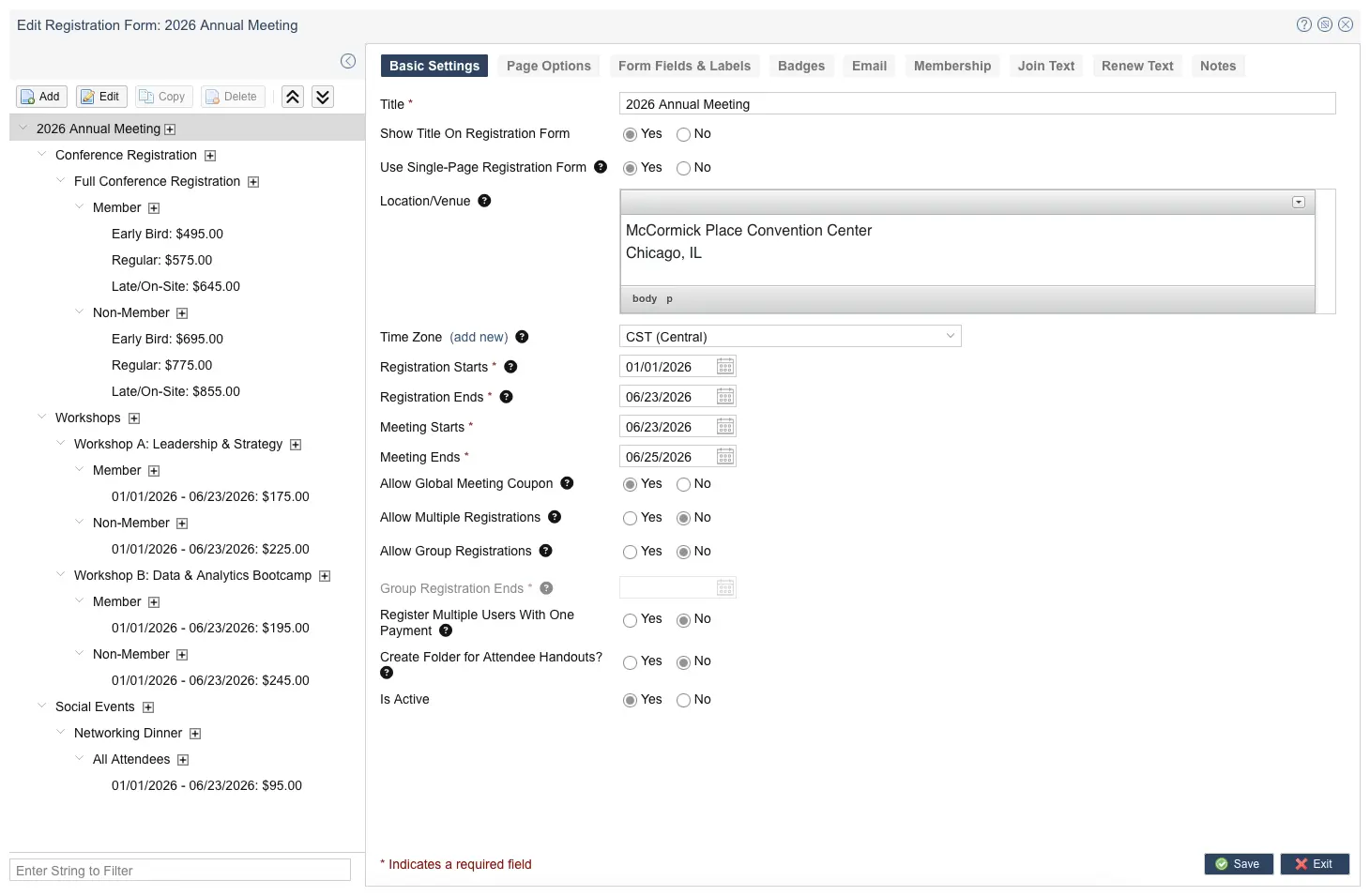
Manage conferences, webinars, workshops, and meetings from a single platform. Event registration integrates with your member database so members automatically receive member pricing and their registration history is recorded.
Submission Management
Collect abstracts, award nominations, and scholarship applications through custom online forms. Assign reviewers to score submissions on custom criteria, email acceptance notifications, and schedule accepted presentations for your conference. Build any type of submission form using our form builder.
Member Portal
Give members 24/7 access to update their profiles, renew memberships, register for events, view transaction history, and access member-only resources. A self-service portal reduces staff workload and improves member satisfaction.
Searchable Member Listings
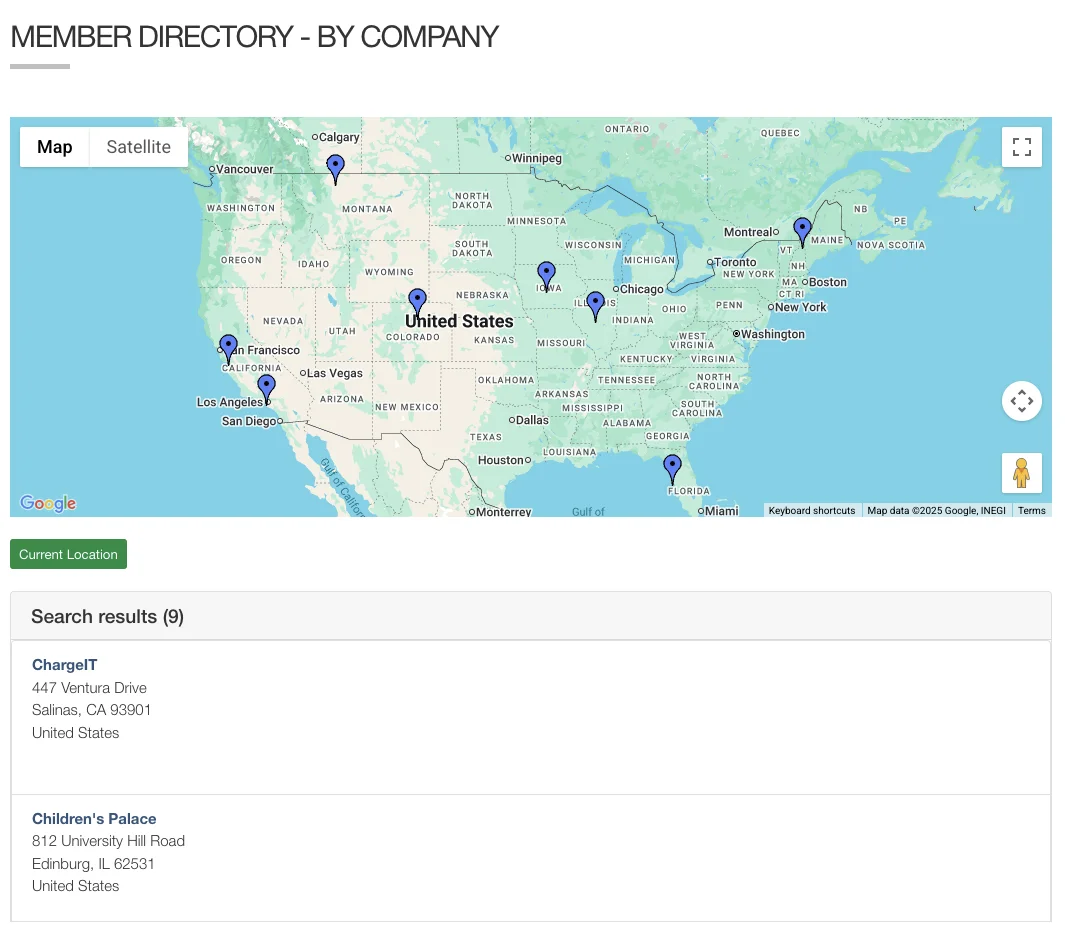
Publish searchable directories that stay current because they pull directly from your member database. Offer public or member-only access, search by location or specialty, and include map integration for geographic searches.
Committee & Board Tracking
Manage volunteer groups, committee assignments, board terms, and leadership succession. Track member involvement over time and identify engaged members for future leadership roles.
Member Communications
Send targeted communications using segments based on membership status, event attendance, interests, or any custom field. Automate renewal reminders, welcome sequences, and event promotions. Track opens, clicks, and engagement.
Job Board / Career Center
Connect members with employment opportunities while generating non-dues revenue through employer job posting fees. Manage listings, employer accounts, and job seeker profiles from your AMS.
Resource Library
Organize documents, publications, webinar recordings, and educational materials. Control access by membership level and track which resources members download and view.
Online Store
Sell publications, merchandise, training materials, and other products. Apply automatic member discounts, track inventory, and process payments through the same system as membership dues.
Payments & Accounting
Process credit cards and ACH payments securely. Auto-code transactions to your chart of accounts, export to QuickBooks, and track revenue by source with real-time dashboards.
Integrations (API, SSO, WordPress)
Connect your AMS with external tools when needed. Look for single sign-on (SSO) capabilities, REST API access for custom integrations, and WordPress plugins for organizations that maintain separate content management systems.
How Association Management Software Supports the Member Lifecycle
Effective association management software supports members at every stage of their relationship with your organization. A well-implemented AMS automates key touchpoints throughout the membership journey:
- Join — Online applications with payment processing, optional board approval workflows, and welcome email campaigns
- Engage — Member portal access, resource library, community forums, and member-only content areas
- Attend — Event discovery, registration with member pricing, session selection, and badge printing
- Learn — Continuing education tracking, certificate generation, and professional development history
- Renew — Scheduled renewal reminder campaigns, self-service renewal, auto-pay options, and grace period management
- Lead — Committee assignment tracking, volunteer management, and leadership pipeline identification
- Advocate — Targeted email campaigns, member segmentation, and communication history tracking
Key Benefits of Association Management Software
Organizations that implement association management software typically see measurable improvements across multiple areas. The right AMS platform delivers ROI through operational efficiency, improved retention, and better member experiences:
Operational Efficiency
- Eliminate manual data entry between systems
- Automate renewal reminders and payment processing
- Reduce staff time spent on routine administrative tasks
- Provide self-service options that free up staff for strategic work
Member Engagement
- Personalize communications based on member data and behavior
- Create seamless member experiences across touchpoints
- Offer 24/7 self-service through member portals
- Build community through forums, directories, and networking features
Retention Improvement
- Identify at-risk members before they lapse
- Automate renewal campaigns with proven timing
- Monitor retention and renewal rates with built-in dashboards
- Implement win-back campaigns for lapsed members
Event Success
- Streamline registration with member data pre-fill
- Apply member pricing automatically
- Track attendance and CEU credits in member records
- Generate revenue reports by event, registration type, and payment method
Financial Management
- Process payments securely with PCI DSS Level 1 compliance
- Track revenue by source (dues, events, store)
- Export transactions to QuickBooks or your accounting system
- Reduce failed payments with auto-pay and card-on-file options
Data-Driven Decisions
- Access real-time dashboards for retention and revenue
- Build custom reports without technical expertise
- View complete member history including transactions and event registrations
- Segment members for targeted outreach based on any criteria
Association Management Software by Industry
While the core functionality of association management software applies across industries, different organization types have specific needs. The best AMS platforms offer industry-specific features and configurations:
Trade Associations
Trade associations manage company memberships rather than individuals. Look for association management software features that support:
- Organizational memberships with multiple employee contacts
- Tiered dues structures based on company size or revenue
- Primary/secondary contact designations
- Company profiles with business information fields
Professional Societies
Professional associations serve individual practitioners who often need continuing education tracking. Key features include:
- CE/CLE/CPE credit tracking and reporting
- Credential and license expiration monitoring
- Professional development history
- Certificate generation for completed courses
Medical Associations
Healthcare professional associations require secure handling of professional data and CME tracking:
- CME/CEU credit assignment and tracking
- Professional credential management
- U.S.-based servers and data hosting
- Specialty and subspecialty designations
Education Associations
Education organizations manage professional development programs and diverse membership types:
- Individual teacher and institutional memberships
- Professional development credit tracking
- Custom fields for licenses, certifications, and grade levels
- School district and building information tracking
Nonprofit Membership Organizations
Budget-conscious nonprofits need affordable solutions that don't penalize growth:
- Flat-rate pricing with unlimited members
- Volunteer management and tracking
- Online dues collection and renewal reminders
- Easy-to-use interfaces for volunteer staff
How Is Association Management Software Priced?
Association management software pricing models vary significantly across vendors. Understanding the common approaches helps you compare true costs when evaluating AMS platforms:
Per-Member Pricing (Common but Problematic)
Many association management software vendors charge based on database size—the more members you have, the more you pay. This pricing model creates several issues:
- Your software costs increase as you succeed at growing membership
- Budget uncertainty makes financial planning difficult
- Organizations feel pressure to delete historical records to control costs
- Surprise bills occur when membership spikes after successful campaigns
Flat-Rate Pricing (Our Approach)
Some vendors, including i4a, offer flat-rate pricing regardless of member count. Benefits include:
- Predictable costs that don't increase as you grow
- Freedom to keep all historical member data
- Alignment between vendor and customer goals (we want you to grow)
- Simplified budgeting and board presentations
What to Ask Association Management Software Vendors About Pricing
- Is pricing based on member count, and what happens when we grow?
- What's included in the base price vs. add-on fees?
- Are there per-transaction fees for payments, event registrations, or emails?
- What's the total cost of ownership over 3-5 years?
- Are implementation and data migration included or extra?
Why Choose i4a Association Management Software?
i4a has provided association management software to membership organizations since 1996. Here's what sets our AMS platform apart:
- Flat-rate pricing with unlimited members — Whether you have 1,000 members or 50,000+ members, you pay the same predictable price. No per-contact fees.
- U.S.-based support team — Work directly with experienced professionals who know associations, not offshore call centers or ticket queues.
- 30 years of stability — No VC funding, no pressure to exit or pivot. We've been serving associations for three decades and plan to continue.
- All-in-one platform — Membership, events, email, payments, website, and reporting in one integrated system. No middleware or sync issues.
- Association-specific design — Built for membership organizations from day one, not adapted from generic CRM software.
- Proven with organizations like yours — References available from professional associations, trade associations, medical societies, and nonprofits across the country.
- Fast implementation — Most organizations go live within 60-90 days, not 6-12 months.
Ready to See i4a in Action?
Schedule a personalized demo to see how our association management software can streamline your operations, improve member engagement, and simplify your technology stack.
TL;DR — Association Management Software Summary
- What is association management software: All-in-one AMS platform combining membership, events, email, payments, and website tools into a single integrated system
- Who uses association management software: Professional associations, trade associations, medical societies, nonprofits, AMCs, and membership organizations of all sizes
- Core association management software features: Member database, event registration, email marketing, payment processing, member portal, directories, and reporting dashboards
- Benefits of association management software: Operational efficiency, better member engagement, improved retention rates, and data-driven decision making
- Association management software pricing: Per-member pricing (costs grow with membership) vs. flat-rate pricing (predictable costs regardless of size)
- i4a association management software: Flat-rate pricing with unlimited members, U.S.-based support, 30 years of stability, all-in-one platform
Frequently Asked Questions About Association Management Software
CRM (Customer Relationship Management) software is designed for sales-focused businesses to track leads, deals, and customer interactions. AMS (Association Management Software) is purpose-built for membership organizations and includes features like dues processing, member portals, event registration, and continuing education tracking that CRMs don't natively support.
While some organizations try to adapt CRMs for membership management, this typically requires extensive customization and add-ons. An AMS provides these capabilities out of the box.
AMS pricing varies widely based on vendor, features, and pricing model. Entry-level platforms start around $50-100/month but often charge per member. Mid-market solutions range from $200-500/month. Enterprise platforms can cost $1,000+/month.
The key question is the pricing model. Per-member pricing means costs increase as you grow. Flat-rate pricing (like i4a offers) keeps costs predictable regardless of member count. Always calculate total cost of ownership over 3-5 years, including implementation, training, and potential growth.
Implementation timelines vary based on data complexity, customization needs, and organizational readiness. Simple implementations can go live in 4-8 weeks. Typical mid-size associations take 60-90 days. Complex organizations with extensive historical data or custom requirements may need 4-6 months.
Key factors affecting timeline include data cleanup, staff training availability, and decision-making speed on configuration options. Working with a vendor that provides hands-on implementation support (rather than self-service) typically accelerates the process.
Most modern AMS platforms offer integration capabilities. Common integrations include QuickBooks for accounting, single sign-on (SSO) for external websites, and API access for custom development. Some platforms integrate with WordPress, learning management systems, and marketing automation tools.
However, the benefit of an all-in-one AMS is reducing integration needs. Native features for membership, events, email, and payments eliminate the complexity of syncing multiple systems. Ask vendors specifically about the integrations you need and whether they're native, via API, or through third-party middleware.
Organizations with 500+ members typically benefit from dedicated AMS software. Below that threshold, simpler tools may suffice. The trigger points for needing an AMS include:
- Managing membership renewals has become time-consuming
- You're juggling multiple disconnected tools
- Members expect self-service capabilities
- Event registration is manual or uses separate systems
- You can't easily report on retention or revenue
Most AMS platforms, including i4a, serve organizations ranging from 1,000 members to 50,000+ members.
Reputable AMS vendors implement enterprise-grade security measures. Key security features to look for include:
- 256-bit SSL encryption for data transmission
- PCI DSS Level 1 compliance for payment processing
- U.S.-based servers (for data sovereignty requirements)
- Regular backups and disaster recovery plans
- Secure data centers with physical and network security
i4a is PCI DSS Level 1 compliant (the highest level of payment security), uses 256-bit SSL encryption, maintains U.S.-based servers, and never sells or shares member data.
Data migration is a critical part of AMS implementation. The process typically involves:
- Exporting data from your current system(s) to CSV/Excel format
- Mapping fields from your old system to the new AMS
- Cleaning data (removing duplicates, standardizing formats)
- Importing data into the new system
- Validating that records transferred correctly
Look for vendors that include data migration support in their implementation package. DIY migrations often encounter issues that experienced implementation teams can prevent.
