Quick Summary: AI for Associations
- AI works best when it supports specific workflows: member communications, content drafts, event support, reporting, and staff productivity—not wholesale department replacement.
- The safest use cases keep staff in control: let AI handle first drafts, summaries, recommendations, and internal assistance, with a person approving the output.
- AI is only as useful as the data behind it. Clean member records, connected systems, and clear permissions are what separate useful AI from disappointing AI.
- Start small: pick one workflow, measure the result, and expand only after you've proven value.
For the last two years, "AI" has been the loudest word in every association conference session—and one of the least practical. The hype made it sound like you needed a data-science team and a six-figure budget just to keep up.
That's not where things actually landed. Heading into 2026, AI has quietly become a set of practical, affordable tools that a two-person staff can use on a Tuesday afternoon. The question facing association leaders is no longer "should we use AI?"—it's "where do we start, and how do we do it responsibly?"
And here's the lens for everything that follows: for most associations, AI success depends less on the AI tool itself and more on the quality of the member records, event history, email activity, certification data, and engagement signals behind it. That data lives in your association management software—which is why your AMS shapes how much value AI can actually deliver.
The data shows most associations are still early. In Sequence Consulting's 2026 Association Trends Report, about 41% of associations were exploring AI in 2025, but only 19% planned a full implementation in 2026—and "put AI to work" landed on the report's short list of strategic imperatives. Translation: the field is wide open. The associations that move deliberately this year will pull ahead of the ones still waiting for AI to feel "ready."
This guide explains how associations can use AI responsibly across member engagement, communications, events, education and certification, reporting, and staff productivity. It's a practical map: where AI genuinely helps right now, where it doesn't, and a simple way to get started without betting the budget. After nearly three decades helping associations modernize, my advice is the same as it's always been—start with a real problem, not a shiny tool.
One framing to keep in mind throughout: AI for associations is a productivity layer for staff, and it works best on clean, connected member data. It is not a replacement for association staff—it handles first drafts and data analysis so people can focus on judgment and relationships.
Where AI actually helps associations right now
Forget the futuristic demos. AI is most useful when it supports specific association workflows instead of trying to replace entire departments—and the most practical opportunities fall into five areas, summarized below and detailed in the sections that follow.
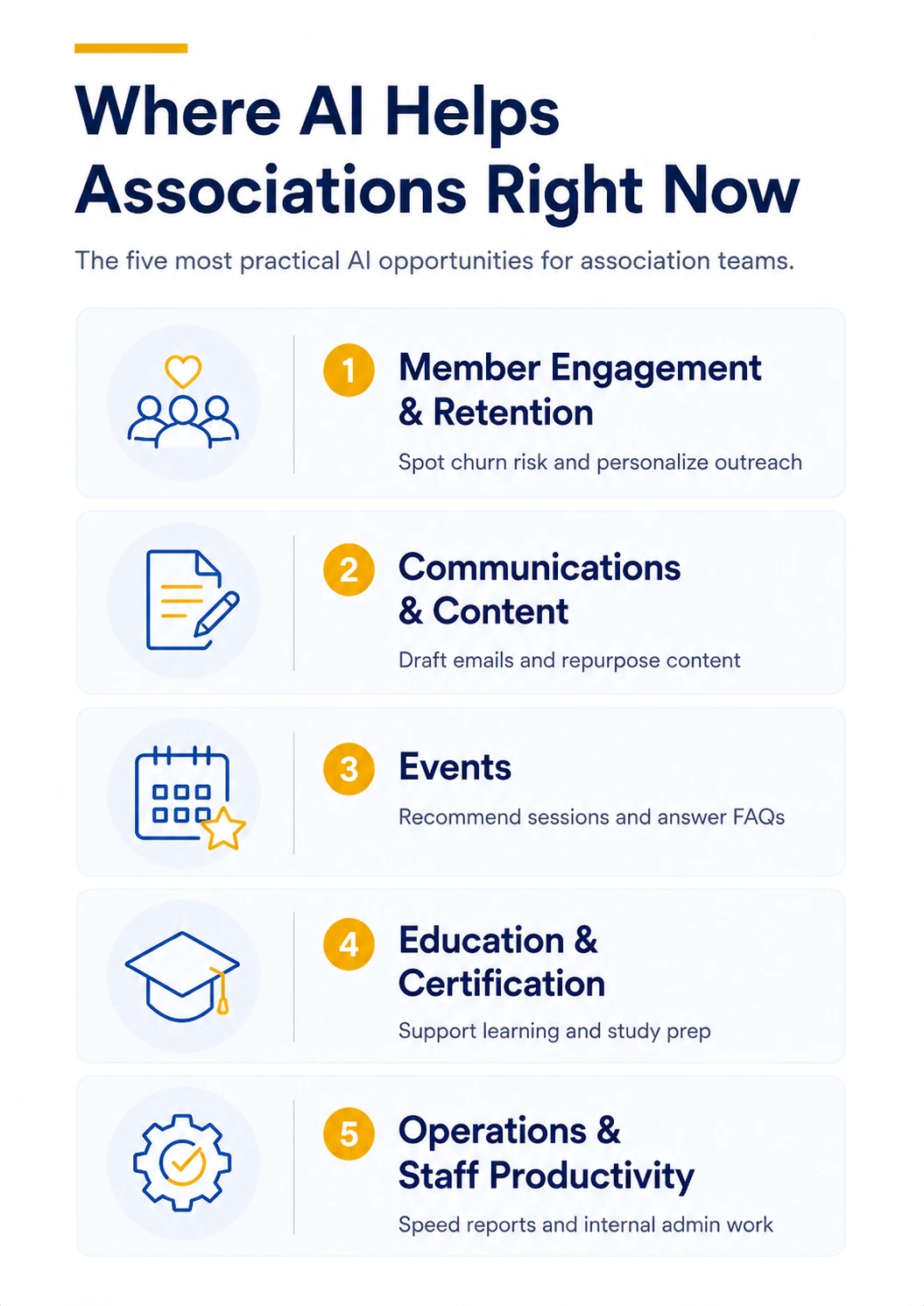
AI is most valuable for associations when it supports specific staff workflows—member retention, communications, events, education, and reporting.
1. Member engagement and retention
AI can predict which members are likely to lapse before they renew. This is the highest-value area, because AI is genuinely good at finding patterns in member behavior that humans miss.
- Predicting who's about to lapse. Instead of reacting after a member doesn't renew, AI can weigh dozens of behavioral signals—logins, event attendance, email engagement, resource use—and flag at-risk members weeks earlier. See our deeper guides on predictive analytics for retention and identifying at-risk members.
- Personalizing what each member sees. Automated segmentation can send early-career professionals different content than executives—so membership feels tailored, not generic.
- Smarter onboarding. AI can recommend the right next step for each new member from day one. More in our new-member onboarding guide.
- Micro-communities. Some associations are grouping members by role or career stage into AI-curated communities, which report meaningfully higher engagement because the content actually feels relevant.
Done well, this turns retention from a once-a-year scramble into a year-round system—the same shift we cover in reducing membership churn.
2. Communications and content
AI can draft an association's emails, newsletters, and social posts from a few notes. This is where most associations start—and the easiest place to see value in week one.
- First drafts, fast. Generate a starting draft of a newsletter, renewal email, event promo, or social post from a few bullet points, then edit for your voice.
- Repurposing. Turn one conference session or article into a short course, a study guide, a member digest, and promotional copy—in a fraction of the time.
- Consistency at scale. A two-person team can produce personalized, well-timed communications across a 5,000-member list.
The rule here: AI writes the draft, a human edits for accuracy and voice. Never publish unread.
3. Events
AI can recommend sessions to attendees and answer routine event questions automatically.
- Agenda and session support: draft session descriptions from your program, flag scheduling conflicts, balance room capacity.
- Personalized agendas: recommend sessions to each attendee based on role and history.
- Attendee questions: an in-app assistant can field routine event FAQs—dates, venue, registration, CE credit—during the busy run-up.
- Post-event analysis: summarize hundreds of open-text survey responses into clear themes in minutes.
We cover the practical side in the conference planning timeline and online learning revenue guides.
4. Education and certification
AI can generate practice exams and study materials from an association's existing content.
- On-demand practice exams generated from your existing learning materials—a differentiated member benefit you can create without writing anything new.
- Faster course production: auto-transcribe webinars, generate summaries and quiz questions, then have a subject-matter expert verify anything tied to credentials.
5. Operations and staff productivity
AI can summarize long documents and answer routine member questions for staff.
- Summarizing: turn a 50-page board packet, a committee report, or a year of survey responses into a readable brief.
- Answering routine member questions through an assistant in your member portal, freeing staff for higher-value work.
- Data analysis: ask plain-language questions of your membership data instead of waiting on a report.
Where associations should be careful with AI
A practical guide has to be honest about the limits. Keep humans firmly in charge of:
- Anything tied to credentials or compliance. AI can draft a practice exam or summarize a CE record, but a person signs off on anything that affects a member's standing.
- High-stakes, member-facing accuracy. A confident-sounding wrong answer is worse than no answer. Review AI output before it reaches a member.
- Judgment calls. Pricing, speaker selection, advocacy positions, and strategy are yours. AI informs them; it doesn't make them.
- Sensitive member data. Be deliberate about what member information goes into which tools—more on that below.
The pattern across all five opportunity areas is the same: let AI handle the first draft and the data crunching; keep people on the judgment and the final word. In practice, the division of labor looks like this:
| AI can help with | Staff should still own |
|---|---|
| Drafting emails and communications | Final tone and approval |
| Summarizing meetings | Official minutes and decisions |
| Recommending outreach segments | Member strategy and judgment |
| Answering common FAQs | Policy interpretation and exceptions |
| Finding internal knowledge | Privacy, permissions, and governance |
| Creating first-draft reports | Final analysis and board-ready conclusions |
How to get started: a practical rollout
You don't need an "AI strategy"—you need one good first project. The safest way to adopt AI isn't a major transformation; it's to start with a single workflow, measure the result, and expand from there. Here's the sequence I'd recommend for a small-staff association:
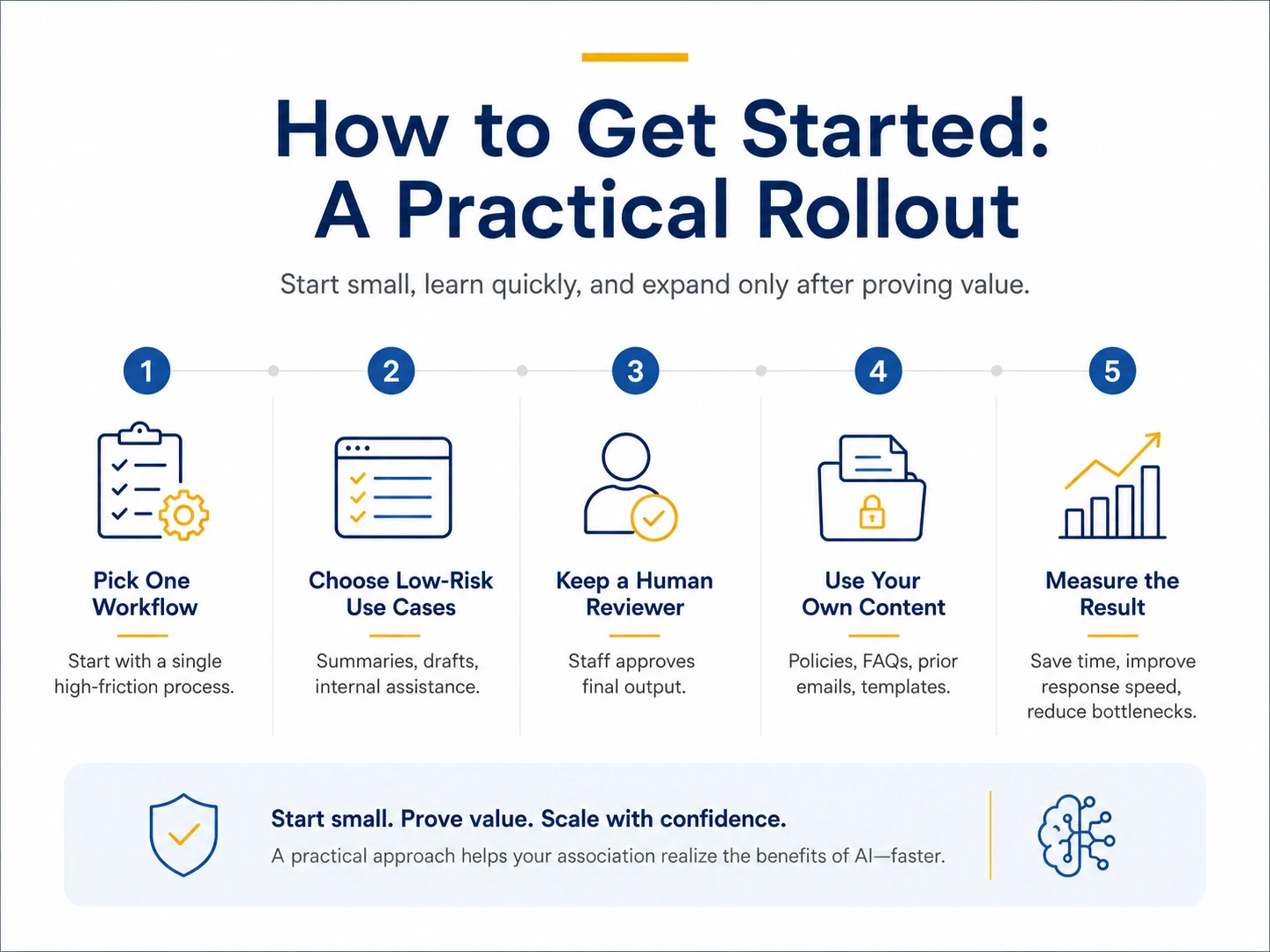
- Pick one painful, repetitive task. Writing renewal emails. Summarizing survey responses. Drafting the monthly newsletter. Choose something you do often and dread.
- Try it with a general AI tool first. Before buying anything, test the use case with a tool you already have access to. Prove the value cheaply.
- Keep a human in the loop. Set the rule from day one: AI drafts, a person reviews and approves. Make it a habit before you scale.
- Measure the time saved. Track hours reclaimed and quality. A few hours a week adds up fast—at the 2026 Independent Sector benchmark of about $34.79 per volunteer hour, reclaimed staff and volunteer time has real, quantifiable value.
- Then expand—into your AMS. Once you've proven a use case, look for the same capability built into the platform you already run, so it works on your real member data instead of in a separate tool.
For example, an association might start by using AI to draft renewal-reminder emails, summarize a backlog of support tickets, or turn board-meeting notes into a first-draft recap—contained, low-risk workflows where staff can easily review the output before it goes anywhere.
This is deliberately unglamorous. The associations getting value from AI aren't the ones with the boldest vision—they're the ones who shipped one useful thing and built from there.
The foundation everyone skips: your data
Here's the part the demos leave out. AI is only as good as the data you feed it. An AI that can't see a member's full history—dues, events, education, engagement—can't predict their behavior or personalize their experience. Clean, connected member data gives AI the context it needs: member history, event participation, certifications, payments, and engagement patterns.
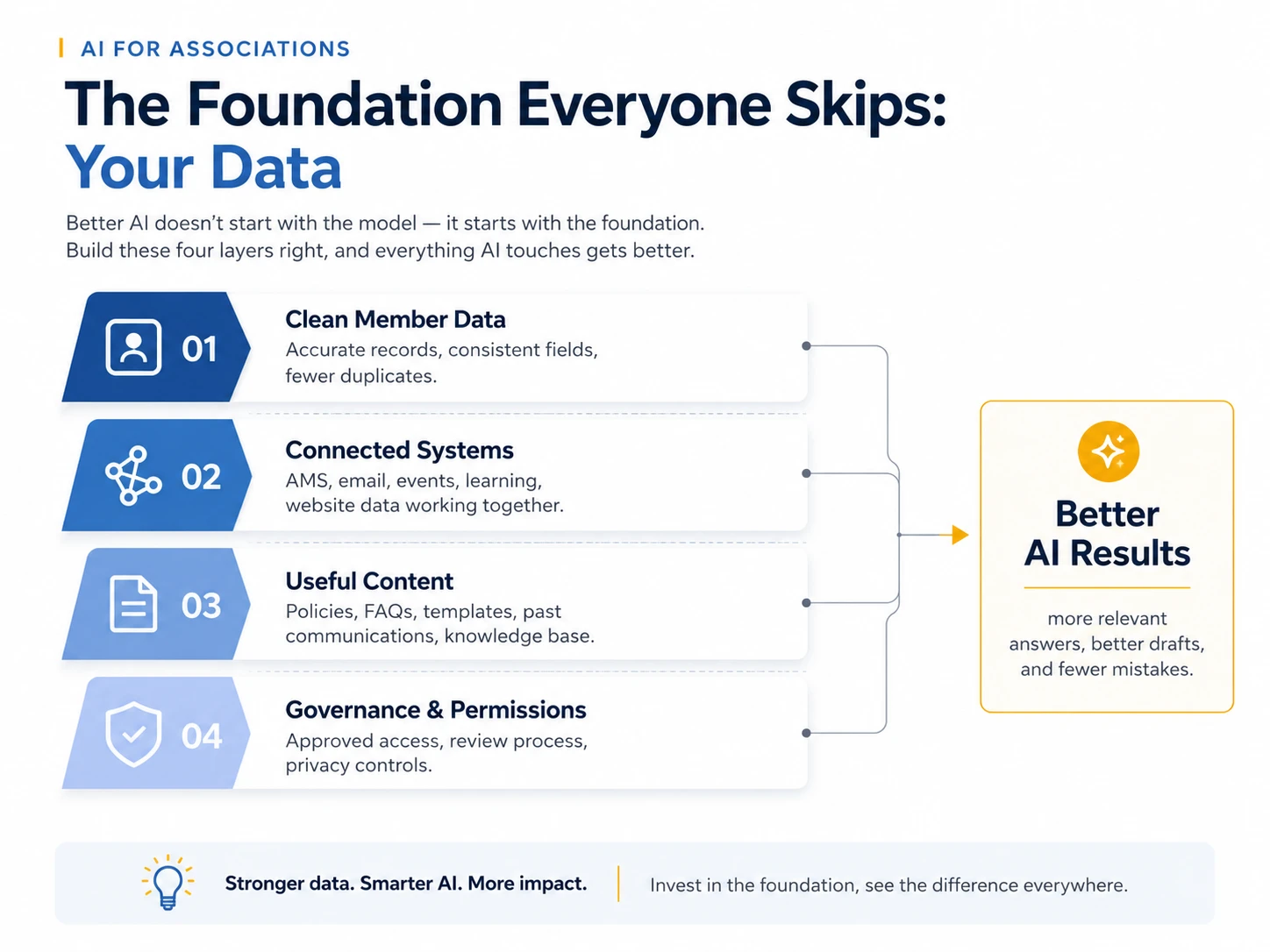
If member data is spread across spreadsheets, email platforms, event tools, LMS systems, and outdated databases, AI has far less context to work with. A connected association management software platform gives staff a cleaner, more complete foundation for using AI responsibly.
An association management software (AMS) is the system that centralizes a member's dues, events, education, and engagement data in one place. That's why your AMS matters more than any individual AI tool: a single connected platform gives AI the complete picture it needs. Scattered data across disconnected tools is the single biggest reason association AI projects underwhelm. This is also why a purpose-built AMS handles AI differently than a generic CRM, a distinction we cover in our comparison of AMS and CRM for associations.
A quick word on trust: as you connect member data to AI, be intentional about privacy. Know what data goes into which tools, minimize what you share, and favor systems that keep member data inside your own platform rather than exporting it. Your members trust you with sensitive information; that trust is worth protecting deliberately.
Common pitfalls to avoid
Most failed AI efforts share the same handful of mistakes. Steer around these five and you're most of the way to a useful result.
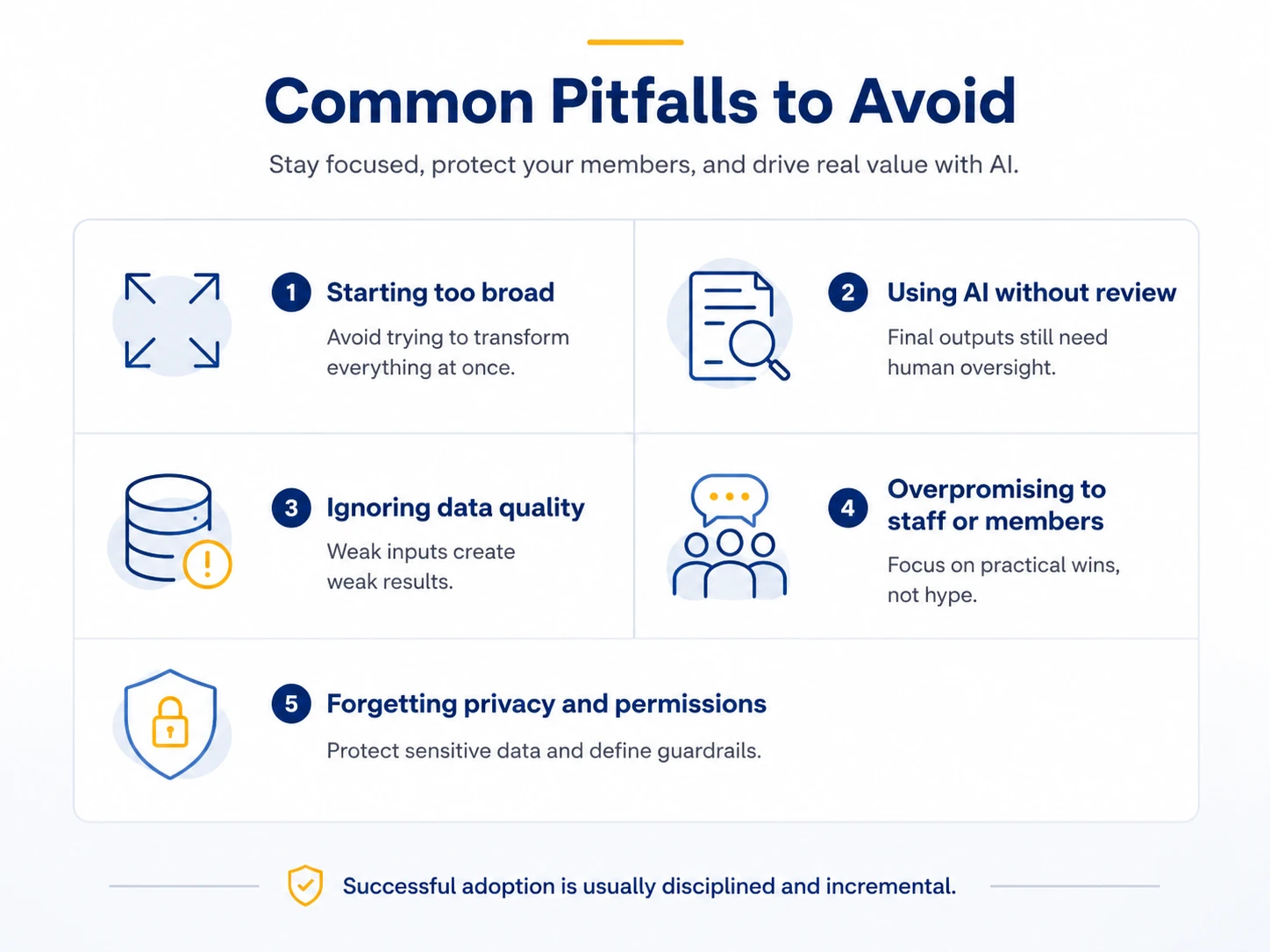
- "Doing AI" instead of solving a problem. Start with the task, not the tool.
- Publishing unreviewed output. One hallucinated fact sent at scale costs member trust.
- Ignoring your data foundation. Messy, scattered data produces messy, scattered results.
- Boiling the ocean. One proven use case beats a grand rollout that never ships.
- Forgetting the humans. Free your team for relationship work—don't remove the human touch members value.
The bottom line
AI won't fix scattered data, unclear workflows, or disconnected systems. But when associations start with focused use cases, human review, and clean, connected member data, AI becomes a practical productivity layer for staff—not just another tool to manage.
Key takeaways
- Start with a problem, not a tool: pick one painful, repetitive task and prove the value cheaply.
- Highest-value uses: predicting churn, personalizing content, drafting communications, and summarizing data.
- Keep a human in the loop: AI drafts and crunches; people own judgment, accuracy, and anything member-facing.
- Your data is the foundation: centralized member data in your AMS is what makes AI useful in the first place.
- Expand deliberately: once a use case works, bring it into the platform that runs on your real member data.
Frequently asked questions
What is AI for associations?
AI for associations is a set of practical tools that help staff predict member behavior, draft communications, support events, and summarize data. It works best when it is built on clean, connected member data in an association management software (AMS).
How can associations use AI?
Associations can use AI to draft communications, summarize meetings, support event questions, recommend sessions, assist with education content, search internal knowledge, and create first-draft reports. The best use cases are specific, low-risk workflows where staff review the final output.
Will AI replace association staff?
No. AI is a productivity layer that handles first drafts and data analysis, while association staff keep control of judgment, accuracy, and member-facing decisions.
Where should an association start with AI?
An association should start with one repetitive, low-risk workflow—such as drafting renewal emails or summarizing survey responses—keep a human reviewer, and measure the time saved before expanding.
Why does data quality matter for AI in associations?
AI can only act on the data it can see. When member, event, email, and certification data are scattered across disconnected tools, AI has less context and produces weaker results; a connected AMS gives it a complete picture.
What is the role of an AMS in association AI?
An association management software (AMS) centralizes member, event, education, and communications data in one system, giving AI the connected foundation it needs to personalize outreach and predict member behavior.
Is Your Member Data Ready for AI?
AI works better when your member records, communications, events, payments, and engagement data are organized in one reliable system. See how i4a helps associations build a stronger foundation.
Schedule a Strategy CallRelated resources
Predictive Analytics & AI for Member Retention
How to use behavioral data to spot at-risk members before they lapse—the highest-value AI use case.
How to Identify At-Risk Members
Build the engagement-scoring foundation that AI-driven retention depends on.
AMS vs. CRM: What Your Association Needs
Why a purpose-built AMS applies AI to the right data—and a generic CRM doesn't.
Turn your member data into the at-a-glance view that makes AI insights actionable.