Quick Summary: AMS vs CRM
- Different purposes: CRMs track sales pipelines and leads; AMS platforms manage membership lifecycles, renewals, and engagement.
- Missing features in CRMs: Standard CRMs lack renewal automation, member portals, CE/CME tracking, tiered memberships, and event registration.
- The CRM trap: Customizing a CRM for membership management can cost $50,000+ in development, plus ongoing maintenance.
- Most associations need AMS: If you have recurring memberships, purpose-built AMS software saves tens of thousands compared to CRM customization.
Part of our AMS selection guide
AMS vs CRM—which does your association actually need? While both manage contacts, choosing the wrong one can cost thousands and countless hours of frustration.
It's an understandable question. Both systems help organizations manage contacts, track engagement, and streamline operations. But the difference between Association Management Software (AMS) and Customer Relationship Management (CRM) systems is significant—and picking the wrong one can be an expensive and time-consuming mistake.
This guide breaks down the key distinctions so you can choose the right solution for your association's needs.
The common confusion
I can't tell you how many times I've heard prospects say, "We're thinking about just using a general CRM." When association executives search online for software solutions, they often search for "CRM for associations" or "association CRM." This happens because:
- CRM is a familiar term — Most executives have heard of popular CRM platforms through corporate experience or advertising
- Generic advice doesn't apply — Business blogs and consultants recommend CRMs for "managing customers," and associations think of members as customers
- AMS is industry-specific — You'll see it called both "Association Management Software" and "Association Management System" (both shorten to AMS)—but these terms circulate mainly within the membership world, so they're less familiar to those outside it
The result? Associations end up evaluating the wrong type of software entirely, or worse—they purchase a CRM and try to force it to work for membership management.
What is a CRM?
A Customer Relationship Management (CRM) system is software designed to manage relationships and interactions with prospects and customers—typically in a B2B sales context.
Primary purpose of CRM:
- Track sales leads through a pipeline
- Manage sales opportunities and deal stages
- Log communication history with prospects
- Forecast revenue and track sales performance
- Automate follow-up tasks and reminders
Core features of CRM platforms:
- Contact Database — Store contact information, communication history, and notes
- Sales Pipeline — Visual workflow showing where each deal stands (e.g., "Prospect," "Demo Scheduled," "Proposal Sent," "Closed Won")
- Task Management — Assign follow-up tasks to sales reps with deadlines
- Email Integration — Track emails sent/received with each contact
- Reporting — Sales activity reports, conversion rates, revenue forecasts
- Lead Scoring — Rank prospects based on engagement level
Popular CRM platforms:
There are many well-known CRM platforms in the market, ranging from enterprise solutions to small business options. Most share the same core sales-focused features—contact databases, pipeline management, and deal tracking—but none are designed specifically for membership organizations.
Put simply, CRMs are built to help sales teams convert leads into customers. They're optimized for tracking one-time or recurring sales deals—not managing ongoing memberships.
What is an AMS?
AMS stands for Association Management Software (sometimes called Association Management System). It's purpose-built for membership organizations, handling the full lifecycle—from recruitment and renewals to engagement and events.
Primary purpose of an AMS:
- Manage membership data and member records
- Automate membership renewals and dues collection
- Track member engagement and participation
- Manage events, registrations, and continuing education
- Provide self-service member portals
- Generate member-facing communications
Core features of AMS platforms:
- Membership Management — Track member types, renewal dates, dues paid, grace periods, join dates, lapsed status
- Automated Renewals — Send renewal notices, process payments, handle grace periods, update membership status automatically
- Tiered Membership Levels — Support multiple membership types (Individual, Student, Corporate, Lifetime) with different pricing and benefits
- Member Portal — Self-service portal where members can update profiles, renew, register for events, view directories
- Event Registration System — Registration forms, session scheduling, CE credit tracking, badge printing, capacity limits
- Committee & Volunteer Management — Track committee assignments, volunteer hours, leadership roles
- Continuing Education (CE/CME/CPE) — Track professional credits earned, compliance reporting, certificate generation
- Member Directory — Searchable directory with privacy controls
- Organizational Memberships — Manage corporate/organizational accounts with multiple contacts
- Member Email Campaigns — Segment members by type, engagement level, renewal status, and send targeted campaigns
- Online Store — Sell publications, merchandise, or sponsorships
- Job Board — Post career opportunities for members
Popular AMS platforms:
There are many AMS platforms available in the market, each designed specifically for membership organizations. When evaluating options, look for platforms that include the features listed above built-in, rather than requiring customization or add-ons.
An AMS is an all-in-one platform built specifically for membership organizations. It includes CRM-like contact management plus all the membership-specific workflows that CRMs don't have.
Key differences: AMS vs CRM
Here's a side-by-side comparison of what each system is designed to do:

| Feature / Function | AMS (e.g., i4a) | CRM |
|---|---|---|
| Primary Purpose | Manage membership lifecycle and engagement | Track sales leads and close deals |
| Contact Database | Yes | Yes |
| Communication Tracking | Yes | Yes |
| Sales Pipeline | Not included | Core feature |
| Membership Renewals | Automated workflows | Not built for this |
| Tiered Membership Levels | Built-in | Requires customization |
| Grace Periods | Configurable | Not available |
| Member Portal | Included | Requires development |
| Event Registration | Built-in | Requires add-on |
| CE/CME Credit Tracking | Included | Not available |
| Member Directory | Built-in | Requires customization |
| Committee Management | Included | Not available |
| Typical Cost | $99-$370/month (unlimited members) | $25-$150/user/month |
Here's the real difference: AMS platforms manage existing members through an ongoing relationship. CRMs manage potential customers moving through a sales process.
When associations try using crms
In my 30 years working with membership organizations, I've seen this scenario play out more times than I can count. An association—especially one with tech-savvy board members or staff who've used CRMs in corporate settings—decides to use a CRM for membership management. It usually goes something like this:
First, the CRM looks like a no-brainer
"This CRM is powerful, flexible, and everyone's heard of it. Let's use that!"
- Free or low-cost nonprofit pricing makes it seem affordable
- Board members recognize the brand name
- Promises of "unlimited customization" sound perfect
Then reality sets in
Within weeks, the association realizes the CRM doesn't do what they need out-of-the-box:
- No membership renewal workflows — You can't set up "send renewal notice 60 days before expiration, then 30 days, then 15 days, then move to grace period"
- No tiered membership structure — Managing different membership types with different pricing and benefits requires custom development
- No member portal — Members can't log in to renew or update their profile
- No event registration — You'll need a separate tool (and manual data syncing)
- No CE credit tracking — Professional associations can't track CME, CPE, or other credentials
Now comes the expensive part
At this point, the association typically faces three options—none of them great:
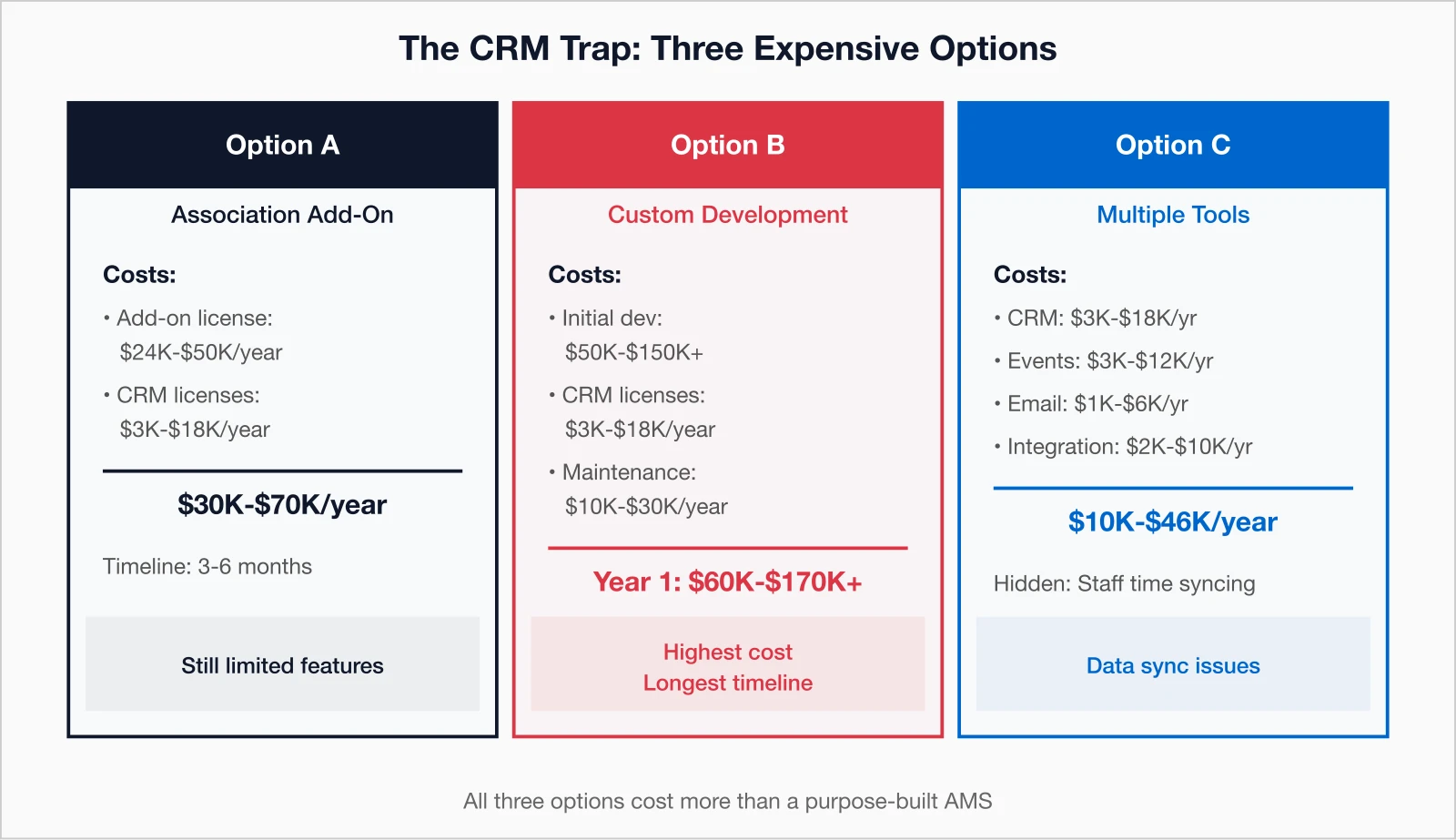
Option A: Buy an Association-Specific Add-On
- Purchase a third-party add-on built for associations
- Cost: $24,000-$50,000+ per year
- Still requires CRM licenses ($25-$150/user/month)
- Total annual cost: $30,000-$70,000+
Option B: Custom Development
- Hire developers to build membership features
- Cost: Custom CRM development often runs into the tens of thousands of dollars ($50,000+ isn't unusual for comprehensive membership functionality)
- Plus ongoing maintenance costs each year
- 6-12 month timeline before it's functional
Option C: Duct-Tape Multiple Tools Together
- Use the CRM for contacts + separate tools for renewals, events, and email marketing
- Manually sync data between systems (or pay for integration tools)
- High staff overhead and constant data errors
This multi-tool approach is disturbingly common. According to Sequence Consulting's 2026 Association Trends Report, technology fragmentation remains one of the top operational challenges facing associations—with staff spending significant time managing data across disconnected systems.
Warning: In our experience, many associations that go the CRM route end up investing significantly in customization, or they switch to a purpose-built AMS within a couple of years. It's worth doing the math before committing.
Why AMS is purpose-built for associations
Association Management Software understands the unique workflows of membership organizations because it was designed specifically for them.
Membership-specific features included in AMS platforms:
1. Automated Renewal Workflows
- Automatically send renewal notices 60, 30, and 15 days before expiration
- Configure grace periods (e.g., 30-90 days after expiration)
- Automatically update member status from "Active" to "Grace Period" to "Lapsed"
- Send different messages based on member type or engagement level
2. Tiered Membership Structures
- Individual, Student, Corporate, Retired, Lifetime membership types
- Different pricing for each tier
- Different benefits and access levels
- Automatic pro-rating for mid-year joins
3. Member Self-Service Portal
- Members log in to renew their membership
- Update contact information and preferences
- View renewal history and invoices
- Register for events with member pricing
- Access member-only resources
- Create registration forms with custom questions
- Offer early-bird pricing and member discounts
- Track session attendance for CE credits
- Generate badges and certificates
- Handle capacity limits and waitlists
5. Continuing Education Tracking
- Track CME, CPE, CEU, or other professional credits
- Generate compliance reports for members
- Issue certificates automatically
- Track credits by category or accreditation body
- Segment members by type, status, engagement, location
- Send targeted emails based on renewal date or member type
- Track email opens and clicks
- Automated campaigns (welcome series, renewal reminders)
i4a includes all of these features in every plan, starting at $99/month with unlimited members. See all features or get in touch
Real-world example: Medical association
Let me share a real example that illustrates why associations need an AMS, not a CRM.
The Scenario:
A state medical association with 2,500 physician members needs to:
- Manage three membership types: Active Physician ($450/year), Resident Physician ($150/year), Retired Physician ($100/year)
- Send automated renewal reminders 60 and 30 days before expiration
- Offer a 60-day grace period after expiration
- Track CME credits earned at annual conference
- Provide a member directory searchable by specialty and location
- Allow members to register for monthly webinars
- Generate compliance reports showing CME credits by category
With a CRM:
- Membership tiers: Requires custom objects and workflows ($15,000+ development)
- Renewal automation: Requires workflow builder customization and email templates ($8,000+ development)
- Grace periods: Requires custom fields and automation logic ($5,000+ development)
- CME tracking: Requires custom objects, forms, and reporting ($20,000+ development)
- Member directory: Requires community portal add-on ($12,000+/year) plus customization ($10,000+)
- Event registration: Requires third-party integration with separate event platforms (separate cost + manual data sync)
- Total cost: $60,000+ initial development + $15,000-$25,000/year ongoing
- Timeline: 6-9 months to build and test
With an AMS (i4a):
- Membership tiers: Configure in 10 minutes using built-in membership type manager
- Renewal automation: Configure automated email sequence in 30 minutes
- Grace periods: Set grace period duration in settings (2 minutes)
- CME tracking: Use built-in CE credit tracking feature (15 minutes to configure)
- Member directory: Enable member directory in portal settings (5 minutes)
- Event registration: Use built-in event management with CME credit assignment
- Total cost: $4,435/year (Pro Platform, 5 users, unlimited members)
- Timeline: 60-90 days from contract to launch
Cost Comparison Over 3 Years:

- CRM + Custom Development: $105,000-$135,000
- i4a: $14,805 ($4,435/year × 3 years + $1,500 one-time setup)
- Savings with i4a: $90,195-$120,195
We've helped dozens of associations migrate away from expensive CRM customizations to i4a, saving them tens of thousands of dollars annually.
How to choose: Do you need an AMS or CRM?
Here's a simple decision framework:
Choose an AMS if you:
- Manage recurring memberships with annual renewals
- Need to track member engagement and participation
- Offer events, webinars, or conferences
- Track continuing education or professional credentials
- Provide a member directory or community
- Have volunteers, committees, or chapters
- Want members to self-renew online
- Need tiered membership levels (Individual, Corporate, Student, etc.)
This describes the vast majority of associations, nonprofits, and membership organizations. If you checked even 3-4 of these boxes, you likely need an AMS.
You might consider a CRM if you:
- Focus primarily on corporate sponsorship sales
- Run a fundraising-focused nonprofit (not membership-based)
- Have a large sales team tracking individual deals
- Don't have recurring memberships or dues
Even in these cases, I'd still suggest looking at an AMS with strong CRM features rather than a pure CRM. You may find you get more value from a platform that can grow with you.
Pro Tip: If you're evaluating software right now, ask these 10 critical questions during your demo
The bottom line
Here's what you need to remember:
- CRMs manage sales pipelines. They're built for B2B companies tracking leads through a sales process.
- AMS platforms manage memberships. They're built for associations managing ongoing member relationships, renewals, events, and engagement.
- Most associations need an AMS, not a CRM. If you have recurring memberships, you need purpose-built membership management software.
- Using a CRM for membership management can get expensive. Custom development often runs into the tens of thousands of dollars, or you may pay significantly for association-specific add-ons.
- An AMS includes CRM functionality. You get contact management, communication tracking, and segmentation—plus all the membership-specific features built in.
If you've been looking for a "CRM for associations," what you actually need is a purpose-built association management software (AMS)
Key takeaways
- CRMs track sales, AMS manages memberships: CRMs are built for B2B sales pipelines and lead tracking, while AMS platforms handle membership renewals, dues collection, grace periods, and member lifecycle management
- Membership-specific features are missing in CRMs: Standard CRMs lack tiered membership levels, automated renewal workflows, CE/CME credit tracking, member directories, and organizational membership structures that associations require daily
- The CRM trap can be expensive: Many associations try building membership management on a CRM, only to discover they need costly add-ons or custom development—often running into the tens of thousands of dollars—to replicate basic AMS functionality
- Most associations need an AMS, not a CRM: Unless you're primarily focused on corporate sponsorship sales or fundraising, you need purpose-built membership management software—an AMS platform like i4a that includes CRM functionality plus all the association-specific features built in
Ready to See What an AMS Can Do?
i4a is a complete Association Management Software platform that includes everything you need—membership management, event registration, email marketing, member portal, committee tracking, CE credits, and more—all in one platform.
Talk to Our TeamRelated resources
AMS Implementation Timeline: What to Expect
Learn the 5 phases from kickoff to go-live and how to prepare for a smooth transition.
Association Management Software Guide
Complete guide to what AMS platforms can do for your membership organization.
Membership Software Selection Guide
How to evaluate and choose the right membership software for your association.
10 Critical Questions to Ask During Software Demos
Essential questions to ask vendors before committing to new membership software.
