Quick Summary: Advertising Revenue
- Revenue scales with audience: Small associations earn $7K–$23K annually; mid-size $23K–$75K; large associations $75K–$225K+.
- Newsletters are usually strongest: Email advertising often outperforms website ads in both engagement and revenue.
- Niche audiences justify premiums: Your targeted membership is worth more per impression than broad general audiences.
- Sponsored content beats banners: Native formats like sponsored articles drive higher engagement and command better rates.
- Limited inventory protects value: Scarcity maintains premium pricing and ensures a positive member experience.
Part of our non-dues revenue guide
Association advertising revenue is one of the most overlooked non-dues income streams—yet you already control the channels, content, and member attention that advertisers pay premium rates to access.
Advertising is often ignored, even though it's one of the simplest non-dues revenue opportunities for associations to launch and grow. You already have the audience and platforms in place; an advertising program simply gives relevant partners a structured way to connect with your members. After working with membership organizations for three decades, I've seen too many associations leave this potential untapped—not because it's difficult, but because no one has taken the time to set it up strategically.
According to Sequence Consulting's 2025 Association Trends Analysis, 63% of associations expect non-dues revenue to grow, and targeted advertising stands out as a low-barrier, high-impact option. Because your members share specific professional interests and purchasing habits, association advertising offers pinpoint targeting that general media can't match—and advertisers are willing to pay a premium for that level of precision.
This article explores how to build an advertising program that delivers meaningful revenue while safeguarding member trust and editorial integrity.
The value of association advertising
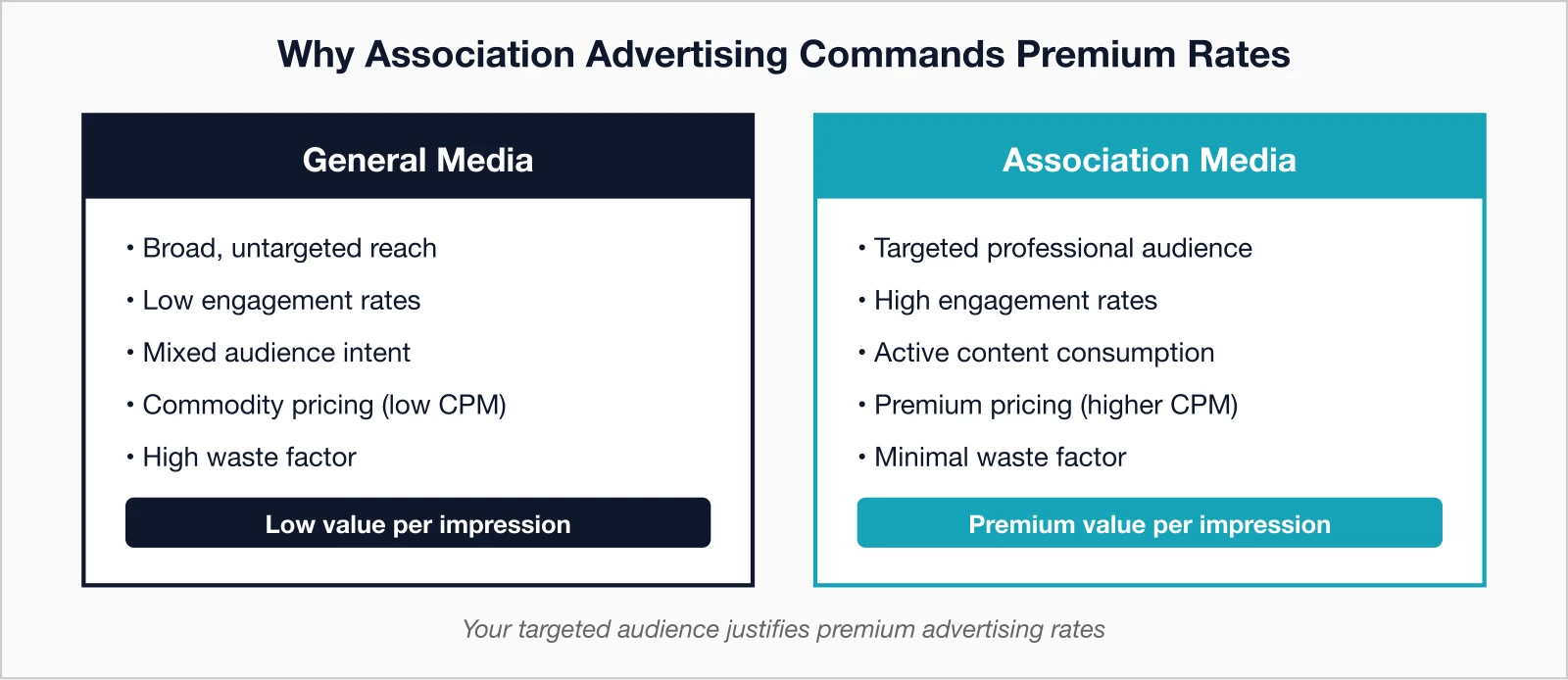
Association advertising works because it combines niche targeting with a trusted context. Instead of casting a wide net, advertisers reach a pre-qualified professional audience that has chosen to engage with your content.
Why advertisers pay premium rates
Advertisers pay more to reach association audiences because they get:
- Targeted reach: Every impression goes to people who fit their ideal customer profile
- Professional context: Ads appear alongside relevant industry news, education, and resources
- Trust transfer: Your brand's reputation lends credibility to the advertisers you feature
- Engaged readers: Members opt in to your communications and interact with them more actively than general web traffic
- Decision-maker access: Many members influence or control purchasing decisions in their organizations
Revenue potential by association size
Advertising revenue scales with list size and web traffic, but even smaller associations can generate meaningful income with the right focus.
| Association Size | Newsletter Ads (Annual) | Website Ads (Annual) | Total Potential |
|---|---|---|---|
| Small (500–2,000 members) | $5,000–$15,000 | $2,000–$8,000 | $7,000–$23,000 |
| Medium (2,000–10,000 members) | $15,000–$50,000 | $8,000–$25,000 | $23,000–$75,000 |
| Large (10,000+ members) | $50,000–$150,000+ | $25,000–$75,000+ | $75,000–$225,000+ |
Why your impressions are worth more
In advertising, an impression is a single view of an ad—one member seeing your newsletter banner or website ad counts as one.
Your inventory isn't commodity web traffic. It delivers far higher value per impression than general media because of who your audience is (targeted professionals) and how they engage (actively, with trusted content). Your concentrated, professional audience justifies higher advertising rates than generic media channels.
Advertising channels
Most associations already have multiple channels that can support advertising without major operational changes. Each channel plays a different role and offers distinct pricing and engagement potential.
Email newsletters
Association newsletter ads are often your most valuable advertising asset. Members subscribe intentionally and tend to open and read these emails at higher rates than typical marketing messages.
- Open and engagement: Association newsletters frequently outperform commercial email in open and click rates
- Formats: Header and mid-content banners, sponsored content blocks, and dedicated sends
- Frequency: Weekly or bi-weekly newsletters create repeatable inventory
- Revenue potential: Approximately $150–$500+ per placement, depending on list size and engagement
Website
Your website provides ongoing visibility and a steady stream of impressions, even if engagement is more passive than email.
- Formats: Header, sidebar, or footer banners; sponsored content; sponsored directory listings
- Targeting: By section, content category, or logged-in/member status
- Revenue models: Monthly or annual flat fees, or CPM-based pricing (cost per thousand impressions) for high-traffic pages
- Revenue potential: Roughly $200–$2,000+ per month per placement
Publications and magazines
Print and digital publications offer premium, often higher-priced placements and extended shelf life.
- Formats: Display ads, advertorials, inserts, and special sections
- Premium positions: Covers, inside covers, and center spreads
- Longevity: Issues are saved, shared, and referenced over time
- Revenue potential: About $500–$5,000+ per placement, depending on circulation and status
Job board and career center
Your job board or career center attracts highly motivated, career-focused traffic.
- Formats: Featured employer spots, recruitment banners, branded employer profiles
- Audience: Active job seekers and employers recruiting in your niche
- Revenue potential: Often in the $200–$1,000 per month range for premium placements
Events and webinars
Events—both in-person and virtual—offer high-engagement advertising and sponsorship opportunities.
- Formats: Program book ads, branded sessions, webinar pre-roll, and sponsored event emails
- Engagement: Attendees are deeply involved and attentive, making ad placements more impactful
- Revenue potential: Approximately $500–$5,000 per event, depending on audience and prominence
Ad formats and placements
Different ad formats support different marketing goals. Offering a balanced mix helps attract a wide range of advertisers and budgets.
Display advertising
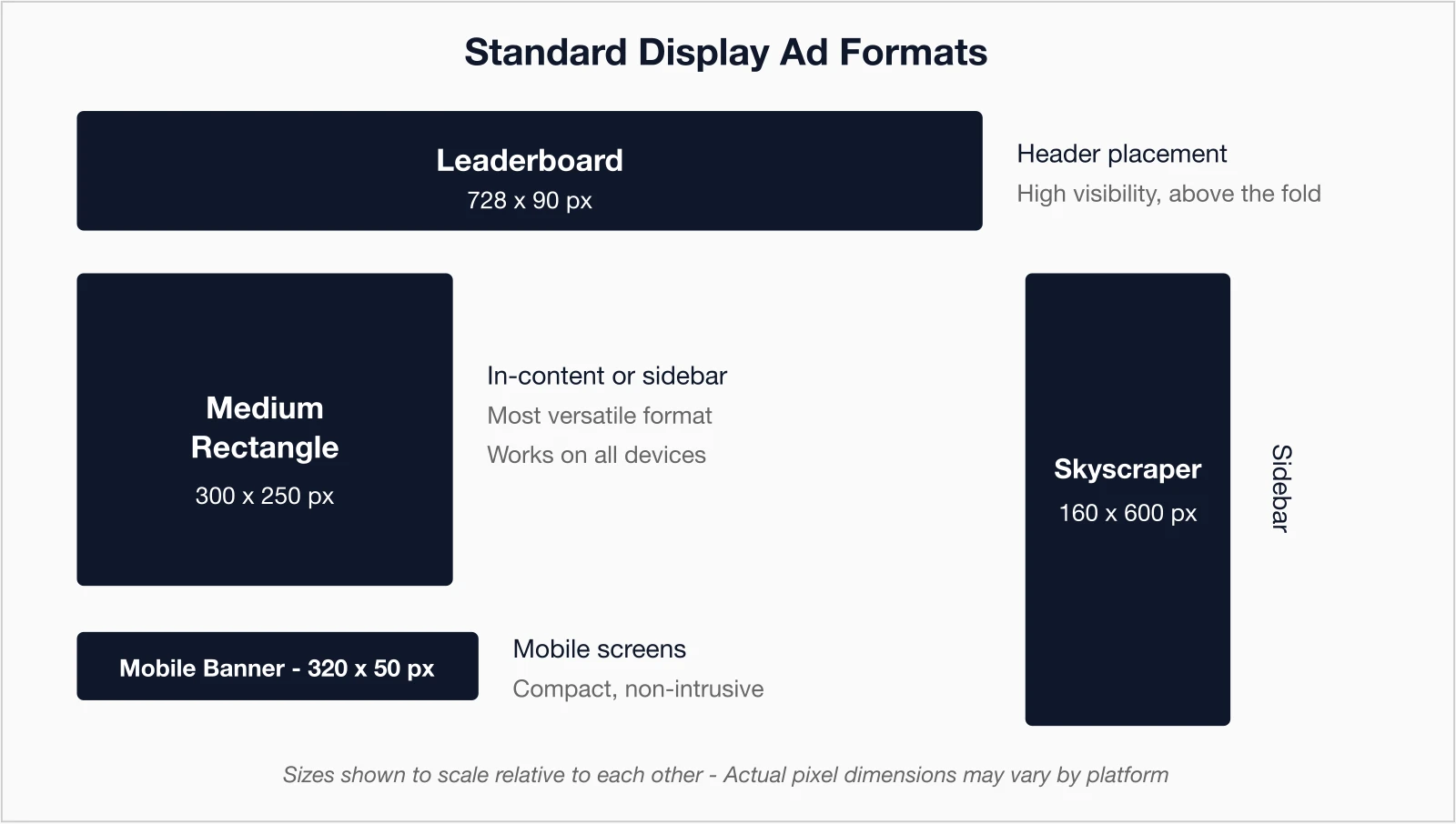
Standard banner ad units provide predictable placement and simple creative requirements.
- Leaderboard (728×90): High-visibility header placement
- Medium Rectangle (300×250): Versatile, often in-content or sidebar
- Skyscraper (160×600): Taller units for persistent sidebar visibility
- Mobile Banner (320×50): Optimized for smaller screens and mobile experiences
Sponsored content (native advertising)
Association sponsored content aligns closely with your editorial style, which tends to feel more natural to members and more valuable to advertisers.
- Sponsored articles: Advertiser-aligned articles presented in your publication style
- Sponsored newsletters: Dedicated sends featuring advertiser content or thought leadership
- Sponsored webinars: Educational sessions presented or co-presented by advertisers
- Podcast sponsorships: Pre-roll, mid-roll, or host-read mentions within episodes
Sponsored content typically delivers higher engagement than display ads, and advertisers will often pay premium rates for these native, story-driven placements. Consider building your inventory around sponsored content, with display ads as complementary options.
Directory and listing advertising
Directories turn your vendor or partner listings into monetizable inventory.
- Enhanced listings: Highlighted or feature-rich entries in your directory
- Featured profiles: Prominent placements with logos, descriptions, and links
- Category sponsorships: Exclusive visibility in high-interest categories or sections
Pricing your advertising
Your pricing should reflect the premium value of your audience and the strength of your engagement—not general web rates. Clarity and consistency in your pricing model also build trust with advertisers.
Common pricing models
- Flat rate: A fixed price per placement (for example, $300 per newsletter banner). Simple to sell and easy to forecast.
- CPM (cost per thousand impressions): Standard for web ads where impression volume is the primary value driver.
- CPC (cost per click): Pay-per-click models that shift more risk to you and more control to the advertiser.
- Sponsorship packages: Bundles of placements across channels that increase deal size and perceived value.
Typical association ad rates
While actual rates vary by audience and industry, many associations fall within these ranges:
| Channel / Format | Typical Rate Range | Pricing Model |
|---|---|---|
| Newsletter banner | $150–$500 per issue | Flat rate |
| Dedicated email send | $500–$2,000 | Flat rate |
| Website banner | $200–$1,000 per month | Flat rate or CPM |
| Sponsored article | $500–$3,000 | Flat rate |
| Webinar sponsorship | $1,000–$5,000 | Flat rate |
| Print magazine ad | $500–$3,000 | Flat rate |
Key pricing factors
Several elements influence what you can reasonably charge:
- Audience size: Larger lists and higher traffic support higher rates
- Audience quality: Seniority, purchasing authority, and income levels increase value
- Engagement metrics: Strong open, click, and time-on-page metrics support premium pricing
- Exclusivity: Limited inventory and category exclusives justify higher rates
- Industry vertical: Certain sectors, such as B2B technology or healthcare, may support higher CPMs
Building a rate card
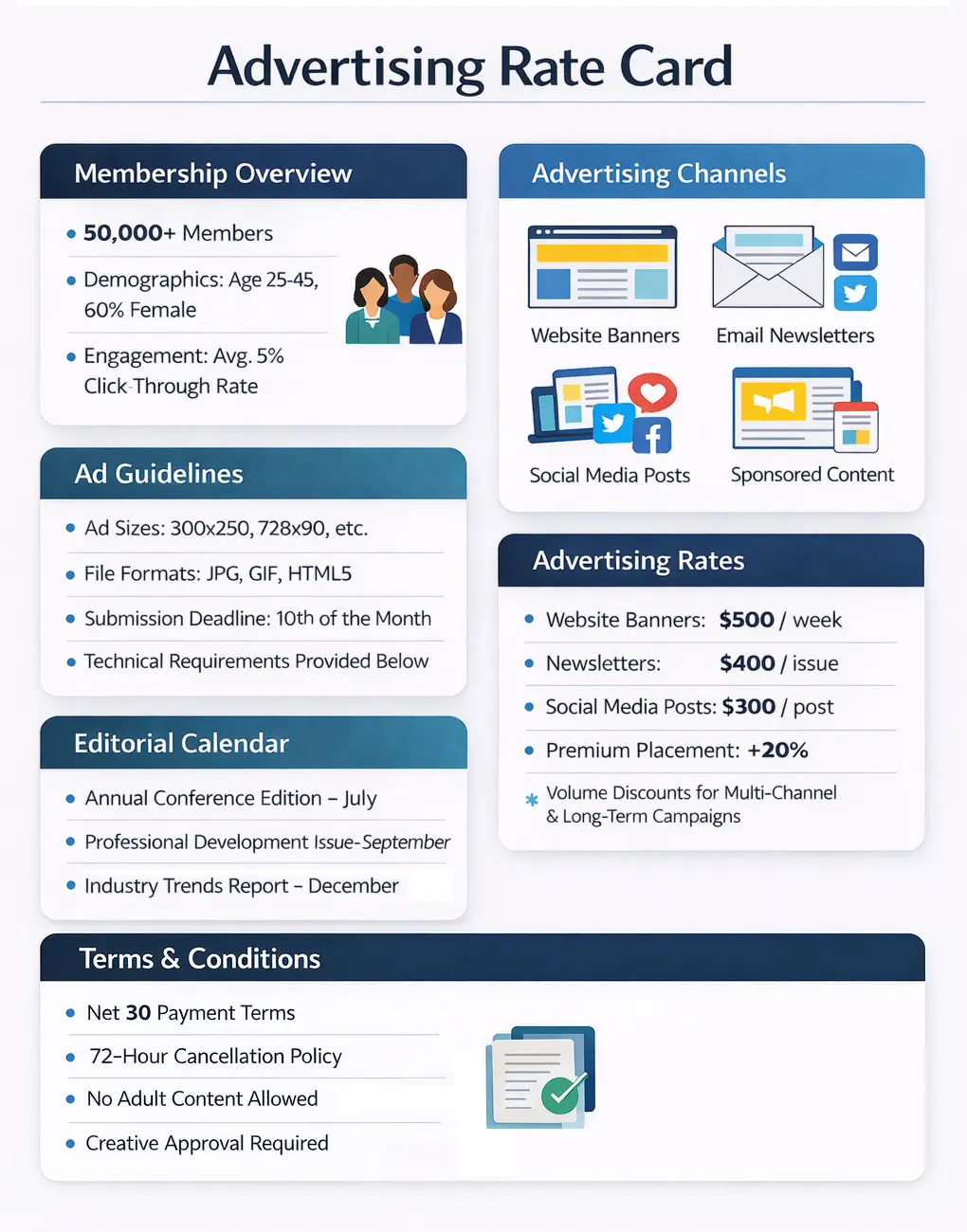
A professional association advertising rate card—your one-page pricing menu listing ad options, rates, specs, and terms—makes it easy for advertisers to browse placements and commit quickly. It signals a structured, reliable program and turns casual inquiries into concrete sales.
What to include
An effective rate card typically covers:
- Audience overview: Member count, key demographics, and engagement metrics
- Placement options: All available ad units and channels with brief descriptions
- Specifications: Ad sizes, formats, deadlines, and technical requirements
- Pricing: Standard rates, with clear notes on discounts or premium positions
- Editorial calendar: Themes, special issues, or seasonal content that might interest advertisers
- Terms and conditions: Payment terms, cancellation policies, and content guidelines
Discount strategies
Discounts should encourage larger and longer-term commitments without undermining your base pricing.
- Frequency discounts: For example, 10–20% off for six or more insertions
- Annual contracts: 15–25% savings for year-long agreements
- Bundle discounts: 10–15% off when combining channels (e.g., newsletter + website + event)
- Member discounts: Preferred pricing for member companies
- New advertiser incentives: Introductory offers for first-time buyers
Sample newsletter rate structure
Audience: 8,500 subscribers | 32% average open rate | 4.2% average click rate
Profile: 78% decision-makers | Weekly distribution | Industry-specific professionals
Selling association advertising
For associations, advertising sales grow over time through relationships and consistent outreach. Unlike one-time event sponsorships, association advertising often renews and expands when advertisers see results from reaching your membership audience.
Identifying the right prospects
Start with organizations that already want to reach your association's membership:
- Current sponsors: Extend their presence into your association's advertising channels
- Industry vendors: Companies that sell products or services to your members
- Member employers: Organizations that hire professionals in your association's field
- Past advertisers: Lapsed advertisers who can be reactivated with new association placements
- Competitor advertisers: Companies advertising in similar professional or trade media
Effective sales approaches
Your sales conversations should emphasize the value of your association's audience and engagement metrics, not just available ad space.
- Lead with membership data: Who your members are, their roles, and their purchasing influence
- Show engagement metrics: Newsletter open rates, click rates, and website page views to demonstrate member attention
- Offer test programs: Lower-risk starter packages for advertisers new to association media
- Bundle strategically: Combine newsletter, website, and event placements for broader member exposure
- Create urgency: Limited inventory and conference-themed issues encourage timely decisions
Helpful sales tools
Equip your association's advertising sales efforts with:
- A polished rate card and media kit highlighting your membership demographics
- Short case studies that show how advertisers reached members successfully
- An editorial calendar to align campaigns with association events and industry topics
- Sample performance reports to show how member engagement is tracked and reported
Advertising policies
Clear policies help protect your association's reputation and member trust while giving advertisers transparency and consistency. Document them and apply them consistently.
Content standards
Define what is acceptable before you start accepting ads:
- Relevance: Ads should align with your members' professional interests and needs
- Accuracy: No false, misleading, or unsubstantiated claims
- Professional tone: Content must be appropriate for a professional audience
- Legal compliance: Ad content must follow applicable laws and regulations
- Competitive considerations: Specify how you handle ads from competitors of member companies
Disclosure requirements
Transparency is essential, especially for sponsored content and native formats.
- Label sponsored content clearly: Use labels such as "Sponsored" or "Advertisement"
- Avoid disguising ads as editorial: Native ads should still be clearly marked as paid
- Disclose affiliate relationships: Make clear when your organization receives commissions
Acceptance and rejection process
Give yourself room to protect your brand when needed.
- Reserve the right to reject any ad at your discretion
- Document criteria and processes for handling questionable content
- Consider a small review group for borderline cases
- Communicate decisions and reasons clearly to advertisers
Protecting your credibility is more important than filling every ad slot. A smaller volume of high-quality ads is better than abundant, low-quality advertising that erodes trust.
Measuring association advertising performance
For associations, measurement is essential for maintaining fair pricing, keeping advertisers happy, and improving your advertising program over time. Make performance reporting part of your standard process so advertisers see the value of reaching your membership.
Core metrics to track
At a minimum, track these metrics for your association's advertising placements:
- Impressions: How many times members saw the ad (each view = one impression)
- Click-through rate (CTR): The percentage of member impressions that produced clicks
- Unique members reached: The number of distinct members who saw the ad
- Engagement time: How long members stayed on advertiser content, where possible
- Conversions: Measurable actions members took after clicking, when tracking allows
Reporting back to advertisers
Regular, transparent reporting builds trust with advertisers and supports renewals of your association's ad inventory.
- Provide campaign summaries with impressions, clicks, and CTR from your membership channels
- Compare results to your association's historical benchmarks where appropriate
- Offer practical recommendations to improve future performance with your member audience
- Present renewal options and upsell opportunities based on what resonated with members
Optimizing your association's advertising program
Use performance data and advertiser feedback to refine your association's approach.
- Test different placements in your newsletter and website to see what members engage with most
- A/B test ad formats, creative types, and calls to action with your membership audience
- Monitor advertiser retention and expansion over time
- Adjust pricing to reflect demonstrated member engagement and advertiser demand
Building sustainable advertising revenue
Advertising revenue grows steadily when you focus on audience value, consistency, and relationships rather than quick wins. Start with your strongest channel—usually your email newsletters—set fair, premium pricing, and expand from there as you demonstrate results. The associations I've seen succeed with advertising all share one trait: they treat it like a real program, not a side project. They have a rate card, they track performance, and they follow up with advertisers. That consistency compounds over time.
Key points to keep in mind:
- Your targeted audience supports premium ad rates
- Association newsletter ads are often the best place to start
- Association sponsored content can drive deeper engagement than display ads alone
- A clear, professional rate card and smart discounting increase deal size
- Limited, high-quality inventory protects your brand and pricing power
- Consistent tracking and reporting prove value and fuel renewals
For more ideas on growing non-dues revenue, explore the full Non-Dues Revenue Guide, or dive into related opportunities like sponsorship packages and publication monetization.
Key takeaways
- Newsletters are usually your strongest channel: Email advertising often outperforms website ads for both engagement and revenue
- Niche audiences justify premium rates: Your focused membership is worth more per impression than broad, general audiences
- Sponsored content often beats banner ads: Native formats typically drive higher engagement and more revenue per placement
- Bundles increase deal size: Packaging placements across channels raises total revenue compared to à la carte sales
- Limited inventory protects value: Scarcity helps maintain premium pricing and a positive member experience
Ready to Monetize Your Association's Channels?
i4a's email marketing tools and integrated website make it easy to place, track, and report on advertising—maximizing revenue while maintaining member experience.
Discuss Your Advertising StrategyRelated resources
10 Non-Dues Revenue Ideas for Associations
Complete guide to diversifying your association's revenue streams.
Sponsorship Packages for Associations
Design tiered sponsorship programs that attract corporate partners.
Publication & Content Monetization
Turn your expertise into revenue through publications and premium content.
Association Job Board Revenue Guide
Monetize career services and turn job boards into revenue engines.
