Quick Summary: Association Chapter Management
- Choose the right chapter model: Autonomous, integrated, or hybrid. Most modern associations use a hybrid approach that balances national consistency with local flexibility.
- Invest in leader onboarding: Chapter leaders are volunteers, not employees. A structured 30-day onboarding program with clear expectations prevents the drift that kills chapter performance.
- Track chapter health, not just membership counts: Event attendance, volunteer pipeline, financial health, and member engagement tell you more than raw numbers.
- Centralize data, decentralize decisions: Give chapters autonomy in programming and local engagement, but maintain shared systems for reporting, branding, and member records.
- Know when to sunset: Not every chapter should exist forever. Consolidating or retiring underperforming chapters is responsible governance, not failure.
Part of our Member Engagement Guide
I've built software for associations for over 30 years, and here's what I've learned about association chapter management: chapter problems are almost never about the chapters themselves. They're infrastructure problems. An amazing volunteer leader with no onboarding, no shared data, and no clear expectations from national will struggle every single time. Meanwhile, a mediocre leader with the right systems in place will surprise you. Most associations pour energy into finding better chapter leaders when they should be building better chapter systems. This guide is about the systems.
The chapter management challenge
Chapters extend your association's reach into local communities and create the face-to-face connections that drive the deepest member engagement. But managing them is one of the hardest things associations do. According to the 2025 Chapter Performance & Benchmarking Report from Mariner Management, 93% of association staff say their chapters deliver local connections — yet both staff and chapter leaders rate overall chapter performance just 3.2 out of 5.0. Only 18% of association professionals say their current chapter structure is up to date.
That gap between how important chapters are and how little infrastructure supports them is where most associations struggle. Chapters operate with volunteer leaders who turn over every 1-2 years, inconsistent branding, limited budgets, and often no visibility into what's working and what isn't. The same Mariner study found that only 35% of chapter members participate in chapter programs and fewer than 20% attend chapter events — numbers that should alarm any association investing in a chapter network.
This guide covers every aspect of association chapter management: choosing the right structural model, setting up governance that works, onboarding leaders effectively, tracking performance, managing the national-chapter financial relationship, and knowing when it's time to consolidate or sunset a chapter. (Note: some associations refer to chapters as "components," "sections," or "affiliates" — ASAE uses "component" as the umbrella term. The principles in this guide apply regardless of what your organization calls them.) Whether you run a trade association with 10 state chapters or a professional society with 200 local sections, the approach is the same.

Why chapters matter for member engagement
Chapters serve a function that national organizations simply can't replicate at scale: local, personal connections. Members who are active in a chapter renew at significantly higher rates than those who interact only with the national organization.
- Local networking: Industry peers in the same region, facing the same local regulations and market conditions
- Leadership pipeline: Chapter boards are the training ground for future national leaders
- Event reach: Local events attract members who can't travel to national conferences
- Advocacy: State and regional chapters are often the front line for grassroots advocacy efforts
- Recruitment: Prospective members are more likely to join after attending a local chapter event than after seeing a national marketing campaign
The challenge isn't whether chapters add value. It's building the systems and structures that let them deliver that value consistently across your entire network. And as Associations Now reported, the definition of "community" itself is shifting: 66% of Gen Z defines community as "a sense of belonging" while only 22% equate it with physical proximity. Chapters that focus solely on geography without fostering genuine belonging will increasingly struggle to attract younger members.
Chapter models: autonomous, integrated, or hybrid
How you structure the relationship between national and chapters shapes everything else. There are three primary models, each with trade-offs.
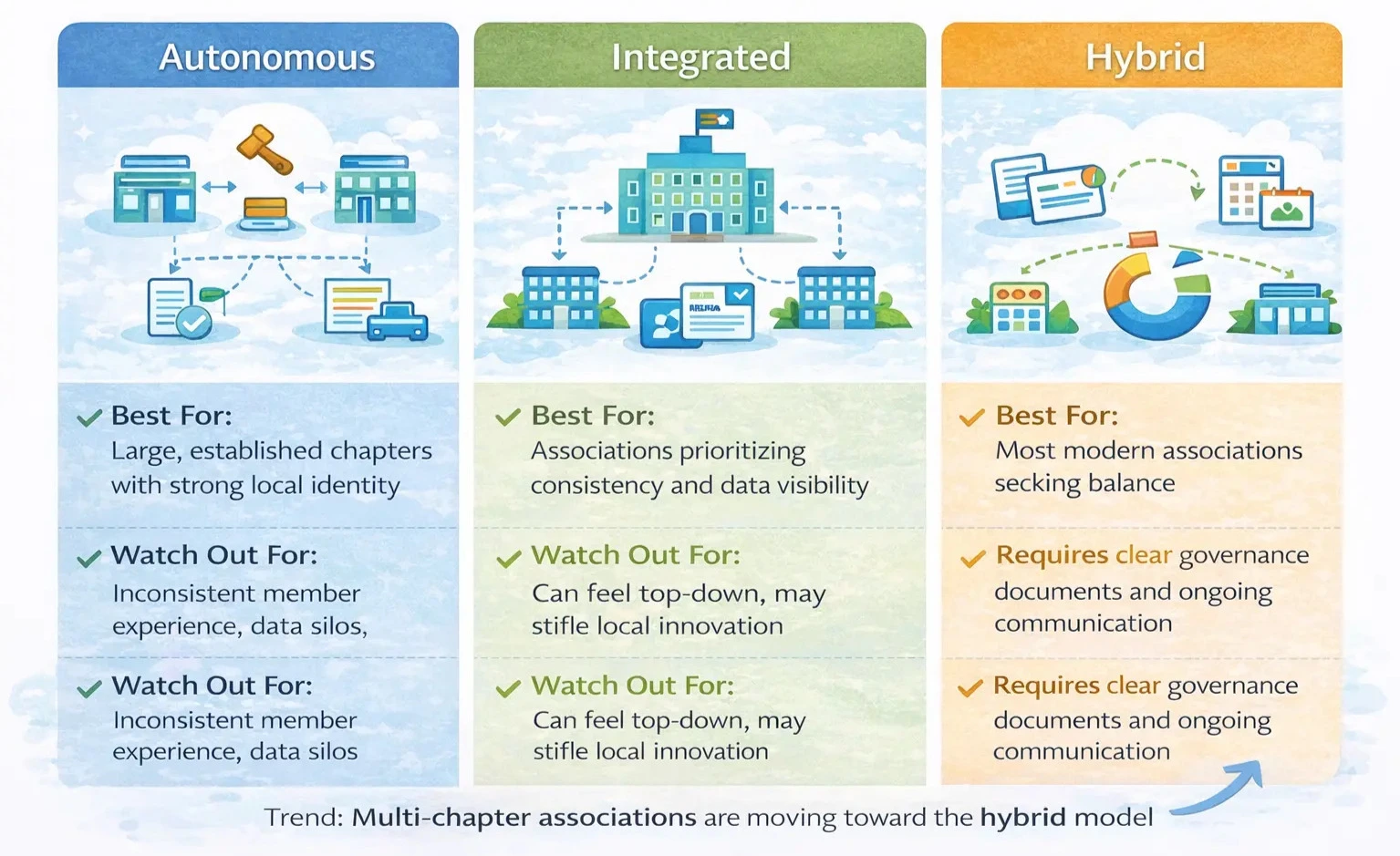
Autonomous chapter model
In the autonomous model, each chapter is a separate legal entity with its own bylaws, budget, tax filing, and membership roster. National provides the brand and a loose affiliation agreement, but chapters make their own decisions about programming, dues, and operations.
Chapters get maximum freedom to tailor their approach to regional needs. A state chapter in Texas can run very differently from one in Vermont, and that's by design. Each chapter sets its own dues, chooses its own technology, and manages its own finances.
The trade-off:
- Data silos — member records live in dozens of separate systems, making national reporting nearly impossible
- Inconsistent member experience — when a member moves cities, their chapter membership doesn't follow them
- Brand fragmentation — chapters create rogue websites, logos, and messaging with no central oversight
- Limited visibility — national can't run a campaign or pull a report without chasing down data from every chapter
The autonomous model made sense before modern technology — today, it creates more problems than it solves for most associations.
Best for: Large, well-established associations with chapters that have strong local identity, dedicated staff, and the resources to manage their own operations independently — such as state-level bar associations or medical societies.
Integrated chapter model
The integrated model is the opposite end of the spectrum. Chapters are divisions of the national organization, not separate entities. Membership is unified — when someone joins the association, they're automatically connected to their local chapter. Branding, dues structure, event platforms, and member data are all controlled centrally.
This model gives national complete visibility and consistency. Every member gets the same standard of experience regardless of which chapter they interact with. Reporting is straightforward because everything lives in one system. Compliance headaches disappear because there's one tax filing, one insurance policy, one set of bylaws.
The trade-off:
- Feels top-down — chapter leaders who are used to running their own show resist being told what platform to use or how to structure events
- Stifles local innovation — every decision requiring national approval slows chapters down and discourages experimentation
- Volunteer burnout risk — leaders who feel managed rather than empowered are less likely to stay engaged or recruit successors
The key to making this model work: invest heavily in communication so chapter leaders feel like partners, not subordinates.
Best for: Newer or fast-growing associations that need tight brand control and unified data, or organizations where chapters are primarily local event organizers rather than semi-independent entities.
Hybrid chapter model
The hybrid model — and this is where most modern associations are heading — splits the difference. Membership and core data are shared. Branding guidelines are set by national. But chapters retain autonomy in programming, local partnerships, and day-to-day operations.
In practice, this means a chapter can plan its own events, choose its own speakers, and set its own meeting schedule. But it uses the national AMS platform for registration, communicates through approved email templates, and reports on standard metrics. The member record is unified, so when someone moves or interacts with both national and local programming, everything is connected.
The trade-off:
- Requires more governance documentation — you need clear lines defining what's centralized and what's local
- Boundary confusion — without that clarity, national thinks it has control while chapters think they have autonomy, and everyone is frustrated
- Ongoing calibration — the line between "national decision" and "chapter decision" needs regular revisiting as the organization evolves
Despite the complexity, this is where the industry is heading — and modern association management platforms are designed to support exactly this kind of shared-but-flexible structure.
Best for: Most mid-size to large associations looking to modernize their chapter program — especially those transitioning from an autonomous model who want shared data and brand consistency without stripping chapters of local autonomy.
Chapter governance: what to document and why
Clear governance prevents the conflicts that derail chapter programs. When roles are ambiguous, money is handled informally, and brand usage is a free-for-all, problems are inevitable. The associations with the smoothest chapter operations aren't the ones with the best volunteers — they're the ones with the clearest documentation. Every chapter relationship needs written agreements covering roles, responsibilities, finances, and brand usage — and those agreements need to be reviewed and enforced, not filed away and forgotten.
What to include in a chapter affiliation agreement
A written affiliation agreement is the single most important governance document in your chapter program. Think of it as the contract between national and each chapter — it defines what both sides are responsible for, what's allowed, and what happens when things go wrong. Without one, you're relying on assumptions, and assumptions are where chapter conflicts start.

Every affiliation agreement should address: brand usage rights, financial obligations and dues sharing, compliance requirements (including IRS filings), minimum performance standards, conditions for charter revocation, and data ownership and reporting expectations.
Exactly how chapters can use the association's name, logo, and visual identity. Can they create their own marketing materials? Do they need approval? What happens to brand assets if the chapter closes? Get specific — vague brand guidelines lead to chapters creating rogue websites and social accounts that don't represent the organization well.
How dues are shared between national and chapter, what percentage flows each direction, reporting deadlines, and who controls chapter bank accounts. Spell out whether chapters can fundraise independently, accept sponsorships, or carry debt.
IRS filing obligations (990 or 990-EZ if the chapter is a separate entity), state incorporation and registration, insurance requirements, and any industry-specific regulations. National should monitor compliance — a chapter's tax problem can become national's reputational problem fast.
What does a chapter need to do to keep its charter? Define thresholds for membership counts, events held per year, board positions filled, and financial reporting deadlines. Without minimums, underperforming chapters can coast for years before anyone intervenes.
The specific circumstances under which national can revoke a chapter's charter, and the process for doing so. Include a warning period, intervention steps, and an appeals process. Having this in writing before you need it makes the difficult conversation much easier.
Who owns the member data? Can chapters export member lists? What happens to chapter-collected data if the chapter closes? With privacy regulations tightening, this section is more important than ever. Ideally, all member data lives in a shared AMS platform so there's no ambiguity.
How to structure a chapter board
Effective chapter boards are lean. The temptation is to create a dozen committee chairs and advisory roles, but volunteer-run boards work best when every seat has a clear purpose and a manageable workload. Stagger terms so the entire board doesn't turn over at once. A 2-year term with half rotating annually provides continuity while keeping leadership fresh. Aim for 5-7 positions: president, president-elect or vice president, secretary, treasurer, membership chair, events chair, and an optional past president advisory role.
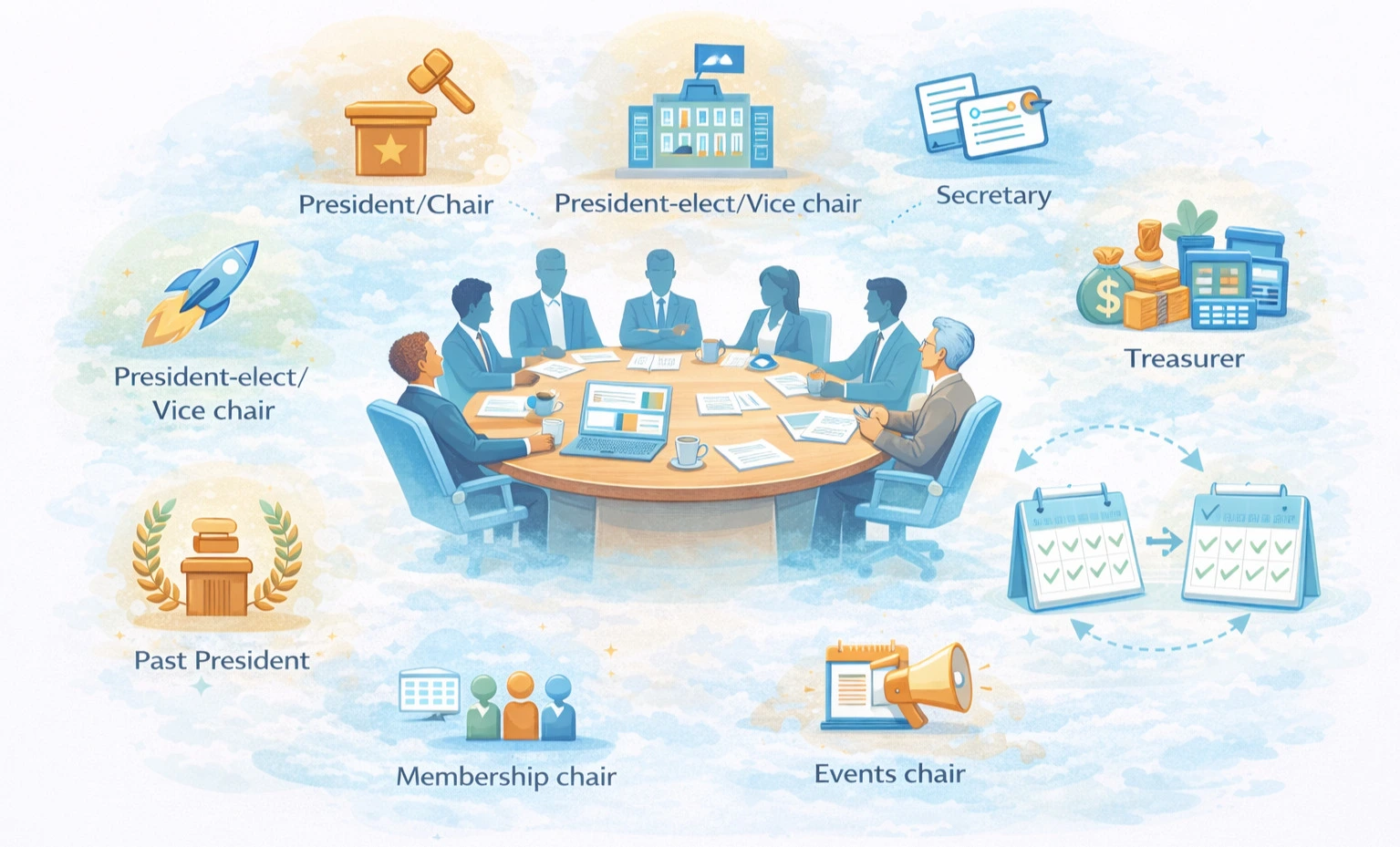
Sets the chapter's strategic direction and serves as the primary liaison with national. This person represents the chapter at national meetings, communicates policy changes back to local members, and is ultimately accountable for chapter performance. Choose someone who can manage up and down.
Shadows the president for a full term before stepping into the role. This eliminates the learning curve that kills chapter momentum during leadership transitions. Between transitions, they own special projects and fill in when the president is unavailable.
Owns meeting minutes, chapter communications, and record-keeping. In practice, this role often becomes the chapter's institutional memory — the person who knows what was decided six months ago and why. Don't underestimate it.
Manages the chapter budget, tracks expenses, handles financial reporting to national, and ensures compliance with any tax filing requirements. For chapters with their own bank accounts, this role needs someone detail-oriented and trustworthy — financial mismanagement is the fastest way to lose a charter.
Focuses on local recruitment and retention. They track who's joining, who's lapsing, and why. They coordinate new member welcome outreach, follow up with at-risk renewals, and work with national's membership management tools to keep data clean.
Plans and executes chapter programming — from monthly meetups to annual conferences. They handle speaker recruitment, venue logistics, registration, and post-event feedback. This is often the most visible role in the chapter and the biggest driver of local engagement.
Provides continuity and mentorship to the current president. They know where the landmines are, which vendors to trust, and what was tried before. Having a formal seat for this role prevents the knowledge loss that happens when outgoing leaders simply walk away.
How to onboard chapter leaders (and why most associations fail at it)
Most chapter leaders are handed a title and left to figure things out. Someone volunteers at the annual meeting, gets a congratulatory email, and then… nothing. No training. No documentation. No introduction to the national staff member they're supposed to work with. They spend their first three months just trying to understand what their predecessor did — if their predecessor left any notes at all.
This is the single biggest failure point in chapter management, and the data backs it up: Mariner Management's 2025 benchmarking study found that 77% of headquarters staff and 63% of chapter leaders cite "insufficient qualified volunteers" as the biggest challenge facing their chapters. It's not that associations recruit the wrong volunteers. It's that they set good volunteers up to fail. A chapter president who doesn't know how to access the member database, submit financial reports, or request marketing support from national isn't going to ask — they're going to disengage. And when a chapter leader disengages, the entire chapter feels it within months.
A structured onboarding process changes everything. It takes 30 days of structured touchpoints, not a single info-dump session, and it prevents the months of drift and frustration that come from the "figure it out yourself" approach. The goal isn't to overwhelm new leaders with information — it's to give them clarity on expectations, access to the tools they need, and a direct line to someone at national who can help when they get stuck.
How to onboard new chapter leaders in 30 days
Welcome call with national staff liaison. Review role expectations, key contacts, and available resources.
System access and training: AMS login, email tools, event management, financial reporting.
Review chapter's current metrics, recent event history, budget, and membership trends with the outgoing leader.
Introduce to other chapter leaders and invite to the leadership community or forum. Nothing accelerates learning like talking to peers who've been through it.
Draft annual chapter plan: 2-3 goals, event calendar, and budget outline. This is when ownership truly transfers.
What to include in a chapter leader toolkit

Don't make every new chapter leader reinvent the wheel. The number one thing you can do to accelerate onboarding and improve consistency across chapters is to give leaders a centralized, ready-to-use toolkit from day one. This isn't a nice-to-have — it's the difference between a chapter leader who hits the ground running and one who spends their first quarter just figuring out where to find things.
The best toolkits live in a shared online location (not buried in someone's email inbox) and are updated regularly by national staff. When a template changes or a new resource is added, every chapter has access immediately.
Here's what the best chapter toolkits include, modeled after organizations that have set the standard for chapter support: the Association of Fundraising Professionals (AFP) with 240+ chapters worldwide, the American Marketing Association (AMA) with 70+ professional chapters, and the Public Relations Society of America (PRSA) with 100+ chapters. Each has invested heavily in giving chapter leaders the tools to succeed from day one.
Governance & onboarding
- Chapter bylaws template aligned with national governing documents
- Officer role descriptions with specific duties and time commitments
- Board orientation agenda (sample: 90-minute session covering strategic plan, key contacts, systems access, and expectations)
- Chapter affiliation agreement and compliance checklist
- Conflict of interest policy template
- Annual chapter calendar template with national deadlines pre-populated
Brand & communications
- Logo files in multiple formats (print, web, social) with chapter-specific lockups
- Color palette, typography, and clear-space specifications
- Do/don't usage examples so chapters know what's off-limits
- Email templates for common communications (welcome series, event invitations, renewal reminders, lapsed member outreach)
- Social media templates with pre-written posts chapters can customize
- Newsletter template with consistent header and branding
- Letterhead and presentation slide deck templates
Event planning
- Event brief template covering objectives, target audience, budget, timeline, and roles
- Step-by-step event planning checklist (from board approval through post-event reporting)
- Venue and vendor contract templates
- Sponsorship guide with tiered packages chapters can customize for local sponsors
- Post-event evaluation form with standard metrics (attendance rate, satisfaction score, net promoter)
- How-to guide for setting up events in your event management platform
Financial management
- Treasurer's handbook with reporting deadlines and procedures
- Budget planning template with typical chapter line items pre-filled
- Monthly/quarterly financial report template (opening balance, income, expenses, bank reconciliation, budget comparison)
- Tax filing guidance for chapters with separate entity status (990/990-EZ requirements)
- Chapter audit checklist for annual self-review
- Expense reimbursement form and approval process
Membership recruitment & retention
- Elevator pitch scripts and talking points for in-person recruitment
- Recruitment email and social media campaign templates
- New member welcome kit outline (what to send in the first 7 days)
- Non-member event invitation templates to drive trial attendance
- Referral program template with reward structure
- Lapsed member win-back scripts (email and phone)
- How-to guide for pulling member reports in your membership management software
Systems & technology
- Quick-start guide for your AMS platform (login, navigation, common tasks)
- Step-by-step guides for: pulling member lists, creating events, sending emails, running reports
- Video walkthroughs for visual learners (even 5-minute screen recordings make a difference)
- FAQ document covering the most common "how do I…" questions from chapter leaders
- IT support contact and escalation path
Pro tip: Don't launch the full toolkit all at once. During onboarding, give new leaders just the 3-4 resources they need for their specific role in their first 30 days. Then introduce the rest as it becomes relevant. A toolkit that feels like a library scares volunteers away. A toolkit that feels like "here's exactly what you need right now" gets used.
How to streamline day-to-day chapter operations
Chapters run on volunteer time. That's easy to say, but the implications are enormous. Your chapter president has a full-time job, a family, and maybe an hour or two a week to dedicate to chapter work. Your treasurer is doing this between client meetings. Your events chair is coordinating speakers during their lunch break.
Every unnecessary administrative task you put on these volunteers is time stolen from the work that actually matters — planning great events, building relationships with members, recruiting new ones. When a chapter leader spends 45 minutes trying to figure out how to pull a member list or manually entering event registrations into a spreadsheet, that's 45 minutes they're not calling a lapsed member or planning next quarter's programming.
The more you can systematize and simplify operations from the national level, the more your volunteers can focus on programming and engagement instead of administration. That means shared systems, automated processes, templates for everything, and a clear answer to the question every chapter leader eventually asks: "How do I do this?"
Centralize data, decentralize decisions
The most effective multi-chapter associations share a single membership database while giving chapters autonomy in programming and local decisions. That means one member record across all chapters, chapter-level access controls, shared event and email tools, and roll-up reporting that aggregates chapter data automatically.
A single record across all chapters — no duplicate data entry, no conflicting contact info, no members falling through the cracks when they move.
Leaders see only their chapter's members, events, and financials while national gets the full picture.
Event management and email marketing on one platform with chapter-specific pages and sending capabilities.
National-level dashboards that aggregate chapter data automatically — no chasing spreadsheets from 30 chapter treasurers.
How often should national communicate with chapters
Set a regular rhythm for national-chapter communication: a monthly chapter leader newsletter, quarterly virtual roundtables for peer sharing, an annual chapter leadership summit for training and strategic alignment, and as-needed direct staff liaison calls for chapter-specific issues.
Updates, resources, upcoming deadlines, and a spotlight on what one chapter is doing well. Keep it scannable — chapter leaders won't read a wall of text.
A 60-minute call where chapter leaders share what's working, ask questions, and learn from each other. Peer learning beats top-down training every time.
In-person or virtual gathering for training, strategic alignment, and relationship-building. This is where you set the tone for the year ahead.
As-needed outreach for chapter-specific issues. Every chapter should know exactly who at national to call and how quickly to expect a response.
How to maintain brand consistency across chapters
Inconsistent branding across chapters confuses members and weakens your organization's identity. Give chapters the tools to stay on-brand without having to design anything from scratch: approved logo variations, pre-loaded email and newsletter templates, social media guidelines with content libraries, and presentation templates for meetings and events.
Pre-approved chapter logo versions that combine the chapter name with the national brand identity.
Pre-loaded with brand colors, fonts, and footer — chapters just add their content.
Content libraries, posting guidelines, and pre-made graphics so chapters can stay active online without going off-brand.
Slide decks for chapter meetings and events that look professional and reinforce the national brand.
How to measure chapter performance
You can't manage what you don't measure — and most associations aren't measuring. According to Mariner Management's 2025 research, only 27% of associations use individual member activity data to evaluate chapter performance, even though 82% of staff say they wish they had it. The vast majority of chapter benchmarking still relies on self-reported information, which means resource allocation decisions are being made without objective baselines or true measures of effectiveness.
What to track in a chapter health scorecard
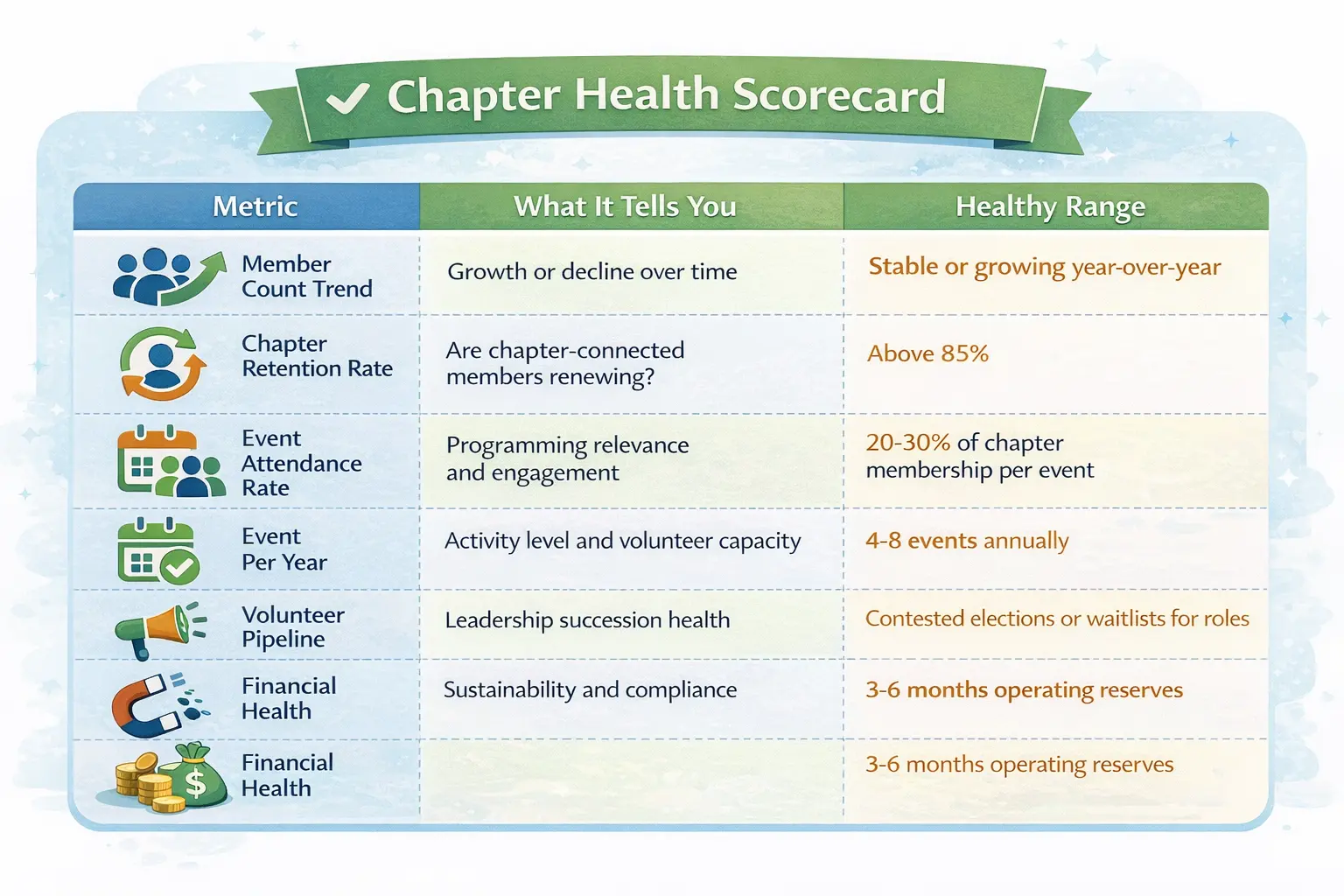
The scorecard below tracks seven metrics that separate thriving chapters from struggling ones — covering membership trends, retention, event engagement, volunteer pipeline, financial sustainability, and local recruitment. Review these monthly with chapter leaders so every chapter knows where it stands and where to improve.
Real Talk: The Data Problem
Most chapter performance issues aren't people problems. They're data problems. When chapters operate on separate spreadsheets and standalone tools, national has no visibility, and chapters have no benchmarks. Integrating chapter data into a single AMS platform is the single highest-impact investment you can make in chapter management.
How to manage finances between national and chapters
Money is where most national-chapter tension lives. Who collects the dues? Who controls the bank account? Who pays for the event platform? These questions sound administrative, but they're really about power and trust. Get the financial relationship wrong and it will poison everything else — governance, communication, volunteer engagement, all of it.
The key is transparency. Chapter leaders who understand exactly how money flows — where it comes from, where it goes, and why — are far less likely to feel resentful about national's cut. Chapter treasurers who have clear reporting templates and deadlines are far less likely to let financial obligations slide until someone notices a problem.
How to split dues between national and chapters
There's no single right way to split dues between national and chapters, but the model you choose has downstream effects on everything from member experience to chapter independence. The three most common approaches are unified dues (national collects and remits a portion to chapters), split dues (members pay national and chapter separately), and chapter supplements (national dues cover base membership, chapters add optional local dues).
National collects all dues and remits a portion to chapters. This is the simplest model for members — one invoice, one payment, done. It gives national control over pricing and ensures consistent collection. The downside: chapters may feel they have less ownership over "their" revenue, and disagreements over the remittance percentage can get heated during budget season.
Members pay separate national and chapter dues — sometimes as two line items on one invoice, sometimes as two entirely separate transactions. More transparent for chapters who want to set their own pricing, but it adds friction for members and can create confusion about what they're actually getting from each level.
National dues cover base membership; chapters can add optional local dues for members who want additional programming. This gives chapters entrepreneurial flexibility — a chapter that runs monthly dinners and a mentorship program can charge more than one that hosts two events a year. The risk: some chapters may struggle to justify the supplement, creating a two-tier member experience.
Whichever model you choose, automate collection through your association payments platform wherever possible. Manual dues collection is where money gets lost, delayed, or disputed.
What financial reports should chapters submit
Financial reporting is the area where chapters most often fall behind — not out of bad faith, but because volunteer treasurers are busy and reporting feels like homework. Require four things: an annual budget submitted before the fiscal year starts, quarterly financial statements, an annual audit or financial review for chapters above a revenue threshold, and proof of IRS filing compliance. Make it easy by providing templates, setting firm deadlines, and building reporting into your AMS platform so the data is already halfway there.
Submitted before the fiscal year starts. Even a simple one-page budget forces chapters to plan rather than spend reactively. National should provide a template with standard line items.
Income, expenses, and bank balance — due within 30 days of quarter end. Quarterly cadence catches problems early before they become annual audit surprises.
Required for chapters above a revenue threshold (typically $50K-$100K). Smaller chapters can submit a financial review instead. This protects both the chapter and national from liability.
Proof of 990 or 990-EZ filing for chapters that are separate legal entities. Missing three consecutive years means automatic loss of tax-exempt status — a problem that's expensive and time-consuming to fix.
When to consolidate or sunset a chapter
This is the conversation nobody wants to have, but it's essential. Underperforming chapters don't just waste resources — they actively harm your brand when members have a poor local experience.
Think about it from the member's perspective. They join your association expecting a certain standard. They attend a local chapter event and it's disorganized, poorly attended, or hasn't been updated since 2019. That one experience doesn't just reflect on the chapter — it reflects on you. Members don't separate "national" from "local" in their minds. Your weakest chapter is your brand in that market.
There's also an internal cost. Staff time spent propping up a chapter that can't sustain itself is staff time not spent supporting your thriving chapters. Board members avoid the topic because it feels like admitting failure. So struggling chapters linger for years, quietly dragging down engagement numbers and consuming goodwill.
The hardest part isn't identifying the problem — it's acting on it. But the associations that manage chapters well have a clear, documented process for intervention and, when necessary, a dignified exit.
Warning signs a chapter is failing
A chapter that isn't hosting events has effectively stopped functioning. Events are the primary reason members engage locally — without them, the chapter exists on paper only.
When nobody is willing to step into leadership, it signals a deeper engagement problem. A chapter without a functioning board can't plan, can't report, and can't represent the organization locally.
One bad year can happen to anyone. Two consecutive years below your minimum signals a structural problem — not a temporary dip — and should trigger a formal review.
Missed financial reports, unfiled tax returns, or an inability to account for chapter funds. This isn't just an administrative issue — it's a legal and reputational liability for the entire organization.
When chapter leaders stop responding to emails, calls, and meeting invitations, the relationship has broken down. Silence is the final warning sign — by the time you notice it, the chapter has likely been disengaged for months.
How to intervene before closing a chapter
Closing a chapter should always be a last resort. Before you get there, exhaust these intervention strategies — in many cases, a struggling chapter just needs the right support at the right time to turn things around.
Assign a dedicated staff liaison who checks in weekly, attends chapter meetings, and helps with logistics. Sometimes all a struggling chapter needs is someone at national who's paying attention and invested in their success.
Help identify and onboard new volunteer leaders. Look beyond the usual suspects — newer members, younger professionals, or recently retired members often bring fresh energy. National can help by reaching out directly rather than waiting for the chapter to recruit on its own.
Scale back to 2-3 events per year with national handling logistics like venue booking, email promotion, and registration. Remove the administrative burden and let volunteers focus solely on showing up and engaging members. A smaller chapter doing two great events beats a burned-out chapter attempting eight mediocre ones.
Combine with a neighboring chapter to create a stronger unit. This works especially well when two nearby chapters are both below critical mass — together they have enough members, volunteers, and budget to thrive. Frame it as growth, not failure.
How to sunset a chapter the right way
Sunsetting isn't failure — it's responsible governance. A chapter that served its community well for 15 years but can no longer sustain itself deserves a dignified conclusion, not a slow decline into irrelevance. The associations that handle this well actually earn more trust from their remaining chapters, because they see that national takes chapter health seriously enough to make hard decisions with care.
But how you do it matters enormously. A botched closing creates resentment, bad press, and member losses that extend far beyond the affected chapter. A well-handled closing preserves relationships and protects your brand. Here's the process:
Call chapter leaders personally before sending any written notice. Acknowledge the chapter's history, its contributions, and the volunteers who gave their time. This isn't a corporate memo — it's a conversation with people who cared enough to lead.
Connect each member to the nearest active chapter or to direct national membership. Don't just reassign them in the database — send a personal email introducing them to their new chapter leader and inviting them to an upcoming event. The goal is zero member loss.
Follow the process outlined in your affiliation agreement: close bank accounts, settle outstanding obligations, transfer remaining funds to national or the receiving chapter, and file final tax returns if the chapter was a separate entity. Document everything.
Deactivate the chapter's website, social media accounts, and email addresses. Redirect any chapter URLs to the national site or the receiving chapter. Orphaned social accounts posting outdated content are a brand liability.
A mention in the national newsletter, a thank-you at the annual conference, or a simple certificate of appreciation goes a long way. These volunteers gave years of unpaid work — don't let their chapter's closing feel like their contribution didn't matter.
Building a chapter program that scales
Effective chapter management comes down to three things: clear structure, consistent support, and honest measurement. Give chapter leaders the tools, training, and data they need, then get out of their way on local decisions.
The associations with the strongest chapter programs share a common trait: they treat chapter relations as a core function, not an afterthought. That means dedicated staff, shared systems, structured onboarding, and the willingness to make hard calls when chapters aren't performing.
Start with an honest assessment of your current chapter landscape. Which chapters are thriving? Which are struggling? Where are the gaps in data, training, or governance? Address those fundamentals first, and the rest follows.
For more on engaging members at every level, see our Member Engagement Guide and our guide to committee management best practices.
Key takeaways
- Choose the right model: Autonomous, integrated, or hybrid. Most associations now use a hybrid approach balancing consistency with local flexibility.
- Document everything: Affiliation agreements, governance structures, and financial obligations should be in writing.
- Onboard leaders properly: A 30-day structured onboarding program prevents months of drift and disengagement.
- Track chapter health: Use a scorecard with 7 key metrics. Share data monthly so chapters can benchmark against peers.
- Know when to sunset: Consolidating underperforming chapters is responsible governance. Intervene first, but don't let struggling chapters damage your brand.
Managing Multiple Chapters?
i4a's association management software supports multi-chapter organizations with chapter-level access controls, shared member records, local event management, and roll-up reporting from one platform.
See How i4a Handles ChaptersRelated resources
Committee Management Best Practices
Structure committees, run productive meetings, and maximize volunteer impact.
Complete guide to building engaged member communities.
Volunteer Management for Associations
Recruit, engage, and retain association volunteers.
Board Reporting Best Practices
Report chapter performance to your board effectively.
