The Short Answer
Association management software typically costs $50–$150/month for entry-level platforms, $200–$500/month for mid‑market systems, and $500–$2,000+/month for enterprise platforms. One-time setup fees add anywhere from $0 to $5,000 or more on top.
But the sticker price is the least important number. What determines your real cost is the pricing model: per-contact pricing grows with your database, quote-based pricing can't be known without a sales call, and flat-rate pricing stays constant. i4a publishes its pricing (starting at $99/month per staff user, unlimited members included), and this guide explains how to compare any vendor's true cost, including ours.
Companion to our membership software buyer's guide
What Association Management Software Costs in 2026
Across the AMS market, monthly subscription prices cluster into three tiers. These ranges reflect published vendor pricing and industry norms; your quote will vary with organization size and modules.
| Tier | Monthly price | Typical setup fee | Best fit |
|---|---|---|---|
| Entry-level | $50–$150 | $0–$1,000 | Clubs and small associations with simple dues and events |
| Mid‑market | $200–$500 | $1,500–$5,000 | Staffed associations managing dues, events, email, committees, and a member website |
| Enterprise | $500–$2,000+ | $5,000 to six figures | Large national organizations with complex integrations and dedicated IT |
These budgets are under real pressure. In the 2024 Nonprofit Digital Investments Report from NTEN and Heller Consulting, 45% of nonprofits surveyed said they spend too little on technology, and 77% of that group named available budget as the top barrier. Every software dollar has to be defensible.
Which tier you land in depends partly on the modules you need. But two similar organizations can also pay very different amounts within the same tier, and that comes down to the pricing model underneath. Understand the model before you compare any two quotes.
The Three Pricing Models, and Why the Model Matters More Than the Price
Nearly every AMS prices one of three ways. Each answers the question "what happens to my bill when my organization grows?" differently.
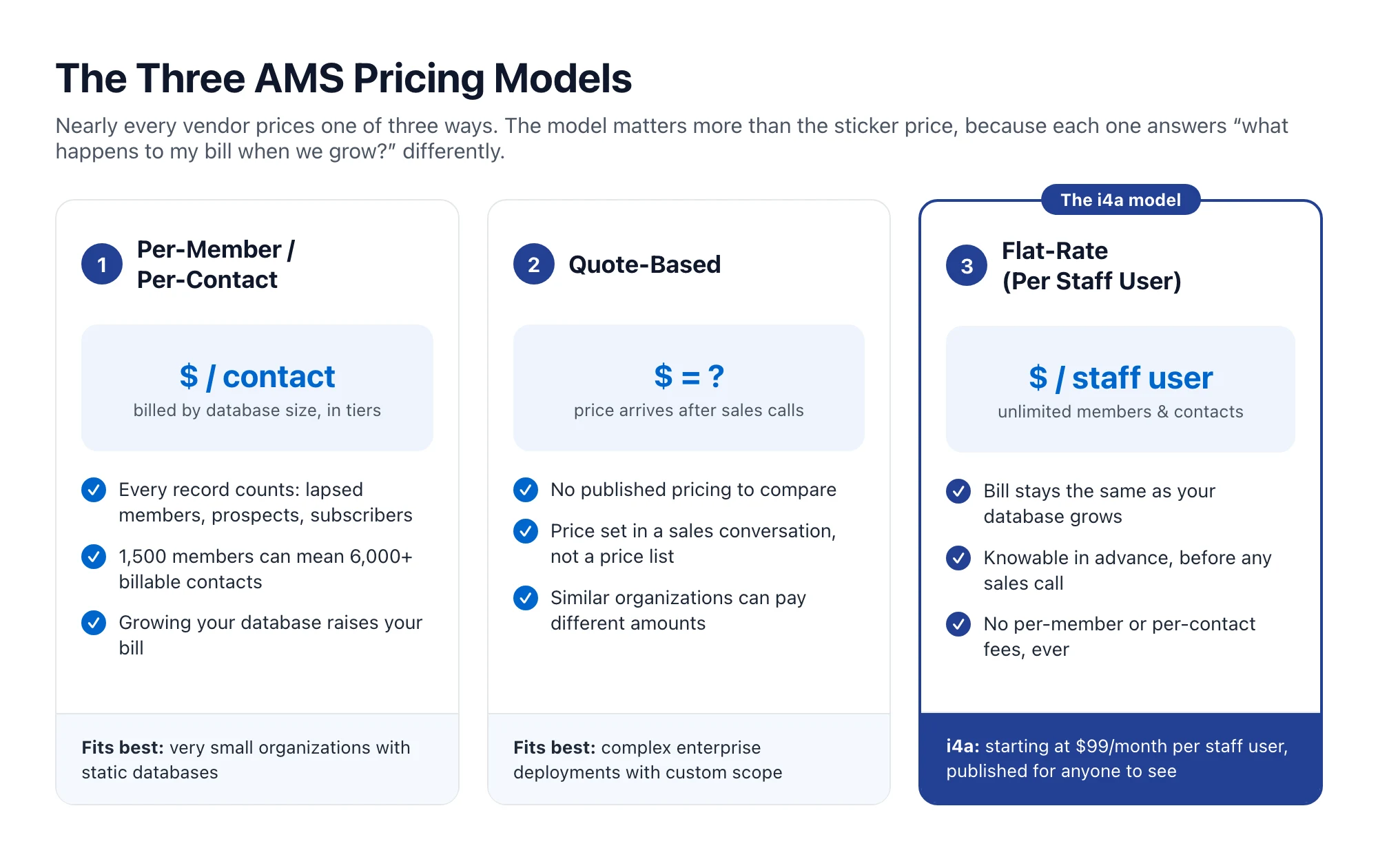
1. Per-member or per-contact pricing
You pay by the size of your database, in tiers. With per-contact pricing, every record counts: lapsed members, prospects, event attendees, newsletter subscribers.
The contact count is where buyers get surprised. An association with 1,500 dues-paying members can easily hold 6,000+ contacts, which lands several tiers above what the member count suggests.
Per-contact pricing also puts a quiet tax on good marketing. Import a prospect list, run a reactivation campaign, or keep your alumni history, and your bill goes up. Some organizations end up deleting their own data to stay under a tier.
Quick check: Before comparing any per-contact quotes, export your full database and count the records. That number, not your member count, is what you'll be billed on.
2. Quote-based pricing
Many leading AMS vendors don't publish prices at all; the number arrives after a sales conversation about your size, modules, and implementation. Vendors frame this as matching price to value, and for complex enterprise deployments it can be legitimate.
Quote-based pricing has two costs for buyers. You can't budget or shortlist without investing hours in sales calls. And two similar organizations may pay meaningfully different prices for the same product, depending on how the negotiation went.
Your finances are public, and vendors can look
Associations and nonprofits file IRS Form 990s. They disclose your total revenue. Anyone can look them up in seconds.
So when pricing is quote-based, the information asymmetry runs one way. The vendor can know your budget ceiling before the first call. You don't know their price floor.
Maybe they look. Maybe they don't. The prudent assumption is that they can.
That's not a reason to walk away from a quote-based vendor. It's a reason to negotiate as if your revenue is known, and to get the all-in number in writing, early. The eight questions below cover exactly what to have them itemize.
3. Flat-rate pricing (per staff user)
With flat-rate pricing, you pay by the number of staff who log in to run the platform, not by how many members you serve. Your bill is knowable in advance and doesn't change when your database grows. This is the model i4a uses: starting at $99/month per staff user with unlimited members and contacts.
The trade-off: a very small organization with a tiny database and no growth plans can genuinely pay less on an entry-level per-contact tier. Flat-rate wins when your database is large, messy, or growing, which describes most working associations.
The Three-Year Cost Worksheet
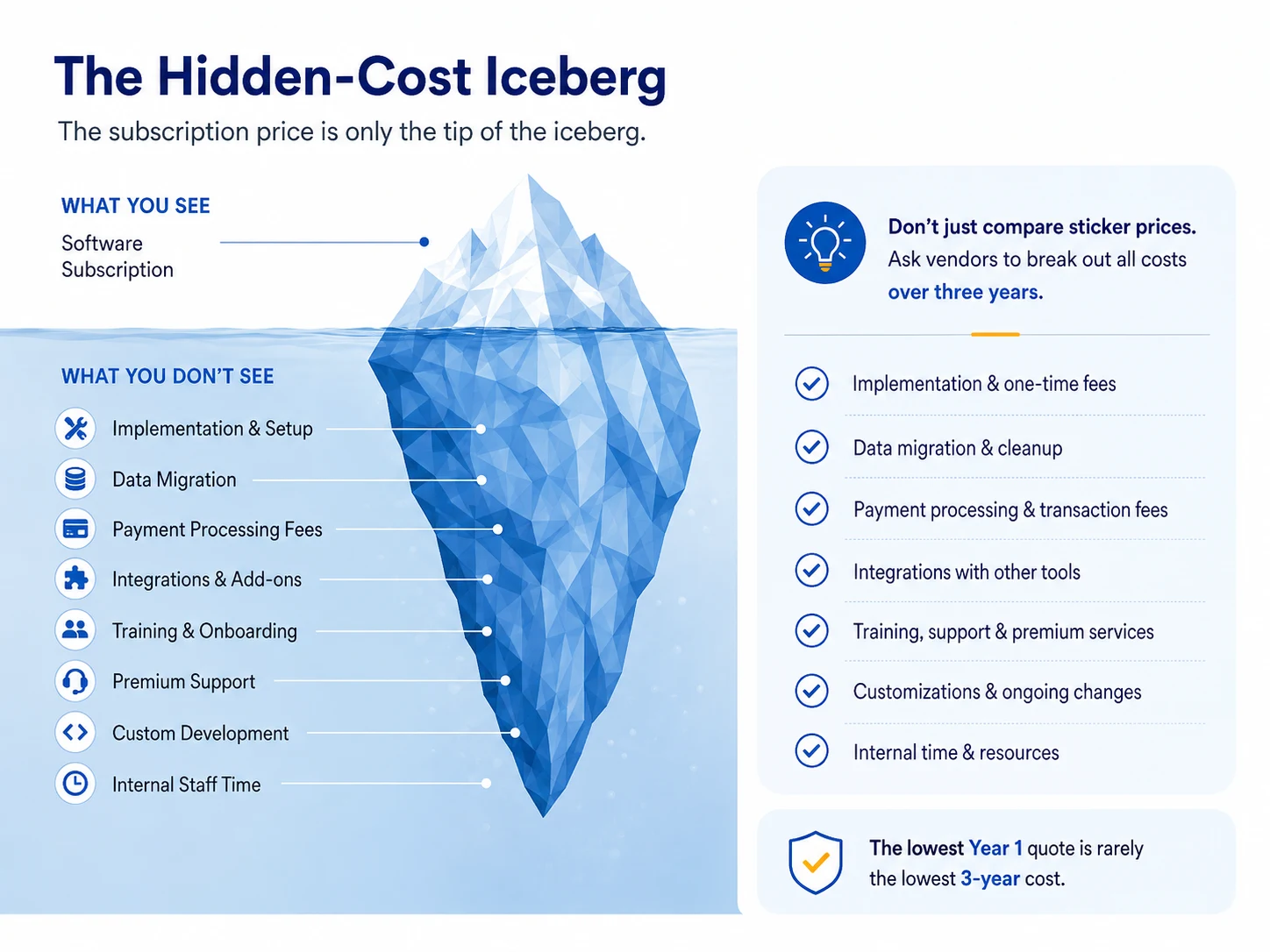
Comparing monthly sticker prices ranks vendors wrong. Compare three-year totals, at the database size you expect in year three rather than the one you have today:
3-year total cost of ownership =
(monthly subscription at year-3 database size × 36) + setup fee + data migration + training + (platform per-transaction fees × your annual payment volume × 3) + required add-on modules + support tier
| Example: a 5,000-contact association with two staff users, growing about 15% a year (using the market ranges above) | ||
|---|---|---|
| Model | The math | 3-year total |
| Per-contact platform | ~$300–$450/mo at 5,000 contacts, climbing a tier as the database passes 7,500 by year three | ~$13,000–$18,000 |
| Quote-based mid‑market | ~$300–$500/mo (typical mid‑market range) + $3,000–$5,000 implementation | ~$14,000–$23,000 |
| Flat-rate (i4a Core) | 2 staff users × $99/mo = $198/mo × 36 + $1,500 setup; database growth doesn't change it | $8,628 |
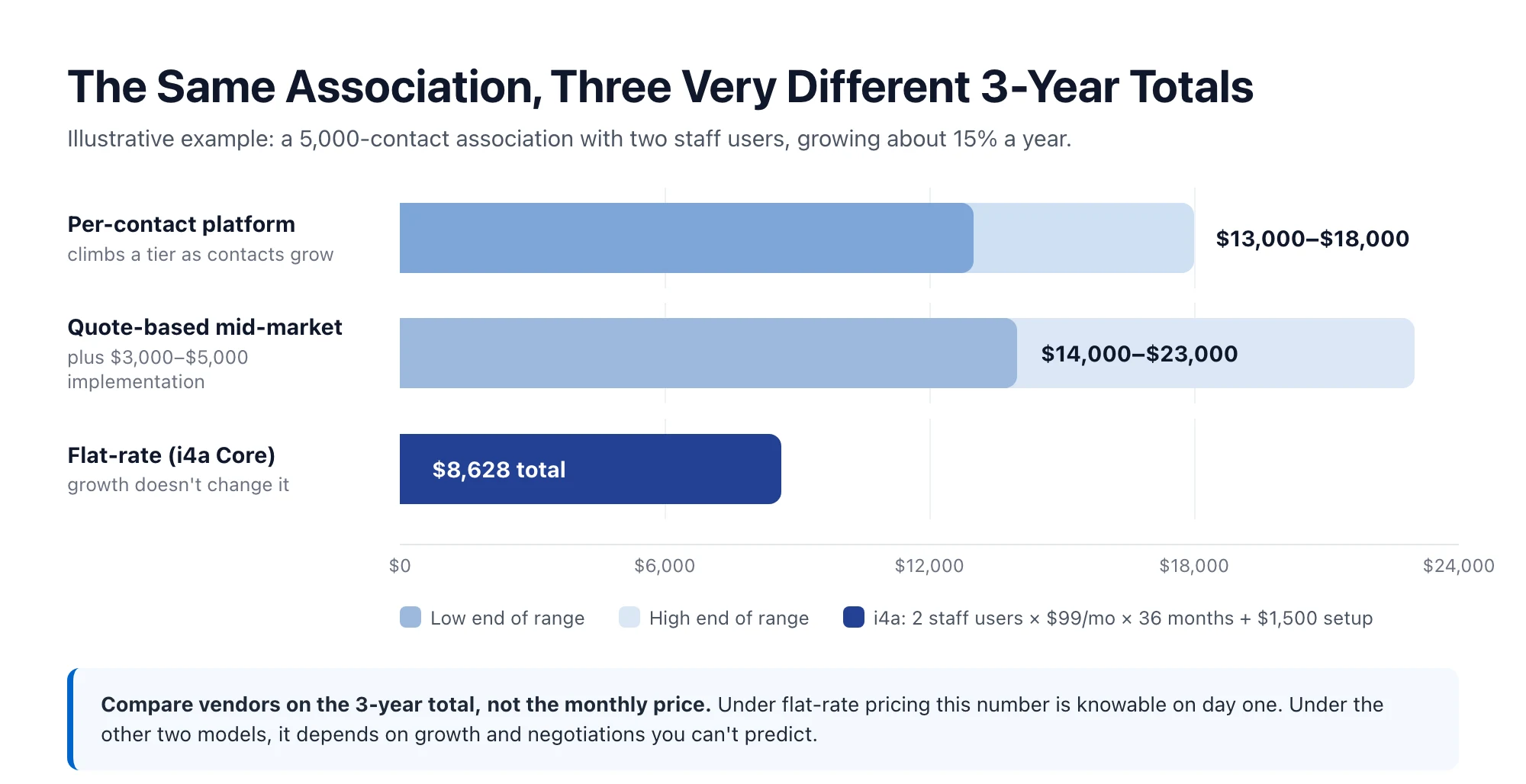
Flat-rate doesn't always win; at 200 contacts the ranking can flip. What the table shows is that a flat-rate three-year number can be filled in on day one, while the other two depend on negotiations and growth you can't predict.
For a deeper look at evaluating vendors beyond price, see our membership software buyer's guide.
Want to run these numbers for your association? View i4a pricing →
Eight Questions to Ask Every Vendor Before You Sign
Each of these maps to a cost that commonly surfaces after the contract. Ask them in writing and keep the answers:
- What is the all-in first-year cost for our organization (subscription, setup, migration, training, everything) as one number?
- Does your pricing depend on our member count, contact count, or staff count? What happens to our bill if our database doubles?
- Do you charge platform fees on payments beyond card processing? What percentage?
- Is data migration included in setup, or billed separately? At what rate?
- How many hours of training and onboarding are included, and what does support cost after that?
- Are there email send limits or contact-based email pricing?
- Which features in the demo are add-on modules not included in the quoted price?
- What happens to our price at renewal? Is there a cap on annual increases?
Use these questions in every AMS demo. A vendor who answers all eight promptly and in writing is telling you something about what the support relationship will be like. So is a vendor who won't.
i4a's Pricing, in Plain View
You've now seen the four things that make AMS pricing hard to compare: member-count-based increases, add-on modules, implementation fees, and transaction fees. Here is our answer to each.
We publish our pricing because we think you should be able to budget before you ever talk to us. The complete picture:
- Core Platform: $99/month per staff user (annual contract) covers membership management, event registration, email marketing, website builder, accounting exports, and unlimited members and contacts
- Pro Platform: $224/month per staff user adds member communities, advanced email analytics, surveys, a job board, and an online store
- One-time $1,500 setup includes 15 hours of onboarding support, data import wizards, and training; most organizations are live in 60–90 days
- No per-member fees, no per-contact fees, no platform transaction fees, so growing your membership never raises your software bill
- Multi-seat savings: teams with 5+ staff users save over $3,000/year on annual plans
A word about the objection this price sometimes raises in board meetings: if it costs that much less, can it be any good?
The instinct is reasonable, but the price gap comes from the pricing model, not the product. Vendors who charge per contact are monetizing your database growth. Quote-based prices scale with perceived value and budget. i4a prices to staff seats and publishes the number, so there's no negotiation margin built in.
The product behind the price has a 4.9/5 rating on Capterra and 30 years of associations running on it. Expensive is a pricing strategy, not a quality certificate.
Full plan details, a feature comparison, and an interactive cost calculator are on our pricing page. No form required.
Frequently Asked Questions About AMS Costs
See What i4a Would Cost Your Association
Budget it yourself, no sales call required. Every i4a price is published, including the setup fee and the optional extras.