Quick Summary: At-Risk Member Identification
- Most churn is predictable: At-risk members show warning signs months before lapsing—declining logins, ignored emails, missed events, unresolved complaints.
- Proactive intervention outperforms reactive: Reaching out 3-6 months before renewal beats waiting to run win-back campaigns after members lapse.
- Build a composite risk score: Single signals mislead—combine login activity, email engagement, event attendance, tenure, and support history for accurate prediction.
- Match response to risk level: High-risk members need personal outreach; medium-risk get automated campaigns; low-risk require monitoring for escalation.
- You already have the data: Most associations collect the signals in their AMS, email tools, and event systems—they just aren't connecting the dots.
Part of our retention strategies guide
At-risk members show warning signs months before they lapse—declining logins, ignored emails, missed events. Here's how to identify them early, build a risk score, and intervene while there's still time.
The framework below shows how these signals roll up into a single risk score that guides outreach before renewal.

By renewal time, the decision to lapse is often already made—weeks or months earlier, when value faded. Industry benchmarking data shows 52% of lapsed members cite lack of engagement, while 24% simply forgot to renew—both preventable with proactive outreach. Associations often miss these cues, like zero logins or ignored emails, leaving them surprised by churn rates. With 55% facing flat or declining retention (Sequence Consulting's 2026 Association Trends report), the organizations that thrive will be those that identify and engage at-risk members before it's too late.
After working with associations since 1996, I've seen a clear pattern: the organizations with the best retention aren't doing anything fancy. They're simply paying attention to the data they already collect—and acting on it before renewal notices go out. The good news? You can start doing this today with the tools you have.
Most churn follows predictable patterns. This guide shows you how to spot at-risk members, score their risk, and act in time to retain them.
Why predicting churn matters
Waiting for renewal notices is reactive and low-yield. Proactive identification lets you intervene 3-6 months early, boosting save rates dramatically. This approach turns potential losses into steady revenue growth.
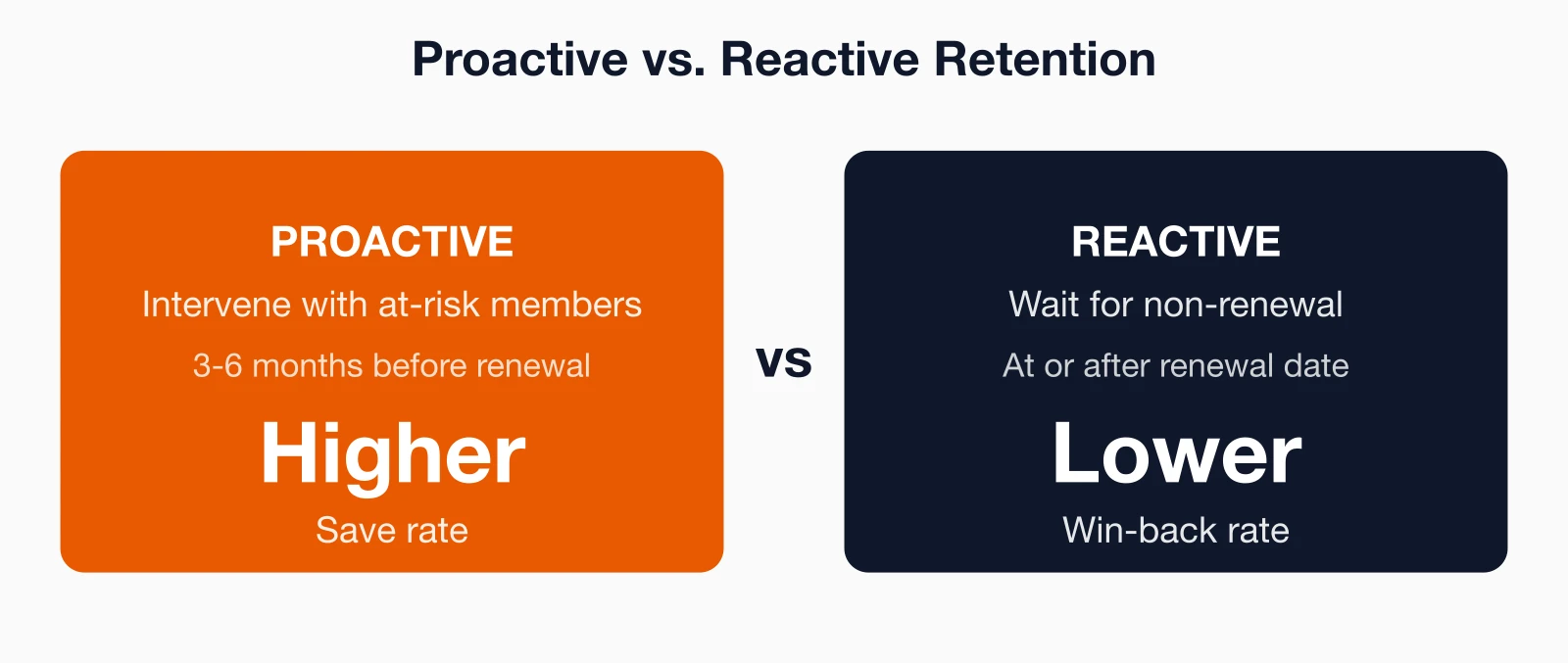
The math favors early action: Spotting risks ahead of time turns potential losses into retained revenue. Every proactive effort compounds into stronger retention over multiple cycles, building long-term stability.
At-Risk Identification ROI Example
This calculator compares two scenarios: reaching out to at-risk members early (proactive) vs. waiting until after they lapse and trying to win them back (reactive). Adjust the values to see how much more revenue you could retain with early intervention.
Adjust to your association's dues and rates.
You're Already Collecting This Data
Most associations have the raw data in their AMS, email tools, and event systems—they just aren't connecting the dots. Logins, opens, and no-shows sit unused until it's too late. The fix? Activate that data with automated scoring and alerts to make retention effortless.
Key warning signs to track
Not all signals predict churn equally. Rank them by power: high-risk demands immediate action, early warnings need monitoring. Prioritizing these lets you focus staff time where it counts most.

Engagement-based signals
Engagement drops are your earliest, most reliable predictors. Track these across all members to spot drifts from baseline behavior. Consistent monitoring reveals patterns unique to your group.
- Portal/Website Logins: Flag drops below personal norms (e.g., weekly user silent for 60 days).
- Email Engagement: Sustained 50%+ drop in opens/clicks signals fading interest.
- Event Participation: Compare to prior years—zero events from a regular attendee is a red flag.
- Content Consumption: Declining resource or publication use shows waning value.
- Community Activity: Reduced posts or views in forums signals disengagement.
Behavioral patterns that predict churn
Certain actions scream "at risk" louder than metrics alone. These often tie to personal frustrations or life changes, making quick outreach essential. Addressing them head-on can flip the trajectory.
- Support Complaints: Unresolved issues spike lapse risk—follow up fast.
- Payment Failures: Declined cards or bounces need immediate outreach.
- Profile Abandonment: Incomplete or deleted profiles indicate low commitment.
- Downgrade Requests: Often a step before full exit.
- Career/Org Changes: Job shifts or retirements trigger many lapses—track employer data.
Building a member risk score
Single signals mislead; a composite score sharpens accuracy. Weight factors by impact and automate the math. This system scales to thousands of members without extra effort.

Sample scoring criteria
| Factor | Low Risk (0-5) | Medium Risk (6-15) | High Risk (16-25) |
|---|---|---|---|
| Login Activity | Logged in past 30 days | Last login 31-90 days | No login in 90+ days |
| Email Engagement | Opens 50%+ of emails | Opens 20-49% of emails | Opens < 20% or unsubscribed |
| Event Participation | Attended event in past 6 mo | Registered but didn't attend | No registration in 12 mo |
| Tenure & History | 5+ years, consistent renewal | 2-5 years or prior lapses | First year or multiple lapses |
| Support Issues | No complaints | Complaint, resolved | Unresolved complaint |
Intervention strategies
Tailor actions to risk level—high-risk gets personal touch, low-risk needs nudges. Matching the right response prevents escalation and builds loyalty. Track results to optimize over time.
High-risk (61-100)
- Personal call/email from staff or leader.
- Ask directly: "What would make membership more valuable?"
- Resolve issues immediately; reconnect with past benefits used.
Medium-risk (31-60)
- Automated email series on underused benefits.
- Personalized event invites.
- Targeted content shares.
- Quick pulse survey.
Low-risk with signs (15-30)
- Value reminder emails.
- Resource nudges.
- Close monitoring for escalation.
Pro Tip: Log every intervention and outcome to refine what works for your segments.
Technology requirements
Manual tracking doesn't scale. Your association management platform should provide the following capabilities to support effective at-risk identification:
- Unified Data: Single view of logins, emails, events, support.
- Automated Scoring: Real-time risk calculation.
- Alert Triggers: Notify staff at thresholds.
- Dashboards: Track trends and intervention results.
- Integrations: Pull from email, events, and more.
Avoid per-contact AMS pricing—it tempts data deletion, killing historical patterns needed for prediction. Flat-rate unlimited storage lets you keep it all.
Getting started
Start simple—no AI required. These steps build momentum quickly and deliver results in your next renewal cycle. Refine as you gather data from real interventions.
- Analyze last year's lapsed members for patterns.
- Pick 3-5 top signals for your group.
- Set up tracking in your AMS.
- Build a basic score (high/medium/low).
- Test interventions on high-risk members.
Here's what I tell every association I work with: don't wait for a perfect system. The associations that improve retention fastest are the ones that start with a simple spreadsheet, learn what signals matter for their members, and build from there. You can always get more sophisticated later—but starting today is what matters.
For full retention strategies, check our Membership Retention Guide
Key takeaways
- Churn is predictable — most lapsed members showed warning signs before leaving
- Key warning signs: Declining logins, email disengagement, event no-shows, support complaints
- Build a risk score combining multiple signals for more accurate prediction
- Intervene early: Proactive outreach beats reactive win-back campaigns
- Your AMS should track these signals so you can pull reports on at-risk members
- Use membership reporting dashboards to monitor at-risk trends over time
Spot At-Risk Members Before They Leave
i4a's membership reporting tools help you pull the data you need to identify at-risk members and intervene in time.
Let's TalkRelated resources
Complete 2026 strategy guide for improving member retention rates.
10 proven strategies to reduce member churn.
Re-engage lapsed members with effective win-back strategies.
Complete 90-day guide to onboarding new members.
