Quick Summary: Appealing to International Members
- Payment isn't the barrier: International cards convert to USD automatically, and USD billing is a global standard for memberships.
- Belonging is editorial: What members see first—inclusive language, diverse imagery, visible global representation—decides whether they feel the association is for them.
- Pricing beats currency: Income-based, World Bank–tiered dues address affordability far more powerfully than a currency symbol.
- Skip multi-currency settlement: It's real operational complexity most associations don't need. Spend where it matters.
Related reading: Membership pricing strategies
Ask an association leader what's stopping them from growing international membership, and one answer comes up again and again: "We can't accept other currencies." It feels like the obvious barrier—but it usually isn't.
The belief that currency is the gatekeeper to global growth quietly leads associations to spend money and engineering effort in exactly the wrong place. Here's a more useful way to think about it: the things that make international members feel they belong are mostly visible, cheap, and editorial. The things that are expensive and technical—multi-currency settlement—are mostly invisible and, for most associations, unnecessary.
Spend where it matters.
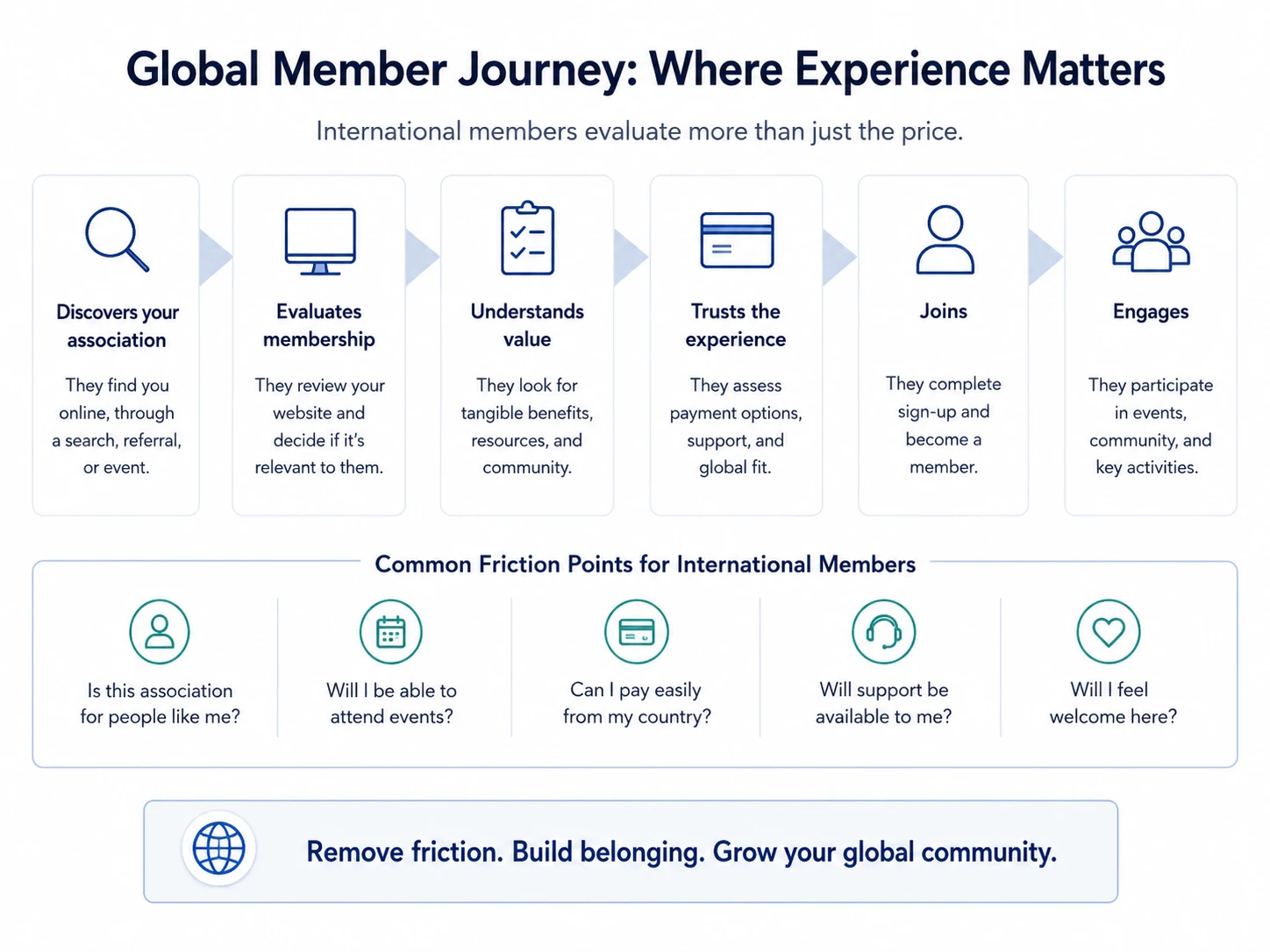
The payment problem is mostly already solved
Start with the fear, because it's the easiest to put to rest.
When a member in another country pays you in USD with their Visa or Mastercard, the conversion happens automatically. Their card network converts at the going rate, their bank posts the charge in their local currency, and the transaction completes—no special configuration on your side. It's the same machinery that lets any of us buy from an overseas website without thinking about it. International members do it every day.
On top of that, USD billing is a global standard for professional memberships, certifications, journals, and conferences. Members of international professional communities are accustomed to seeing dues and registration fees in dollars. It doesn't read as exclusionary; it reads as normal.
So the literal ability to pay is rarely the blocker. A member who wants to join can almost always complete the transaction today, exactly as your systems already work. What actually stops people is something that happens earlier—before they ever reach the payment screen.
Belonging is decided by what members see first
People decide whether something is "for them" in the first few seconds, long before they read your pricing. That judgment is made on signals—the language, the faces, the places, the framing. If those signals say "this is a US organization that happens to allow outsiders in," international prospects feel it immediately. If they say "this is a global community and you're part of it," they lean in.
This isn't soft sentiment—it's what members tell us drives their decision. In one survey of more than 2,000 members, 35% ranked "interacting with people with shared interests" among the top three things they value most about membership, and belonging consistently outranks transactional perks like discounts (Associations Now). Get belonging right and the rest follows: 82% of members report feeling engaged, and 83% plan to stay for at least five years (iMIS Member Experience Report).
None of those signals require new payment infrastructure. They require intention. Here's where the real leverage is:
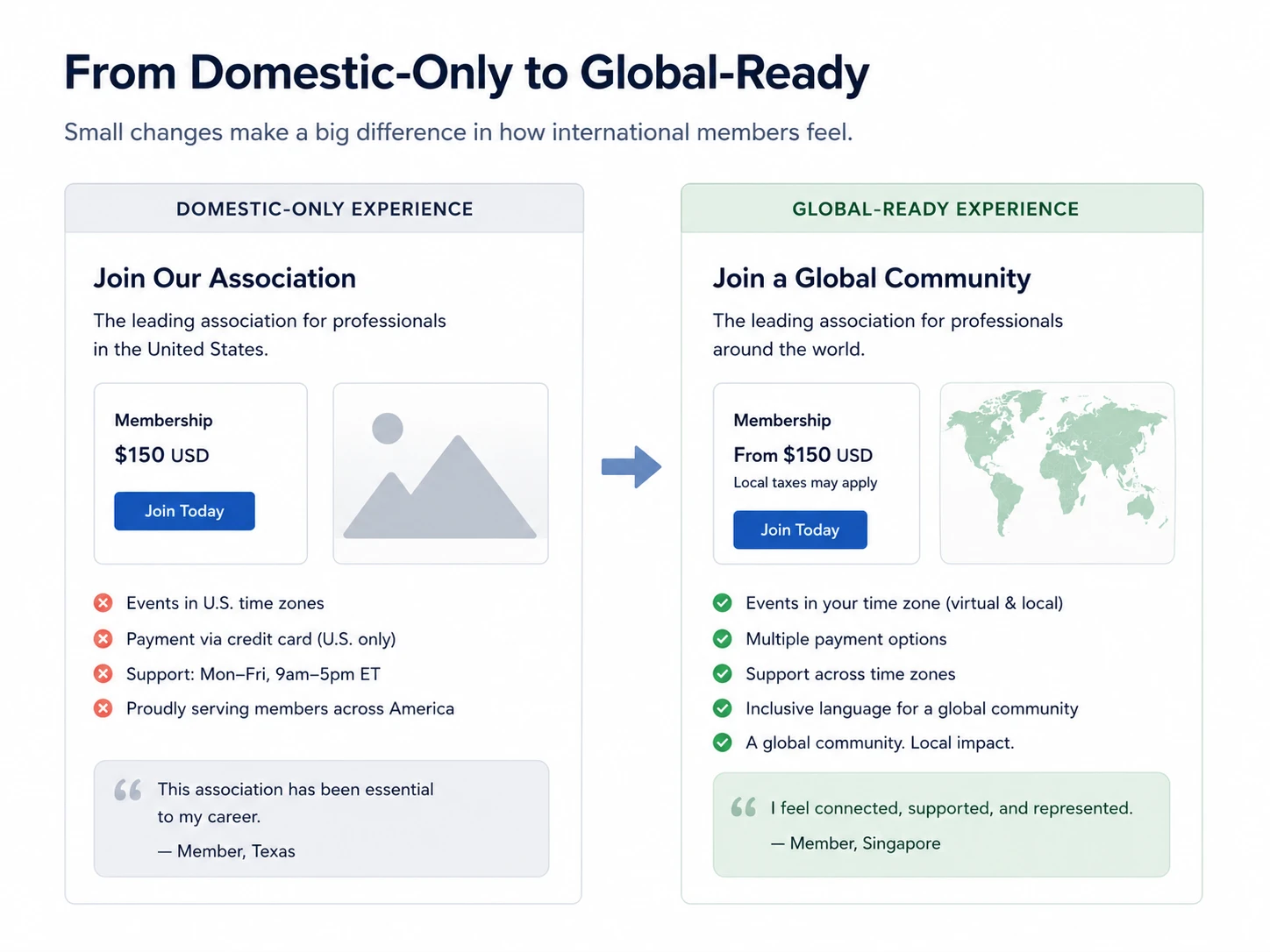
Welcoming, geographically-neutral language
Small wording choices carry a lot. "Members nationwide" tells half the world they're an afterthought; "members in 40+ countries" tells them they're expected. Watch for assumptions baked into your copy—references to a single country's holidays, regulations, seasons ("our fall conference"), or "domestic vs. international" framing that quietly sorts people into insiders and outsiders.
Language carries more weight than most organizations realize. Across 29 countries, 76% of consumers said they prefer to buy when information is in their own language, and 40% won't buy from another-language site at all (CSA Research, surveying 8,709 people). Full translation is a bigger commitment, and not every association needs it—but the underlying signal is the point: language tells people whether a space was built with them in mind. If you operate in English, the lowest-cost version of that signal is simply phrasing that doesn't assume everyone reading is in one country.
Imagery that reflects a global membership
The photos on your homepage, join page, and event pages are a statement about who belongs. If everyone pictured looks like they're from one place, that's the message. Diverse, international imagery does quiet, constant work to say "you'll see yourself here." Consumers notice: 63% say diverse representation matters to them, and 47–64% are more likely to consider or buy from a brand after seeing imagery they find inclusive (Numerator). The same instinct applies to a prospective member sizing up whether your organization is for them.
Maps, regions, and visible representation
A membership map, regional chapters or interest groups, country counts, and international members on your board, committees, and speaker rosters all signal that the organization's center of gravity isn't purely domestic. Representation is one of the strongest belonging cues there is—members look for someone like them in a position that matters.
Income-based, World Bank–tiered pricing
This is the highest-impact pricing move most associations overlook—and notably, it's about price, not currency. A flat global dues rate that's reasonable in a high-income economy can be genuinely out of reach in a lower-income one. Tiering membership by country income level directly addresses affordability and sends an unmistakable message: we want you here, and we've thought about what's fair for you. That lands far harder than showing the same number with a different currency symbol in front of it.
You don't have to invent the framework. The World Bank classifies every economy into four income tiers—low, lower-middle, upper-middle, and high—based on income per capita, and it's free to use. Professional societies already build on it: the International Association for Impact Assessment, for example, sets individual membership rates by country tier using those World Bank groupings and revises them every two years. Adopt the same approach and "fair pricing for every economy" becomes a lookup table, not a research project.
Notice what these have in common: they're things a member sees and feels, they shape the join decision, and they cost little more than editorial attention and intent.
Where currency display actually fits
So is showing local currency worthless? No—but it's a late-stage, low-impact polish, not a growth lever.
Currency display—showing an approximate local-currency equivalent next to the USD price—is a nice convenience. It can reduce a moment of friction at checkout for a member doing mental math. If it's easy to add, it's a pleasant touch. But it arrives at the very end of the funnel, after the member has already decided you're for them. It rarely changes whether someone joins; at most it smooths the final step. Treat it as a finishing touch, not a foundation.
"But doesn't the data say currency matters?" Fair challenge. In retail e-commerce it clearly does: 94% of cross-border shoppers expect to pay in local currency, and 49% say they'd abandon a purchase if they couldn't (PYMNTS / Worldpay). Those are big numbers—so why don't they change the advice here?
Because they describe a different buying situation. Retail conversions are discretionary and substitutable: an impulse purchase with a dozen competing sites one click away, where any friction sends the shopper elsewhere. Joining a professional association is a considered, high-intent decision—often with no real substitute—where USD billing is already the global norm for dues, journals, and certifications. A motivated member completing a deliberate signup behaves nothing like a shopper abandoning a cart over a checkout surprise. The retail data is real; it just doesn't transfer to membership the way it first appears.
Multi-currency settlement is a different animal entirely—and this is where associations tend to over-invest. Truly charging, collecting, and settling in multiple currencies means real, ongoing complexity: payment processors and merchant accounts that support each currency, foreign exchange and settlement risk, reconciliation across currencies, tax and regulatory questions per market, refunds and chargebacks in the original currency, and accounting that has to make sense of all of it. It's a genuine operational program, not a setting you flip on.
For the vast majority of associations, that complexity buys very little. Your members can already pay in USD, automatically. Unless you have a specific, concrete reason to settle in local currency, you'd be taking on cost and risk to solve a problem your members don't actually have.
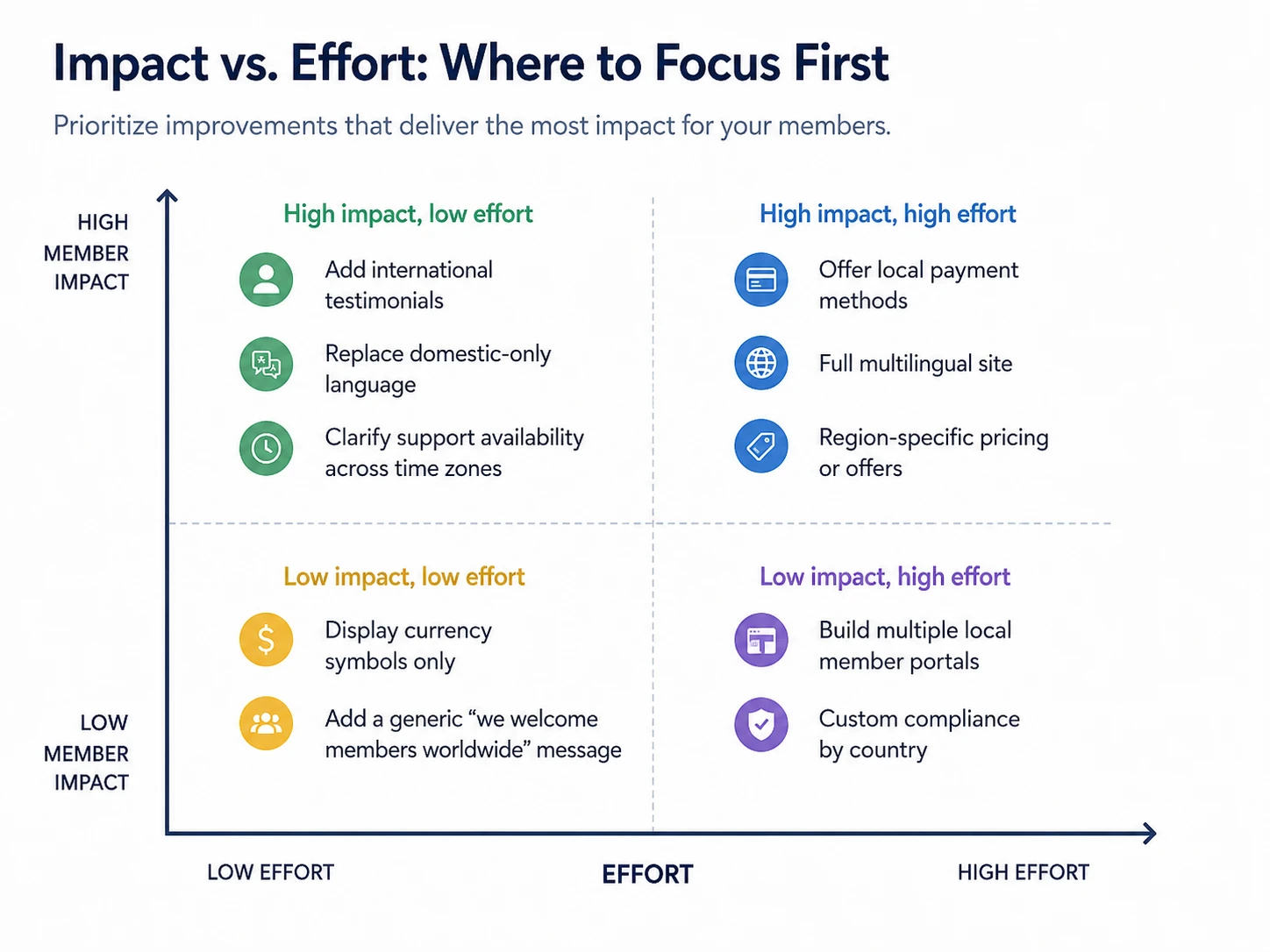
A low-cost checklist: ways to feel global this quarter
None of these require new payment infrastructure. Most are editorial and can be done with the tools you already have:
- Audit your language for hidden assumptions—single-country holidays, seasons, regulations, "domestic/international" othering. Replace with neutral, inclusive phrasing.
- Lead with global proof—"members in X countries," a membership map, regional groups—on your homepage and join page.
- Refresh your imagery so the people pictured reflect an international membership, not one location.
- Show international representation—board members, committee chairs, speakers, and authors from multiple countries, visibly.
- Introduce income-based, World Bank–tiered dues so membership is affordable across economies. (The single highest-impact item here.)
- Localize the small things—list times in multiple zones, offer event sessions at internationally-friendly hours, and spell out dates unambiguously (the world doesn't agree on MM/DD).
- Welcome new international members by name and place so they feel seen from day one.
- (Optional, late-stage) Add an approximate local-currency equivalent beside the USD price as a convenience—once the above are done.
Work down that list and you'll have moved nearly every lever that actually influences whether an international prospect feels they belong—without writing a line of multi-currency payment code.
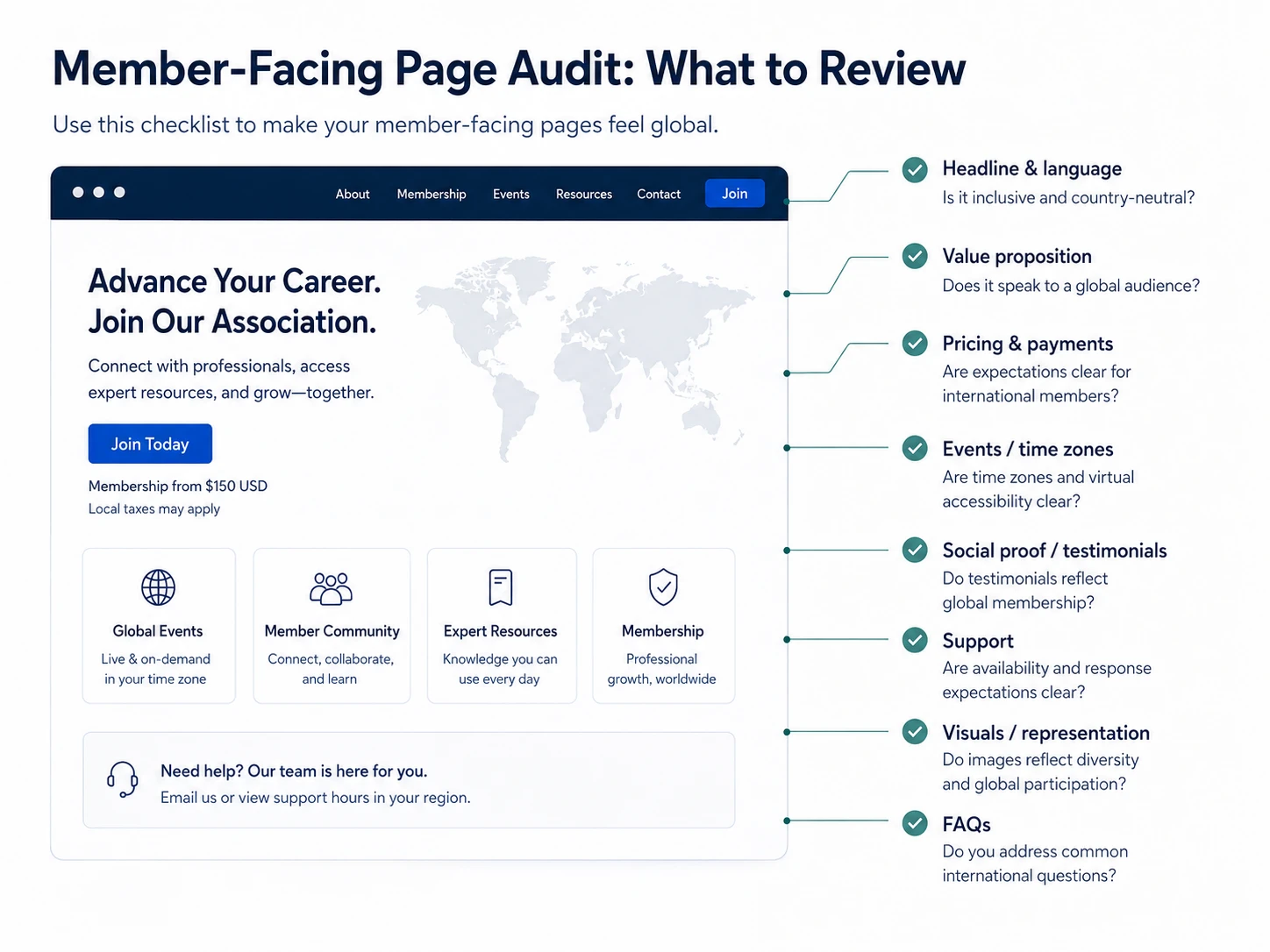
When currency support is worth it
Being honest about the other side: sometimes real currency support earns its complexity. Consider it when one or more of these is clearly true:
- A large, concentrated membership base in one or two specific countries—enough volume in a single currency to justify dedicated settlement, rather than a long tail of individuals scattered across many countries.
- Local payment-method expectations you can't meet with cards—markets where bank transfers, direct debit, or popular local wallets dominate and card penetration is low, so USD-card billing genuinely excludes people.
- A regulatory, tax, or contractual requirement to invoice, collect, or report in local currency—for example, a formal regional entity, local chapter incorporation, or in-country tax obligations.
- Friction you've actually measured—abandoned joins or documented complaints tied to currency specifically, not assumed. Let evidence, not anxiety, trigger the investment.
If you're in one of those situations, multi-currency support is a legitimate, strategic project—scope it deliberately, with the operational and accounting work it really entails. If you're not, you almost certainly don't need it yet.
The bottom line
Feeling global is mostly an editorial and design decision, not an engineering one. The signals that make international members feel they belong—inclusive language, representative imagery, visible global representation, and fair income-based pricing—are inexpensive, member-facing, and within reach right now. The genuinely expensive piece, multi-currency settlement, is invisible to members and unnecessary for most associations.
So before you budget for currency programming, budget for belonging. Spend where it matters—on what your future members see first.
Make Your Member-Facing Pages Feel Global
i4a gives you the tools to shape what members see first—flexible pages, tiered pricing, member directories, and event management—so appealing to an international audience is a matter of intent, not engineering.
Schedule a DemoRelated resources
Membership Pricing Strategies: Tiered vs Flat Pricing
How to structure dues—including income-based tiers—so pricing is fair and grows membership.
10 Ways to Improve Member Experience
Practical strategies to make every member touchpoint feel welcoming and personal.
New Member Onboarding: The Complete 90-Day Guide
Make new members—wherever they're from—feel they belong from day one.
Membership Management Software Guide
Everything an AMS should do for your member database, pricing, and self-service.