Quick Summary: Member Lifetime Value
- Most associations undervalue members by 2x or more: Dues-only LTV calculations miss events, certifications, products, and sponsorship revenue—include all sources for accurate valuation.
- Basic formula, complete picture: LTV = (Annual Dues + Non-Dues Revenue) × Average Tenure. Use 1 ÷ (1 - Retention Rate) to estimate tenure from your retention percentage.
- Target a 3:1 LTV-to-CAC ratio: Your member lifetime value should be at least three times your acquisition cost; below that, you're overspending on growth.
- Small retention gains compound significantly: A 5% improvement in retention can increase LTV by 25-30%—often more impactful than adding new revenue streams.
- Segment analysis reveals where to focus: LTV varies dramatically by member type, acquisition source, and engagement level—calculate separately to guide strategic decisions.
Part of our member retention strategies guide
Member lifetime value (LTV) is the single most important metric for budgeting acquisition and retention spend—yet most associations don't calculate it. Use our formula and calculator to find what your members are really worth.
How much is a member worth to your association? Not just their annual dues — their total lifetime value, including all the revenue they generate over the full span of their membership.
Here's a question worth asking: What's your member LTV? Many associations can't answer that. Yet they'll debate for hours whether to spend $2,000 on a membership marketing campaign. How can you know if that's a good investment if you don't know what a member is worth? Knowing your LTV transforms how you evaluate every membership decision.
Member Lifetime Value (LTV) is one of the most important metrics for any association, yet many don't calculate it. With 55% of associations reporting flat or declining retention (Sequence Consulting's 2026 Association Trends Report
Why LTV matters for associations
Knowing your member LTV enables smarter decisions across your organization:
- Acquisition budgeting: How much can you afford to spend to acquire a new member?
- Retention investment: How much is it worth spending to save an at-risk member?
- Program prioritization: Which programs attract and retain your highest-value members?
- Segment focus: Which member types deliver the most long-term value?
- Revenue forecasting: Predict future revenue based on current membership composition
Your membership database
The basic LTV formula
At its simplest, member LTV is:

Example: If your annual dues are $500 and members stay an average of 7 years:
$500 × 7 = $3,500 LTV
This basic calculation gives you a starting point, but it understates the true value of members for most associations.
Complete LTV calculation
For a more accurate picture, include all revenue sources:
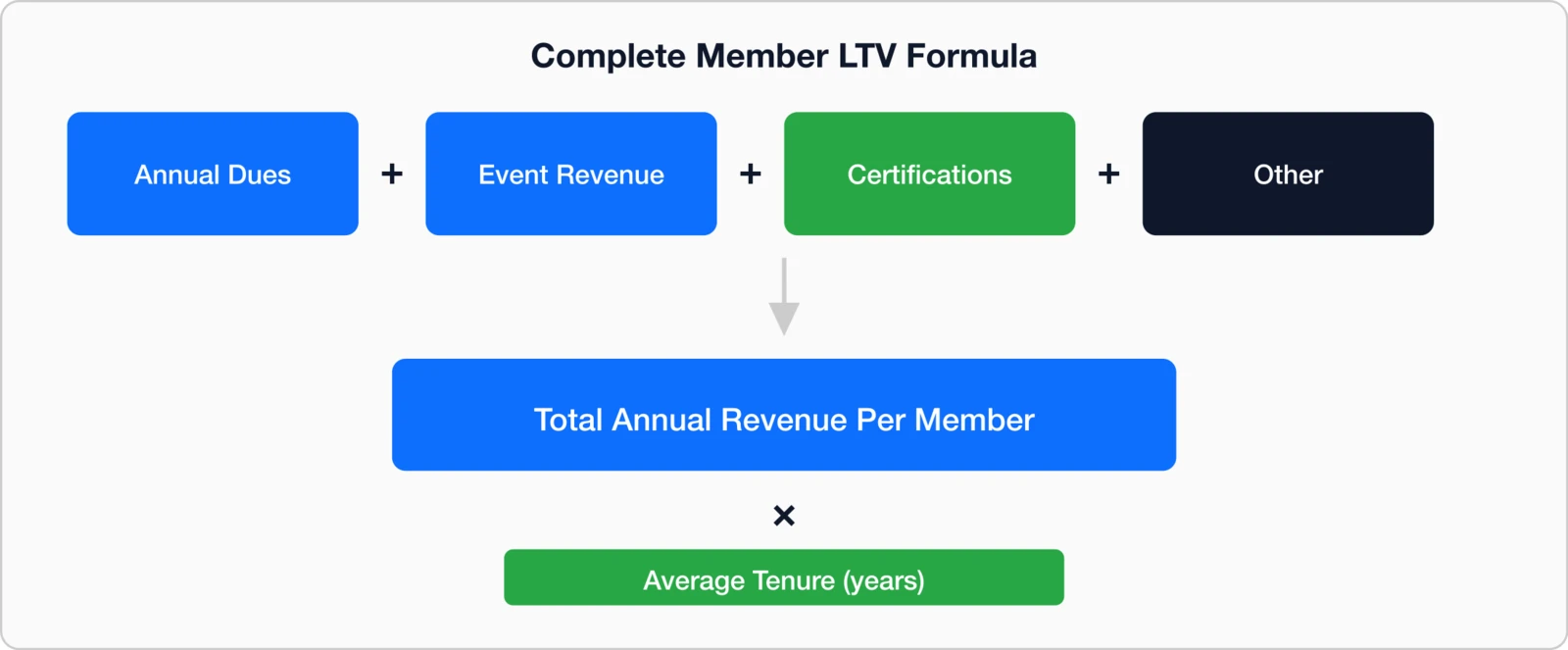
Revenue components to include
| Revenue Source | How to Calculate | Example |
|---|---|---|
| Dues | Annual dues amount | $500/year |
| Events | Avg. event spend per member/year | $300/year |
| Certifications | Exam + renewal fees averaged | $150/year |
| Products/Publications | Avg. purchases per member/year | $50/year |
| Sponsorship Attribution | Sponsor revenue ÷ member count | $25/year |
| Total Annual Revenue | $1,025/year | |
Complete LTV Example:
$1,025/year × 7 years average tenure = $7,175 LTV
This is more than double the dues-only calculation, demonstrating why the complete formula matters.
Calculating average tenure
Average tenure is critical to your LTV calculation. Calculate it using:
- Pull all members who have ever lapsed from your membership database
- Calculate the tenure (join date to lapse date) for each
- Average across all lapsed members
Alternatively, if you know your annual retention rate, you can estimate tenure:

Example: With 85% retention rate: 1 ÷ (1 - 0.85) = 1 ÷ 0.15 = 6.7 years
Member Lifetime Value Calculator
Use this calculator to estimate your association's member LTV. Enter your annual dues, average per-member revenue from events and other sources (certifications, products, etc.), and your retention rate. The calculator will estimate average tenure and show your member LTV along with the maximum you should spend to acquire a new member while maintaining a healthy 3:1 LTV-to-CAC ratio.
Max CAC = Maximum you should spend to acquire a member while maintaining a 3:1 LTV:CAC ratio.
Real Talk: You're Probably Undervaluing Your Members
We consistently see associations calculate LTV using only dues revenue. When you add events, certifications, product purchases, and sponsor revenue attribution, the real number is often significantly higher than the dues-only calculation.
This matters because it changes what you can afford to spend on acquisition and retention. If you think a member is worth $3,000 but they're really worth $8,000, you're under-investing in growth.
LTV benchmarks by association type
LTV varies significantly by association type. Trade associations with organizational members typically see higher LTV than professional associations with individual members, while AMCs need to track LTV across multiple client associations:
| Association Type | Typical LTV Range | Key Drivers |
|---|---|---|
| Professional Associations (Individual) | $2,000 - $8,000 | Lower dues, longer tenure, certification revenue |
| Trade Associations (Organizational) | $10,000 - $50,000+ | Higher dues, event sponsorships, advocacy value |
| Certification Bodies | $5,000 - $15,000 | Exam fees, CE requirements, career-long relationship |
| Chambers of Commerce | $3,000 - $12,000 | Variable dues, event revenue, advertising |
LTV to acquisition cost ratio
Knowing LTV is most valuable when compared to your Customer (Member) Acquisition Cost (CAC).
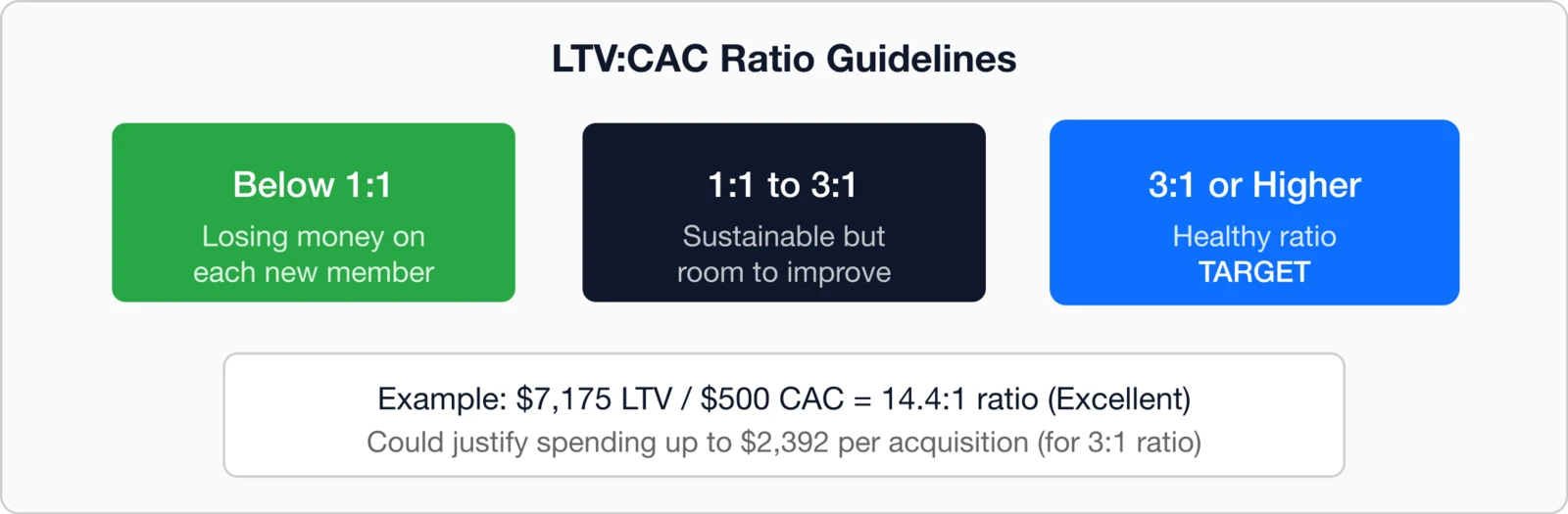
Calculating your acquisition cost
CAC includes all costs to acquire a new member:
- Marketing and advertising spend
- Staff time dedicated to recruitment
- Trade show and outreach event costs
- Sales commissions or referral incentives
- Technology and tools for recruitment
CAC Formula: Total Acquisition Costs ÷ Number of New Members Acquired
Analyzing LTV by segment
Average LTV masks significant variation. Calculate LTV for different segments to understand where to focus:
Segments to analyze
- By member type: Individual vs. organizational, different tiers
- By acquisition source: Referral, web, event, sales
- By industry/sector: Which verticals are most valuable?
- By geography: Regional differences in tenure or spending
- By engagement level: High engagement vs. passive members
Pro Tip: Members acquired through referral tend to have higher LTV than those from other sources—they often stay longer and engage more deeply. This makes referral programs valuable — see our guide on reducing churn
Strategies to increase LTV
There are two ways to increase LTV: extend tenure or increase annual revenue.
Extending tenure (retention)
- Improve new member onboarding to reduce first-year churn
- Identify and intervene with at-risk members before they leave
- Create multi-year membership options with incentives
- Build community and peer connections that create switching costs
- Continuously demonstrate and communicate value
Increasing annual revenue
- Develop additional programs and services members want
- Cross-sell certifications, events, and products
- Create premium membership tiers with enhanced benefits
- Personalize offerings based on member interests and behavior
- Price appropriately — don't underprice valuable benefits
Impact analysis
Small improvements compound significantly:
| Improvement | LTV Impact | Example |
|---|---|---|
| 5% retention improvement | +25-30% LTV | $7,175 → $9,328 |
| 10% more annual revenue | +10% LTV | $7,175 → $7,893 |
| Both combined | +38% LTV | $7,175 → $9,900 |
Don't Let Your AMS Eat Your LTV
Here's something associations rarely factor into LTV: their AMS costs per member. If your platform charges $3-5 per member per month, that's $36-60/year coming directly out of your LTV.
For a $500 dues member with 7-year tenure, per-contact AMS pricing could cost you $252-$420 per member lifetime — money that should be going into programs and services.
This is why i4a uses flat-rate pricing with unlimited members. Your LTV calculation stays clean: member revenue minus your fixed platform cost, regardless of how many members you have or how long they stay.
Getting started
To calculate your association's member LTV:
- Pull your data: Dues by member, event revenue, certification revenue, other purchases
- Calculate tenure: Use lapsed member data or estimate from retention rate
- Apply the formula: Start with the basic formula, then add non-dues revenue
- Segment: Calculate LTV for key member segments
- Calculate CAC: Know your acquisition cost for LTV:CAC ratio
- Track over time: Monitor LTV quarterly to see trends
After working with associations for nearly 30 years, I've noticed a pattern: the organizations that calculate and track LTV tend to make better decisions about where to invest their limited resources. They stop guessing about what members are worth and start making choices based on actual numbers. That shift—from gut feelings to data-driven decisions—often marks the difference between associations that struggle with retention and those that build lasting member relationships.
For more retention strategies that directly impact LTV, see our comprehensive Membership Retention Strategy Guide
Curious about tracking member value in your association? Get in touch
Key takeaways
- Basic LTV formula: Annual Dues × Average Member Tenure = Lifetime Value
- Include non-dues revenue: Events, certifications, sponsorships, and other purchases
- Typical association LTV: $2,000-$15,000 depending on dues and tenure
- LTV:CAC ratio target: At least 3:1 (lifetime value should be 3x acquisition cost)
- Track LTV by segment in your AMS to identify highest-value member types
Understand Your Member Value
Discover how i4a's reporting tools can help you calculate and track member lifetime value across all revenue sources—dues, events, store, and donations.
Talk to Us About AnalyticsRelated resources
Complete 2026 strategy guide for member retention.
10 proven strategies to reduce member churn.
Tiered vs flat pricing approaches.
Estimate your software investment.
