Quick Summary: Certification Revenue
- Six-figure revenue potential: Programs can grow to $250K+ within 5 years as new certifications and recurring recertifications compound.
- Lifetime value is substantial: A single credential generates $4,000+ over 20 years at $200 annual recertification.
- High margins after development: Ongoing operational costs remain low once exams and content are built.
- Member pricing drives membership: 20–25% certification discounts make joining the association financially attractive.
- Offer multiple credential types: Certificates, certifications, specialties, and micro-credentials serve different professional needs.
Part of our revenue diversification guide
Association certification revenue can grow to six figures within a few years—with recurring recertification fees providing stable income decade after decade. Here's how to build a program that works.
According to Marketing General's 2025 Membership Marketing Benchmarking Report, nearly six in ten associations position certification and professional development as a core member benefit, while 39% of members cite continuing education as their primary reason for joining. With 63% of associations anticipating growth in non-dues revenue, certification programs represent a strategic opportunity that aligns mission objectives with financial sustainability.
However, building successful certification programs demands significant upfront investment in program design, content development, and technology infrastructure. Associations that thrive treat these initiatives as long-term strategic assets rather than short-term revenue tactics.
This comprehensive guide outlines how to design certification programs that deliver genuine career value to participants while supporting your organization's sustainability goals—particularly well-suited for professional associations, medical associations, and education organizations.
Why certification programs work
Professional certifications excel because they simultaneously address critical career advancement needs for individuals and create stable financial foundations for associations. Professionals seek credentials for tangible benefits like promotions, salary increases, and job security, while associations gain high-margin revenue, recurring income streams, and strengthened industry authority.
Value to credential holders
Credentials deliver measurable career advantages that drive candidate demand. They signal expertise to employers, boost earning potential, enhance job security, reinforce professional identity, and meet regulatory requirements in many fields.
- Career advancement: Clearly signals verified expertise to employers, clients, and peers
- Salary premium: Positions certified professionals to command higher compensation than their non-certified counterparts
- Job security: Demonstrates proven competency, commitment, and adaptability in competitive markets
- Professional identity: Reinforces a sense of belonging and mastery within the field
- Regulatory compliance: Satisfies mandatory requirements for practice in regulated industries
Value to your association
Associations capture organizational benefits that extend beyond mission alignment. These programs yield high profit margins, predictable renewals, member retention, authoritative positioning, and deep candidate engagement throughout the process.
- High margins: Ongoing operational costs remain low once development is complete
- Recurring revenue: Annual recertification fees provide dependable, forecastable income streams
- Membership synergy: Credential holders frequently maintain or upgrade their association memberships
- Industry authority: Positions your organization as the recognized standard-setter for professional competence
- Engagement driver: Candidates develop strong organizational connections through the multi-stage certification journey
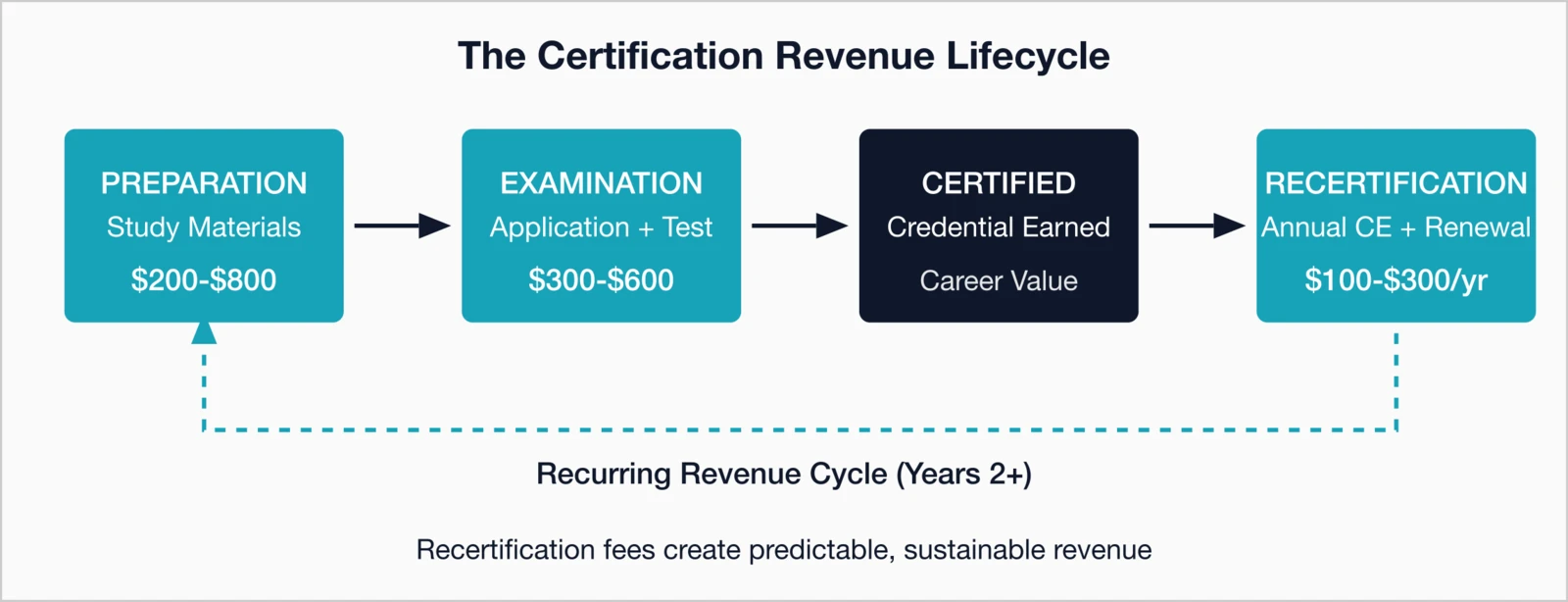
The certification revenue model
Certification programs generate revenue across multiple stages of the credential lifecycle, from initial preparation through ongoing maintenance. One-time fees from exams and courses provide startup capital, while recurring recertification and continuing education create long-term stability essential for financial planning.
Sample revenue sources
These line items convert broad revenue concepts into actionable financial projections. Typical fee structures, price ranges, and billing cadences help benchmark your program and identify high-potential growth areas.
Note: These figures serve as illustrative examples only. Actual pricing and revenue potential will vary based on industry dynamics, credential complexity, and market positioning.
| Revenue Source | Typical Range | Frequency |
|---|---|---|
| Application fee | $75-$200 | One-time |
| Exam fee | $200-$500 | One-time (or per retake attempt) |
| Study materials | $100-$500 | One-time |
| Preparation courses | $200-$1,000 | One-time |
| Annual recertification | $100-$300 | Annual |
| Continuing education courses | $25-$150 per course | Ongoing |
Example projection for a mid-sized association
Revenue compounds as new certifications fuel growth and recertifications provide stability. This modeling demonstrates why sustained investment delivers superior long-term returns.
| Year | New Certifications | Recertifications | Total Revenue |
|---|---|---|---|
| Year 1 | 100 × $600 = $60,000 | $0 | $60,000 |
| Year 2 | 150 × $600 = $90,000 | 90 × $200 = $18,000 | $108,000 |
| Year 3 | 200 × $600 = $120,000 | 220 × $200 = $44,000 | $164,000 |
| Year 5 | 250 × $600 = $150,000 | 500 × $200 = $100,000 | $250,000 |
As the credential holder base expands steadily, recertification revenue emerges as the program's financial backbone, providing resilience even during slower recruitment periods.
Types of credential programs
Associations benefit from offering diverse credential types to address varying professional needs and market segments. A comprehensive ecosystem of certificates, full certifications, specialties, and micro-credentials maximizes reach, revenue, and participant pathways.

Certificate programs
Certificate programs represent completion-based credentials ideal for targeted skills training with accessible entry points. These lower-barrier offerings launch quickly and frequently serve as strategic on-ramps to more advanced certifications.
- No examination required, enabling broader participation
- Perfect for foundational or specialized skill development
- Often functions as the first step toward comprehensive certification
Professional certifications
Professional certifications constitute the gold standard of competency-based credentials, validated through rigorous examinations that command premium pricing and market recognition. These programs demand sophisticated development and ongoing maintenance.
- Provides rigorous validation of knowledge and skills through testing
- Delivers superior recognition and career advancement potential
- Requires systematic recertification and potential experience verification
Examples: PMP, CPA, PHR, CISA
Specialty credentials
Specialty credentials build upon foundational certifications to address advanced or niche expertise areas within the profession. They generate incremental revenue from existing credential holders.
- Extends value for holders of base certifications
- Targets specific practice areas or advanced competencies
- Strengthens organizational positioning in niche markets
Micro-credentials and digital badges
Micro-credentials offer compact, focused proofs of competency that participants can earn quickly and stack toward larger qualifications. Their shareability makes them ideal for high-volume adoption.
- Achievable in hours or days rather than months
- Stackable toward comprehensive credentials
- Lower pricing supports higher participation volume
- Highly shareable on professional networks and resumes
- Perfect for rapidly evolving technologies and skills
Pricing your certification
Effective pricing strategies reflect the credential's genuine career value while considering competitive positioning and membership incentives. Frameworks balance revenue maximization with candidate accessibility and employer reimbursement realities.

Key pricing factors
Pricing decisions require balancing multiple strategic considerations to avoid arbitrary approaches. This framework ensures choices align with market realities and objectives.
- Career value: Price according to the credential's impact on salary, promotions, and employability
- Competitive landscape: Benchmark against comparable industry certifications
- Development costs: Account for examination creation, content development, and technology
- Delivery costs: Include testing centers, proctoring services, and customer support
- Membership differential: Structure discounts to reinforce membership value proposition
Sample pricing structure
This component breakdown illustrates total candidate investment from application through initial certification. Pricing in the $500–$1,000 range typically aligns optimally with employer reimbursement policies.
| Component | Member Price | Non-Member Price |
|---|---|---|
| Application fee | $100 | $150 |
| Exam fee | $350 | $450 |
| Study guide | $75 | $100 |
| Prep course (optional) | $400 | $500 |
| Annual recertification | $150 | $225 |
| Total initial investment | $525-$925 | $700-$1,200 |
Recertification: Building long-term value
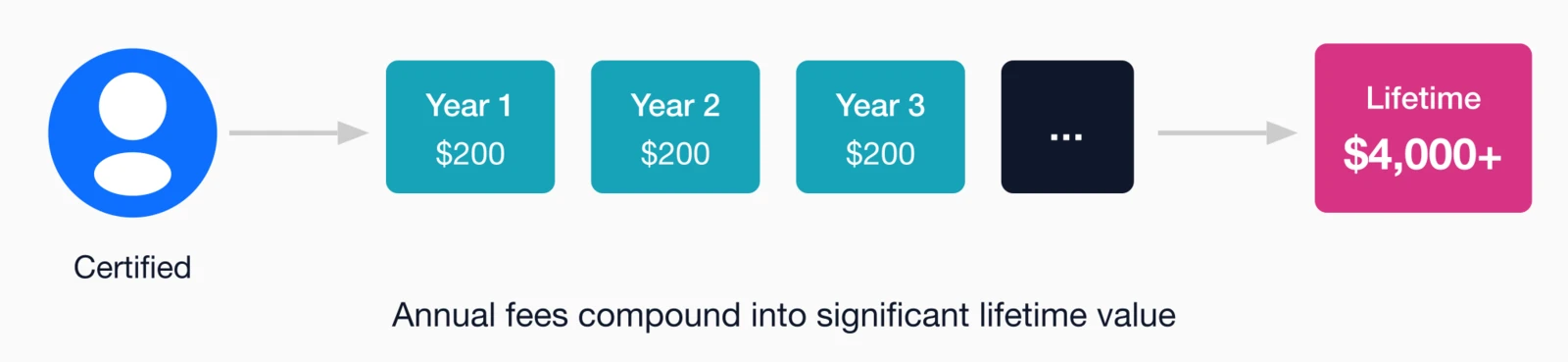
Recertification transforms one-time certification revenue into lifetime value, with a single credential potentially generating $4,000+ over 20 years at $200 annually. Structured requirements maintain professional currency while creating revenue opportunities.
Typical recertification requirements
Well-designed requirements balance rigor with achievability to maintain credibility without excessive burden. These standards ensure professionals remain current.
- Continuing education: 20–60 credits required per renewal cycle
- Renewal fee: Annual payment or multi-year bundled options
- Professional activity: Documentation of ongoing field practice or portfolio
- Re-examination: Periodic retesting every 5–10 years for select programs
Additional CE revenue streams
Continuing education requirements create monetization opportunities beyond basic renewal fees. Integrated offerings turn compliance into diversified channels.
- Develop and sell association-branded continuing education courses
- Charge approval fees to third-party continuing education providers
- Establish revenue-sharing partnerships with approved education collaborators
- Award credits for participation in association conferences and events
Retention strategies
Proactive measures address the 52% of lapses attributed to disengagement, per Marketing General's 2025 report. These practices convert transactional renewals into enduring relationships.
- Initiate automated renewal reminders 90 days before expiration
- Offer discounts for multi-year renewal commitments
- Provide intuitive online portfolios for continuing education tracking
- Deliver added value through job boards, networking opportunities (top priority for 64% of members per MGI 2025), and exclusive content
- Recognize certification milestones at 5, 10, and 20 years
The membership connection: Bundling membership with recertification maximizes lifetime value through deeper organizational commitment.
Win-back strategies for lapsed credential holders
Re-engaging former certificants is one of the most cost-efficient ways to boost program revenue and long-term participation. Lapsed credential holders already recognize the certification's value; they simply need the right nudge to return.
Segment lapse types to tailor outreach: Different lapse reasons call for different reactivation approaches.
- Recent lapses (30–90 days): Often simple administrative oversights; gentle reminders and easy renewal paths work best
- Mid-term lapses (90–180 days): May signal distraction or competing priorities; reinforce the credential's professional value
- Long-term lapses (180+ days): Require deeper re-engagement and renewed value framing
- Cost-driven lapses: Respond with flexible payment plans, limited-time discounts, or employer reimbursement support
Time-based campaign framework: Plan outreach touchpoints around key lapse windows to maximize timing and message relevance.
- 30 days: Friendly reminder to renew, emphasizing continuity and avoiding gaps in credentials
- 90 days: Highlight professional risks of lapse—missed opportunities, lost recognition, and diminished competitive standing
- 180 days: Make reactivation simple through grace periods or continuing education (CE) catch-up programs
Reduce reactivation friction: Every unnecessary step can deter a return. Simplify the process wherever possible.
- Maintain grace periods that preserve status during renewal catch-up
- Offer CE completion options instead of requiring full back payments
- Provide streamlined re-entry exams for longer-term lapses
- Consider prorating renewal fees based on elapsed time since expiration
Value-based messaging that resonates: Motivate re-engagement by connecting renewal to tangible career outcomes and community benefits.
- Quantify career risks such as pay gaps, job eligibility, or promotion potential
- Surface industry updates or new standards since the lapse that make renewal even more valuable
- Share real success stories from professionals who reactivated and advanced
- Remind former holders of the networking and learning ecosystem they're missing
Associations equipped with modern membership management systems can automate these win-back efforts—from triggered outreach sequences to personalized renewal offers—creating a seamless path back for every credential holder.
Program design essentials
The foundational elements of exam development, eligibility criteria, and governance structures determine a program's credibility and defensibility. Essential design principles protect integrity, support accreditation, and build market trust.
Exam development
Psychometrically sound examinations require systematic processes beyond simple question creation. These steps ensure legal defensibility, candidate fairness, and ongoing relevance.
- Conduct job task analysis to precisely define required competencies
- Develop and rigorously test questions through subject matter expert review
- Establish defensible passing standards using validated methodologies
- Regularly refresh content to reflect field evolution and retire compromised items
Eligibility requirements
Strategic eligibility criteria balance program accessibility with credential prestige. Appropriate gateways enhance perceived value without limiting growth potential.
- Minimum education level or relevant coursework completion
- Verified professional experience in the field
- Professional endorsements, references, or prerequisite credentials
Governance structure
Independent oversight mechanisms demonstrate professionalism and support accreditation. Clear separation from association operations builds stakeholder confidence.
- Certification board operating independently from association management
- Subject matter experts guiding content development and standards
- Formal appeals process ensuring candidate fairness
- Ethics and discipline policies with defined accountability measures
Protecting credential integrity: Monitoring and enforcement
Maintaining the integrity of your certification program protects not only credential holders but also the association itself. Formal academic integrity monitoring ensures exams are fair, consistent, and defensible—essential for accreditation readiness (especially under NCCA and ANSI standards) and sustained employer trust in the credential's value.
Proactive integrity monitoring: Effective credential programs don't wait for problems to arise—they monitor continuously to detect and prevent them early.
- Implement systems that flag examination anomalies or unusual behavior patterns
- Establish baseline metrics for score distributions and completion times
- Monitor for potential collusion or shared testing patterns across sessions
- Deploy appropriate proctoring technologies aligned with each exam delivery format
Academic integrity alerts as investigation triggers: Alerts should prompt informed review—not automatic conclusions. Handling these incidents with balance reinforces transparency and procedural fairness.
- Treat flagged events as signals requiring review, not final judgments
- Define thresholds that distinguish statistical anomalies from actionable issues
- Document every alert, review, and outcome for audit readiness
- Maintain confidentiality throughout all monitoring and investigation activities
Defined investigation workflows: Clear, repeatable workflows make the integrity process defensible and efficient.
- Standardize procedures for conducting academic integrity reviews
- Assign trained personnel to ensure investigations are fair and thorough
- Define reasonable timelines for each stage of the review
- Separate investigation roles from certification decision-making to avoid bias
Due process protections: Due process builds trust in both outcomes and the institution behind them.
- Give candidates the opportunity to respond before any adverse action is taken
- Maintain comprehensive documentation of evidence and decision rationale
- Offer formal appeals reviewed by an independent authority
- Keep detailed records that demonstrate procedural fairness over time
Robust monitoring and due process together form the foundation of a trusted certification system—one that meets accreditation expectations and reassures employers, regulators, and professionals of the program's rigor and fairness.
Technology infrastructure
Comprehensive technology supports every operational phase from application through renewal management. Purpose-built systems enhance candidate experience, reduce administrative burden, and enable program scalability.

Application & eligibility
Streamlined front-end processes maximize application completion rates. Automation minimizes staff intervention while maintaining compliance rigor.
- Secure online application forms with document upload capabilities and integrated payment processing
- Automated eligibility verification and real-time applicant status tracking
Exam delivery
Secure, scalable testing infrastructure protects exam integrity while accommodating diverse delivery preferences.
- Computer-based testing at authorized centers or AI-assisted remote proctoring
- Secure item banking systems for exam content management
- Automated scoring with immediate result delivery
Credential management
Post-certification tools simplify maintenance and verification for all stakeholders.
- Digital credential verification services for employers
- Integrated continuing education tracking and automated renewal reminders
- Issuance of shareable digital badges and formal certificates
Many associations integrate certification functionality with their membership management system to maintain unified records and streamline workflows.
Marketing your certification
Even superior programs require deliberate market positioning to achieve adoption and recognition. Frameworks treat certification as a strategic product launch with targeted outreach across key audiences.

Key audiences
Audience segmentation ensures messaging resonates with distinct motivations and decision triggers.
- Professionals: Seeking tangible career advancement and recognition
- Employers: Prioritizing hiring efficiency and certified talent pools
- Educators: Preparing students for industry-relevant credentials
- Career changers: Establishing credibility when entering the field
Marketing tactics
Execute these proven strategies to build demand and pipeline.
- Secure and promote employer endorsements highlighting hiring preferences
- Publish proprietary salary survey data demonstrating credential premiums
- Feature compelling success stories of certified professionals' career trajectories
- Launch targeted LinkedIn advertising campaigns to in-market professionals
- Prominently showcase certification at industry conferences and events
- Offer free preparatory resources that funnel participants to paid materials
Employer partnerships
Employers amplify individual demand through organizational adoption. Strategic partnerships create exponential growth.
- Volume discount programs for corporate team enrollments
- Recognition programs highlighting employers of certified professionals
- Streamlined verification tools enabling rapid credential validation
Accreditation considerations
Third-party accreditation provides independent quality validation that enhances market credibility. The process, benefits, and strategic timing clarify when and how to pursue formal recognition.
Major accrediting bodies
Select the accreditor most relevant to your field and credential type.
Benefits
Accreditation delivers measurable competitive advantages.
- Validates psychometric rigor and program quality
- Builds confidence among employers and regulators
- Differentiates from unaccredited competitor offerings
- Unlocks regulatory recognition and partnership opportunities
Accreditation processes typically require one year or more, so incorporate standards from program inception to avoid costly retrofits.
Building a sustainable certification revenue engine
Strategically designed certification programs evolve into enduring organizational assets. While initial investments prove substantial, the combination of examination fees, recurring recertifications, and integrated continuing education creates powerful long-term revenue stability.
Key takeaways:
- Articulate a compelling, differentiated value proposition for professionals
- Construct psychometrically defensible, high-quality examinations
- Design recertification processes ensuring both engagement and revenue continuity
- Establish pricing grounded in career impact and industry benchmarks
- Execute dual-market strategies targeting professionals and employers
- Pursue accreditation to maximize credibility and market positioning
Explore additional strategies in our Non-Dues Revenue Guide, including online learning programs and content monetization.
Quick wins
- High-margin revenue: Strong profitability emerges after recouping development costs
- Built-in recurring revenue: Annual recertification fees ensure predictable cash flow
- Membership synergy: Credential holders frequently become loyal association members
- Continuing education entry point: CE programs provide fastest path to certification revenue
- Differentiation imperative: Credentials must deliver clear, unique career value
Ready to Launch or Grow Your Certification Program?
i4a's all-in-one AMS integrates credential management with membership, events, and CE tracking for seamless administration.
Discuss Your Certification StrategyRelated resources
10 Non-Dues Revenue Ideas for Associations
Complete guide to diversifying your association's revenue streams.
Online Learning Revenue Strategies
Build profitable e-learning programs for your members.
Sponsorship Packages for Associations
Design tiered sponsorship programs that attract corporate partners.
CEU and CME Tracking for Events
Manage continuing education credits for professional development.
