Quick Summary: CEU CME Tracking
- Accreditation is foundational: Get approved before promising CE credits—requirements vary by profession and state.
- Track attendance rigorously: Licensing boards audit; you need proof of full session attendance at the session level.
- Automate certificate generation: Members expect instant access, not weeks of waiting for documentation.
- Retain records 5-7 years: Maintain complete documentation according to your accreditor's requirements.
Part of our event planning guide
CEU and CME tracking at events is critical for professional associations—get it wrong and members can't prove compliance, risking their licenses. Here's how to handle accreditation, attendance tracking, certificates, and reporting without the spreadsheet chaos.
Industry benchmarking data shows nearly 40% of members cite continuing education as a top reason for joining their association. A strong CE program can be both a major retention driver and a valuable revenue stream. But without the right systems, manual tracking quickly turns into frustration and compliance risk.
This guide walks through how to plan, track, and manage continuing education at association events—from getting accredited to generating certificates and maintaining records. Whether you're offering CME for medical professionals, CEUs for engineers, or CLE for attorneys, these principles apply across disciplines.
CE basics for associations
Continuing education (CE) goes by different names across professions, but the goal is the same: lifelong learning that meets professional or licensing standards.

| Acronym | Full Name | Common Professions |
|---|---|---|
| CEU | Continuing Education Unit | Social work, counseling, general professional |
| CME | Continuing Medical Education | Physicians, medical professionals |
| CNE | Continuing Nursing Education | Registered nurses, nursing professionals |
| CLE | Continuing Legal Education | Attorneys, legal professionals |
| CPE | Continuing Professional Education | Accountants, CPAs |
| PDH | Professional Development Hours | Engineers, technical professionals |
Why CE matters to members
- License maintenance: Required CE ensures members remain credentialed
- Certification renewal: Many certifications mandate ongoing learning
- Employer compliance: Proof of CE often supports employment standards
- Career advancement: Documented learning highlights professional growth
Why CE matters to associations
- Membership value: CE is a key motivator for joining and renewing
- Event attendance: CE offerings reliably boost registration
- Revenue diversity: Education programs generate vital non-dues income—63% of associations expect non-dues growth (Sequence Consulting)
- Mission alignment: Supporting professional development reinforces your core purpose
Getting accredited
To award CE credits, your organization must be approved by the relevant accrediting bodies. While requirements vary by profession and state, most follow a similar model.
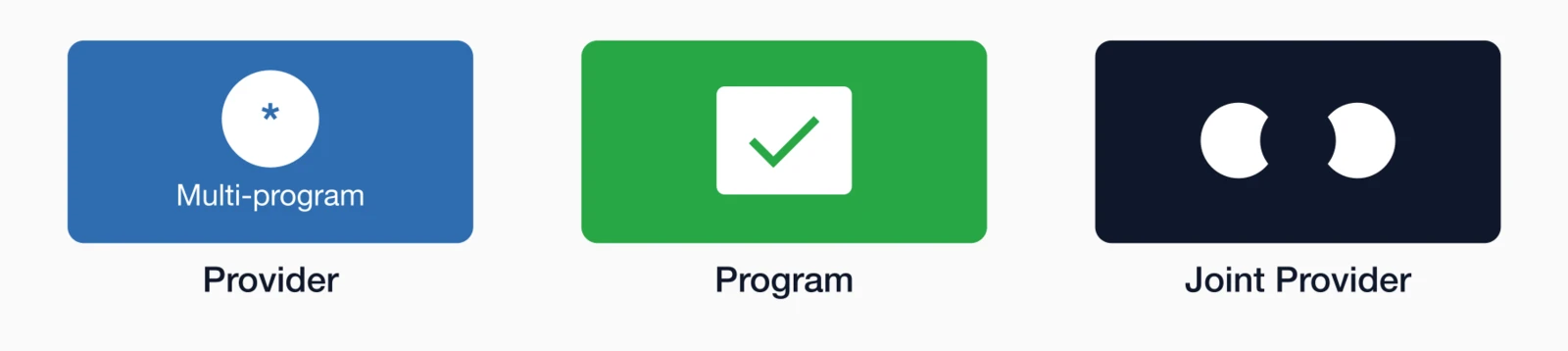
Types of accreditation
- Provider accreditation: Approval for your organization to offer CE across multiple programs
- Program accreditation: Approval granted on a course-by-course basis
- Joint providership: Partnering with an accredited organization to co-offer CE
Common accreditation requirements
- Qualified planners: Education committees with relevant expertise
- Learning objectives: Clearly defined, measurable outcomes
- Content review: Peer-reviewed, evidence-based content
- Conflict of interest policies: Disclosure requirements for speakers and planners
- Evaluation mechanisms: Structured feedback processes
- Record-keeping systems: Secure documentation for attendance and completion
State-by-state considerations
CE approval often depends on state licensing boards. For multi-state associations:
- Apply where most members are licensed
- Track and maintain approval status by state
- Clearly communicate which states recognize each program
A deeper look: Navigating multi-state CE approvals
Licensing boards generally fall into three categories:
Reciprocity states automatically accept nationally accredited CE without additional state-level review. If you're accredited by the right national body, you're approved in these states automatically.
Pre-approval states require application and fees before courses are offered. This often involves processing times of several weeks and fees that can add up across multiple states.
Post-reporting states require reporting after completion rather than pre-approval. The state verifies that education meets their standards during the license renewal process.
To stay efficient, prioritize the states where your membership base is largest. Maintain a centralized log tracking approval numbers, renewal dates, and fees. Designate a CE compliance lead to oversee this process.
Important: It's fine to market a session as "pending approval," but never collect CE fees until formal confirmation is received.
Planning CE-eligible sessions
Well-designed CE sessions meet learning standards and keep attendees engaged.
Writing effective learning objectives
Use action verbs that define what participants will do after the session:
- Good: "Identify three risk factors for patient falls in acute care settings"
- Weak: "Understand patient safety"
- Good: "Apply the new regulatory framework to licensing decisions"
- Weak: "Learn about regulations"
Content standards
- Relevance: Directly applies to professional practice
- Evidence-based: Especially important in healthcare education
- Non-promotional: Keep content educational, not commercial
- Appropriate level: Align difficulty with the intended audience
Credit calculation
Common standards include:
- 1 CEU = 10 contact hours (IACET standard)
- 1 credit = 1 hour of instruction (common for CME, CLE)
- 50 minutes = 1 contact hour (accounts for breaks)
Check your specific accrediting body's requirements—getting this wrong creates compliance problems.
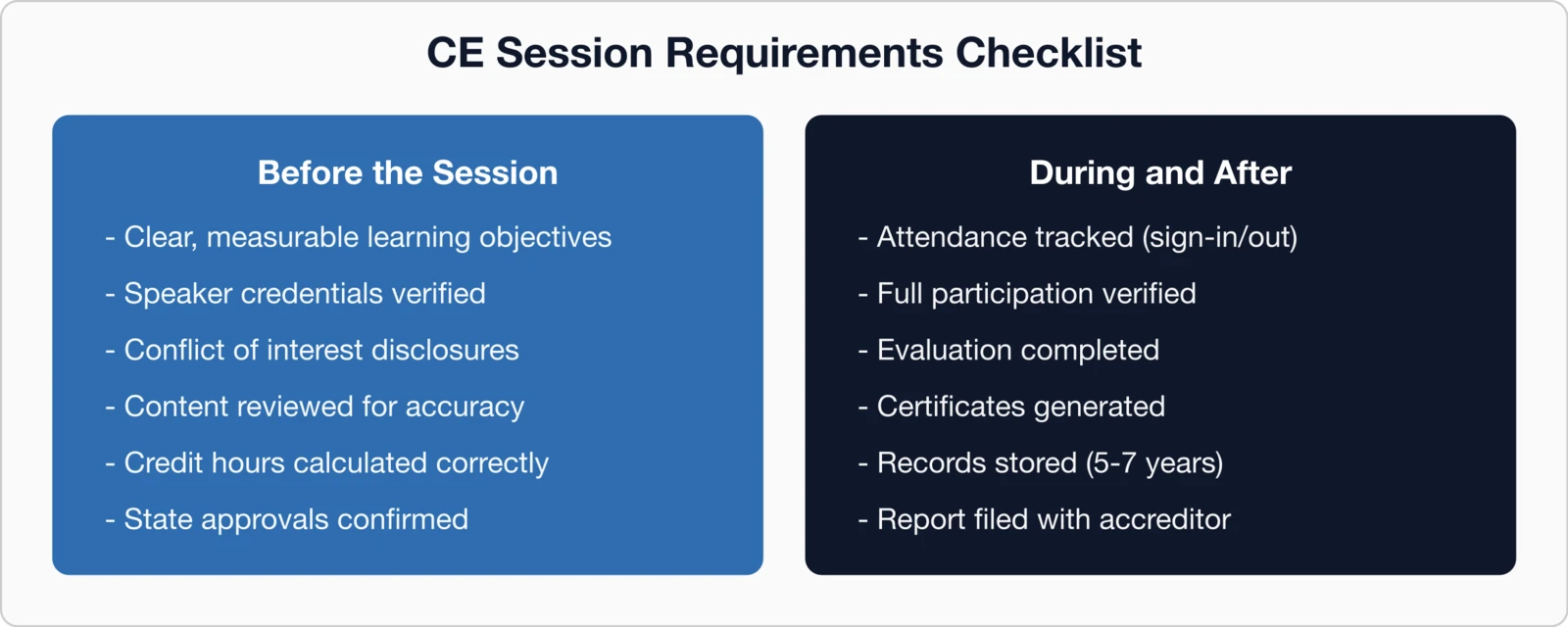
Attendance tracking
Accurate attendance data is essential for accreditation. Saying "they were at the conference" doesn't cut it—proof of session-level participation is required.

In-person tracking methods
- Sign-in/sign-out sheets: Simple but manual
- Badge scanning: Scan at entry and exit
- Session monitors: Staff for spot verification
- Mobile app check-ins: Attendees check in via app
Virtual event tracking
- Log-in duration: Track engagement metrics
- Attention checks: Polls or periodic questions
- Completion thresholds: Must watch majority of content
- Post-session quizzes: Verify learning
Minimum attendance requirements
Most accrediting bodies require full session participation, meaning:
- Arrival within a few minutes of start time
- No early departures
- Verified engagement throughout
A deeper look: Audit preparation
Imagine a member is audited and requests attendance verification from your event. If records are complete, your staff retrieves data instantly, issues certificates, and the member passes the audit stress-free.
If records are missing or disorganized, it becomes a scramble that risks both compliance and member trust.
To be audit-ready:
- Capture attendance in real time: Not reconstructed later
- Include clear identifiers: Member ID, license number, or email
- Store records securely: Accessible for years
- Enable instant retrieval: Staff can respond within minutes
Reliable CE tracking technology pays off the first time you face an audit.
Audit Protection: When a licensing board audits a member's CE records, they'll contact you for verification. Solid attendance tracking protects both you and your members.
Certificate generation
Today's members expect instant access to CE certificates. The process should take minutes, not days.

What certificates must include
- Participant name: Exact as licensed
- Program title and date(s): When education occurred
- Hours or credit earned: Number of CE hours/units
- Credit type: CEU, CME, CLE, etc.
- Provider information: Organization name and accreditation number
- Learning objectives: If required by accreditor
- Certificate ID: Unique number for verification
Delivery options
- Self-service downloads: Through member portals
- Automated email delivery: Post-session
- Bulk generation: For conferences
- Printed copies: For special awards
Member self-service features
Members should always be able to:
- View their full CE history
- Download or reprint certificates
- See credit progress by renewal cycle
- Track credits by topic or state
Reporting and record retention
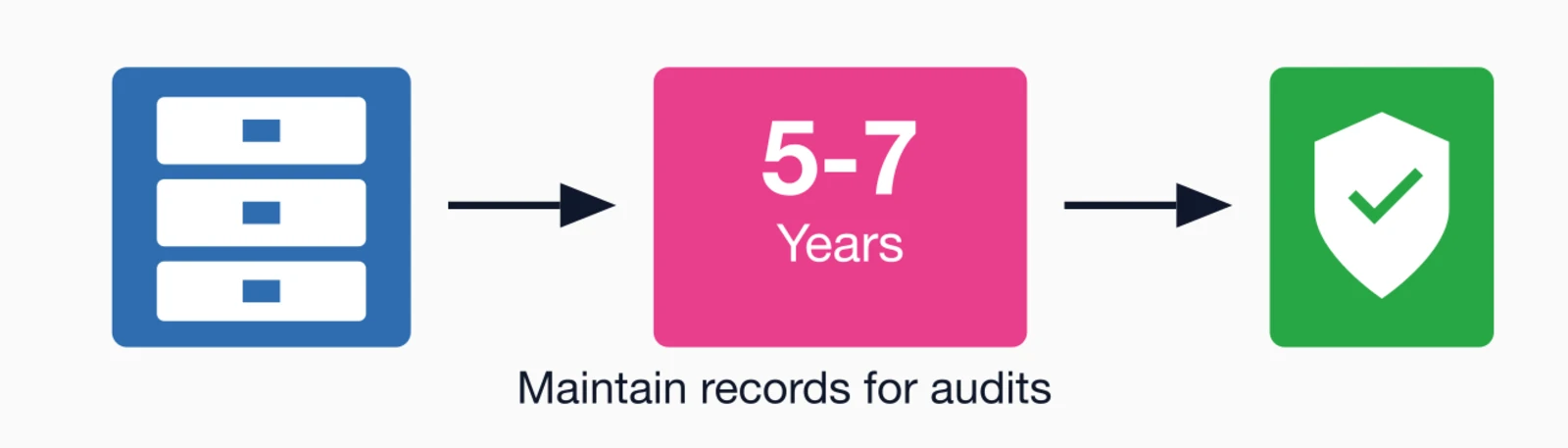
Each accrediting body has distinct reporting standards, but documentation is non-negotiable.
Common reporting requirements
- Annual summaries: Programs offered and participants
- Completion lists: Who earned credit for specific courses
- State-level reporting: Some states require direct submissions
- Audit documentation: Records to produce on request
Retention guidelines
Retain all CE-related records for several years (typically 5-7 years, though requirements vary), including:
- Course materials and learning objectives
- Speaker credentials and disclosures
- Attendance and evaluation forms
- Copies of certificates
- Accreditation correspondence
Technology solutions
Manual CE tracking—spreadsheets, sign-in sheets, paper files—doesn't scale. An integrated system saves staff time and ensures accuracy and compliance.

Essential capabilities
- Session-level attendance capture: Track who attended which sessions
- Automatic credit calculation: Apply attendance rules automatically
- On-demand certificate generation: Branded, compliant certificates
- Individual member transcripts: Cumulative education records
- Reporting dashboards: For accreditors
- Integration with registration: Connect CE to event sign-ups
Advanced options
- Multiple CE types: Manage CME, CLE, CEU simultaneously
- State-specific approval tracking: Track which states recognize each program
- Renewal progress dashboards: Show members progress toward requirements
- Post-session assessment integration: Require passing score for credit
- On-demand learning support: CE for recorded content with completion tracking
i4a's event management system allows CE credits to be assigned per session in the event registration form and automatically added to each member's record in the member portal
CE management best practices
Smart associations treat CE like any other mission-critical process: plan, track, verify, and document.

Before the event
- Apply early for accreditation: Some accreditors take weeks to process
- Communicate CE options in marketing: Specify which sessions offer credit and which states are approved
- Collect license details at registration: Get data needed for certificates upfront
- Train staff and session monitors: Ensure everyone understands CE tracking procedures
During the event
- Remind participants of attendance rules: Announce sign-in and stay-for-full-session requirements
- Use reliable tracking technology: Badge scans beat paper sheets
- Require evaluations: Before awarding credit
After the event
- Issue certificates promptly: Members expect access within a day or two
- Store records securely: Organize for easy retrieval
- File accreditor reports on schedule: Don't miss deadlines
Ongoing
- Maintain renewals and compliance: Keep accreditation current
- Audit internal records annually: Verify documentation is complete
- Gather member feedback: Improve CE offerings based on input
Making CE a competitive advantage
Continuing education is more than a requirement—it's one of your strongest membership drivers. When managed well, it adds tangible, measurable value to your events and fosters loyalty.
Streamlined CE processes—easy registration, accurate tracking, instant certificates, and transparent records—demonstrate professionalism and respect for your members' time.
Investing in a reliable, integrated CE tracking system isn't just operationally smart—it's strategically essential.
Explore more practical insights in our Association Event Management Guide
Key takeaways
- Accreditation is foundational: Get approved before promising CE credits
- Track attendance rigorously: Licensing boards audit—you need proof of full session attendance
- Automate certificate generation: Members expect instant access, not weeks of waiting
- Maintain records for years: Retain documentation according to your accreditor's requirements
- Integrate with member records: CE history should be visible in member profiles for easy verification
Simplify Your CE Tracking
i4a's event management includes built-in CE tracking, automatic certificate generation, and member CE transcripts—all integrated with your membership database.
Ask About CE FeaturesRelated resources
Association Event Management Guide
Comprehensive guide covering registration, pricing, and event execution.
See how i4a handles events, CE tracking, and member education records.
12-month checklist for successful association conferences.
Event Registration Best Practices
Optimize registration to boost attendance and reduce friction.
