Quick Summary: AMS Support Quality
- Support determines success: Poor support costs time, money, and momentum—especially during renewals and major events.
- Resolution time matters most: Fast ticket acknowledgment means nothing if problems take days to actually fix.
- Test before buying: Submit real support tickets during trials and ask current customers about their experiences.
- Seek partnership over transactions: Consistent team members who know your account outperform rotating call center staff.
Part of our membership software guide
When evaluating membership management software, it's easy to focus on feature checklists, pricing comparisons, and polished demos. But there's one critical factor that often gets overlooked until it's too late—the quality of customer support.
No matter how sleek a platform looks, you will need help at some point. Implementation questions will arise. Technical hiccups will happen. New staff will need training. And when your annual conference is two days away and something breaks, the difference between a quick resolution and long downtime can make or break your event.
After nearly 30 years of working with associations, I've seen this pattern countless times: organizations spend months evaluating features and pricing, then discover too late that their vendor treats support as an afterthought. The "24/7 support" promised on a sales page doesn't always translate to real help when you need it most.
Why support quality really matters
Research on customer service quality and long-term business performance
Your membership management platform isn't just software—it's the engine behind every key operation. It manages member data, processes payments, powers communications, and supports events
The true cost of poor support
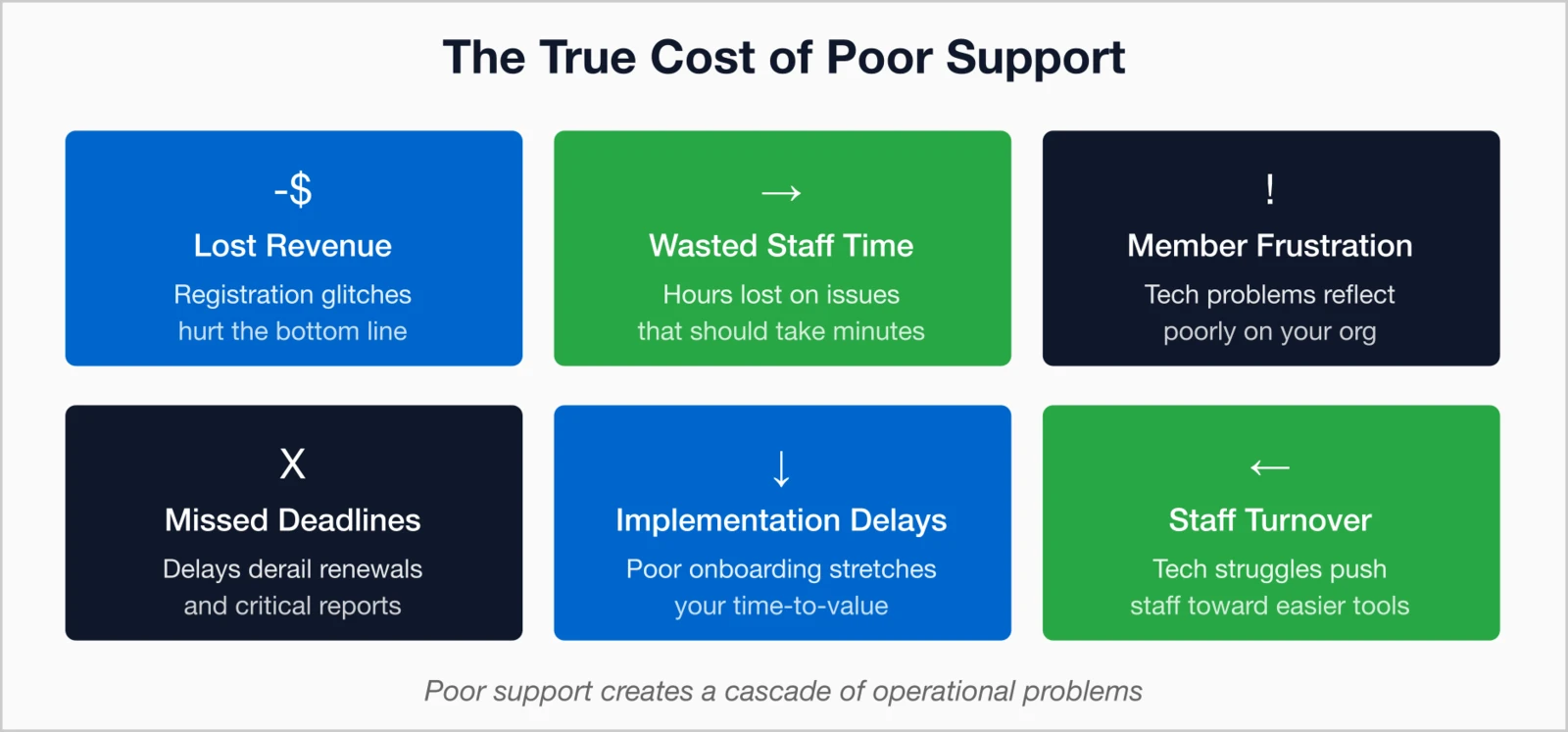
Bad support doesn't just frustrate staff—it undermines your entire operation.
- Lost revenue. Registration glitches during event launches hurt the bottom line.
- Wasted staff time. Hours lost troubleshooting issues that should take minutes.
- Member frustration. When tech problems reach members, they reflect poorly on your organization.
- Missed deadlines. Delayed assistance can derail renewals or critical reports.
- Implementation delays. Poor onboarding stretches your time-to-value.
- Staff turnover. Constant tech struggles push team members toward easier tools.
When you'll need support most
Understanding when support matters most helps you evaluate if a vendor can truly deliver when it counts. These are your pressure points—the moments you cannot afford to wait.
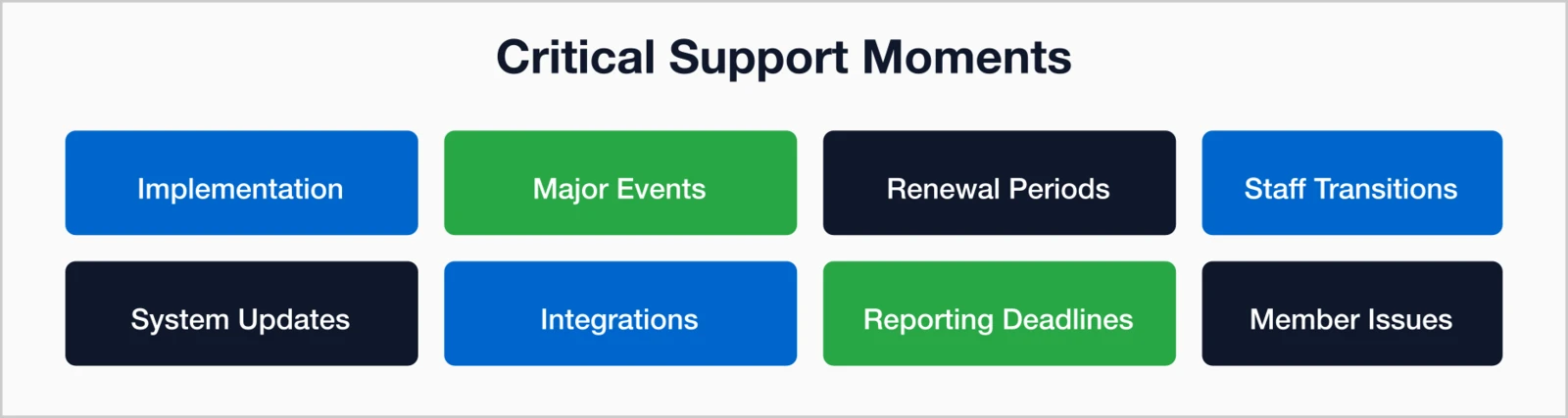
Critical support moments
- Initial implementation. Data migration, settings configuration, and staff onboarding.
- Major events. Annual conferences, exams, or fundraising campaigns.
- Renewal periods. Payment processing and auto-renewal troubleshooting.
- Staff transitions. Training new team members quickly.
- System updates. Adapting to new features or configurations.
- Integrations. Syncing your AMS with email or accounting tools.
- Reporting deadlines. Delivering board or compliance data under tight timelines.
- Member service issues. Resolving login or access problems fast.
Many of these are time-sensitive situations—you can't wait 48 hours for someone to reply when your conference opens tomorrow.
In my experience, associations that thrive with their software aren't necessarily using the platform with the longest feature list. They're working with vendors who understand that a renewal deadline or event launch waits for no one—and who staff their support teams accordingly.
What to evaluate when assessing support quality
Not all "support" means the same thing. Understanding the real difference between marketing promises and on-the-ground help is essential.
Response time vs. resolution time
Vendors love to highlight fast response times. But an automated "We've received your ticket" is meaningless if your issue stays unresolved for days. What really matters is how quickly your problem gets fixed.
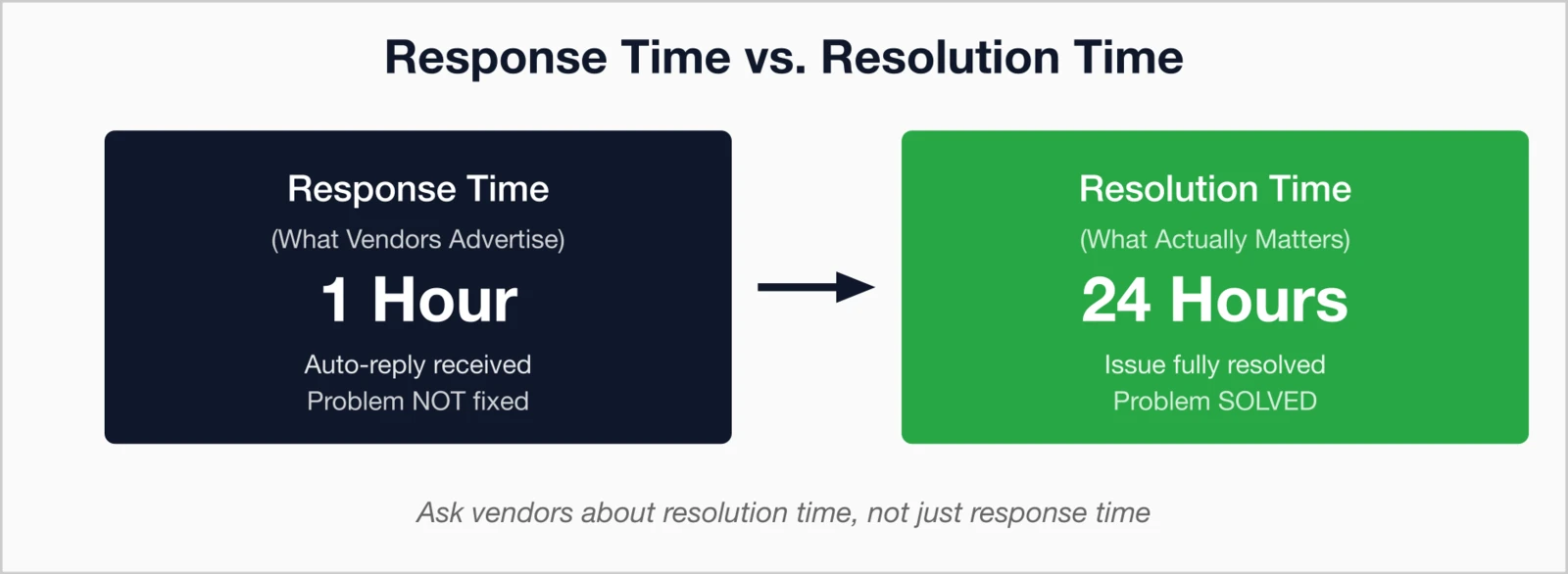
Ask vendors:
- What's your average time to resolve typical issues?
- What percentage of tickets are resolved within 24 hours?
- How are urgent issues prioritized?
Who actually provides support
The expertise behind your support team directly affects your outcomes.
- Tier 1 agents. Basic, scripted help—common at large vendors.
- Product specialists. Knowledgeable staff who know your system inside-out.
- Developers or technical staff. Can diagnose and fix complex issues.
- Outsourced centers. Third-party contractors with limited product insight.
- In-house team. Long-term employees invested in your success.
Pro Tip: Ask to meet the actual support team during evaluation. If the sales rep says that's not possible—that's telling.
Support availability
"24/7 support" can vary widely. Clarify what it actually means.
- Are business hours aligned with yours?
- Do they offer weekend or evening assistance for events?
- Is overnight coverage handled in-house or outsourced?
- Can you escalate emergencies quickly?
Support channels
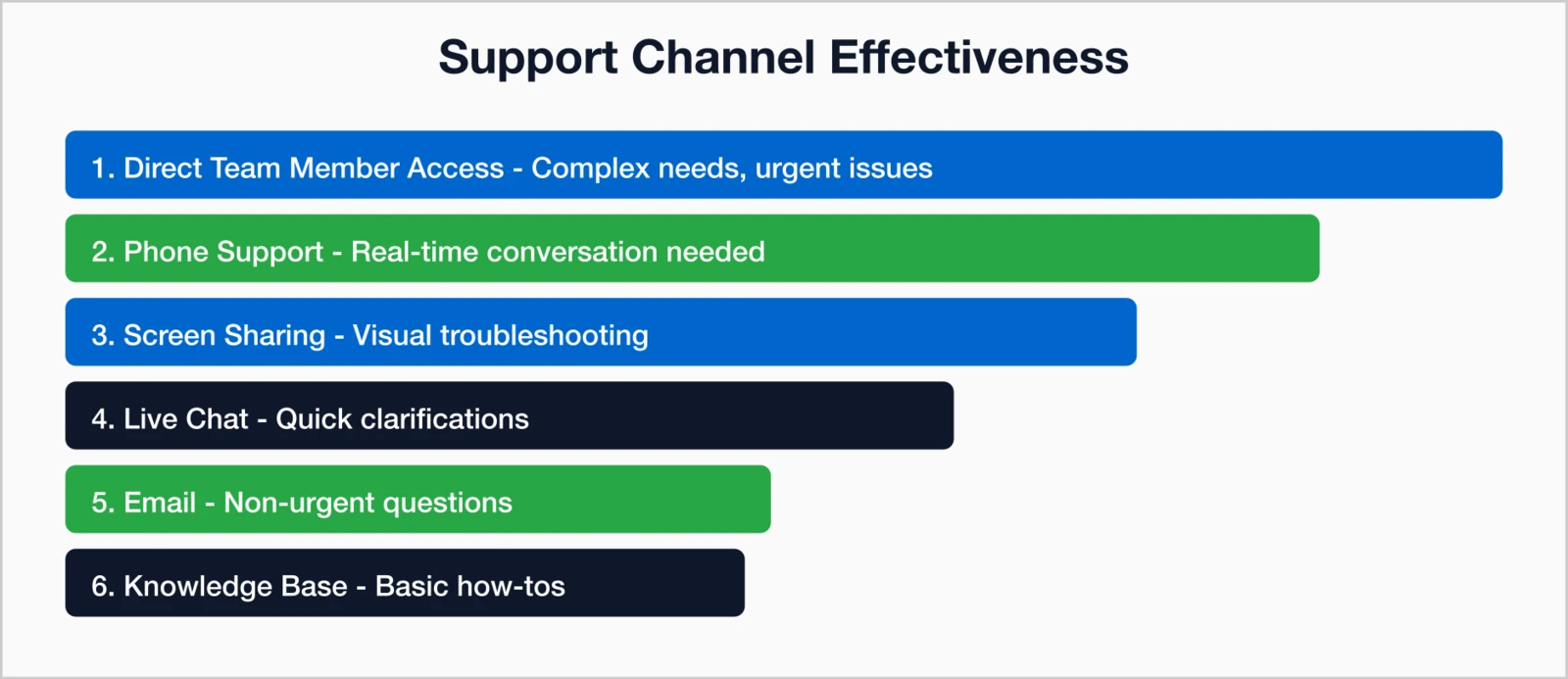
Different needs call for different channels. A well-rounded mix ensures flexibility.
- Direct access to team members. Best for ongoing or complex needs.
- Phone support. Vital when you need real-time discussion.
- Screen sharing. Crucial for visual troubleshooting.
- Live chat. Handy for quick clarifications.
- Email support. Effective for non-urgent, documented questions.
- Knowledge base. Self-service for simple how-tos.
Red flags to watch for
Poor support often announces itself early—if you know what to look for.
During the sales process
- Vague promises about "great support."
- No mention of support unless you ask.
- Can't meet the support team.
- Basic support not included.
- No current client references.
- High customer churn.
From customer references
Listen for phrases like:
- "Support is hit or miss."
- "It takes forever to get help."
- "We had to figure things out ourselves."
- "Sales was responsive—but support is different."
Online signs
- Negative reviews about support on Capterra or G2.
- Inactive community forums.
- Outdated knowledge base.
- Complaints about outsourced support.
How to test support quality before you buy
Don't wait until after signing a contract to learn what "support" really means.
During your trial
- Submit a real support ticket—see how fast and helpful responses are.
- Send at least one complex question.
- Test every available channel (chat, email, phone).
- Try after-hours or weekend contact.
- See how consistent answers are across different staff.
Talk to current clients
Ask for references from similar organizations and inquire:
- How responsive is support day-to-day?
- What happens during urgent situations?
- Do you get consistent team members?
- How proactive is the support team?
- Has support improved or declined over time?
Pro Tip: If a vendor won't share customer references, walk away.
Key questions to ask vendors
Use these during demos or RFP evaluations:
- "Walk me through what happens when a support request is made."
- "Who actually provides support—staff or contractors?"
- "How do you define and measure resolution time?"
- "Do you offer after-hours or event-period help?"
- "Is support included or billed separately?"
- "Can I speak directly to technical staff if needed?"
- "Can I meet the team who would support us?"
Partnership vs. vendor: What makes the difference
The best providers don't see support as a cost center—they see it as a partnership.
What a true partnership looks like
- They know your organization and history.
- The same team assists you consistently.
- They proactively share guidance and best practices.
- They respond faster during critical periods.
- Your feedback genuinely shapes product updates.
- They're invested in your long-term success.
Vendor relationships vs. partnership
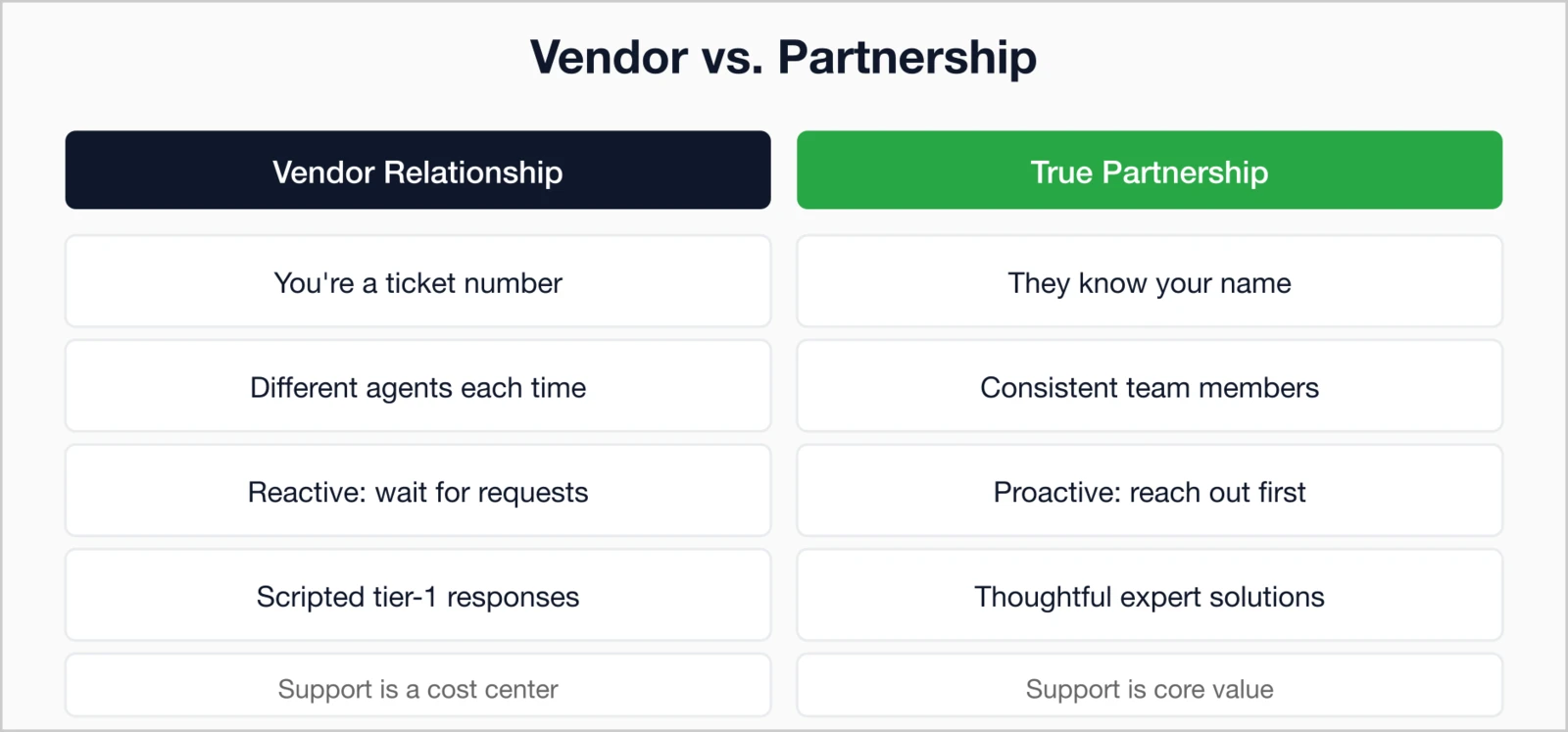
Real Difference: With a vendor, you file a ticket and wait. With a partner, you call someone who understands your system—and cares about helping you succeed.
The bottom line
When choosing association management software, features and pricing matter—but support quality determines your success. Test it. Ask the hard questions. Talk to references. Make sure support isn't an afterthought.
The software decision you're making today will shape your operations for years to come. The right platform paired with responsive, knowledgeable support becomes a force multiplier for your team. The wrong match—even with impressive features—becomes a daily source of friction.
Your association deserves more than a queue number. Choose a partner who knows your name, understands your goals, and stands with you when it matters most. Because the best platform isn't just the one rich in features—it's the one backed by a team that ensures you can use them confidently.
How i4a delivers partnership-quality support
At i4a, we've been serving membership organizations
- Dedicated experts. You work with the same team who knows your account.
- Direct access to our developers. No outsourced call centers.
- Rapid response. Most issues resolved the same day.
- Proactive partnership. We invest in your success, not just your subscription.
- Client-driven roadmap. Your feedback shapes our product evolution.
See what partnership-style support feels like—reach out
Key takeaways
- Support affects everything. Poor support costs time, money, and momentum—especially around renewals or events.
- Resolution time matters. Don't be fooled by response speed; ask about real outcomes.
- Test support early. Experiment during trials and talk to current customers.
- Look for partnership, not transactions. Consistency, context, and care make all the difference.
Experience Partnership-Quality Support
i4a delivers direct access to experienced team members who know your account, rapid response times, and personal investment in your success. Talk with actual team members who would be supporting you.
Talk to Our Support TeamRelated resources
10 Questions to Ask During a Software Demo
Make the most of your software demo by asking these essential questions.
What Features to Look for in Membership Software
Essential features every association management system should have.
Support quality matters most during migration.
10 Questions to Ask During a Demo
Ask the right questions to evaluate support quality.
