Quick Summary: E-Commerce Integration
- Fragmentation multiplies costs: Multiple payment systems mean duplicate vendor fees, manual reconciliation, and inconsistent member experiences.
- Integration connects everything: Each transaction automatically updates member profiles, accounting systems, and analytics dashboards.
- Single sign-on reduces friction: One login and saved payment method for dues, events, store purchases, and donations.
- Unified reporting reveals lifetime value: See total member contribution across all revenue streams in one dashboard.
- Security improves with centralization: One PCI-compliant system is easier to secure than multiple disconnected tools.
Part of our non-dues revenue guide
Your members pay you in countless ways—renewals, event registrations, store purchases, certifications, sponsorships, and donations. Every one of those transactions is a chance to deliver a smooth, satisfying experience—or introduce unnecessary friction.
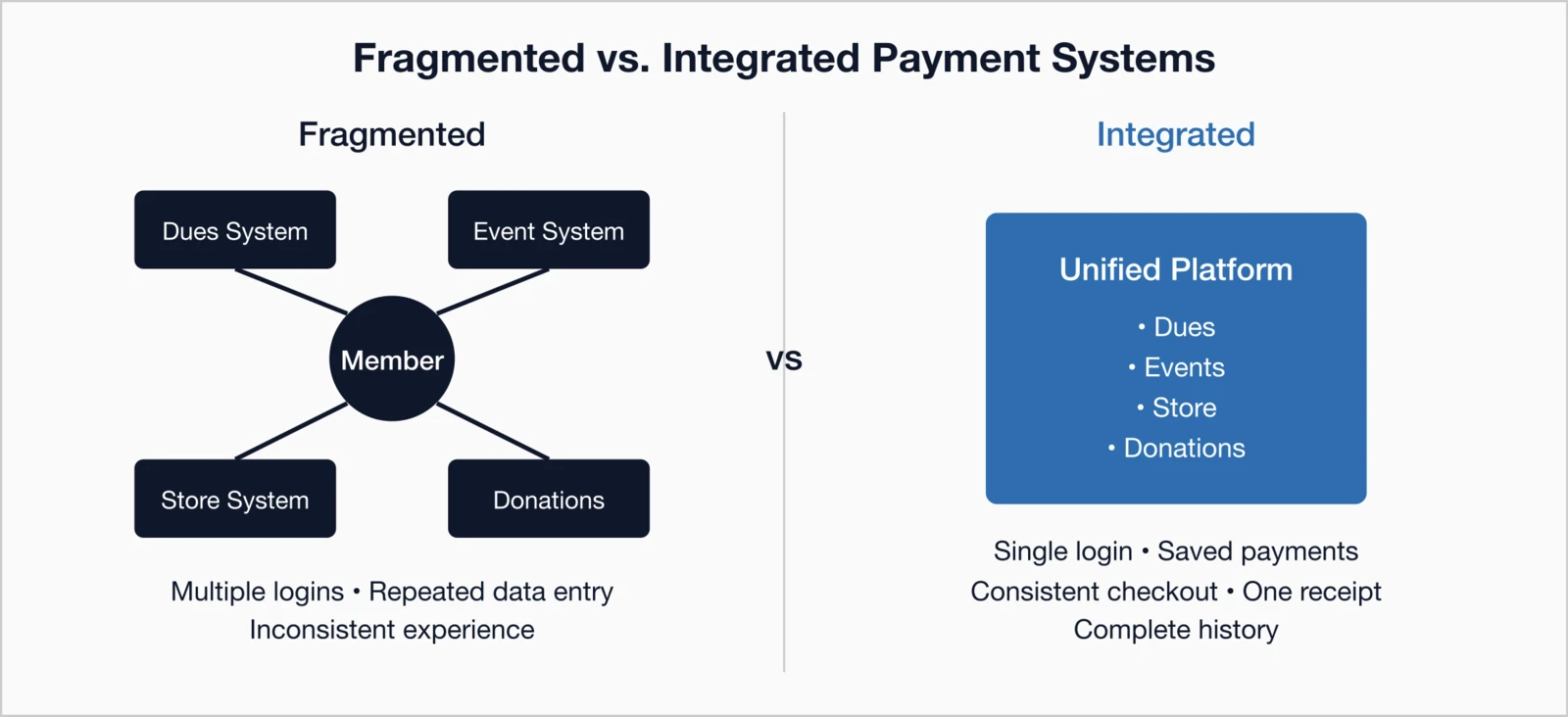
When your payment systems don't connect, things get messy fast. Members re-enter payment details, manage multiple logins, and receive inconsistent receipts. Internally, staff battle reconciliation headaches and broken integrations. According to Sequence Consulting's 2026 Association Trends Report, 70% of associations struggle to connect their engagement and transaction tools—leading to member frustration and operational inefficiency.
After nearly three decades advising associations, I've seen too many organizations patch together payment systems one need at a time—each solving an immediate pain point while creating bigger problems later. Integrated e-commerce fixes this. It's not just about collecting payments; it's about connecting every part of your membership experience. When done right, it delivers seamless transactions, stronger insights, and streamlined operations.
The hidden cost of fragmented payment systems
Over time, many associations piece together multiple payment tools to meet specific needs. The result? A complex web that multiplies costs and erodes efficiency. With 63% of associations expecting non-dues revenue growth and 52% citing limited staff capacity as their top barrier, according to Sequence Consulting, fragmentation is a growing liability.
Operational costs
- Multiple vendor fees. Each platform adds its own subscriptions and transaction costs.
- Manual reconciliation. Staff spend hours matching and verifying records.
- Duplicate data entry. Systems require constant updates across platforms.
- Integration maintenance. Custom bridges break frequently, demanding IT fixes.
- Training overload. Teams juggle multiple logins, systems, and processes.
Member experience costs
- Login fatigue. Separate credentials for every purchase.
- Repetitive entry. Members retype payment data over and over.
- Inconsistent checkout. Each tool feels different—and confusing.
- Receipt clutter. Disjointed systems send multiple confirmation emails.
- Incomplete history. No single view of total engagement or spending.
What integrated e-commerce really means
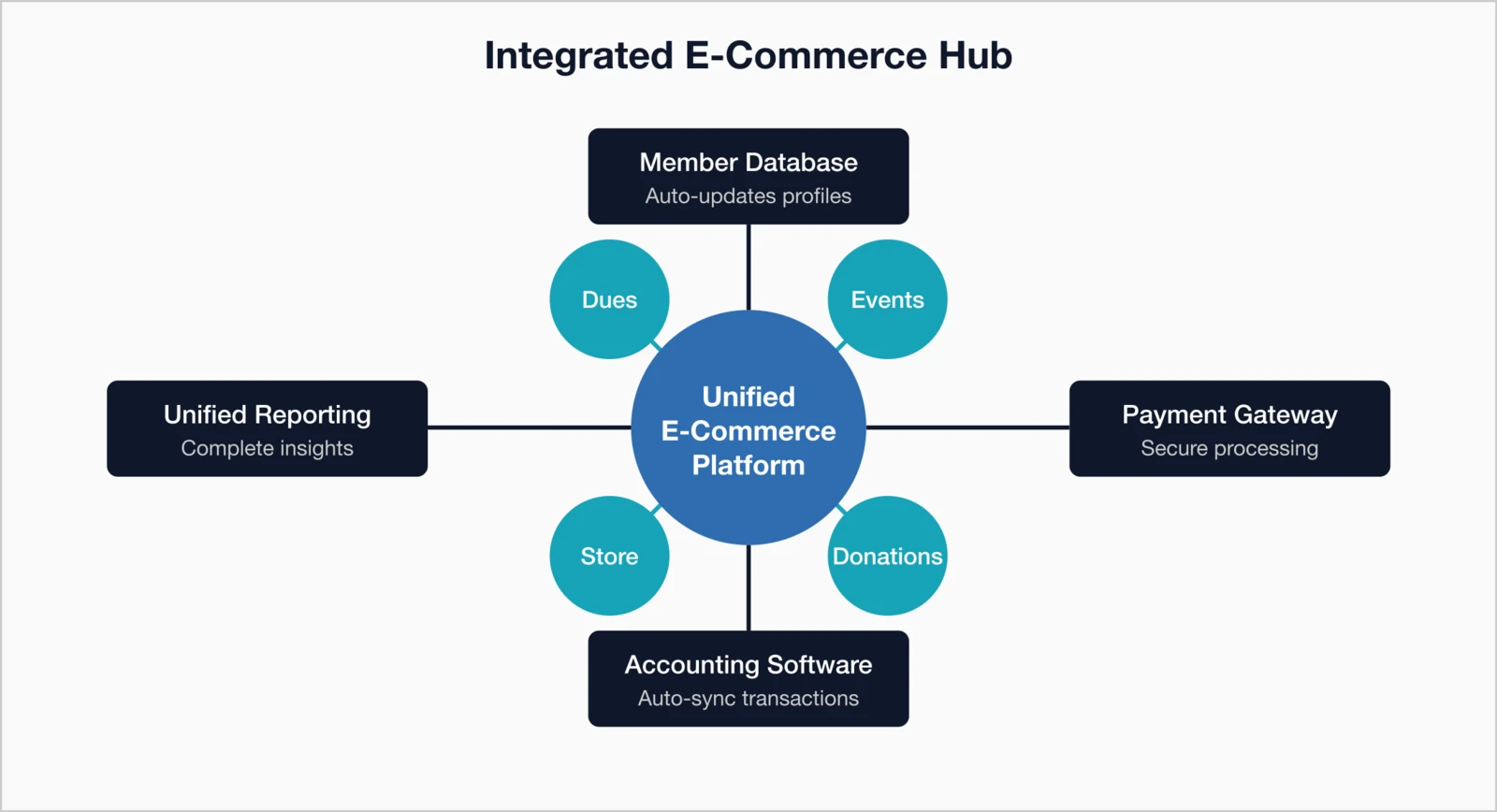
True integration goes far beyond a shared shopping cart. It connects every transaction directly to your member database, accounting system, and reporting tools—automatically and in real time.
Key integration points
- Member database sync. Transactions instantly update profiles.
- Single sign-on (SSO). One login unlocks every purchase option.
- Unified payment processing. One gateway, one account, one saved card.
- Accounting integration. Payments auto-code and reconcile in your books.
- Consolidated reporting. All revenue—dues, events, store, donations—in one dashboard.
Pro Tip: Ask your vendor to simulate a complete member journey—from renewal to event registration to store purchase. Count how many times credentials or payment details are re-entered, and check whether staff can instantly view the member's full activity history.
Membership dues: The foundation transaction
Membership renewal is your most predictable revenue—and the easiest to automate. The right membership management system eliminates friction while keeping data synced across systems.
Essential features
- Flexible payment options. Credit card, ACH, check, or invoice.
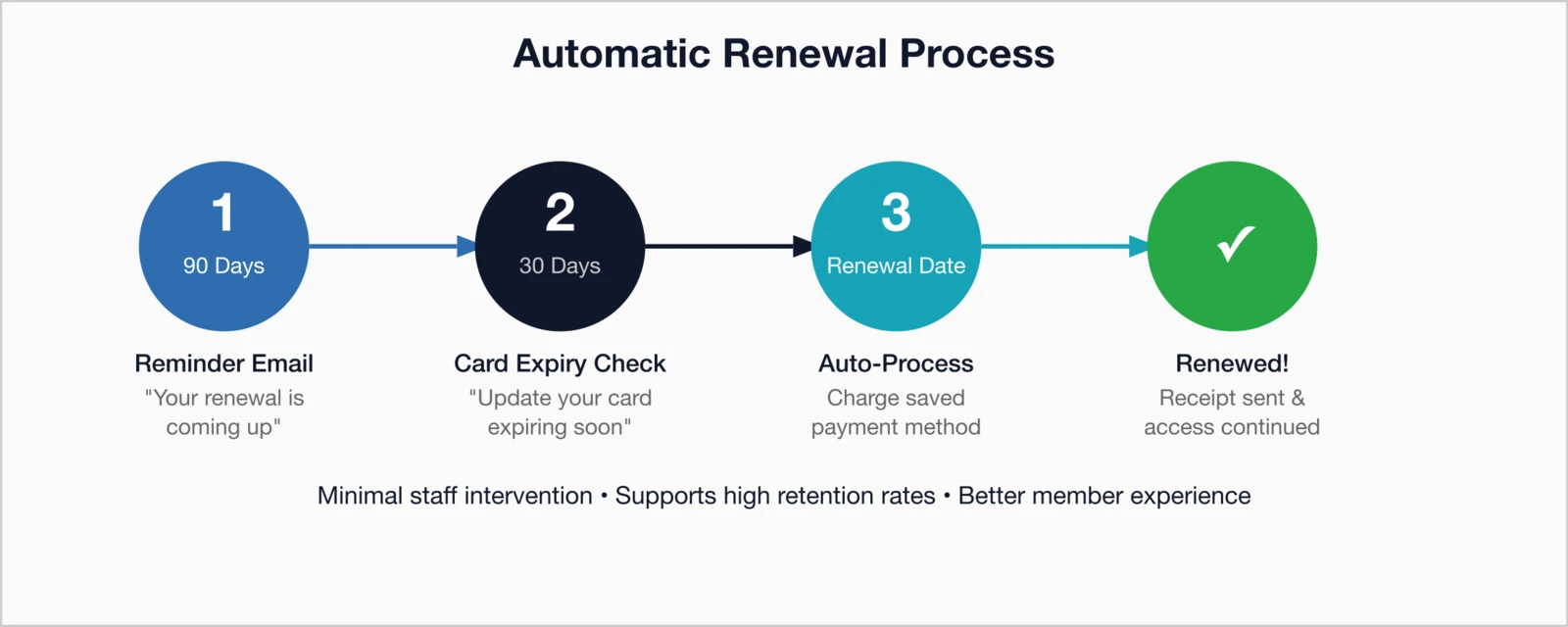
- Auto-renewal. Saved cards make renewals effortless.
- Automated reminders. Built-in "renewal coming soon" and "card expiring" prompts.
- Self-service updates. Members can switch levels or methods anytime.
- Proration tools. Automatic mid-cycle pricing adjustments.
- Tax handling. Exempt status remembered and applied automatically.
This automation saves staff time, reduces errors, and creates a smooth renewal flow from start to finish.
Event registration: Simplify complex transactions
Event registration is often the most intricate payment process—tiered pricing, group rates, discounts, and extras. A well-integrated event management system handles that complexity automatically.
Integrated event features
- Automatic member pricing. Member rates apply instantly at login.
- Dynamic pricing. Early-bird and regular tiers switch on schedule.
- Group registration. One checkout covers multiple attendees.
- Add-on options. Include workshops or guest tickets in a single flow.
- Payment plans. Support deposits and installment billing.
- Refund automation. Cancellations and waitlists sync smoothly.
Example Scenario: A medical association with 2,000 annual conference attendees verifies membership manually to apply discounts—leading to errors, refunds, and reconciliation delays. With integrated event registration, member pricing applies automatically and reconciliations align perfectly with accounting.
Online store: Make shopping effortless
Your online store is a natural extension of your member experience—whether you sell publications, swag, or continuing education materials. Integration ensures every sale connects directly to the member record.
Store integration benefits
- Member-only access. Control eligibility and automatic discounts.
- Tiered pricing. Adjust rates by membership level—no manual codes.
- Instant delivery. Digital products appear immediately in the portal.
- Inventory sync. Real-time stock tracking.
- Comprehensive purchase history. All orders visible in one view.
- Simplified bulk orders. Generate quotes or invoices automatically.
Pro Tip: Use bundles like "Conference Registration + Study Materials." Integrated systems handle pricing and fulfillment automatically.
Donations and fundraising: Build giving into every transaction
Donations shouldn't live in isolation. Integrated e-commerce turns giving into a natural part of the member journey—especially when people are already in "transaction mode."
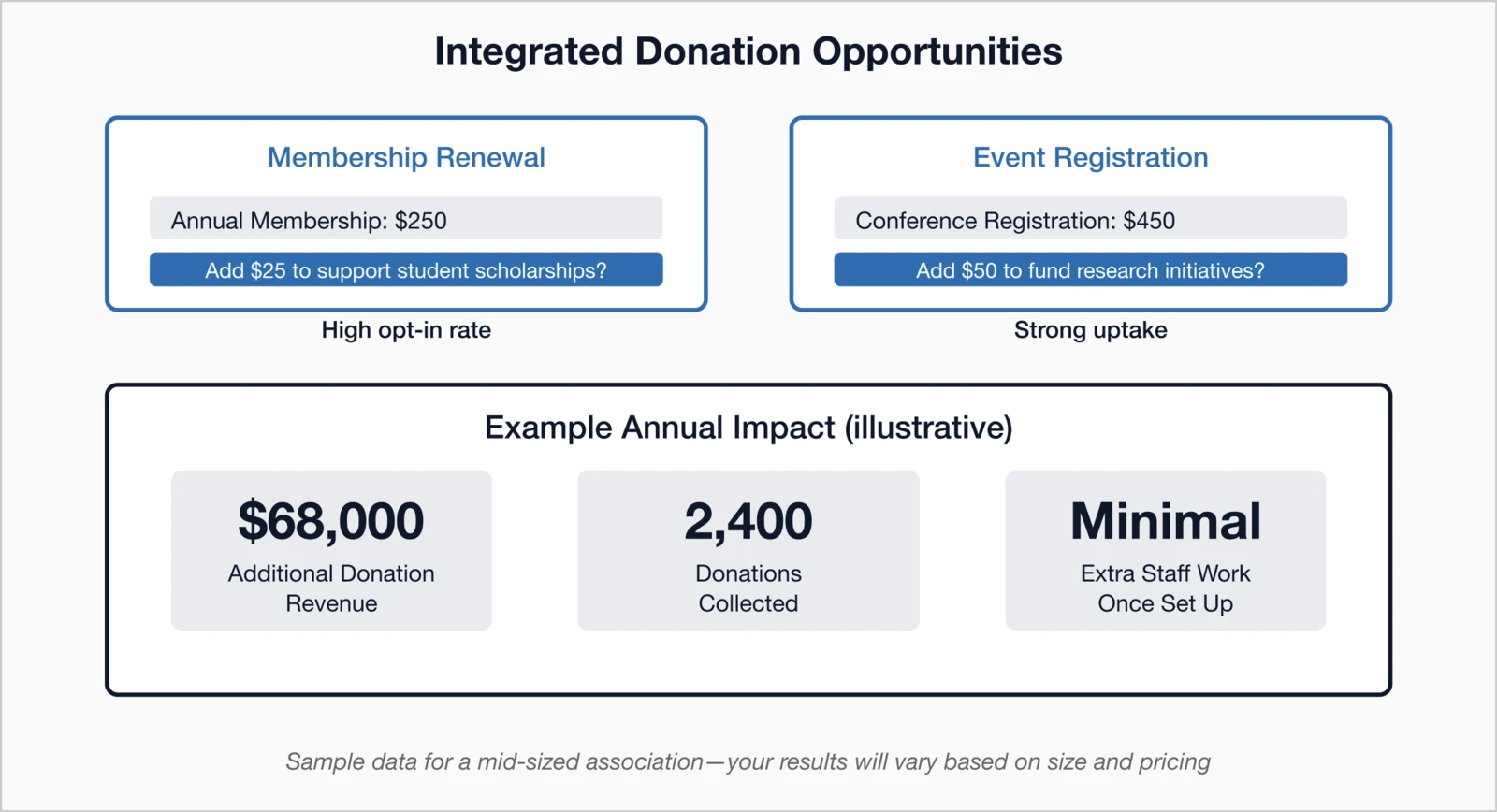
A simple prompt such as "Add $25 to support student scholarships?" at renewal or checkout often outperforms standalone appeals. You're not interrupting their day—just adding a meaningful option at the right moment.
What to look for in fundraising integration
- Add-on donations. One-click giving during renewals or registrations.
- Targeted appeals. Personalize asks using engagement data.
- Recurring giving. Use saved cards for monthly donations.
- Tribute gifts. Automated acknowledgment messaging.
- Instant tax receipts. Compliant summaries sent automatically.
- Campaign tracking. Measure performance by appeal or designation.
i4a Note: i4a currently supports accepting donations through event registration forms, membership applications, and custom forms with open-amount fields. A dedicated donations and fundraising module is coming soon.
The power of unified financial reporting
When every transaction connects through one system, your reporting transforms from accounting to insight. Integrated reporting tools show the true value of each member and program.
Reporting capabilities
- Lifetime value tracking. Understand total member contribution.
- Revenue by source. Compare dues and non-dues streams.
- Engagement insights. Correlate activity with retention.
- Forecasting tools. Build data-driven budgets.
- Budget tracking. Monitor real-time variances.
- Payment analysis. Identify method preferences and costs.
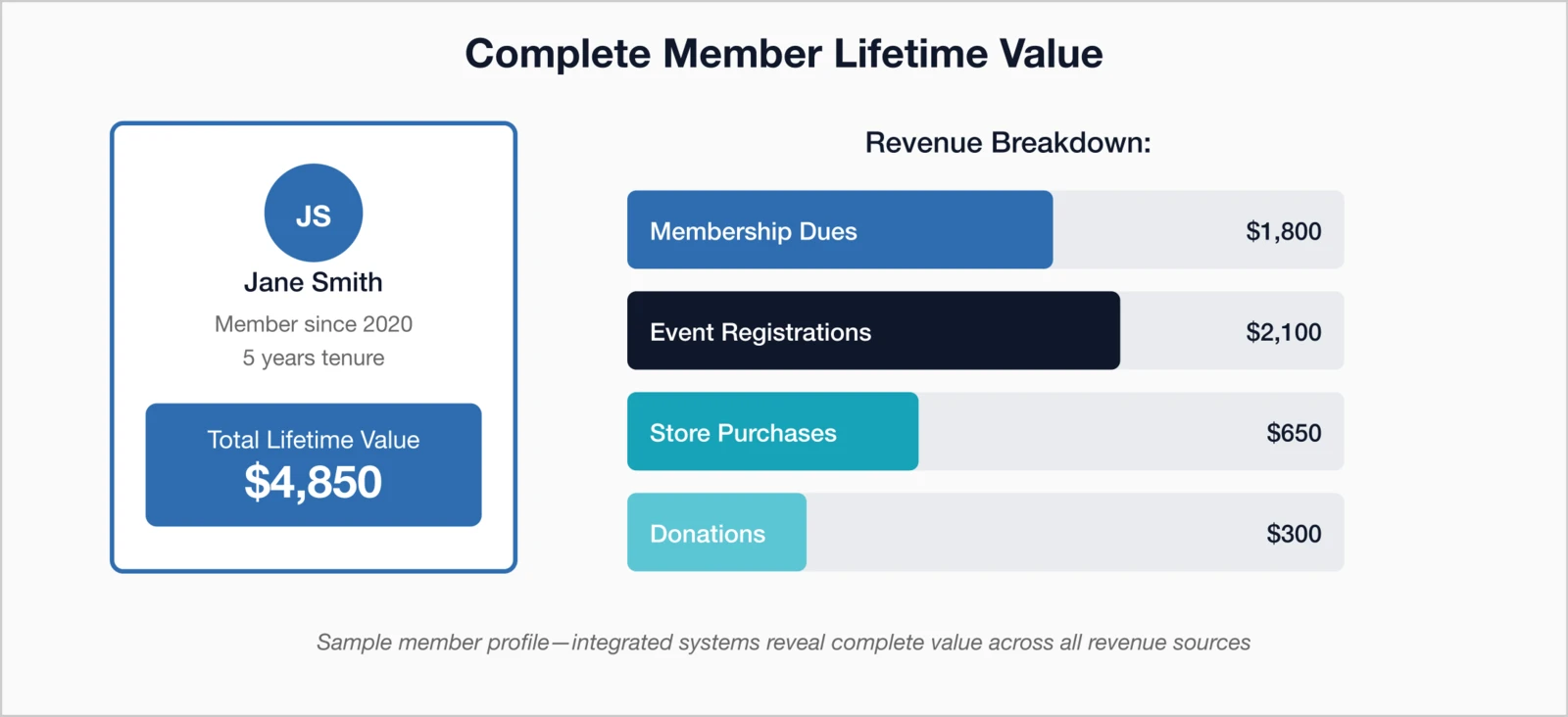
Example uses sample data to show how lifetime value can be broken down by revenue source.
Example Scenario: An education association discovers through reporting that event participants renew at significantly higher rates. Staff can use that insight to design campaigns that grow both event attendance and membership retention.
Security and compliance: One system, strong protection
Centralizing payments doesn't just simplify operations—it dramatically enhances security. One payment hub means consistent standards and reduced compliance risk.
Security benefits
- Simplified PCI compliance. Tokenized payments reduce audit scope.
- Fraud detection. System-wide pattern recognition.
- Secure vaults. Store cards safely for future use.
- Audit-ready logs. Unified transaction histories.
- Faster chargeback resolution. Complete verification trails.
- Data privacy. Easier GDPR and CCPA adherence.
Pro Tip: Confirm your vendor supports PCI Level 1 compliance, tokenization, and secure data exports—so your information stays protected, even if you change systems.
Making integration work for you
Transitioning to an integrated platform doesn't have to be complicated. Modern association management systems make migration achievable without disrupting operations.
What to look for
- Native e-commerce (not bolt-on modules)
- Single sign-on across all purchase types
- Real-time member record updates
- Unified reporting across all revenue streams
- Flexible payment method support
- PCI Level 1 compliance
- Accounting system connections
- Mobile-optimized checkout
Integrated e-commerce ties every financial touchpoint together—simplifying operations and enhancing member experience. Associations that thrive aren't necessarily the ones with the biggest budgets—they're the ones that remove friction wherever members engage.
Assess Your Payment Ecosystem
A quick internal audit can reveal your best opportunities for improvement:
- List every system currently processing payments
- Total monthly subscription and transaction costs
- Estimate staff hours spent on reconciliation
- Ask five members about their payment experience
You may be surprised how much inefficiency—and value—an integrated system can uncover.
Key takeaways
- Fragmentation doubles your costs. Disconnected tools waste staff time and frustrate members.
- Integration connects everything. Each transaction automatically updates records, books, and analytics.
- Convenience drives growth. Seamless checkouts and saved payments increase renewals and conversions.
- Visibility fuels strategy. Unified data reveals trends that drive smarter decisions.
Unify Your Payment Processing
i4a's integrated e-commerce handles dues, events, store, and donations in one platform with unified reporting, saved payment methods, and seamless member experience.
See E-Commerce FeaturesRelated resources
10 Non-Dues Revenue Ideas for Associations
Diversify revenue streams beyond membership dues.
How to Reduce Membership Churn
Keep members engaged and protect your revenue.
How to Automate Membership Processes
Save time and reduce errors by automating workflows.
Integrated event registration and payment processing.
