Quick Summary: Email Segmentation
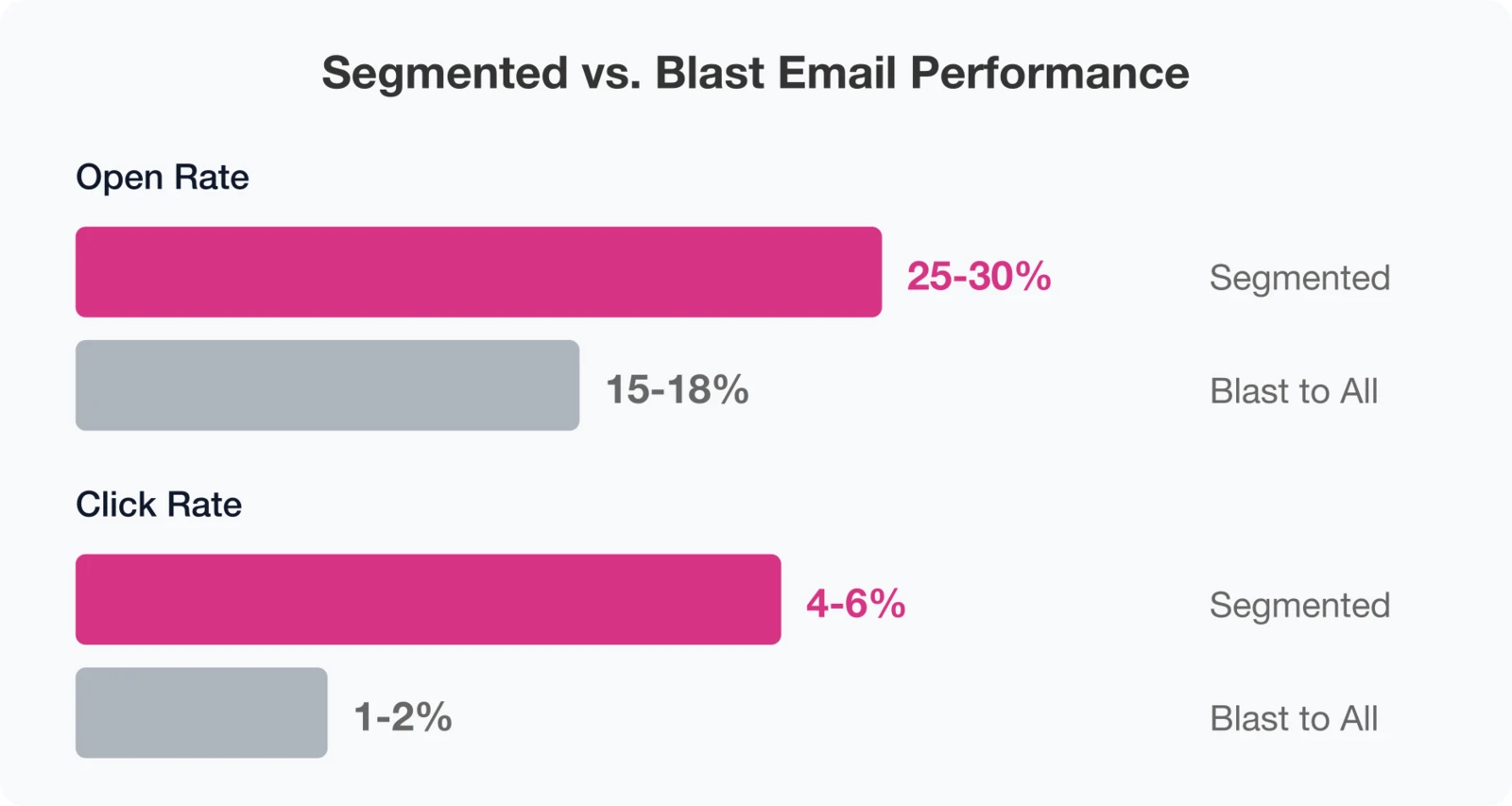
- Relevance drives results: Segmented emails achieve 20–30% higher open rates because members engage when content clearly applies to their situation.
- Start with membership status: New, active, expiring, grace, and lapsed members need different messages—this foundation eliminates confused renewers getting reminders.
- Layer in engagement levels: Distinguish highly engaged members from inactive ones to adjust content, frequency, and offers appropriately.
- Behavioral triggers power automation: Event registrations, resource downloads, and email clicks trigger timely follow-ups that feel personal, not generic.
- Use auto-updating segments: Your AMS should maintain segments automatically—manual CSV exports introduce errors and create unnecessary work.
Part of our association email marketing resource
Email segmentation for associations means sending renewal reminders only to expiring members—not the ones who already renewed. This guide covers status, engagement, demographic, and behavioral segments that dramatically outperform "blast to all" emails.
Email segmentation solves a fundamental problem: it aligns each message with a member's real situation—whether that means welcoming a new join, nudging someone toward renewal, or re-engaging a lapsed member.
According to Sequence Consulting's 2026 Association Trends Report, half of associations still do not consistently tailor communications to different member segments—a gap that directly affects retention and long-term growth. After nearly 30 years working with associations, the standouts are not those sending the most email, but those sending the most relevant email. The difference between a 75% and 85% renewal rate often comes down to whether members feel like you are speaking to them specifically or broadcasting to everyone.
This guide walks through practical segmentation strategies—from basic membership status to advanced behavioral and lifecycle targeting—and how to put them into practice without living in spreadsheets.
Why segmentation matters
Segmentation works because relevance drives engagement. When members receive content that clearly applies to their goals, career stage, or relationship with your association, they pay attention and are more likely to act. When every message feels generic, they tune out—even if the information might technically be useful.
Industry benchmarking data shows more than half of members who do not renew point to weak engagement with the organization as a key factor, often because communications don't feel relevant to their needs or interests. That makes segmentation not just a marketing tactic, but a retention strategy.
The impact of segmentation
Associations that segment their emails see stronger performance across core metrics:
- Higher open rates because subject lines speak directly to each segment's interests
- Better click-through rates when content is tailored to what members actually need
- Increased revenue from campaigns that reach the right audience with the right offer
- Fewer unsubscribes because members see less irrelevant "noise" in their inbox
In many programs, segmented campaigns routinely outperform "blast to all" emails by 50–100% on engagement metrics, especially open and click rates. Those gains compound over time as members stay more responsive and email reputation improves.
What happens without segmentation
When every email goes to the full list, predictable problems show up:
- Members receive content that doesn't apply to them and stop opening emails altogether
- Renewal reminders go to members who already renewed, creating confusion and frustration
- Event invitations target members who already registered, wasting attention and goodwill
- New member onboarding content bores long-time members who have seen it all before
- Overall deliverability declines as disengaged recipients drag down sender reputation
The bottom line: unsegmented "blasts" make it harder for your most interested members to see the messages that matter.
Membership status segments
Membership status is the foundation of an effective segmentation strategy. Where a member is in their journey with you determines what they need to hear next—and what they definitely do not need to hear.
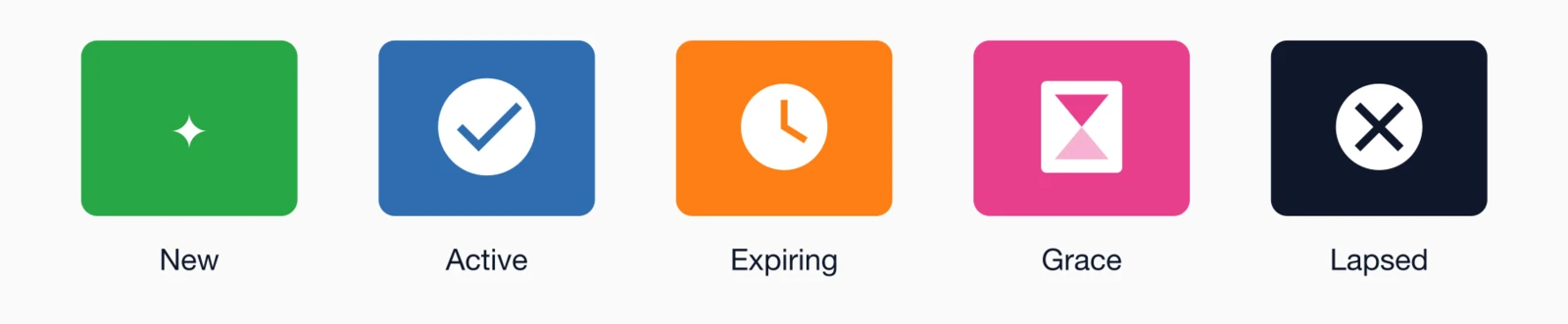
Think of status segments as the basic "storyline" for every contact in your database:
✦ New → Active → Expiring → Grace → Lapsed → (Non-member)
Essential status segments
These core segments support most of your high-value campaigns:
| Segment | Definition | What to Send |
|---|---|---|
| New Members | Joined within last 30-90 days | Welcome series, onboarding content, first event invites |
| Active Members | Current, not near expiration | Newsletters, event promotions, ongoing engagement opportunities |
| Expiring Soon | Renewal due in 30/60/90 days | Renewal reminders, value recaps, early-renewal incentives |
| Grace Period | Recently expired, still in grace | Urgent renewal messages, "don't lose benefits" content |
| Lapsed Members | Expired beyond grace period | Win-back campaigns, "we miss you" messages, special offers |
| Non-Members | Prospects in your database | Membership promotions, value propositions, trials or limited offers |
Each of these segments has a clear job: make sure members get the right message at the right point in their membership lifecycle, without manual list building for every send.
A deeper look: Time-based expiration segments
Instead of a single "expiring soon" bucket, break expiration into more precise time windows. This lets you adjust tone and urgency as the deadline approaches:
- 90 days out: Gentle reminder and value summary—"Your membership renews in three months"
- 60 days out: Early renewal benefits—"Renew now and save 10%"
- 30 days out: Standard renewal reminder—"Your membership expires next month"
- 14 days out: Stronger urgency—"Two weeks left to renew"
- 7 days out: Final reminder cadence—"Your membership expires in one week"
- Expiration day: Last-chance message—"Your membership expires today"
Modern membership management systems can calculate these segments automatically using renewal dates, so you configure the campaigns once and let the system send each message at the right time. That reduces human error and ensures no one falls through the cracks.
Engagement-based segments
Not all members engage in the same way or at the same level. Engagement-based segmentation gives you a way to treat your most active members differently from those who are drifting away.
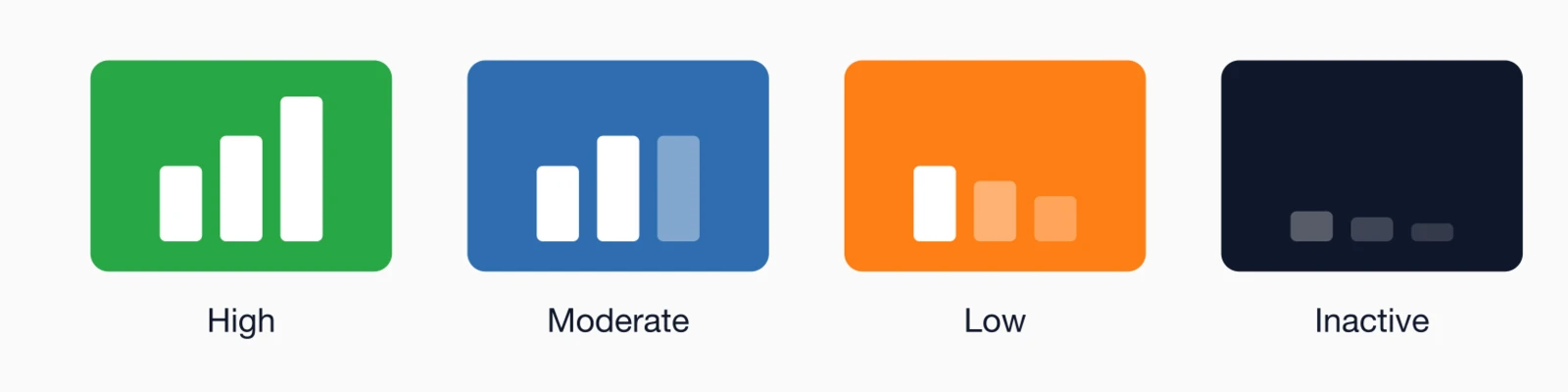
Think in terms of a simple engagement spectrum:
High → Moderate → Low → Inactive
Engagement scoring factors
Engagement scores typically pull together several kinds of activity, such as:
- Email behavior: opens and clicks over the last 90 days
- Event participation: conferences, webinars, and local chapter events
- Digital activity: portal logins, resource downloads, and tool usage
- Community involvement: forum posts, discussion lists, or online communities
- Learning: CE course enrollments and completions
- Leadership and service: committee work, speaking, or volunteer roles
You don't need a perfect scoring model to start. Even a basic system that distinguishes high, medium, and low engagement can transform the way you prioritize communication.
Engagement-based segment strategy
Use engagement levels to adjust both content and frequency:
| Segment | Characteristics | Communication Strategy |
|---|---|---|
| Highly Engaged | Frequently opens emails, attends events, uses resources | Leadership opportunities, advanced content, ambassador or referral programs |
| Moderately Engaged | Opens some emails, occasional event attendance | Standard communications, targeted nudges to increase involvement |
| Low Engagement | Rarely opens, limited participation | Re-engagement campaigns, new content formats, short surveys |
| Inactive | No opens or activity for 6+ months | Win-back sequences, preference updates, possible list suppression |
Protect your deliverability: Continuously emailing completely inactive contacts hurts sender reputation and makes it harder to reach engaged members. Consider suppressing truly inactive contacts or moving them to a reduced-frequency communication track.
One thing I often suggest to associations: don't be afraid to send less email to inactive members. It can feel counterintuitive—you want to re-engage them, so you keep trying—but reducing frequency to your least engaged segment often improves overall performance. When you stop emailing people who never open, inbox providers see stronger engagement signals, and more of your messages land where active members will see them.
Demographics & firmographics
Who your members are—their roles, industries, locations, and organizations—strongly influences what content will resonate. Demographics describe individual attributes like job title, career stage, and location. Firmographics are the organizational equivalent: attributes that describe a member's employer or company, such as industry, organization size, and geographic footprint. Both can be used to segment your communications.
Think of these attributes as the "context" around a member's engagement and status. When you layer them onto your status and behavior segments, your messages feel much more tailored without becoming overly complex.
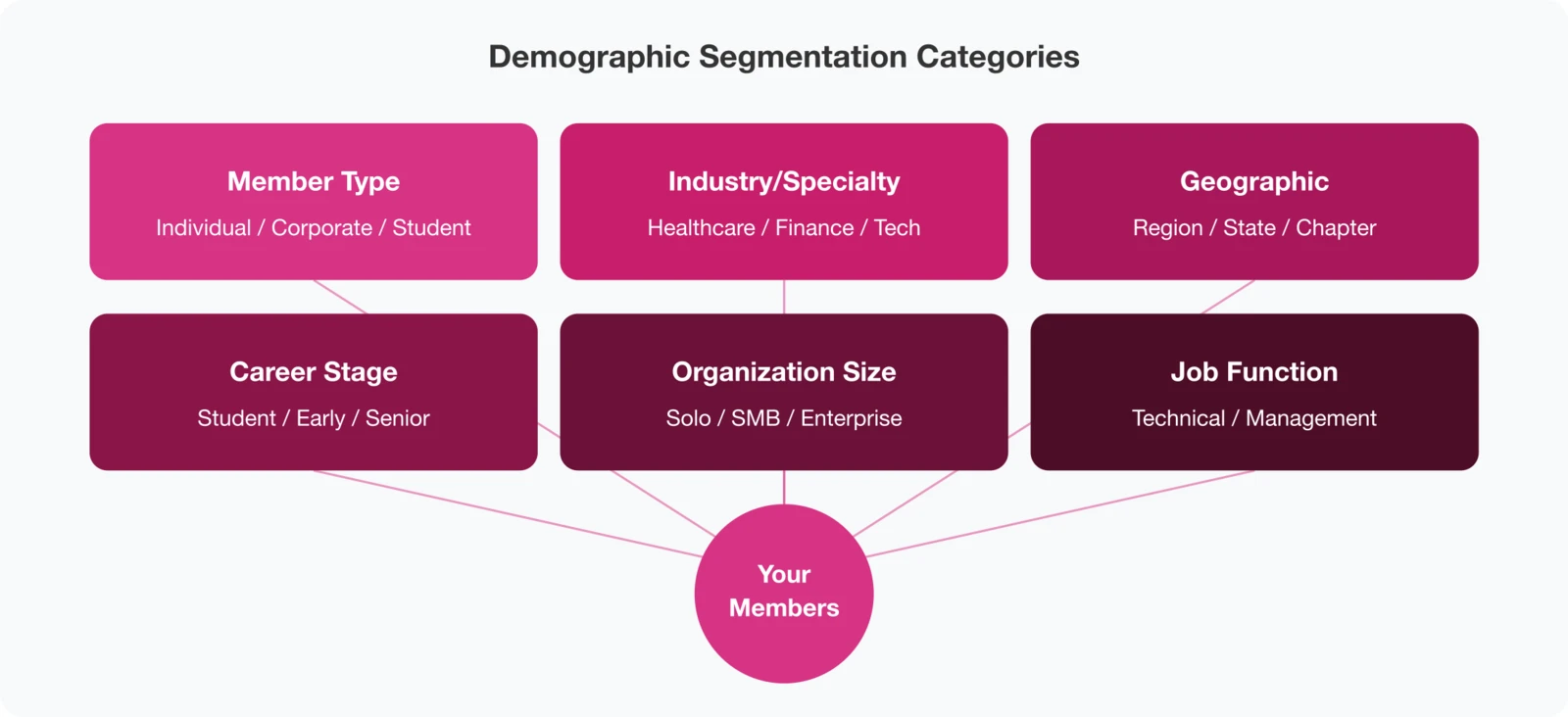
Common demographic segments
Useful demographic and firmographic dimensions include:
- Member type or level: Individual vs. corporate, student vs. professional, basic vs. premium
- Industry or specialty: Healthcare vs. manufacturing, pediatrics vs. oncology
- Geographic location: Region, state, chapter, or metro area
- Career stage: Student, early career, mid-career, senior/executive
- Organization size: Solo practitioner, small business, mid-sized, enterprise
- Job function: Clinical vs. administrative, technical vs. management
Even simple versions of these segments—like broad regions or high-level member types—can dramatically improve the relevance of your messaging.
When to use demographic & firmographic segments
Demographics and firmographics shine when the value you're promoting is clearly targeted:
- Regional events: Target members who can actually attend based on location
- Specialty content: Send subspecialty resources to the members who practice in that area
- Tiered benefits: Highlight benefits specific to each membership level or package
- Career resources: Align content with career stage, from job board resources to executive networking
Behavioral segments
What members do is one of the strongest signals of what they want. Behavioral segmentation targets members based on recent actions—or inaction—so your emails feel timely and relevant rather than generic.
These segments often operate as triggers: when a specific action happens, a specific sequence starts. That keeps your program responsive without constant manual setup.
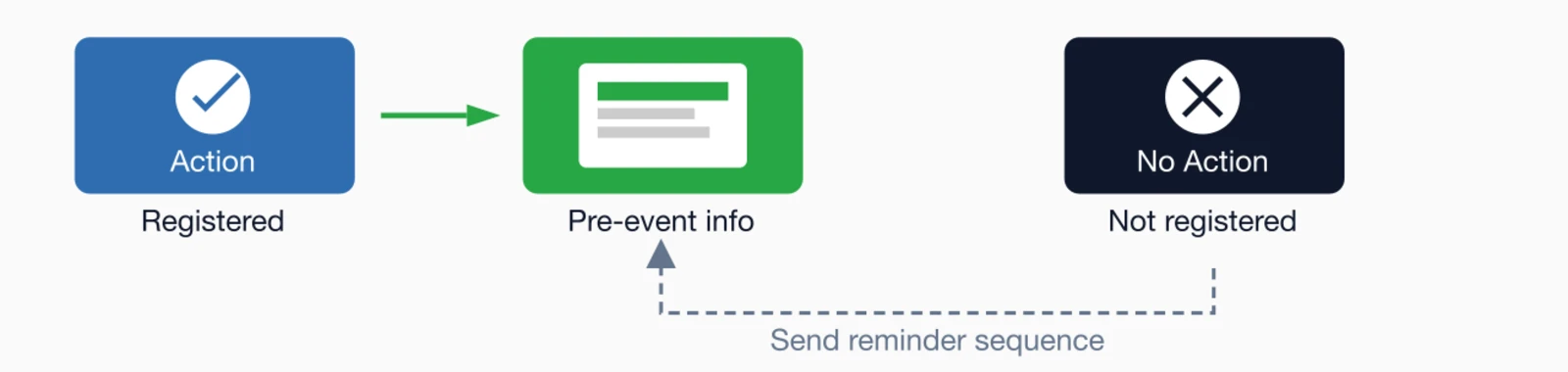
Action-based triggers
Here are common behaviors you can use to trigger or shape campaigns:
| Trigger | When It Runs | What to Send |
|---|---|---|
| Event registration | Member registers for a conference or webinar | Pre-event content, logistics, networking tips; exclude from further registration reminders |
| Event non-registration | Eligible member hasn't registered by a certain date | Additional promotions, FAQs, or testimonials emphasizing value |
| Resource download | Member downloads a certification guide or key resource | Information about the related program, deadlines, or next steps |
| Page visits | Member visits the career center or a specific initiative page | Job board updates or related resources |
| Survey completion | Member completes a survey | Thank-you and follow-up using member survey email templates |
| CE completion | Member completes a CE course | Advanced course promotions and recertification reminders |
| Purchase history | Member purchases conference registration or a key product | Relevant add-ons such as workshops or post-event resources |
Email engagement triggers
Email behavior itself also provides useful signals for segmentation:
- Opened but didn't click: Subject line worked, content or call-to-action missed—test different offers or clearer next steps
- Clicked a specific link: Demonstrated interest in that topic—follow up with related content or offers
- Didn't open: Consider resending with a different subject line or at a different time
- Unsubscribed: Capture reasons when possible, stop sending immediately, and move to a suppression list
These micro-segments help you refine campaigns continuously without rebuilding your entire segmentation model.
A deeper look: Event behavior segmentation
Events are a rich source of behavioral data and can support several powerful segments:
- Conference attendees (past 1–2 years): Proven interest in your flagship event—promote the next conference early with targeted event promotion email templates
- Conference non-attendees: May need a different value proposition, pricing, or format to convert
- Webinar-only attendees: Prefer virtual experiences—highlight online learning and virtual events
- Local event participants: Show strong regional engagement—promote chapter programs and local leadership roles
- Event no-shows: Registered but didn't attend—follow up to understand barriers and offer recordings or alternate options
An integrated association management platform can automatically track these behaviors and sync them with your email tool, so these segments are always up to date for your next campaign.
Lifecycle segments
Beyond current membership status, consider where members are in their overall relationship with your association. Lifecycle segmentation helps you design communication that fits each stage of the journey, from first awareness to long-term leadership.
Think of the member journey as a series of stages:
Aware → Consider → Onboard → Active → Deepen → At Risk → Lapsed → Win-back
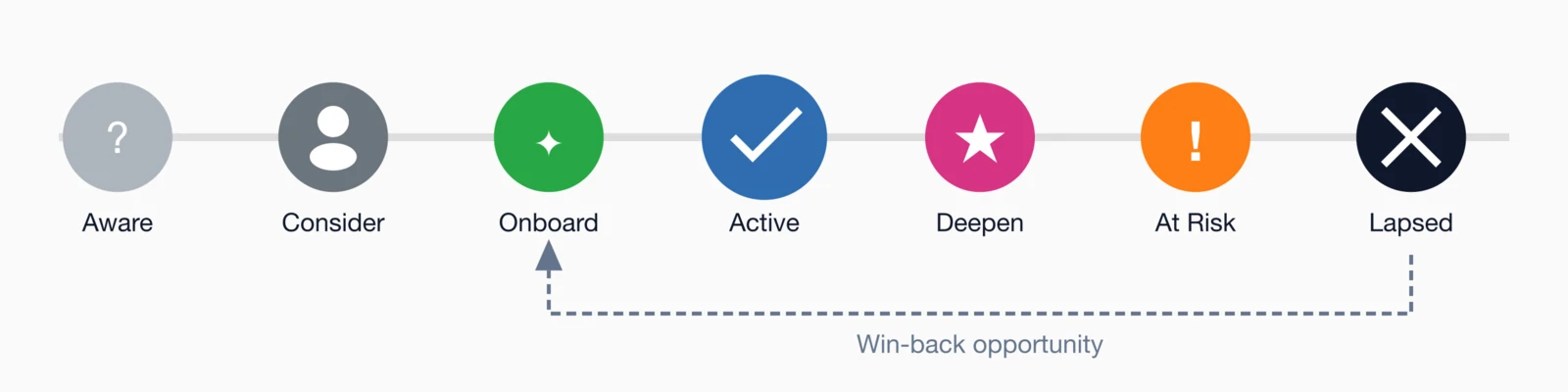
Member journey stages
Here's how those stages typically break down:
- Awareness: Prospects know your association exists but haven't meaningfully engaged
- Consideration: They're exploring membership, attending an event, or downloading a resource
- Onboarding: They just joined and are learning about benefits and how to get value quickly
- Active Participation: They regularly engage with content, events, and community
- Deepening Engagement: They take on leadership or volunteer roles and act as ambassadors
- At Risk: Their engagement declines noticeably, and renewal becomes uncertain
- Lapsed: Membership ends, but they remain a potential win-back opportunity
Mapping your key touchpoints to these stages makes it easier to see where communication is strong and where members slip away.
Tenure-based segments
Length of membership is another simple but powerful lens:
- First-year members: Need high-touch onboarding, frequent value reminders, and clear next steps
- 2–5 year members: Ready for deeper engagement, specialization, and leadership development
- 5–10 year members: Benefit from recognition and advanced opportunities to contribute
- 10+ year members: Often candidates for legacy programs, mentorship, and strategic input
Even basic tenure bands allow you to adapt tone and offers, so long-term members don't receive the same "getting started" content as first-year members.
Implementation strategy
Segmentation doesn't need to be overwhelming. The most effective programs start with a solid foundation and build complexity only where it adds real value. A phased approach keeps the work manageable and the impact measurable.
Think in three stages:
- Foundation: Status segments
- Behavioral: Event + engagement
- Advanced: Demographics + scoring
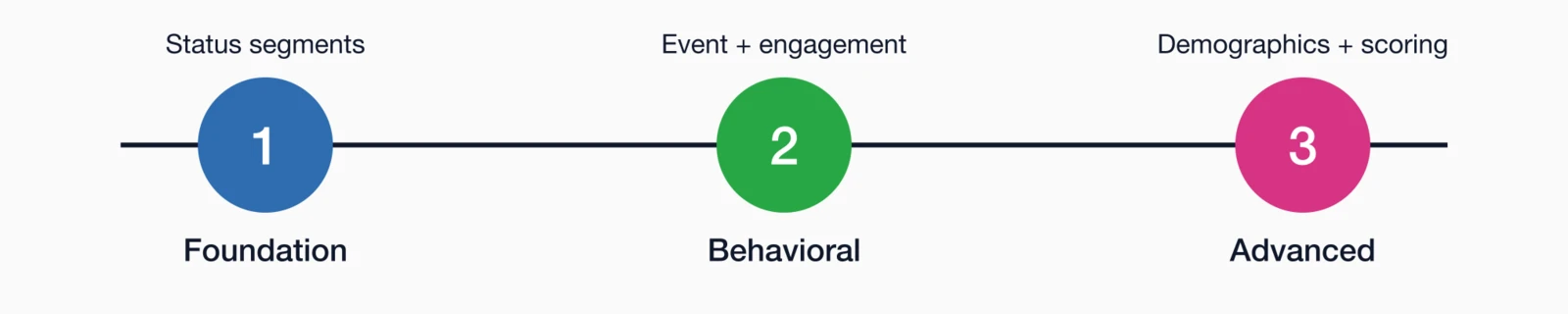
Phase 1: Foundation
Start by making sure your core membership data is clean and reliable:
- Implement status-based segments: new, active, expiring, grace, lapsed, and non-member
- Confirm your database accurately tracks membership status and key dates
- Set up basic automated campaigns for each segment (welcome, renewal, win-back)
- Test and refine renewal reminder timing, especially around expiration windows
Getting this layer right immediately reduces confusion and ensures your most critical communications go to the right members.
Phase 2: Behavioral
Once status segments are in place, layer in behavior:
- Add event registration and non-registration segments for key programs
- Segment by email engagement—at minimum, active openers vs. inactive contacts
- Build post-event follow-up sequences that vary for attendees vs. no-shows
- Launch a re-engagement campaign specifically for inactive members
These steps help you move from static segments to a more dynamic, responsive program.
Phase 3: Advanced
With the basics humming, you can move into more sophisticated segmentation:
- Add demographic segments for member type, geography, and specialty
- Implement engagement scoring to identify high-value and at-risk members
- Create interest-based segments from behavior patterns, such as resource topics
- Test personalization elements beyond the segment itself, like tailored calls-to-action
Use your AMS: Your association management system should support this work rather than create more manual tasks. For example, i4a's email marketing features include pre-built segments for expiring members, new joins, lapsed members, and event non-registrants—all automatically updated from live membership data.
Common segmentation mistakes
As you expand your segmentation strategy, a few common pitfalls can undermine results. Being aware of them upfront makes it easier to avoid unnecessary complexity and frustration.
Over-segmentation
Creating dozens of tiny segments might feel precise, but it quickly becomes unmanageable and doesn't always yield better outcomes. If a segment has fewer than about 100 contacts, ask whether it truly needs its own campaign or can be combined with a similar group.
Stale data
Segments based on outdated information will inevitably send the wrong messages. Make sure your database updates in real time or at least daily, especially for key fields like membership status and event registration. The member who renewed yesterday should not receive an expiration warning today.
Ignoring segment overlap
Members often belong to multiple segments at once: for example, a highly engaged conference attendee who is also nearing renewal. Build rules to manage overlap so people don't receive conflicting emails—or multiple variations of the same message—from different campaigns.
Manual list building
Constantly exporting CSV files and hand-curating lists is error-prone and time-consuming. It also makes it hard to keep campaigns running consistently. Use an AMS or marketing platform with built-in, auto-updating segments wherever possible to reduce manual work.
Not testing
Segmentation is not "set it and forget it." Treat it as an ongoing experiment:
- Compare segmented vs. non-segmented campaigns on open, click, and conversion rates
- Test different messages for the same segment to see what resonates
- Adjust and retire segments that don't move the needle
Over time, this test-and-learn approach lets you focus on the segments and strategies that deliver real results.
Start sending smarter emails
Segmentation turns email from a broadcast channel into a personalized conversation. When members receive messages aligned with their situation, interests, and actions, they engage more deeply. When they engage, they renew more consistently, attend more events, and are more willing to advocate for your association.
Start with the basics: membership status segments that ensure the right people receive welcome messages, renewal reminders, and win-back campaigns at the right times. Then layer in behavioral and demographic segments as your program matures and your team grows more comfortable.
The aim is not complexity—it's relevance. Every segment should exist for a clear reason: to get the right message to the right member at the right moment in their journey.
Over the years, the associations I've seen succeed with segmentation aren't the ones with the most elaborate setups. They're the ones that started simple, measured what worked, and added new segments only when the data supported it. You don't need 50 segments on day one; you need the four or five that matter most for your organization, implemented well. Once those are in place, improvements in renewal rates and event registrations typically appear within a few months.
To go deeper on email strategy, explore the complete Association Email Marketing Guide or dive into effective renewal email sequences for detailed examples and templates tailored to association needs.
Key takeaways
- Segmented emails often achieve 20–30% higher open rates because members engage when content is clearly relevant to them
- Membership status is the best place to start: new, active, expiring, grace, and lapsed members require different messages and timing
- Engagement scoring helps you treat highly engaged members differently from inactive ones, aligning offers and frequency with actual behavior
- Behavioral triggers based on actions like event registration or resource downloads are some of the most effective drivers of timely, high-performing campaigns
- Your AMS or association email platform should make segmentation easier, with built-in, auto-updating segments that eliminate manual list building and reduce errors
Ready to Segment Your Member Communications?
i4a's platform includes pre-built member segments that update automatically—no CSV exports or manual list building required.
Talk to Us About Email SegmentationRelated resources
Membership Renewal Email Sequences
Build automated renewal campaigns that drive on-time renewals.
Email Deliverability for Associations
Ensure your emails reach the inbox, not the spam folder.
Complete strategy guide for association email marketing.
Member Communication Best Practices
Effective strategies for all member communications.
