Quick Summary: Event Sponsorship Packages
- Sponsors prioritize leads over logos: Lead generation and decision-maker access drive renewals, not passive visibility.
- Three to four tiers work best: Provides clarity for sponsors and revenue potential without creating decision friction.
- Price strategically: Top tier should be 3-4x the bottom tier, not 10x—maintain reasonable ratios.
- Fulfillment earns renewals: Flawless delivery and proactive relationship management are the fastest path to repeat business.
Part of our event sponsorship guide
Event sponsorship is one of the most powerful non-dues revenue drivers for associations, and expectations are only getting higher. According to Sequence Consulting's 2026 Association Trends briefing
Here's the thing: the difference between a sponsorship program that grows and one that stagnates usually comes down to alignment. When packages are built around what sponsors actually need—not just what's convenient to offer—renewals follow. This guide shows how to design sponsorship packages that attract the right partners, grow revenue, and earn those renewals year after year.
Understanding what sponsors actually want
Before you can design effective sponsorship packages, you need a clear view of why sponsors invest in your event and what outcomes they expect. Industry research shows associations are placing increased emphasis on measurable marketing outcomes, including lead generation and digital engagement, and sponsors are aligned with those priorities. Conversations with sponsors across industries show that, regardless of organization size, their core goals are surprisingly consistent.
Primary sponsor goals
Most sponsors are looking for a mix of high-quality access and measurable business results:
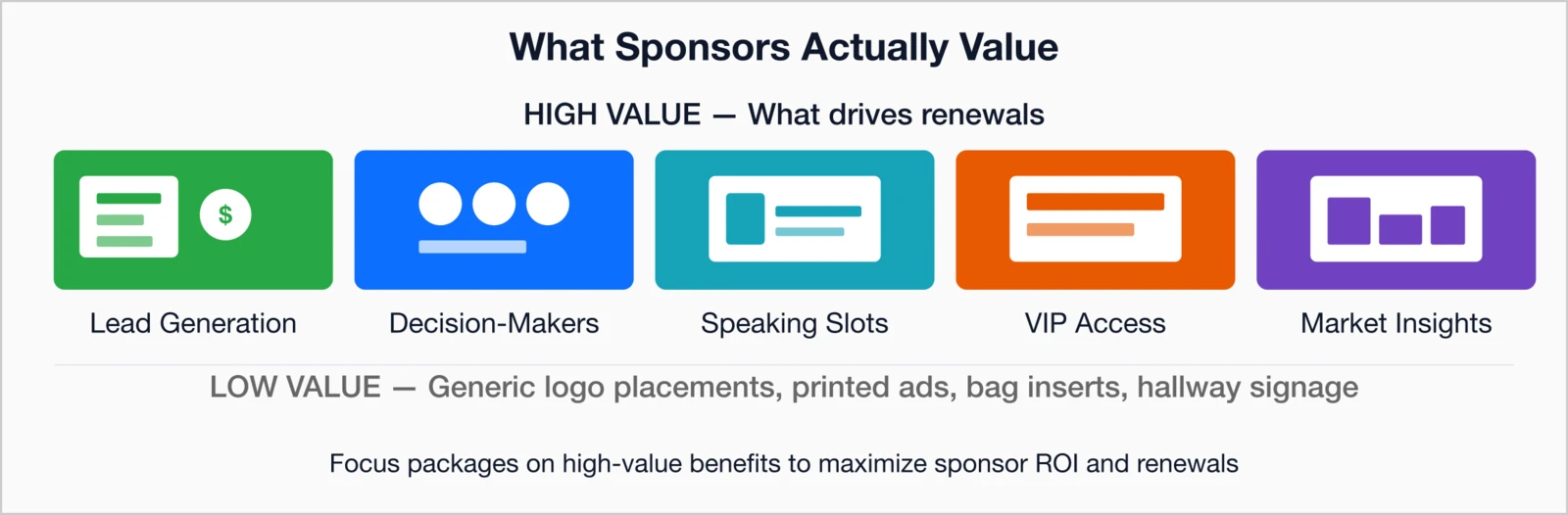
- Lead generation: Names and contact information for qualified prospects they can follow up with after the event
- Relationship building: Meaningful face time with decision-makers and influencers, not just casual drive-by traffic
- Thought leadership: Opportunities to position their company as a credible industry expert through content and education
- Brand awareness: Visibility with the right audience segments, especially within niche or hard-to-reach communities
- Market intelligence: Insights into trends, challenges, and competitor activity they can take back to their teams
What sponsors do not value
Sponsors will rarely say no to added benefits, but that does not mean those benefits drive renewal or justify higher pricing. Common low-value items include:
- Passive logo placement: Static sponsor pages crowded with dozens of logos rarely drive meaningful engagement or clicks—they become visual wallpaper
- Printed program ads: Many attendees skim or skip the printed program, limiting ad exposure and offering no measurable ROI
- Bag inserts: A large share of printed inserts go directly into the trash without being read
- Generic signage: Hallway banners and undifferentiated signs usually draw minimal attention
The distinction that matters: Passive digital exposure (a logo buried on a sponsor page) delivers almost no value. High-value digital exposure—contextual mentions on session pages, featured spots in email campaigns, and traffic-driving links tied to specific content—creates measurable engagement sponsors can report back to their teams.
Pro Tip: Survey current sponsors about which benefits they value most and which they could do without. The answers often challenge assumptions about what is "valuable" versus what they are truly willing to pay for.
Creating a clear tier structure
A strong tier structure makes sponsorship easier to sell and easier for sponsors to understand. Most successful programs rely on three to four levels: more than that creates confusion and decision friction, while fewer can cap your revenue potential. The goal is a structure that feels intuitive, transparent, and aligned with tangible benefits.
Classic four-tier structure
Many associations use a four-tier model that balances scarcity at the top with broader participation at lower levels:
| Tier | Typical Price Range | Quantity | Primary Value |
|---|---|---|---|
| Platinum/Title | $15,000–$50,000+ | 1–2 | Exclusive prominence, speaking, and hosting |
| Gold | $7,500–$20,000 | 3–5 | High visibility and engagement opportunities |
| Silver | $3,000–$10,000 | 5–10 | Solid exposure and strong networking access |
| Bronze/Supporting | $1,000–$5,000 | Unlimited | Basic visibility and visible association support |
This format makes it easy to signal scarcity at the top while keeping entry points accessible for smaller sponsors.
Alternative: A la carte model
For some events and industries, a menu-based model can be more effective. In this approach:
- You charge a base sponsorship fee for recognition and core benefits
- High-value elements (for example, session sponsorship, lunch, or a happy hour) are priced as individual add-ons
- Sponsors "build their own" package from available options that best fit their goals
This model works particularly well when sponsor needs vary widely and when you have limited inventory of premium benefits, though it typically requires more consultative sales conversations.
Naming your tiers
Tier names help communicate value and personality. Standard metal-based names like Platinum, Gold, Silver, and Bronze are widely understood but can feel generic. Alternatives include:
- Industry-themed: Names that reflect your profession or sector
- Benefit-focused: Labels such as "Thought Leader," "Innovator," or "Partner"
- Simple: Clear names like "Premier," "Featured," and "Supporting"
Whichever naming convention you choose, keep it consistent and ensure it maps logically to the benefits offered at each level.
Building your benefits inventory
Your benefits inventory is the foundation of every sponsorship package you offer. Start by listing every asset and opportunity your event can provide, then assign benefits strategically to tiers to maintain perceived value and protect your top levels. Think in terms of access, exposure, and outcomes rather than a long list of tactical items.
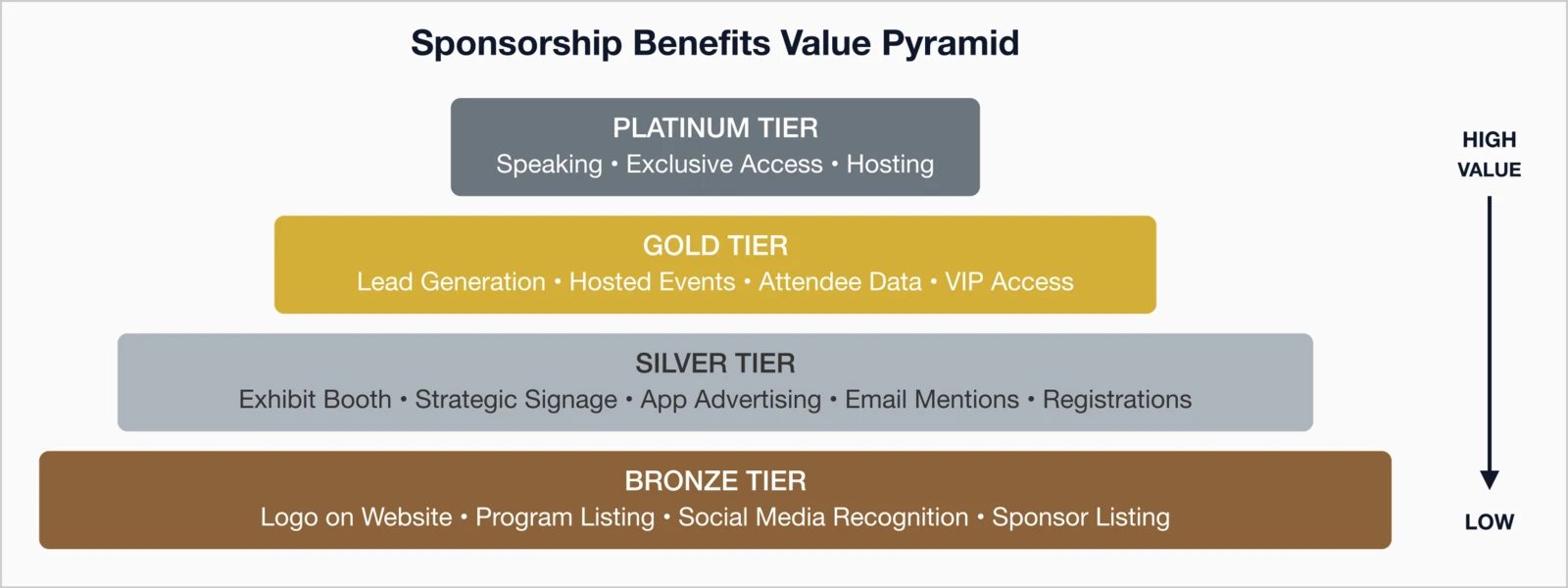
High-value benefits (reserve for top tiers)
These benefits drive decisions at the highest levels and should be reserved for your premier packages:
- Speaking opportunities: Dedicated presentation slots or panel participation in key sessions
- Exclusive session hosting: Sponsor-branded educational sessions with clear thought leadership positioning
- Attendee list access: Opt-in contact information with appropriate permission and privacy safeguards
- Private meeting room: Space for scheduled one-on-one or small-group meetings with prospects
- Reception or meal hosting: "Sponsored by" recognition for major networking events or meals
- Opening/closing remarks: Stage time in front of the full audience at key program moments
- Exclusive networking events: Access to VIP receptions or invite-only gatherings
Medium-value benefits
These benefits add meaningful value and can be used to differentiate mid-level tiers:
- Exhibit booth: Included or discounted exhibit space in a prime location
- Complimentary registrations: Full conference passes included with sponsorship
- Featured email placement: Dedicated sponsor spotlight or contextual mention in attendee emails with trackable links—not just a logo in the footer
- Session page sponsorship: Sponsor branding and links on high-traffic session description pages, where attendees actively browse content
- App advertising: Banner ads or promoted listings in the conference app with click-through tracking
- Digital amplification: Sponsored email features, session landing pages, and app placements that drive qualified traffic to sponsor content or offers—extending visibility beyond the event itself
- Strategic signage: Placement at high-traffic or high-visibility locations
Standard benefits (include in all tiers)
Baseline benefits help every sponsor feel recognized and ensure consistency across the program. Be honest with sponsors: these are table-stakes recognition items, not ROI drivers.
- Logo on the event website: Recognition on the sponsor page—valuable for credibility but unlikely to generate clicks or leads on its own
- Logo in the program: Presence in printed and/or digital programs
- Social media recognition: Thank-you posts with sponsor tags that extend reach to your audience
- Sponsor listing: Inclusion on marketing materials and sponsor overviews
Note: Standard benefits establish presence and legitimacy—but do not oversell them. Reserve outcome-driven digital exposure (trackable links, email features, session page placement) for higher tiers where they justify premium pricing.
Pricing your sponsorships strategically
Sponsorship pricing is part science and part art. You must balance revenue goals, fulfillment costs, and sponsor expectations while staying competitive in your market. Sequence Consulting's 2026 Association Trends briefing
Key pricing principles
These guiding principles help keep your pricing both credible and sustainable:
- Anchor to the top tier: Your highest level sets the reference point for the rest of the program
- Maintain reasonable ratios: Aim for your top tier to be about three to four times the price of your bottom tier, not ten times
- Price for renewals: Avoid setting prices so high that sponsors feel they can only participate once
- Factor in fulfillment costs: Ensure that the deliverables in a $5,000 package do not cost you $3,000 to fulfill
Market-based pricing
Market-based pricing looks outward at what similar organizations charge and how sponsors view your event relative to other options. When calibrating your pricing, consider:
- What comparable associations in your industry charge for similar access and benefits
- How your pricing stacks up against direct competitors, if any
- How your cost-per-impression or cost-per-lead compares to other marketing channels sponsors use
This benchmarking helps you avoid underpricing premium benefits or overpricing packages in a way that stalls sales.
Value-based pricing
Value-based pricing starts from what sponsors stand to gain rather than what the benefits cost you to deliver. To estimate value:
- Multiply the number of decision-makers attending by an estimated value of a qualified lead
- Consider the equivalent cost of reaching the same audience through other channels
- Use historical conversion rates from event leads to customers to estimate potential revenue
When sponsors see a clear path from your event to meaningful business outcomes, higher price points become easier to justify. In my experience working with associations on their sponsorship programs, the ones that can articulate sponsor ROI in concrete terms—leads generated, connections made, deals closed—tend to command stronger pricing and see better renewal rates than those selling on visibility alone.
A deeper look: The psychology of sponsorship pricing
Sponsorship decisions are not purely rational line-item calculations; they are shaped by budget thresholds, internal politics, and perceptions of fairness and value. Understanding these dynamics helps you design tiers that feel realistic and attractive instead of arbitrary. When your pricing aligns with how sponsors actually make decisions, you reduce friction and increase conversions.
Budget thresholds matter. Many organizations have internal approval cutoffs—for example, under $5,000 may be approved by a marketing manager, over $5,000 might require VP approval, and over $10,000 may need C-suite sign-off. If your Silver package is $5,500 and your Gold is $12,000, both require higher-level approvals and can slow decisions. Pricing at $4,500 and $9,500, by contrast, keeps tiers below common thresholds and can speed up approvals.
Relative pricing affects perception. Extreme price jumps can make top tiers feel unreachable. A set of tiers at $2,500, $5,000, $10,000, and $25,000 makes the highest level look like an outlier, which often leads sponsors to cluster at the bottom. Compressing the range—for instance, $3,000, $5,000, $8,000, and $15,000—keeps the top tier aspirational but attainable.
Anchoring works both ways. Your top-tier price sets the mental anchor for the entire program. If Platinum is $50,000, a Silver package at $7,500 can feel like a bargain. But if that Platinum level never sells because it is obviously overpriced, sponsors may question whether all your tiers are inflated. Your top tier should be ambitious yet realistic, with the goal of selling at least one or two each cycle.
Real scarcity works; artificial limits do not. Limiting the number of Gold sponsorships works when tied to genuine inventory constraints, such as a finite number of session slots. Artificial limits are easy to spot and can erode trust.
Early commitment discounts create urgency. Offering a 10–15% discount for sponsors who commit four to six months before the event creates urgency without undermining standard pricing. It rewards your best partners, improves cash flow, and gives you a clearer picture of remaining inventory.
Price Increase Strategy: Raising prices incrementally each year—typically 5–10%—helps sponsors adjust without feeling penalized, especially long-time supporters. Large jumps, by contrast, can feel like a sudden tax on loyalty.
Building a compelling sponsorship prospectus
Your sponsorship prospectus is a sales tool, not just an information packet. Its job is to tell a concise story about your event, clearly explain the audience value, and make it easy for sponsors to say "yes." A well-designed prospectus combines strong positioning with simple navigation so decision-makers can quickly see where they fit.
What to include
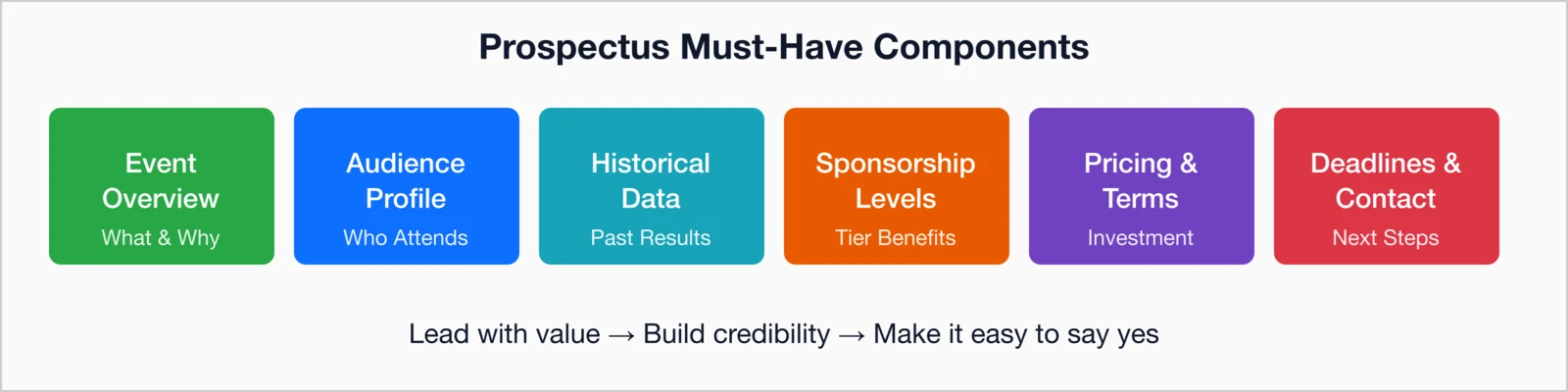
A comprehensive prospectus typically includes:
- Event overview: What the event is, when and where it takes place, and why it matters in your industry
- Audience profile: Who attends, including titles, roles, and buying authority
- Historical data: Past attendance numbers, satisfaction scores, and testimonials from attendees and sponsors
- Sponsorship levels: A clear comparison of benefits at each tier, ideally in a simple table
- Pricing details: Investment levels, payment terms, and any early commitment incentives
- Key deadlines: Dates when benefits must be confirmed or assets submitted
- Contact information: A clear point of contact for questions and next steps
Prospectus design tips
How you present information is just as important as what you include. To make your prospectus more effective:
- Lead with value: Start with the audience and business opportunities before presenting prices
- Use comparison tables: Make it easy to scan what each level includes and how they differ
- Include testimonials: Short quotes from past sponsors about return on investment add credibility
- Show, do not just tell: Include photos from past events and logos of current or prior sponsors
- Keep it skimmable: Use clear headings, bullets, and white space so busy executives can grasp the essentials quickly
Digital vs. print formats
Offering your prospectus in multiple formats ensures you can support different sales situations:
- Digital PDF: Easy to email, host online, and enhance with links or embedded media
- Print version: Useful for in-person meetings, site visits, or trade show conversations
- Web page: An always-current version on your event site that can be updated as inventory changes
Fulfillment best practices
Selling the sponsorship is only half the job; delivering on every promised benefit is what earns renewals and long-term partnerships. Fulfillment is where your credibility is tested and where sponsors decide whether to invest again. Treat it as an operational discipline with clear ownership and processes rather than an afterthought.
Before the event
Pre-event planning sets the stage for a smooth experience:
- Create a fulfillment checklist: Document every promised benefit, associated deadlines, and required assets for each sponsor
- Assign ownership: Make one team member responsible for each sponsor's overall experience
- Collect assets early: Gather logos, bios, and collateral weeks in advance to avoid last-minute rushes
- Confirm speaker details: Lock in session times, room assignments, and AV needs for sponsor speakers
- Send exhibitor/sponsor kits: Provide clear instructions on setup, shipping, parking, and on-site logistics
During the event
On-site execution is where sponsors experience the value you promised:
- Provide a dedicated sponsor contact: Ensure sponsors know exactly who to reach with questions or issues
- Verify signage and branding: Confirm that logos and placements match what was promised
- Facilitate introductions: Proactively connect sponsors with key attendees and decision-makers
- Document delivery: Capture photos of signage, booth traffic, and session attendance as proof of fulfillment
After the event
Post-event follow-through reinforces value and sets the tone for renewal conversations:
- Send prompt thank-yous: Reach out within 48 hours of event close with a personalized message
- Share a fulfillment report: Summarize what you delivered, including impressions, leads, and photos
- Conduct a satisfaction survey: Ask what worked, what did not, and what they would change next year
- Discuss ROI: Help sponsors articulate the outcomes to their leadership and identify ways to improve results
Common Fulfillment Failures: Missing or incorrect logos, uninstalled signage, last-minute schedule changes for sponsor speakers, or delays in delivering promised leads can quickly undermine even a strong sponsorship experience. Treat these risks seriously and address issues transparently when they arise.
Sponsor retention strategies
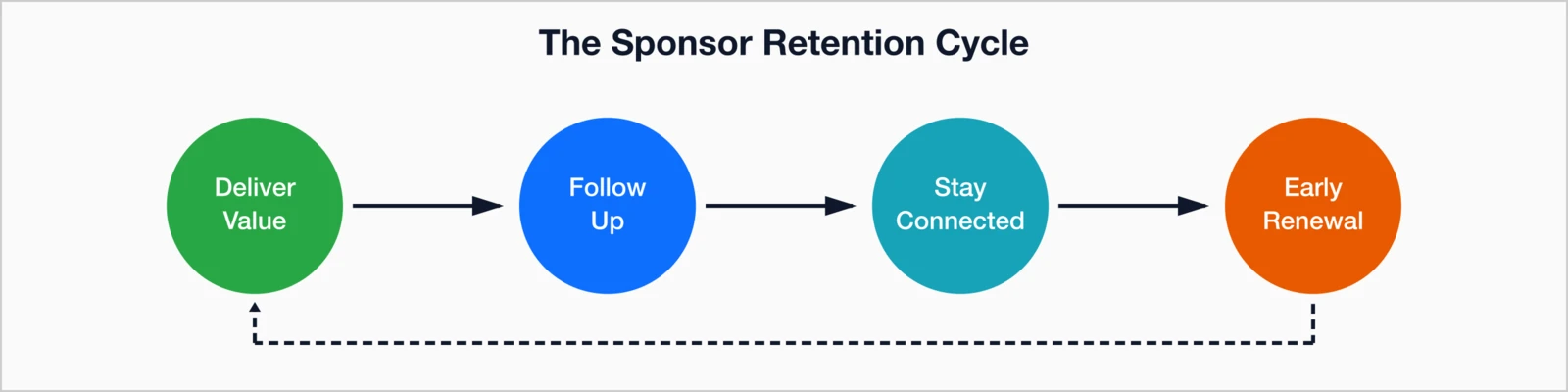
Acquiring a new sponsor is almost always more expensive and time-consuming than renewing an existing one. A proactive retention strategy turns one-off transactions into long-term partnerships that grow over time. The goal is to stay connected, add value between events, and make renewal the default choice rather than a fresh decision.
Year-round relationship building
Strong sponsor relationships do not end when the event closes:
- Stay in touch: Maintain regular, relevant contact instead of going silent until the next sales cycle
- Share insights: Provide sponsors with industry updates, survey findings, or event-related data that can help their business
- Offer early renewal options: Give returning sponsors the first choice of high-demand benefits before opening them to new prospects
- Explore multi-year deals: Offer incentives for two- or three-year commitments, which provide stability for both sides
Loyalty benefits
Loyalty benefits reward long-term partners and encourage ongoing investment:
- Price protection: Allow early renewers to lock in current rates for the next year
- Priority placement: Offer the best booth locations, preferred session times, or premium visibility slots
- Exclusive opportunities: Give loyal sponsors first access to new sponsorship concepts or pilots
- Special recognition: Highlight milestones such as "10-year sponsor" status in your materials and from the stage
When sponsors do not renew
Even strong programs will occasionally lose sponsors, but unexamined departures are missed learning opportunities. Exit conversations help you understand whether the issue is value, pricing, audience fit, or fulfillment. With that insight, you can refine your offerings and strengthen future partnerships.
When a sponsor chooses not to renew, ask focused questions:
- Did they achieve the outcomes they expected, especially around leads and relationships?
- Was the price aligned with the value they perceived? Would another level have made more sense?
- Did your audience match their target market in terms of role, industry, and buying power?
- Were there any fulfillment issues that affected their experience or internal perception?
Many sponsors will cite reasons like "budget cuts" or "shifting priorities," which may be true but incomplete. Use thoughtful follow-up questions to uncover the deeper drivers.
A deeper look: Why sponsors really leave
Several underlying factors commonly drive non-renewals:
Insufficient leads. Lack of leads is the number one reason sponsors quietly move on. Sponsors may be hesitant to say so directly, especially if their own on-site engagement was limited. In reality, lead generation is a shared responsibility: sponsors must engage actively, and your event must create meaningful interaction opportunities. Structured networking sessions, facilitated roundtables, and "ask the expert" formats can materially improve outcomes.
Decision-maker turnover. A new marketing leader or executive may want to reshape the sponsorship portfolio, and prior relationships do not automatically transfer. Multi-level relationships—spanning marketing, sales, and leadership—make your sponsorship harder to displace.
Fulfillment gaps. Errors such as missing logos, last-minute schedule changes, or delayed delivery of leads can overshadow positive results. Treat fulfillment as a core promise, backed by checklists and verification steps, and respond quickly when issues arise.
Competitive comparisons. If a sponsor sees a competitor enjoying better access—such as a speaking slot—while paying a similar fee, questions about fairness will follow. Clear policies around premium benefits and exclusivity (for example, one speaking slot per industry sector) can prevent misunderstandings and resentment.
Building sponsorship success
The strongest sponsorship programs are built on partnership, not just transactions. When you start with sponsor goals, structure benefits around real outcomes, and deliver consistently on your commitments, you create a virtuous cycle of trust, results, and renewal. I've watched associations transform their sponsorship revenue simply by shifting from a "what can we sell?" mindset to a "what do sponsors need to achieve?" approach. It takes more upfront work to understand each sponsor's objectives, but the payoff in renewals and referrals makes it worthwhile.
Focus first on what sponsors need to achieve, then design packages that genuinely support those objectives. Provide flexibility to customize where it matters, and strive to deliver slightly more than you promise. Sponsorship revenue can become a cornerstone of your broader non-dues revenue strategy
For more on event planning and revenue optimization, explore the full Association Event Management Guide
key takeaways
- Sponsors prioritize leads and engagement over pure visibility: Logo impressions alone do not justify higher spend
- Three to four sponsorship tiers typically provide the best balance: Clarity for sponsors and revenue potential for you
- Price strategically: Your top tier should generally be three to four times the price of your lowest tier, not ten times higher
- Allow customization within reasonable boundaries: So sponsors can align benefits with their specific goals
- Flawless fulfillment and proactive relationship management: Are the fastest paths to renewals and multi-year commitments
Track Your Event Revenue
i4a's event management tools help you track sponsorships, registrations, and all event revenue in one place—giving you the data you need to grow your sponsorship program.
Let's Talk About EventsRelated resources
Track the right metrics to demonstrate event value.
12-month checklist for successful conference planning.
Event Registration Best Practices
Optimize registration to boost attendance and revenue.
Association Event Management Guide
Complete guide to planning and executing successful conferences.
