Quick Summary: Member Engagement Gamification
- Gamification amplifies, not creates: Game mechanics make valuable activities more engaging but can't make boring content worthwhile.
- Know your audience first: Younger professionals and tech-oriented industries embrace gamification; senior professionals in traditional fields may find it patronizing.
- Points need purpose: Without a clear redemption path—discounts, recognition, or rewards—accumulated points become meaningless numbers.
- Scarcity creates value: Badges everyone earns mean nothing; meaningful achievements require selective, difficult criteria.
- Start with challenges: Time-limited goals are the easiest way to test gamification before committing to complex systems.
Part of our engagement strategies guide
Gamification for member engagement works when points, badges, and leaderboards align with genuine member value—and fails when it feels gimmicky. Here's when game mechanics actually motivate, and how to implement them right.
The reality is more nuanced. I've seen gamification drive remarkable engagement increases in some associations and fall completely flat in others. The difference isn't the technology—it's understanding when game mechanics align with member psychology and when they come across as gimmicky manipulation.
This guide will help you understand when gamification is likely to work for your association, which mechanics to use, and how to implement them in ways that genuinely motivate rather than annoy your members. Professional associations
What is gamification?
Before diving into tactics, it helps to understand what we're actually talking about. Gamification applies game design elements to non-game contexts—tapping into the same psychological drivers that make games compelling without turning your association into an actual game.
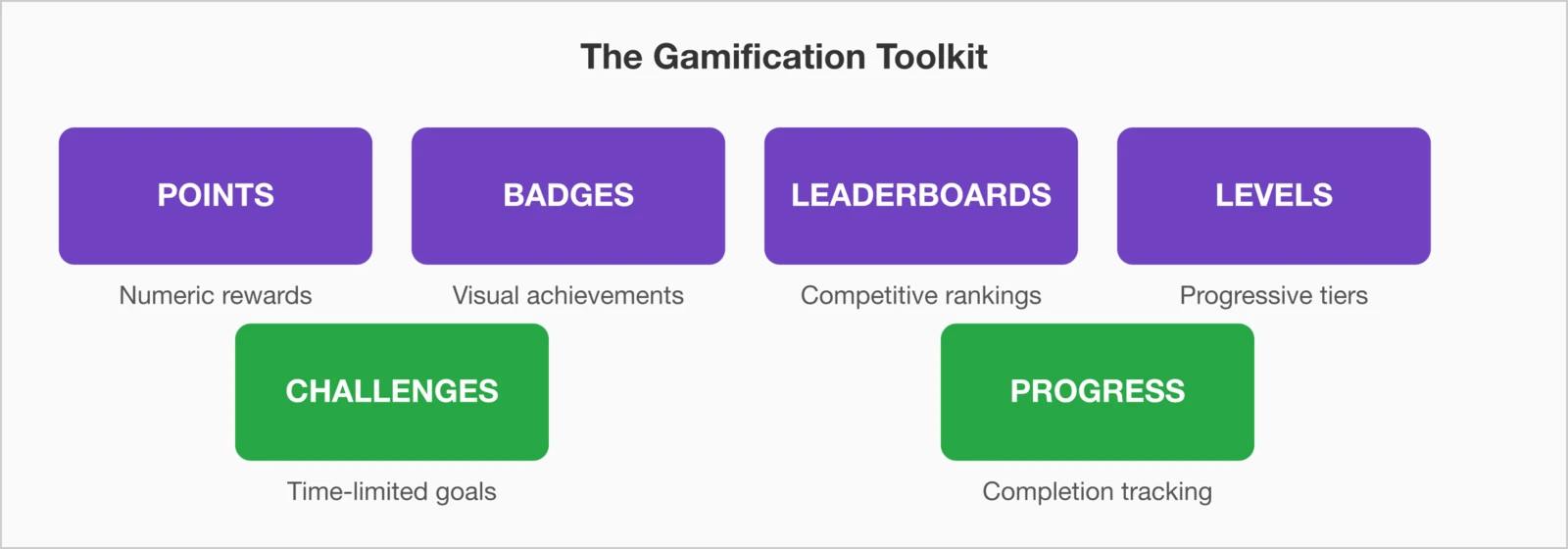
In practice, this typically means adding:
- Points: Numeric rewards for completing actions (attend a webinar = 10 points)
- Badges: Visual achievements for accomplishing specific goals
- Leaderboards: Rankings comparing member activity or achievement
- Levels: Progressive tiers members advance through
- Challenges: Time-limited goals with specific rewards
- Progress bars: Visual indicators of completion status
These mechanics tap into psychological drivers like achievement, status, competition, and completion—the same drives that make games compelling.
What gamification is not
Gamification isn't turning your association into a game. It's not creating a full gaming experience. It's selectively applying proven motivational techniques from games to encourage specific member behaviors. The activities remain professional and substantive; the game elements simply add motivation and feedback.
When gamification works
Not every association will see results from gamification—but when it works, it can meaningfully increase engagement with the activities that matter most. In my experience, gamification succeeds when several conditions align.
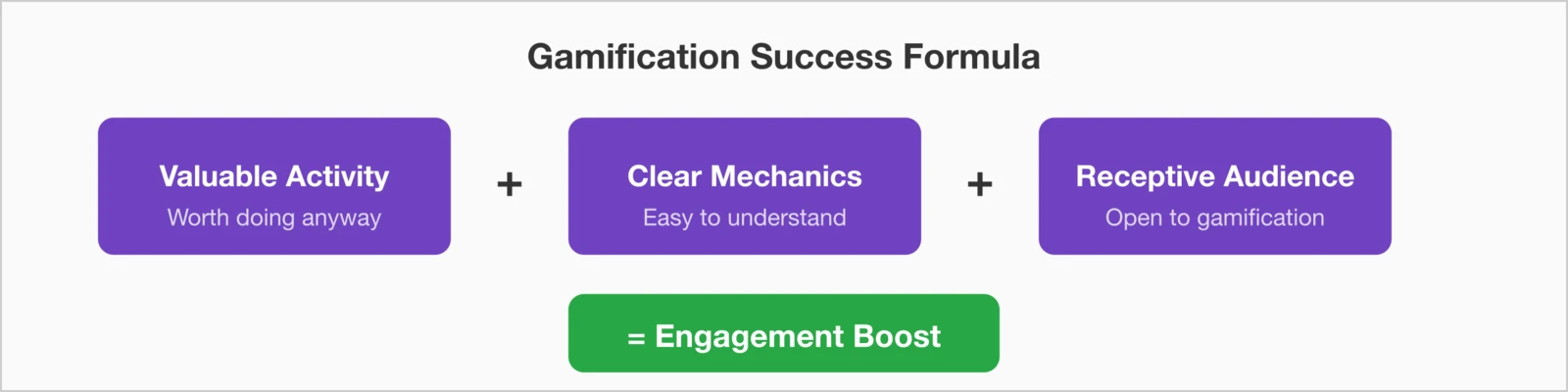
The underlying activity has value
Gamification amplifies engagement with activities members would find valuable anyway. It can motivate members to complete a CE course they've been putting off. It can't make a useless CE course seem worthwhile. If the core offering isn't valuable, gamification just makes the problem more visible.
Clear actions lead to clear rewards
Game mechanics work when members understand exactly what to do and what they'll get. "Complete your profile for a profile badge" is clear. "Engage with content to earn points" is vague. Specificity matters—members need to see the path to achievement.
The audience embraces it
Some demographics respond enthusiastically to gamification:
- Younger professionals (under 40) who grew up with games
- Tech-oriented industries and associations
- Members who are already competitive by nature
- Communities with strong peer relationships where status matters
Other demographics may find it off-putting or patronizing. Test with your specific audience before going all-in.
When gamification backfires
Research on gamification and human motivation
For every gamification success story, there's an association that rolled out points and badges to crickets—or worse, member complaints. Understanding these failure modes helps you avoid them.
The activity becomes about the points
When members game the system rather than genuinely engage, you have a problem. Forum posts that say "just posting for points" or event attendance that ends immediately after check-in suggests members are chasing rewards without experiencing value. This undermines both engagement and the integrity of your metrics.
It feels patronizing
Senior professionals in traditional industries often find badges insulting. "I've been practicing law for 30 years and you're giving me a sticker?" Associations with older, more conservative memberships need to approach gamification carefully or not at all.
Rewards devalue over time
If badges are easy to earn, they become meaningless. If points lead nowhere, members stop caring. The psychology of rewards requires that achievement feels genuinely achieved—not handed out like participation trophies.
Competition creates negativity
Leaderboards that showcase the same people over and over discourage everyone else. Competitive elements can breed resentment instead of motivation if not designed thoughtfully.
Test before committing: Pilot gamification with a subset of members before rolling out organization-wide. Their feedback will tell you if you're on the right track.
Points systems
Points are the most flexible gamification mechanic—and the most commonly misused. When designed well, a points system creates a satisfying loop where members see their engagement translated into tangible progress. When designed poorly, it becomes a meaningless number that nobody cares about.
Points work when...
- They can be redeemed for something meaningful (discounts, swag, recognition)
- The earning structure is clear and consistent
- Point values reflect actual effort (attending a conference > clicking a link)
- There's ongoing opportunity to earn and use points
Points fail when...
- Points accumulate with no redemption path
- Every action earns points regardless of value
- Point totals become meaningless large numbers
- The system is too complex to understand
A deeper look: Designing a sustainable points economy
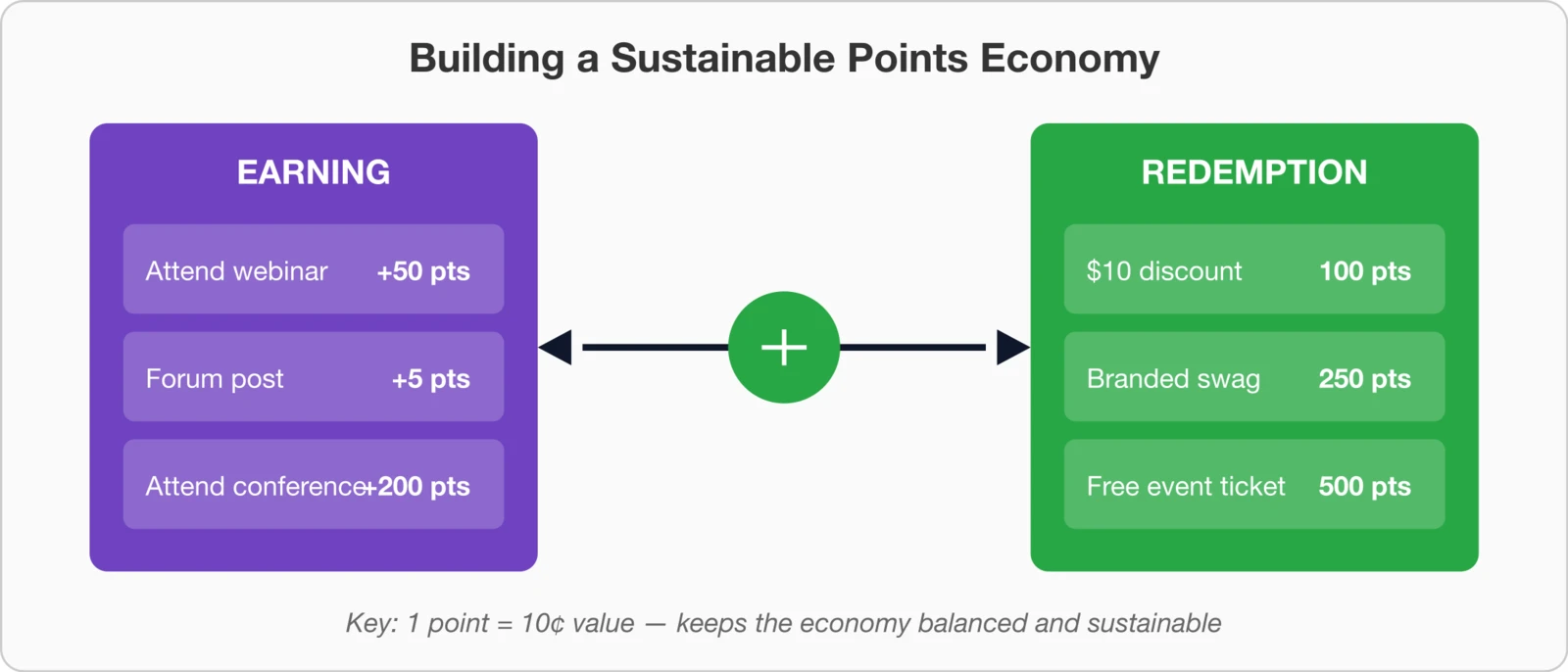
The biggest mistake with points systems is treating them like an afterthought. "Let's add points to things" quickly becomes an inflationary mess where numbers lose meaning. Successful points systems require economic thinking.
Start by defining what points are worth. If 100 points equals a $10 discount on conference registration, you've established value. Every point earned represents 10 cents. Now you can design earning opportunities rationally: attending a webinar (worth maybe $25 to the member) might earn 50 points. Posting a forum response takes effort but creates community value—maybe 5 points.
Then ensure the system is sustainable. If members can easily accumulate thousands of dollars worth of points, you've created a liability. Set earning caps, point expiration, or tiered redemption options to maintain balance.
Some associations use points purely for status (leaderboard ranking) without redemption. This can work but removes a powerful motivator—the tangible reward that makes abstract numbers feel real.
Badges and achievements
Badges are one of the most visible gamification elements—and when designed well, they can become genuinely valued symbols of professional achievement. They work through social proof—showing others what you've accomplished—and through collection psychology—the drive to complete sets and earn recognition.
Effective badge design
- Meaningful achievements: Badges should represent genuine accomplishments, not trivial actions
- Clear criteria: Members should know exactly how to earn each badge
- Visual appeal: Badges are displayed; they should look good
- Scarcity: The most valuable badges should be genuinely hard to earn
- Public display: Badges members can show on profiles, directories, or certificates
Badge categories
| Category | Examples | Difficulty |
|---|---|---|
| Onboarding | Complete profile, attend first event | Easy |
| Participation | 10 forum posts, 5 events attended | Medium |
| Expertise | CE milestones, certification | Hard |
| Leadership | Committee chair, mentor | Exclusive |
| Tenure | 5 year member, founding member | Time-based |
A deeper look: Badge psychology
The most effective badges tap into identity, not just achievement. A "Certified [Specialty]" badge isn't just saying "I completed training"—it's saying "I am this type of professional." That identity connection creates lasting value beyond the moment of earning.
Consider badges that members would be proud to display on their professional social profiles or in their email signature. Those are the badges worth creating. If you can't imagine a member wanting to show it off, the badge probably isn't meaningful enough.
Leaderboards
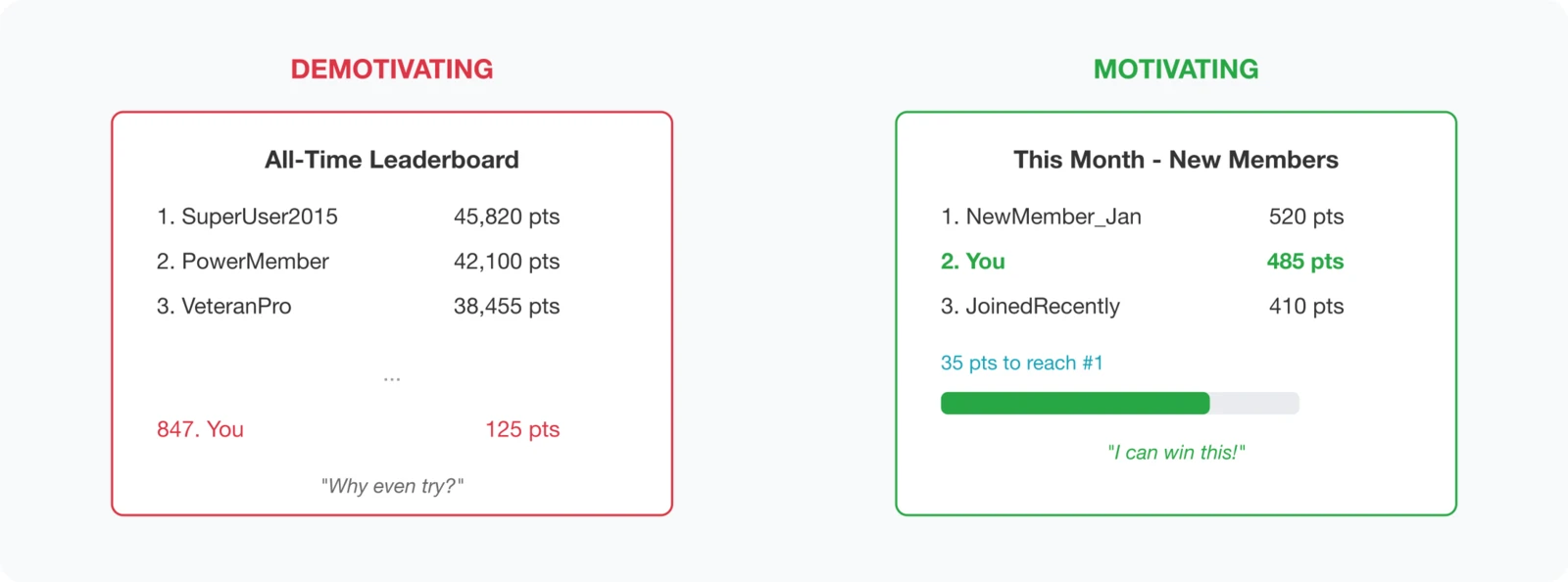
Leaderboards tap into one of the most powerful human motivators: the desire to see how we compare to others. But that same power makes them the riskiest gamification element. They can drive intense engagement among competitive members—and simultaneously demoralize everyone else who feels they can never catch up.
Leaderboard challenges
- Top performers dominate, creating a discouraging gap for newcomers
- Early leaders accumulate advantages that make catching up impossible
- Public ranking can feel like public shaming for those at the bottom
- Some members actively avoid participation to avoid low rankings
Smarter leaderboard design
If you use leaderboards, design them to motivate broadly:
- Time-limited boards: Monthly or quarterly resets give everyone a fresh chance
- Segment by tier: Newcomer leaderboard, regular member leaderboard, power user leaderboard
- Show local ranking: "You're #47 of 500" rather than displaying all 500
- Multiple dimensions: Separate boards for different activities so different members can excel
- Progress metrics: Track improvement, not just totals (most improved this month)
- Team-based: Chapter or committee leaderboards spread credit across groups
Challenges and quests
If you're not sure where to start with gamification, challenges are usually the answer. These time-limited goals with specific rewards create urgency without permanent competitive dynamics—and they're easier to test and iterate on than points systems or leaderboards.
Why challenges work
- Natural urgency: Deadlines motivate action (complete by March 31!)
- Fresh starts: Every new challenge is a new opportunity
- Low commitment: Members can participate in one challenge without ongoing engagement
- Easy to test: Run a challenge, measure results, adjust
Challenge examples
- New member challenge: Complete 5 actions in your first 30 days for a bonus
- Learning challenge: Complete 3 CE courses this quarter for a completion badge
- Engagement challenge: Attend 3 events this year for a recognition
- Community challenge: Post in forums 5 times this month to be entered in a drawing
- Referral challenge: Recruit a new member and both receive rewards
Challenge design tips
- Achievable goals: Most members should be able to complete if they try
- Clear rewards: What exactly do members get? Make it concrete
- Progress visibility: Show members where they stand throughout
- Multiple ways to win: Completion rewards (for all who finish) plus prizes (for random or top performers)
- Community element: Track organizational progress toward collective goals
Implementation guide
When you're ready to add gamification, a phased approach reduces risk and helps you learn what works for your specific membership. Here's a proven structure to follow:
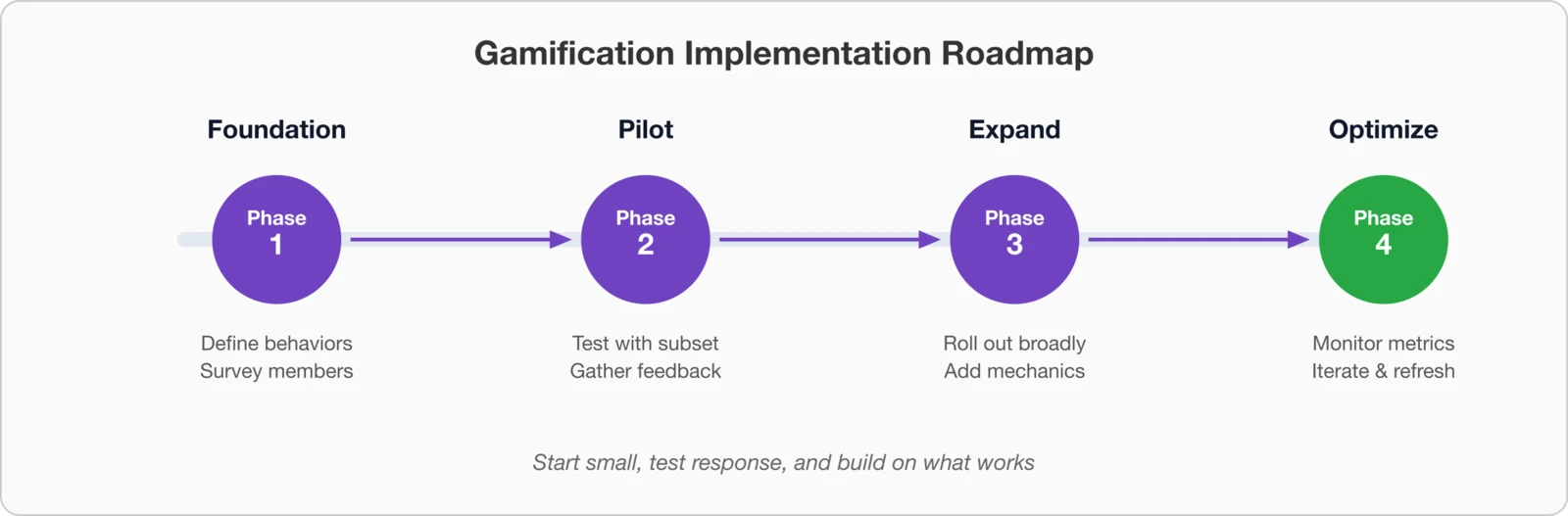
Phase 1: Foundation
- Define what behaviors you want to encourage
- Survey members about interest in gamification elements
- Evaluate your technology platform's gamification capabilities
- Start with a single mechanic (challenges are usually easiest)
Phase 2: Pilot
- Run a time-limited pilot with a subset of members
- Keep it simple—one or two mechanics maximum
- Gather qualitative feedback on member experience
- Measure participation and behavior changes
Phase 3: Expand
- Roll out successful elements to full membership
- Add complementary mechanics (points + badges, not everything at once)
- Create ongoing challenge calendar
- Integrate gamification visibility into the member portal
Phase 4: Optimize
- Monitor engagement metrics continuously
- Adjust difficulty and rewards based on participation
- Retire mechanics that aren't working
- Refresh to prevent staleness (new badges, new challenges)
A modern association management system
Remember: Gamification is a tool, not a strategy. Start with clear engagement goals, then determine if gamification can help achieve them—not the other way around.
Make games work for your members
Gamification works when it aligns game psychology with genuine member value. Points that lead to real rewards, badges that represent meaningful achievement, leaderboards that motivate without demoralizing, and challenges that create urgency around valuable activities—that's the formula.
The key is understanding your members. Not every association needs gamification, and not every gamification element will work for every audience. Start small, test response, and build on what works.
When done right, gamification doesn't feel like manipulation—it feels like recognition and motivation. Members engage more deeply because the feedback loop makes their progress visible and their achievement celebrated.
For more engagement strategies, explore the complete Member Engagement Guide or see how member community features
Key takeaways
- Gamification amplifies, not creates: It makes good experiences more engaging but won't fix boring ones
- Know your audience: Some member demographics embrace gamification; others find it patronizing
- Badges work when scarce: A badge everyone earns means nothing; selective achievement matters
- Leaderboards are risky: They motivate top performers but discourage everyone else
- Start with challenges: Time-limited challenges are the easiest way to test gamification
Looking for Ways to Boost Member Engagement?
i4a's association management platform helps you connect with members, streamline operations, and build stronger communities.
Get in TouchRelated resources
Celebrate member achievements and contributions.
Build thriving discussion communities.
Complete guide to building engaged communities.
Create engaging first experiences for new members.
