Quick Summary: Grace Period Best Practices
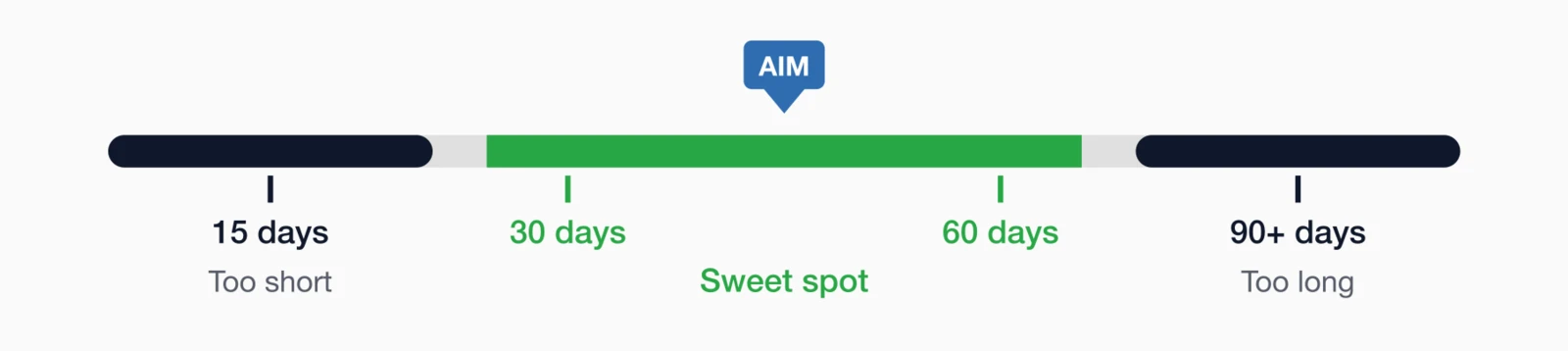
- 30-60 days is the sweet spot: Long enough to catch genuinely delayed renewals (budget cycles, oversights), short enough to maintain urgency and not normalize late payment.
- Match duration to member type: Professional associations typically need 30-45 days; trade associations and chambers need 45-60 days for organizational budget approval cycles.
- Continue partial benefits with warnings: Restricted access that reminds members of value while creating urgency converts better than full access or immediate cutoff.
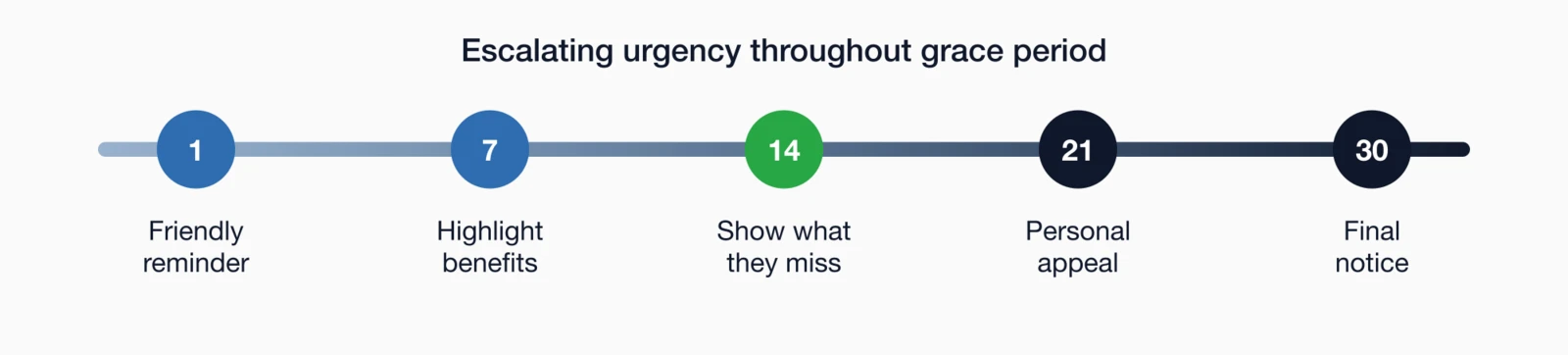
- Escalate communication across 3-5 touches: Start with friendly reminder on day 1, progress to value highlights, then personal appeal, ending with clear final notice.
- Track grace conversion separately: Target 70-80% of grace-period members renewing, with average days-to-renew under 14.
Part of our renewal grace period strategies guide
Grace period best practices balance urgency with opportunity—30-60 days typically works best. This guide covers duration benchmarks, benefit access during grace, and the communication sequence that recovers the most renewals.
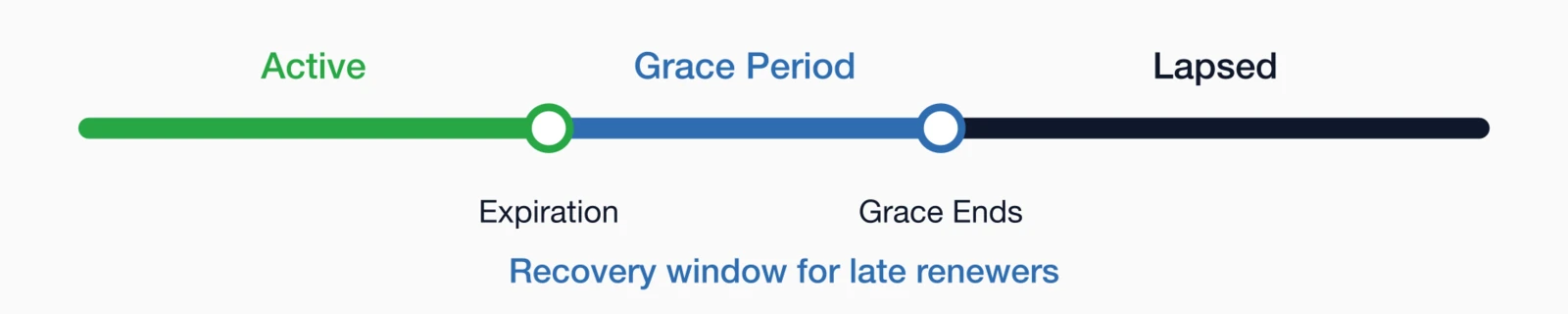
Your member's renewal date has passed, but they haven't renewed yet. What happens now? The grace period — that window between expiration and true lapse — is one of the most important yet often overlooked elements of membership retention.
Here's what I see associations get wrong: They pick a grace period length out of thin air — or worse, they have no formal grace period at all. Some associations let members drift for months after expiration, still receiving benefits, with no urgency to renew. Others cut off access immediately, surprising members who just forgot to click the renewal button. Both approaches leave money on the table.
Get it right, and you'll recover a significant percentage of members who would otherwise be lost. Get it wrong, and you're either leaving money on the table (too short) or training members to ignore renewal deadlines (too long).
What is a grace period?
Before we dive into best practices, let's make sure we're on the same page about what a grace period actually is. A grace period is the window of time after a membership expires during which the member can still renew without penalty or disruption. Think of it as a buffer zone between active membership and true lapse—a second chance window that, when managed well, can recover a significant portion of otherwise lost renewals.
During the grace period, associations typically:
- Continue some or all member benefits
- Intensify renewal communications
- Allow renewal at the standard rate (no reinstatement fees)
- Maintain continuity of membership record
Finding the optimal duration
Many associations align their renewal and grace period policies with broader membership retention best practices
How long should your grace period be? This is where many associations overthink it—or don't think about it at all. The "right" grace period length balances two competing needs:
- Long enough to catch genuinely delayed renewers (budget cycles, vacation, oversight)
- Short enough to create real urgency and not normalize late payment
Industry benchmarks
| Association Type | Typical Grace Period | Rationale |
|---|---|---|
| Professional Associations | 30-45 days | Individuals can act quickly once reminded |
| Trade Associations | 45-60 days | Organizational budgets may need approval cycles |
| Credentialing Bodies | 30 days or less | Credential maintenance requires strict deadlines |
| Chambers of Commerce | 60 days | Small business cash flow considerations |
Grace Period Revenue Calculator
See how grace period conversion rates impact your renewal revenue:
A 15% improvement in grace conversion can often be achieved through better timing and communication.
Real Talk: Stop Being Afraid to Enforce Deadlines
We consistently see associations that are terrified to cut off benefits — even at the end of a generous grace period. They'll let members access member-only content for 6+ months past expiration because "we don't want to upset anyone."
Here's the thing: members who get indefinite free access don't renew. Why would they? You've trained them that the deadline doesn't matter. A firm, fair grace period with clear communication actually increases renewals because it creates real urgency.
Benefit access during grace
One of the most debated questions in grace period policy is what happens to member benefits. Should members retain full access during the grace period, or should you restrict access to create urgency? The answer depends on your specific situation—but there's a clear best practice for most associations.
There are three common approaches:
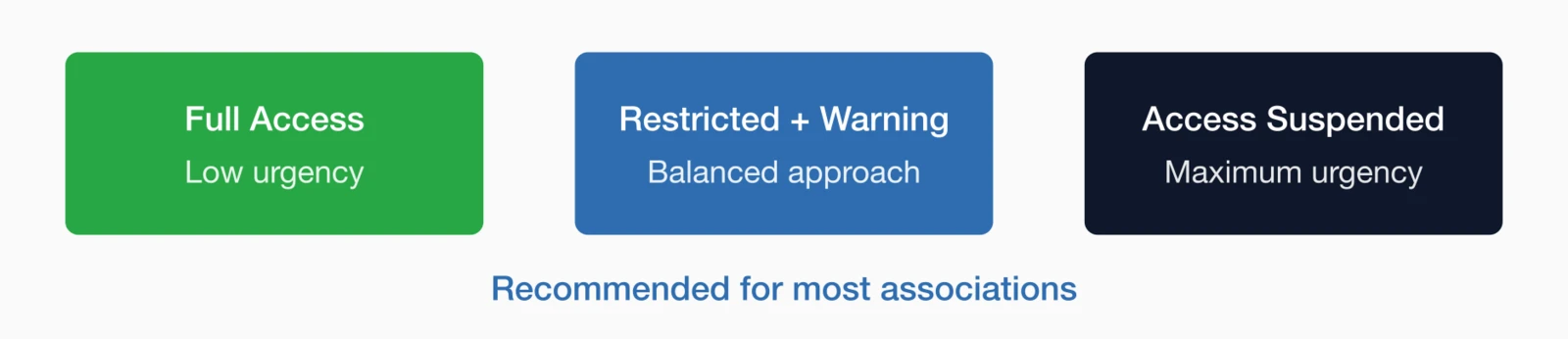
Full access maintained
- Approach: Member experiences no change during grace
- Pros: No friction, demonstrates trust, no support issues
- Cons: Less urgency to renew, may train late behavior
- Best for: High-value organizational members, long-tenured members
Restricted/warning access
- Approach: Members can log in but see prominent renewal warnings; some features may be limited
- Pros: Creates urgency while allowing value demonstration
- Cons: Some technical complexity to implement
- Best for: Most associations — balances urgency with relationship
Access suspended
- Approach: Member access cut off immediately at expiration
- Pros: Maximum urgency, clear deadline enforcement
- Cons: May frustrate members, feels punitive, can damage relationship
- Best for: Subscription-based models, very short grace periods
Recommended Approach: For most associations, restricted access with warning messaging provides the best balance. Members are reminded of value while feeling appropriate urgency. Your association platform
Grace period communication strategy
The grace period is your final opportunity to save the member—and communication is your primary tool. The key is escalating urgency throughout the grace window while providing easy paths to renewal at every touchpoint. Here's a framework that works.
Sample communication sequence
- Day 1: "Your membership has expired" — Friendly reminder with easy renewal link
- Day 7: "Don't miss what's coming" — Highlight upcoming events or content they'll miss
- Day 14: "You're missing out" — Specific benefits they've used that are now unavailable
- Day 21: "We haven't heard from you" — Personal-feeling appeal, possibly from leadership
- Day 28-30: "Final notice" — Clear deadline, consequences of not renewing
Multi-channel approach
Don't rely solely on email. For valuable members or those not responding to email:
- Direct mail letter (especially for organizational members)
- Phone calls from staff or volunteer leaders
- Text/SMS if you have consent
- Social media outreach
Technical implementation
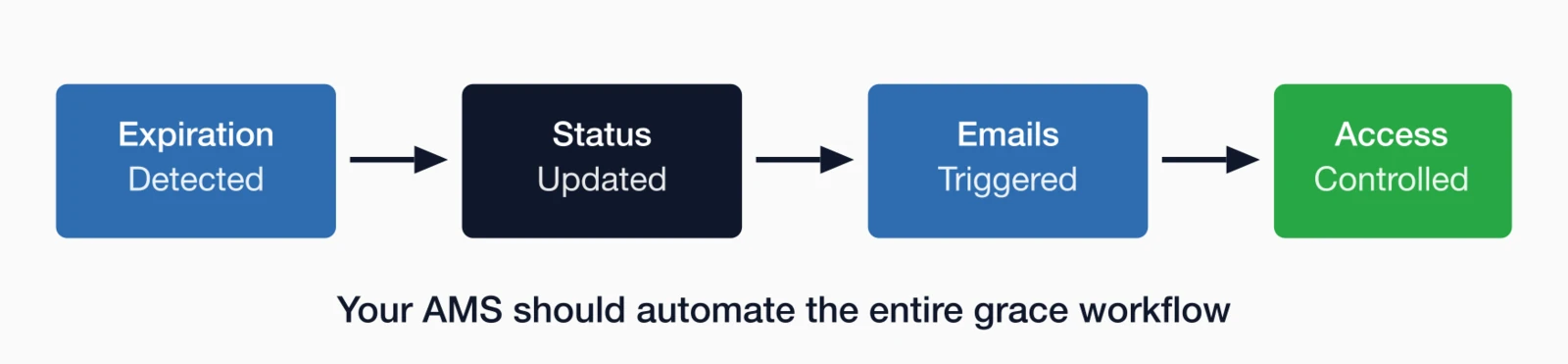
A well-designed grace period policy is only as good as your ability to enforce it consistently. Your association management system should handle grace periods automatically. Here are the key requirements to look for:
Configurable grace period length
Ability to set different grace periods for different member types (organizational members might get 60 days, individuals 30 days).
Automatic status updates
System should automatically move members through Active → Grace → Lapsed statuses based on dates.
Triggered communications
Automated emails triggered at specific points in the grace period. See our guide on automating membership renewals
Benefit access control
Ability to restrict or flag access to member-only areas during grace period.
Reporting
Clear reporting on members currently in grace, conversion rates from grace, and average days-to-renew during grace. Without this data, you can't optimize.
The Hidden Grace Period Cost
Here's something most associations don't consider: if your AMS charges per-member, you're paying for members during their grace period — whether they renew or not.
Some associations shorten grace periods specifically to reduce their AMS costs, which is the wrong reason to make a retention decision. You should set your grace period based on what maximizes renewals, not what minimizes your software bill.
This is why i4a uses flat-rate pricing with unlimited members. Set your grace period based on what works best for your members, not what your AMS charges you. Your retention strategy shouldn't be constrained by per-contact fees.
Special situations
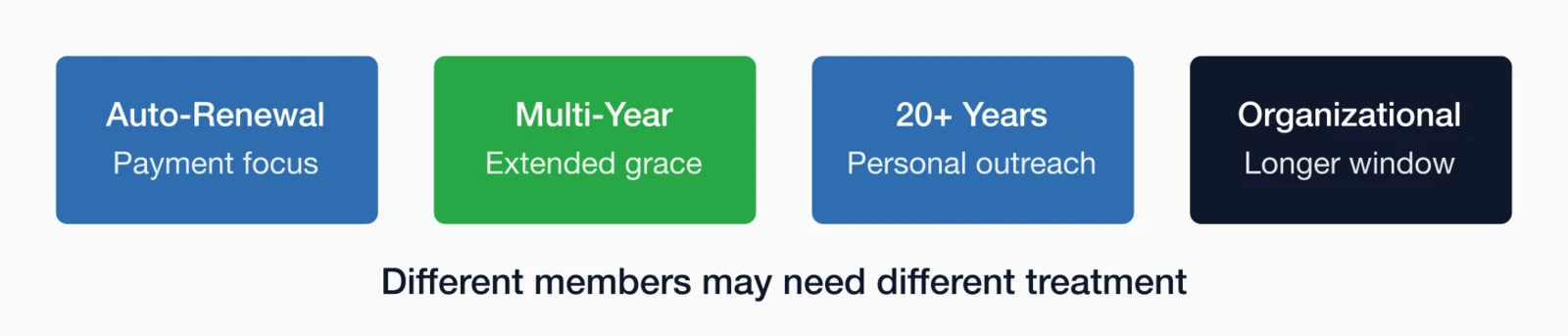
Not every member fits neatly into your standard grace period policy. Here are some common exceptions that need special handling.
Automatic credit card renewals
For members with auto-renewal enabled, failed payment triggers a modified grace period focused on payment recovery rather than renewal decision. See our guide on reducing churn
Multi-year members
Members who paid for multiple years may warrant extended grace periods, as their investment suggests commitment.
Long-tenured members
A 20-year member who misses renewal deserves different treatment than a first-year member. Consider extended grace or personal outreach for your most loyal members.
Organizational vs. individual members
Organizational memberships often need longer grace periods due to internal approval processes and budget cycles.
Measuring effectiveness
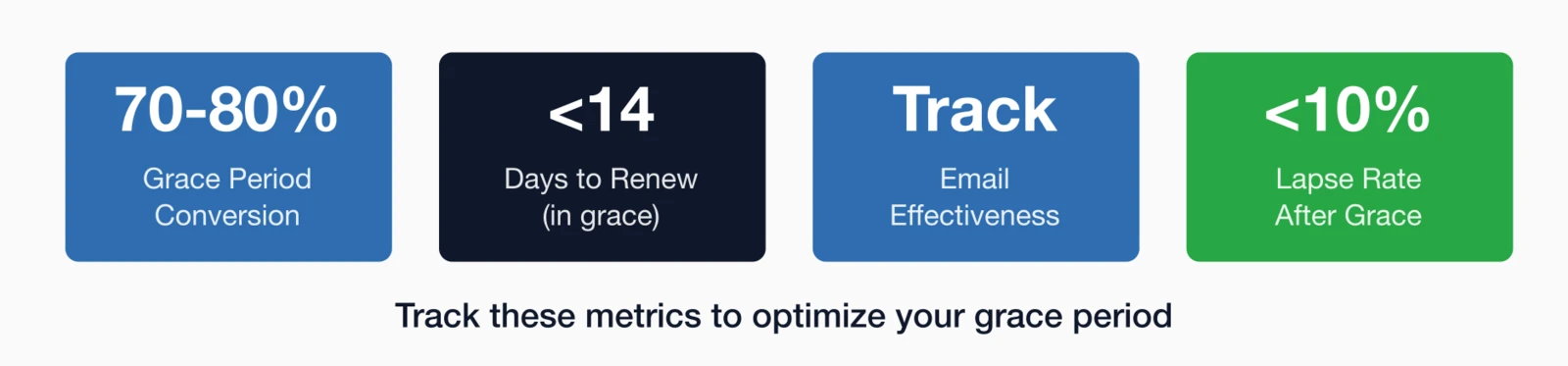
You can't improve what you don't measure. Track these metrics to understand whether your grace period policy is working—and where you have room to improve:
| Metric | Target | What It Tells You |
|---|---|---|
| Grace Period Conversion Rate | 70-80% | % of grace members who renew |
| Days to Renew (in grace) | Under 14 | How quickly grace members act |
| Communication Touch Effectiveness | Varies | Which emails drive most renewals |
| Lapse Rate After Grace | Under 10% | % who truly leave after grace ends |
Setting your policy
If you're establishing or revising your grace period policy, here's a practical approach that balances analysis with action:
- Analyze historical data: When do most late renewals come in? That tells you where your natural grace period falls.
- Understand your member base: Individual professionals can act faster than organizational budget processes.
- Test and measure: If unsure, try different grace periods for different renewal cohorts and compare conversion rates.
- Document and communicate: Once set, document the policy and ensure staff understand the rationale.
For more retention strategies, see our comprehensive Membership Retention Strategy Guide
Have questions about grace period configuration? Contact us
Key takeaways
- 30-60 days is the sweet spot for most associations — long enough to catch stragglers, short enough to maintain urgency
- Continue partial benefits during grace to remind members of value while creating urgency
- Communicate clearly: 3-5 touchpoints during the grace period with escalating urgency
- Track grace period conversions separately to measure effectiveness
- Configure grace periods in your membership software for automatic enforcement
Automate Grace Period Management
i4a automatically manages grace periods, status changes, and renewal communications—ensuring no member falls through the cracks during this critical retention window.
Learn About Renewal AutomationRelated resources
Complete 2026 strategy guide for improving member retention.
Complete automation guide for renewal processes.
10 proven strategies to reduce member churn.
Re-engage lapsed members with effective win-back strategies.
