Quick Summary: Improving Member Experience
- Member experience is every interaction: From recruitment to renewal and advocacy, each touchpoint shapes whether members stay or leave.
- Retention beats recruitment: It costs significantly more to acquire a new member than to keep an existing one. Strong experience drives renewals, event attendance, and referrals.
- Personalization matters: Generic outreach gets ignored. Tailor communications by member type, career stage, and interests for better results.
- Simplify your technology: Disconnected systems frustrate members and staff. An integrated AMS connects the entire experience.
- Start small, measure consistently: You don't need a larger team. Focus on one lifecycle stage at a time and track what matters.
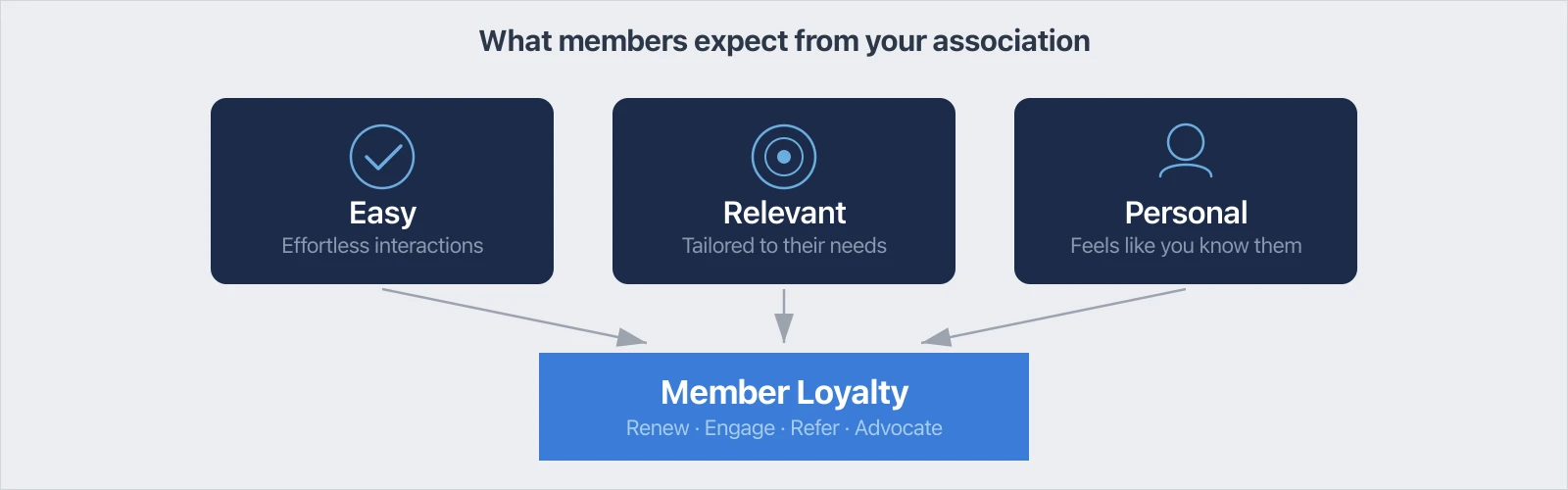
Association membership has always been about relationships. But expectations have changed. Members now compare your association to the digital experiences they get everywhere else. They want things to be easy. Relevant. Personal.
Research from PwC found that 73% of consumers say experience is a key factor in their spending decisions—and they'll pay up to 16% more when the experience is right. Members apply the same standard to their dues. When they feel the experience matches the investment, they stay. When it doesn't, they look elsewhere.
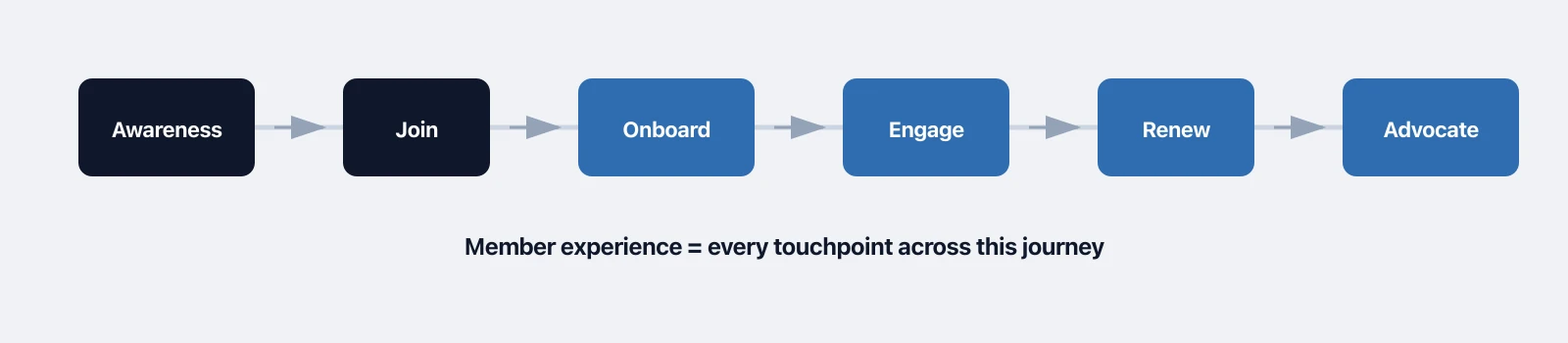
Member experience includes every interaction someone has with your organization. From the first time they hear about you to renewal and, ideally, advocacy.
When the experience is strong, members renew. They attend events. They refer colleagues. They buy additional programs.
When it falls short, trust fades. And dues become harder to justify.
After 30 years working with associations of all sizes, I've seen this pattern play out hundreds of times. The organizations that invest in experience keep their members. The ones that take members for granted lose them. It's that straightforward.
This guide walks through what matters most in 2026. We'll follow the member journey from awareness to advocacy and share 10 practical strategies to improve member outcomes at every stage.
What Is Association Member Experience?
Member experience is the sum of every interaction a member has with your association.
That includes:
- Marketing and recruitment
- Onboarding
- Events and programs
- Community engagement
- Renewal
- Customer service
It covers digital experiences, in-person events, and everyday communications.
At its core, member experience is about perceived value. Not the value you think you're delivering, but the value members actually feel in their daily professional lives.
- Do members feel understood?
- Do they see benefits that matter to their careers?
- Do interactions feel thoughtful and consistent?
If the answer is yes, loyalty grows. If not, churn follows.
Think of it this way: member experience is not a single department's responsibility. It's the cumulative result of every email you send, every event you run, every support request you handle, and every login to your member portal. Each touchpoint either builds trust or erodes it.
Why Member Experience Is Critical for Retention and Growth
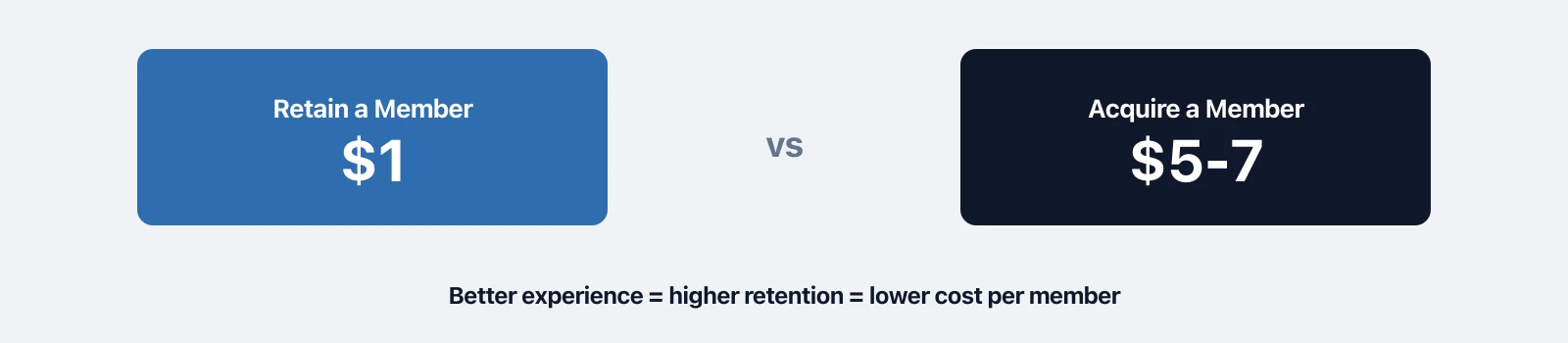
Retention is more cost-effective than recruitment. According to Harvard Business Review, acquiring a new customer costs five to 25 times more than retaining an existing one. Bain & Company found that even a 5% improvement in retention can increase profits by 25% to 95%. When you calculate the lifetime value of a member, the case for investing in experience becomes clear.
Loyal members:
- Renew consistently year after year
- Spend more on events, education, and certifications
- Recommend your association to colleagues
- Volunteer for committees and leadership roles
- Provide feedback that helps you improve
Strong experience drives all five. And the inverse is equally true: poor experience undermines every one of them. The 2025 Membership Marketing Benchmarking Report from Marketing General found that 56% of associations have plateaued or declined in membership over the past year. In most cases, the root cause traces back to experience.
Many associations recognize this shift. More teams are investing in personalization, new products, and AI tools to better serve members. That investment isn't about keeping up with trends. It's about modernizing how you engage members in a world where they have more choices than ever for their professional development and networking.
I often tell association leaders: your biggest competitor is not another association. It's indifference. When members stop caring about your organization, they don't leave in protest. They just quietly don't renew. That's why experience matters. It's the difference between a member who actively chooses you and one who simply forgets.
10 Proven Ways to Improve Member Experience for Associations
Here are practical steps you can take right now. You don't need to implement all 10 at once. Start with the areas where your organization has the most room to grow.
1. Use Member Data to Understand Real Needs
Start by listening.
Use surveys. Review engagement data. Look at event attendance, email clicks, and renewal history.
Centralize that data in your AMS or CRM so your team sees one clear picture. When member data lives in separate spreadsheets and disconnected tools, nobody has a complete view of the member.
From there, segment members by:
- Career stage (student, early-career, mid-career, executive, retired)
- Industry focus or specialty area
- Membership type and tenure
- Interests and content preferences
When you understand patterns, you can spot who is thriving and who may be drifting away. You can also identify which benefits members actually use versus which ones go untouched.
This matters more than most associations realize. The same Marketing General benchmarking data shows that first-year members renew at a median rate of just 75%—nine points below the 84% overall renewal rate. Without data to identify these at-risk members early, many will quietly lapse before you ever know there was a problem.
That clarity makes every next step smarter.
How i4a Helps: i4a's membership management system centralizes all member data in one place, with custom reporting tools that let you build engagement reports, track renewal patterns, and segment members by any data field.
2. Personalize Member Communications
Generic emails feel invisible. Personalized communication feels intentional.
This can be simple:
- Different welcome paths for students vs. senior leaders
- Event recommendations based on past attendance
- Newsletters tailored to member interests
- Renewal messages that reference specific benefits the member has used
You don't need complexity. You need relevance. A member who works in healthcare policy doesn't need to see every event invitation for manufacturing professionals. And a 20-year veteran doesn't need the same onboarding emails as someone who joined last week.
Small improvements in personalization lead to measurable gains. Industry benchmarking data shows that segmented email campaigns achieve 14% higher open rates and over 100% higher click-through rates compared to generic blasts. Even something as basic as segmenting your list by member type can make a meaningful difference.
How i4a Helps: i4a's email tools let you segment communications by any member field—type, interest, renewal date, location—so every message reaches the right audience.
3. Make Renewal Easy
Renewal is a critical moment. It's the one time each year when members actively decide whether your organization is worth their investment.
Some members lapse for a simple reason. They forget. Others hit friction in the process—a confusing payment page, an expired credit card, a form that asks them to re-enter information you already have.
Offer auto-renewal. Send timely reminders starting well before the expiration date. Make payment simple with saved payment methods and multiple options.
Also be transparent. Make policies clear. Make opt-out easy. Members who feel trapped don't become advocates. Members who feel respected do.
Convenience builds trust. Friction weakens it. And when members do lapse, a well-timed win-back campaign can still bring them back.
How i4a Helps: i4a includes automated renewal reminders, saved payment methods, auto-renewal functionality, grace period configuration, and multiple payment options including installment plans. Members can renew 24/7 through the self-service portal.
4. Build a Strong Member Community
Community is one of the top reasons people join associations. Benefits and resources matter, but relationships create true stickiness. When members form genuine connections with peers, leaving the organization means leaving a community—not just canceling a subscription.
Give members space to connect. This can include:
- Online discussion forums where members ask questions and share advice
- Mentorship programs pairing experienced members with newcomers
- Interest-based groups or special interest committees
- Member directories that make it easy to find peers
Encourage connection before and after events, not just during them. The conversations that happen in the hallway are often more valuable than the keynote—give members digital spaces where those conversations can continue year-round.
When members build relationships with each other, retention increases naturally. People don't leave communities they're embedded in. According to ASAE, lack of engagement is the top reason members cite for not renewing. Community gives them a reason to stay engaged between events.
How i4a Helps: i4a's member community features include discussion forums, member directories, and interest-based groups—all integrated with your membership data.
5. Improve the Event Experience
Events are often your most visible touchpoint. A well-run conference or webinar series can reinforce a member's decision to stay. A poorly organized one can accelerate their departure.
Make registration easy. Keep check-in smooth. Follow up thoughtfully with session recordings, slides, and next steps.
Use event data to improve future programs. Look at:
- Session attendance and which topics draw the most interest
- Post-event survey feedback
- Engagement during sessions (questions asked, polls answered)
- Revenue per attendee and cost per registrant
Events should feel organized and intentional. Not chaotic. Members remember how an event made them feel long after they forget the specific content.
A good event experience often strengthens renewal decisions. A bad one raises the question: "What am I paying for?"
How i4a Helps: i4a's event management tools handle registration, payments, attendee tracking, and post-event follow-up—all connected to your member records.
6. Simplify Your Technology Stack
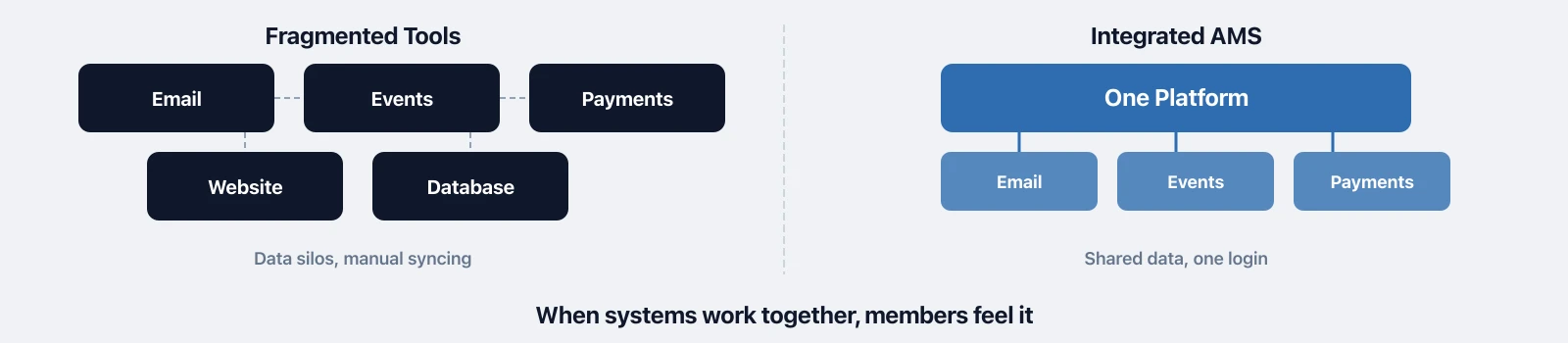
Disconnected systems create frustration—for members and staff alike.
Members should not feel like they're moving between separate worlds when they:
- Visit your website
- Register for events
- Log into the community
- Pay dues or purchase products
- Update their profile
An integrated AMS helps connect these experiences. Single sign-on. Unified data. Clean member portals. When a member updates their address in one place, it should be updated everywhere.
When systems work together, members feel it. And staff save significant time that would otherwise be spent on manual data entry, reconciliation, and troubleshooting between disconnected tools.
7. Use Automation to Free Up Staff Time
Small teams often worry they don't have the bandwidth to improve experience. That's exactly where automation helps. It handles the repetitive work so your team can focus on meaningful, human interactions.
You can automate:
- Onboarding email sequences triggered when new members join
- Renewal reminders on a timed schedule
- Payment processing and receipt generation
- Basic reporting and data exports
- Event confirmation and follow-up emails
AI tools can help identify members at risk of churn before they lapse. Chatbots can handle routine questions like "How do I reset my password?" or "When is the next conference?"
Automation is not about replacing people. It is about freeing your team to have the conversations that actually move the needle—calling a long-time member who seems disengaged, or personally welcoming a high-profile new member.
8. Invest in Professional Development
For many members, professional growth is the primary reason they joined. If your association doesn't help them advance their careers, they will find one that does—or they will decide they don't need an association at all.
Professional development can take many forms:
- Certification and credentialing programs
- Continuing education courses and webinar series
- Leadership development tracks
- Peer-led workshops where members teach each other
- Career resources like job boards, resume reviews, or salary guides
The key is making these opportunities visible and accessible. If members have to dig through your website to find them, most won't bother. Feature professional development prominently in your communications, your member portal, and your event calendar.
Peer-led content is especially powerful. When members contribute as instructors or panelists, they become more invested in the organization. They go from consumers to contributors, which deepens their connection and makes them far less likely to leave.
9. Create Feedback Loops That Drive Real Change
Asking for feedback is easy. Acting on it's what separates great associations from average ones.
Many organizations send annual surveys, compile the results into a report, and then file it away. Members notice. When they take the time to share concerns and see nothing change, they stop responding to surveys—and eventually stop renewing.
Build feedback into your regular operations:
- Post-event surveys after every conference, webinar, and workshop
- New member check-ins at 30, 60, and 90 days
- Annual or semi-annual member satisfaction surveys
- Exit surveys for members who don't renew
- Informal feedback channels like community forums or office hours
The critical step is closing the loop. When members tell you something is broken and you fix it, tell them. "You asked, we listened" is one of the most powerful messages you can send. It shows members their voice matters and gives them a reason to stay engaged.
10. Support Advocacy and Give Members a Voice
Members want to feel like they belong to something that matters. Advocacy—whether it's lobbying on industry issues, publishing position papers, or mobilizing members around shared causes—gives your association a purpose beyond networking and education.
Effective advocacy engagement includes:
- Regular updates on policy issues that affect your members' industries
- Easy ways for members to contact elected officials or sign petitions
- Grassroots campaigns where members can share their stories
- Recognition for members who actively participate in advocacy efforts
Even associations that are not heavily policy-focused can give members a voice. Invite members to contribute to your blog. Feature their success stories. Let them vote on conference topics or strategic priorities. When members feel ownership over the direction of the organization, they're far more likely to stick around.
Common Mistakes That Hurt the Member Experience
Even strong organizations slip up. Here are the mistakes I see most often:
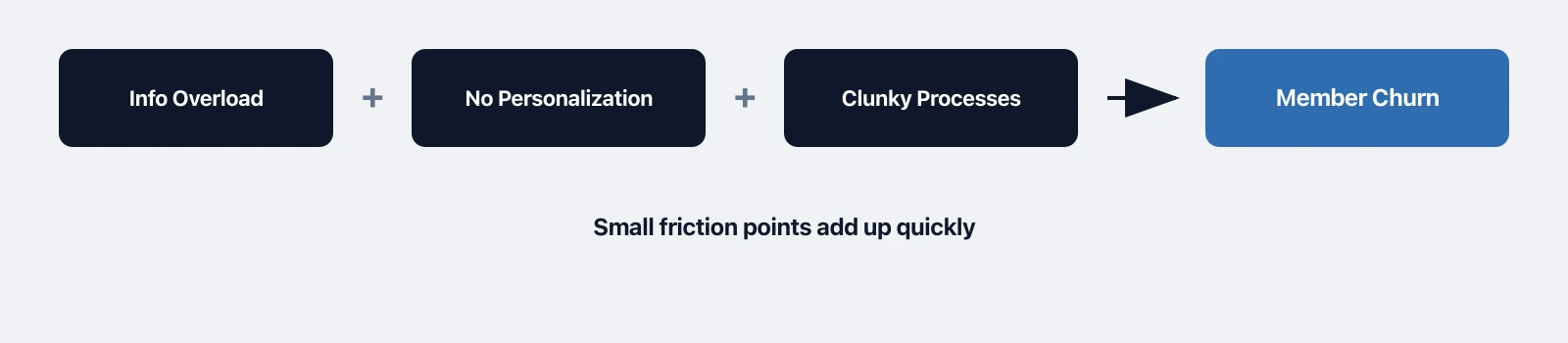
- Too much information at once: Flooding new members with emails in the first week creates overwhelm. Space out your onboarding communications over the first 90 days instead.
- No personalization: Members feel like a number when every message is the same generic blast. Even basic segmentation by member type makes a difference.
- Complicated processes: Paper forms. Outdated payment systems. Clunky registration pages that require multiple logins. Every extra step is a chance for members to give up.
- Fragmented branding across chapters: When local chapters look and feel different from the national organization, it creates confusion about what the member actually belongs to.
- Treating onboarding as a one-time event: Engagement should continue for months, not days. A single welcome email is not an onboarding program. ASAE research found that members who engage in three or more activities during their first year renew at significantly higher rates—yet only 18% of associations offer personalized onboarding.
- Ignoring feedback: Asking members for input and then doing nothing with it's worse than not asking at all. It signals that you don't actually care what they think.
- Only communicating when you want something: If every email is a renewal notice, event registration, or donation request, members learn to tune you out. Lead with value first.
Small friction points add up quickly. One awkward payment form is annoying. A dozen small frustrations over the course of a year become a reason not to renew.
How an AMS Supports Every Stage of the Member Lifecycle
A modern AMS should support members from their first interaction to long-term advocacy. When your technology connects the full journey, members experience a cohesive organization rather than a collection of disconnected departments.
- Recruitment: Easy online join forms with immediate confirmation. Clean integration with your website and marketing tools.
- Onboarding: Automated welcome email sequences. Guided setup steps in the member portal. Early engagement tracking to identify members who need extra attention.
- Engagement: Member portals with personalized dashboards. Community spaces for peer interaction. Event registration with one-click sign-up for logged-in members.
- Renewal: Auto-renewal with saved payment methods. Smart reminders timed to each member's renewal date. Data-driven outreach for at-risk members.
- Advocacy: Tools that make it easy to refer colleagues, share success stories, or participate in campaigns. Member directories that facilitate peer connections.
When technology supports the journey, experience feels cohesive. When it does not, every gap between systems becomes a gap in the member's trust.
How i4a Helps: i4a's all-in-one platform connects membership, events, email, payments, community, and reporting in a single system—so members get a seamless experience and staff get a complete picture of every member.
Key Metrics to Track
You can't improve what you don't measure. But you also don't need to track everything. Focus on metrics that directly inform decisions about member experience.
Retention metrics:
- Overall renewal rate: Your most fundamental indicator of member satisfaction
- First-year renewal rate: Often significantly lower than overall renewal, making it your biggest opportunity
- Churn rate: The inverse of retention—track it by segment to find patterns
Engagement metrics:
- Engagement score: A composite of login frequency, event attendance, email opens, and resource usage
- Event attendance and satisfaction: Both the number of attendees and their post-event feedback
- Email open and click rates: Segment by communication type to see what resonates
- Community participation: Forum posts, directory searches, group activity
Experience metrics:
- Net Promoter Score (NPS): Would members recommend your association to a colleague?
- Staff response time: How quickly do you resolve member questions and issues?
- Onboarding completion rate: What percentage of new members complete key first steps?
Review trends regularly. A single data point is a snapshot. Trends over quarters and years tell you whether your experience is actually improving.
How Small Association Staff Can Improve Experience Without Extra Work
You don't need a larger team to improve member experience. You need focus and the right tools.
In my experience working with associations, some of the best member experiences come from small organizations with limited staff. They succeed because they're close to their members, they know them personally, and they use technology to handle the repetitive work.
Here is a practical approach for small teams:
- Centralize data first. Get all member information into one system. This is the foundation everything else builds on.
- Automate repetitive tasks. Welcome emails, renewal reminders, event confirmations—set them up once and let them run.
- Use AI thoughtfully. AI can help identify at-risk members, suggest content, and handle routine questions. It's not a replacement for personal connection, but it can free you up to provide more of it.
- Empower volunteers. Members who moderate forums, mentor newcomers, or lead committees extend your team's reach without adding headcount.
- Focus on one lifecycle stage at a time. Do not try to fix everything at once. Improve onboarding this quarter. Tackle renewal next quarter. Steady progress adds up.
Consistency matters more than complexity. A small team that reliably delivers a good experience will outperform a large team that delivers an inconsistent one.
Frequently Asked Questions
Member experience is the overall impression members form based on every interaction with your organization—from recruitment and onboarding through engagement, renewal, and advocacy. It encompasses digital experiences, in-person events, communications, and customer service.
Better experience increases satisfaction and renewal rates. Poor experience increases churn. Members who feel understood and supported are far more likely to renew, attend events, and refer colleagues. The connection is direct: when members consistently experience value, they stay.
Use data to personalize outreach. Build community spaces where members connect with peers. Automate routine tasks so staff can focus on meaningful interactions. Start with one area—like onboarding or renewal—and improve it before moving on to the next.
An AMS centralizes member data, connects systems like events, email, and payments, and supports automation across the entire member lifecycle. It serves as the technology backbone that makes personalized, seamless member experiences possible at scale.
An integrated AMS, event management tools, community platforms, email marketing systems, and analytics solutions all play a role. The most important factor is that these tools work together with shared data rather than operating as disconnected silos.
Member experience is the broader concept—it covers every interaction and impression across the entire member journey. Member engagement is one component of experience, focused specifically on how actively members participate in your programs, events, and community. Strong experience leads to higher engagement, and higher engagement reinforces a positive experience.
Track a combination of retention metrics (renewal rate, churn rate), engagement metrics (event attendance, email engagement, portal logins), and satisfaction metrics (Net Promoter Score, survey results). No single metric captures the full picture, so use a dashboard approach that shows trends over time.
Run a comprehensive satisfaction survey annually or semi-annually. Supplement with shorter, targeted surveys after events and at key lifecycle moments (post-onboarding, pre-renewal). The goal is continuous feedback without survey fatigue—keep individual surveys brief and always act on what you learn.
Improve Your Association's Member Experience with the Right AMS
Great member experience doesn't happen by accident.
It comes from clear data. Thoughtful communication. Simple systems. And a genuine commitment to understanding what your members need at every stage of their journey.
When members feel understood and supported, they stay. They participate. They advocate. They become the kind of members who make your association stronger for everyone.
Take time to map your current member journey. Identify the friction points. Then choose technology and processes that support your mission—not the other way around.
The goal is simple. Make it easy for members to belong.
Key takeaways
- Member experience covers every touchpoint from recruitment through advocacy—not just events and emails
- Retention is cheaper than acquisition: Invest in experience to keep members renewing year after year
- Personalize communications based on member type, interests, and renewal date—even basic segmentation helps
- Simplify technology: An integrated AMS connects the full member journey and eliminates data silos
- Build feedback loops: Ask members what they need, act on it, and tell them what changed
- Start small and measure: Focus on one lifecycle stage at a time and track what matters
Deliver a Better Member Experience
i4a's all-in-one AMS connects membership, events, email, payments, and community into a single platform—so every member interaction feels seamless. Personalize communications, automate routine tasks, and give your team the tools to focus on what matters.
See How i4a Improves Member ExperienceRelated resources
Complete 2026 strategy guide for improving retention across the entire member lifecycle.
Complete 90-day framework to turn new members into engaged advocates.
Proven tactics to identify at-risk members and prevent churn before it happens.
Complete guide to renewal automation that reduces churn and saves staff time.
