Quick Summary: Membership Pricing
- Tiered pricing increases revenue: Associations typically see 15-25% more revenue when moving from flat to tiered models.
- Half of associations raised dues in 2024: The MGI benchmarking report shows 49% increased pricing, with 46% using category-based tiers.
- Match model to membership type: Trade associations with diverse organizational members benefit from tiers; professional associations with individual members often work best with flat pricing.
- Keep tiers simple and meaningful: Limit to 3-5 levels with clear, verifiable criteria like employee count or annual revenue.
- Technology must support your model: Your AMS needs to handle tier assignment, invoicing, and reporting for your chosen structure.
Part of our membership pricing guide
Membership pricing strategies determine whether you maximize revenue, accessibility, and retention—or leave money on the table. Tiered pricing often increases association revenue significantly over flat rates. Here's how to choose the right model for your organization.
For associations wrestling with this decision, the core question usually comes down to: Should we charge everyone the same rate, or should we tier our pricing based on member characteristics? The answer often differs by organization type—trade associations with organizational members typically benefit from tiered structures, while professional associations
Here's what I've learned after 30 years: The pricing debates I see at association board meetings are often the wrong debates. Boards will spend hours arguing about whether dues should be $495 or $525, when the real question is whether their pricing structure captures the full value spectrum of their membership.
The answer depends on your membership base, organizational goals, and operational capacity. Let's break down both approaches.
Pricing fundamentals for associations
Before diving into specific models, it's worth stepping back to understand what membership pricing is actually trying to accomplish. Pricing isn't just about covering costs—it shapes how members perceive your association and influences who joins in the first place.
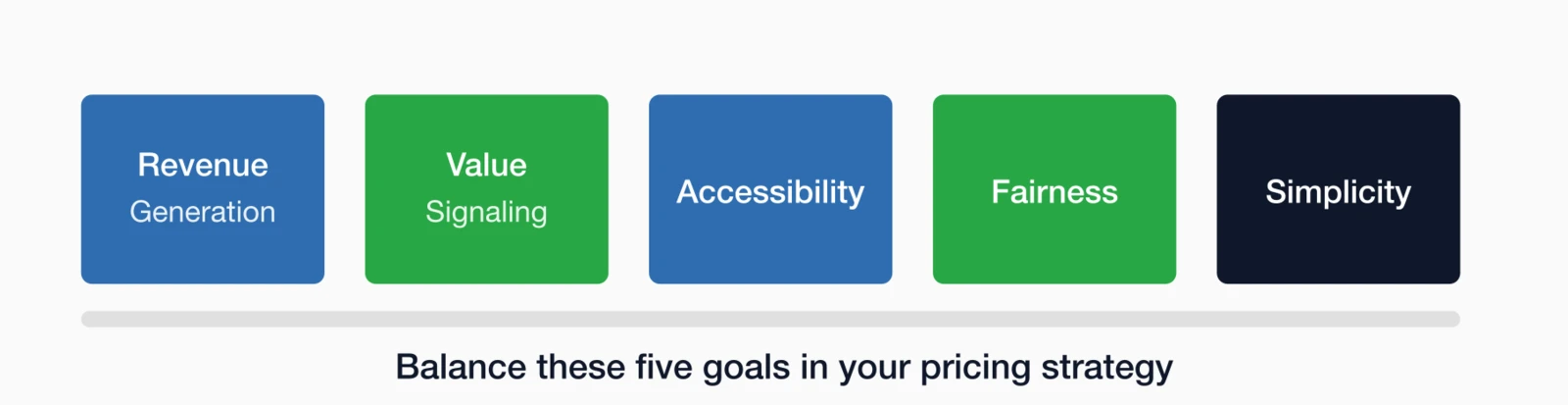
- Revenue generation — covering operational costs and funding programs
- Value signaling — price communicates perceived value to potential members
- Accessibility — ensuring membership is attainable across your target market
- Fairness — members should feel they're paying appropriately for what they receive
- Simplicity — complex pricing creates friction and confusion
The 2025 Membership Marketing Benchmarking Report from Marketing General Inc. reveals current pricing practices:
- 49% of associations raised dues in 2024
- 24% raise dues annually; another 35% raise every 2-5 years
- 46% offer membership categories with different pricing tiers
No pricing model perfectly optimizes all five factors. The key is understanding which factors matter most for your association.
Flat pricing: Simplicity and equality
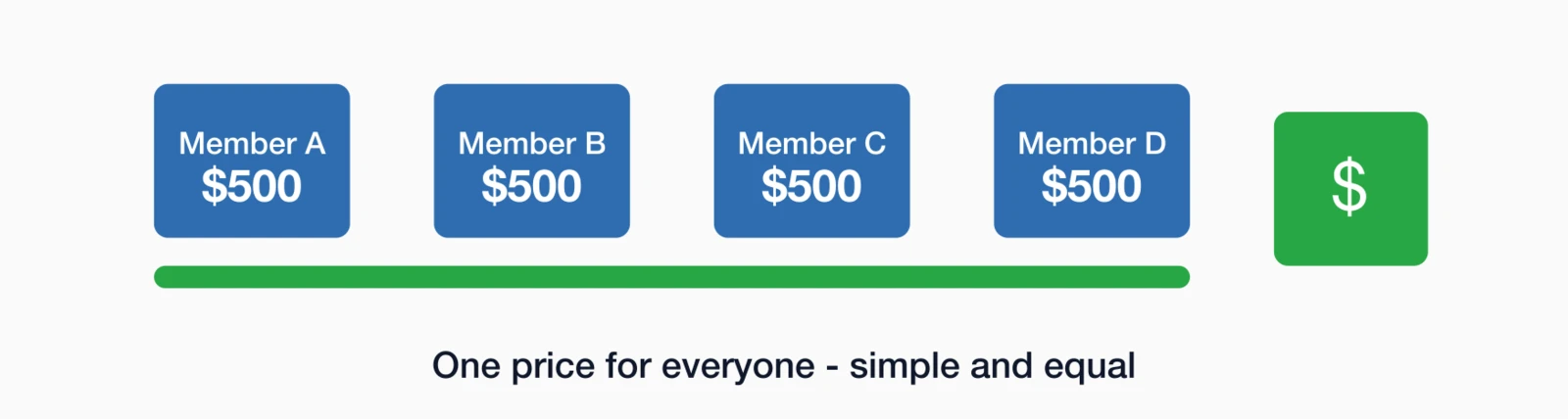
Flat pricing means every member pays the same annual dues, regardless of company size, revenue, or any other variable. It's the simplest model to implement and communicate, and there are situations where it's genuinely the right choice.
Advantages of flat pricing
- Easy to understand: No confusion about which tier applies
- Simple to administer: Less complexity in billing, reporting, and member management
- Democratic perception: Every member has equal standing
- Lower acquisition friction: Prospects don't need to provide company data to get a price
Disadvantages of flat pricing
- Revenue left on the table: Large organizations can easily afford more but aren't asked to pay it
- Potential barrier for small members: The single price may be too high for smaller organizations
- Fairness questions: Is it really fair for a 10-person company to pay the same as a 10,000-person enterprise?
When flat pricing works best
- Individual professional memberships (everyone is truly equal)
- Homogeneous membership bases with similar-sized organizations
- Associations with limited administrative capacity
- When membership value is truly equal regardless of organization size
Tiered pricing: Capturing more value
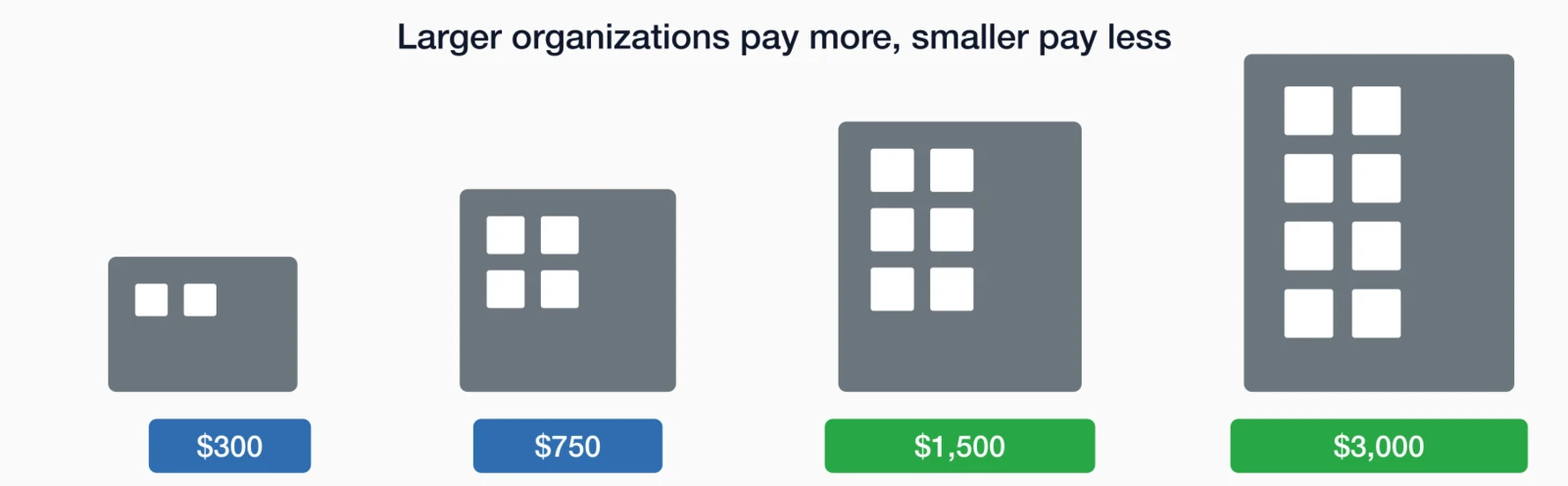
Tiered pricing charges different rates based on member characteristics—typically company size, annual revenue, number of employees, or budget. This model is used by the majority of trade and professional associations with organizational members, and there's a reason for its popularity.
Advantages of tiered pricing
- Increased revenue: Associations typically see 15-25% more revenue when moving from flat to tiered pricing
- Greater accessibility: Lower entry points for smaller organizations
- Perceived fairness: Larger organizations pay more, which most members find reasonable
- Segmentation data: Tier information provides valuable insights about your membership base
Disadvantages of tiered pricing
- Administrative complexity: Must verify and manage tier placement
- Verification challenges: Members may under-report to get lower rates
- Tier boundary friction: Organizations near tier boundaries may push back
- Upgrade resistance: Growing members may resist moving to higher tiers
Common tier criteria
- Employee Count: Easy to verify, widely understood — best for trade associations
- Annual Revenue: Directly tied to ability to pay, but verification is harder
- Budget/Assets: Appropriate for nonprofit members
- Geographic Scope: Local vs. regional vs. national operations
Best Practice: Keep tiers to 3-5 levels. More than that creates confusion and administrative burden. Make sure the price jumps between tiers are meaningful — $500, $550, and $600 isn't differentiation; $500, $1,000, and $2,500 is.
Tiered Pricing Revenue Calculator
See how tiered pricing could increase your revenue:
*Assumes small members at 60% of flat rate, mid at 100%, large at 150%. Your results may vary.
Hybrid and alternative models
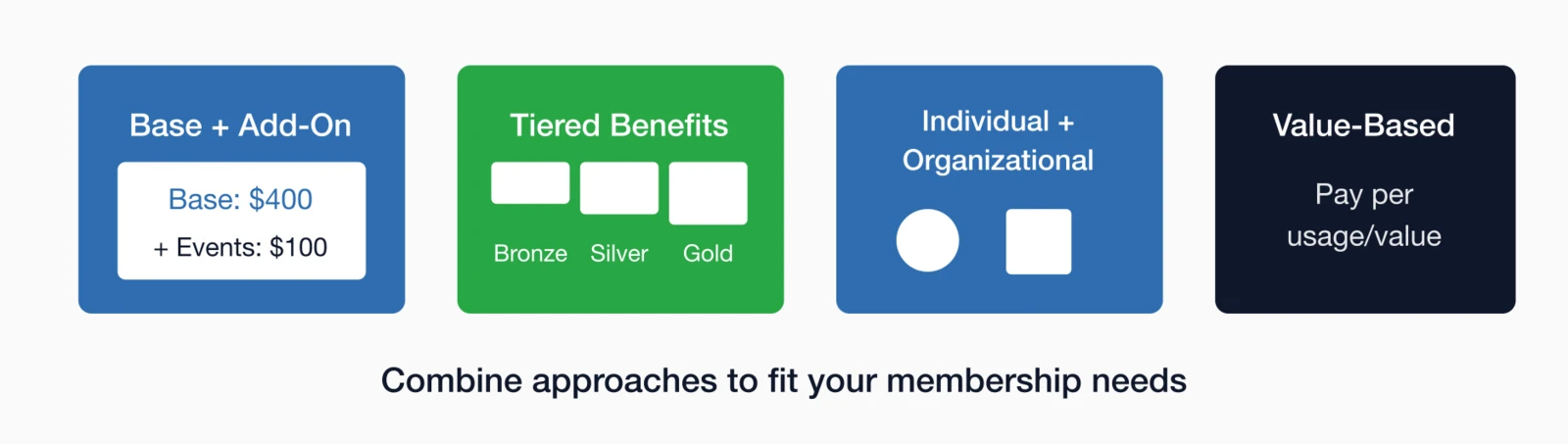
Many associations find success with models that combine elements of flat and tiered pricing, or that introduce other variables. These hybrid approaches can offer the best of both worlds when designed thoughtfully.
Base + add-on model
Everyone pays a flat base rate, with optional add-ons for enhanced benefits. This maintains simplicity while allowing revenue optimization.
Tiered benefits model
Different price points come with different benefit packages (Bronze, Silver, Gold). Members self-select based on the value they want.
Individual + organizational model
Organizations pay a flat rate, but individual professionals within those organizations pay a separate (usually discounted) rate for personal membership.
Value-based pricing
Pricing based on the specific value delivered — for example, charging based on number of certifications, job postings, or event registrations included.
Which model is right for you?
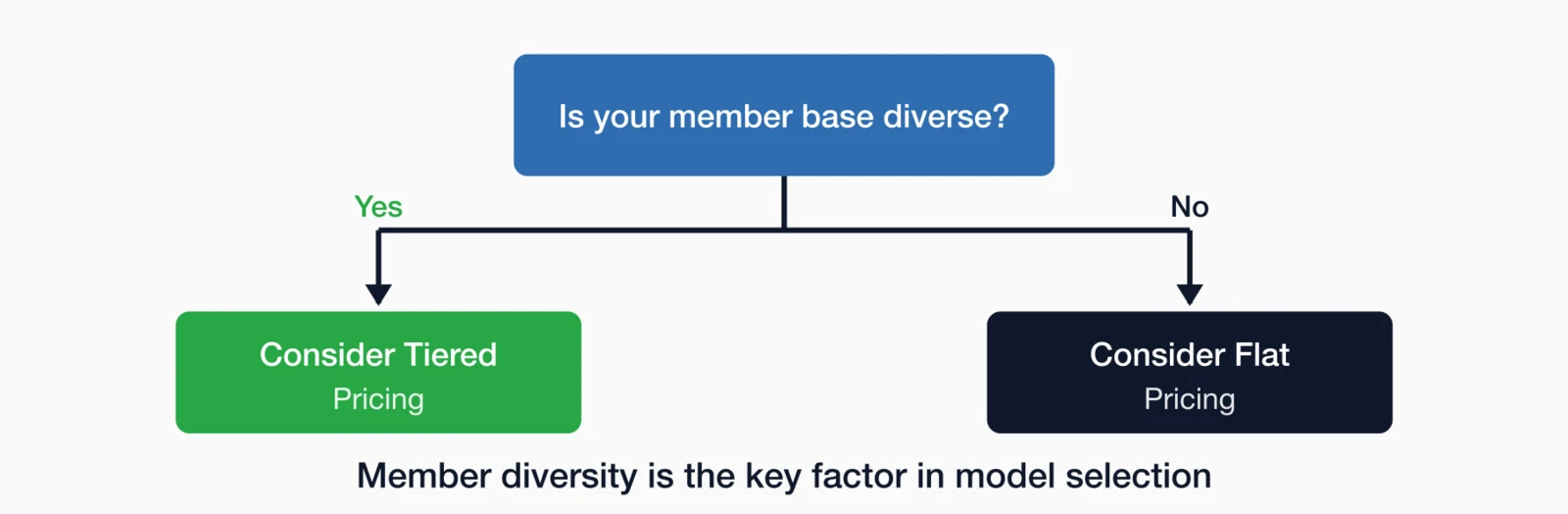
The answer isn't universal—it depends on your specific membership base and organizational context. Use this framework to evaluate which pricing model best fits your association.
Key questions to ask
- How diverse is your membership base? More diversity = stronger case for tiered pricing
- What's your administrative capacity? Limited staff may favor simpler flat pricing
- How price-sensitive are smaller members? High sensitivity suggests lower entry tiers needed
- Can larger members afford to pay more? If yes, you're leaving revenue on the table with flat pricing
- What do similar associations do? Members have expectations based on other memberships
Implementation best practices
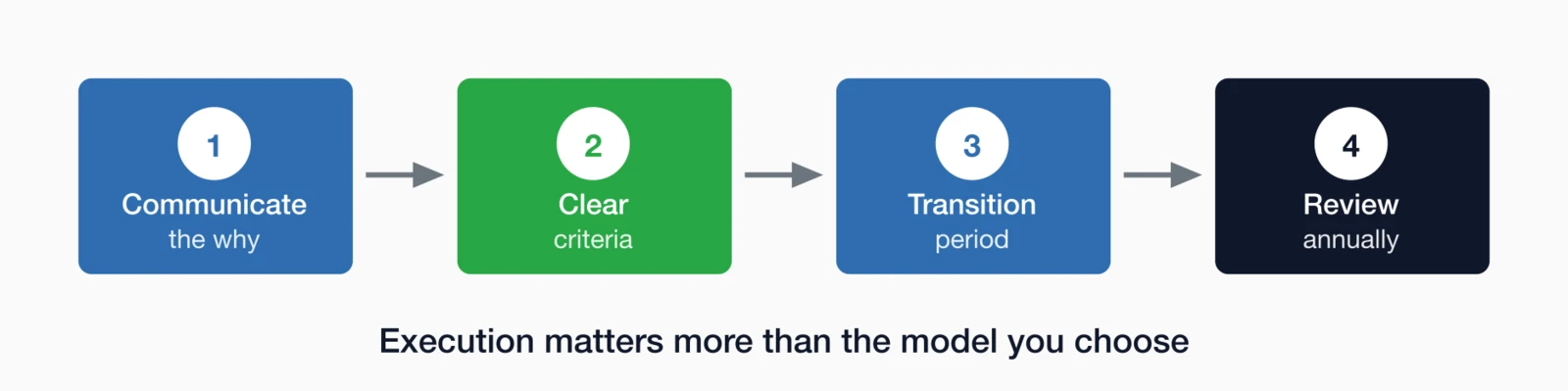
The pricing model you choose matters less than how well you execute it. Whichever direction you go, these best practices will increase your chances of a successful transition.
Communicate the rationale
Members should understand why you've chosen your pricing model. For tiered pricing, emphasize accessibility and fairness. For flat pricing, emphasize simplicity and equality.
Make tier criteria clear and objective
If using tiers, base them on easily verifiable criteria. Vague or subjective tier definitions lead to disputes and frustration.
Build in transition periods
When changing pricing models, grandfather existing members or phase in changes over 2-3 years. Sudden increases breed resentment.
Real Talk: The biggest implementation risk I've seen isn't the pricing model itself — it's board politics. In one implementation, a trade association had clearly outgrown their flat pricing, but two board members ran smaller companies and blocked the change for three years. Make your case with data, not opinions. Show the board what you're leaving on the table, and show them that smaller members will pay less, not more.
Ensure your technology supports it
Your association management software
Review annually
Pricing isn't set-and-forget. Review your structure annually against revenue goals, member feedback, and market conditions.
Watch Out: Your AMS Pricing Matters Too
Here's something most pricing articles won't tell you: your membership pricing strategy can be undermined by your AMS pricing.
Many AMS platforms charge per-contact or per-member fees. If your AMS costs you $2-5 per member, you need to factor that into your dues structure. Growing associations get punished — as you add members, your AMS costs balloon.
That's why i4a uses flat-rate pricing with unlimited members. Your AMS cost stays the same whether you have 500 members or 50,000. No penalties for growth. No surprise bills. Your dues revenue is yours to reinvest in your mission.
How i4a Supports Pricing: i4a's membership management system
Common pricing pitfalls to avoid
These mistakes are common because they often seem reasonable in isolation. But each one can undermine otherwise sound pricing strategies.
Too many tiers
More than 5-6 tiers creates confusion and administrative burden. Keep it simple with 3-5 well-defined tiers.
Tiers too close together
If your tiers are $500, $550, and $600, the differentiation isn't meaningful. Tiers should represent significant jumps in both criteria and price.
Ignoring churn data
Track renewal rates by tier. If a specific tier has significantly higher churn, there's likely a value-to-price mismatch.
Not testing price changes
Before rolling out major pricing changes association-wide, consider testing with a segment of new members to gauge response.
Forgetting about perceived value
Price increases must be accompanied by clear value communication. Don't just raise prices — enhance and communicate value simultaneously.
The bottom line
There's no universally "right" pricing model—only the right model for your specific association, membership base, and goals. For most associations with organizational members, tiered pricing offers the best balance of revenue optimization, accessibility, and perceived fairness.
The key is matching your pricing strategy to your membership reality and ensuring you have the technology infrastructure
Key takeaways
- Dues increases are common: According to the 2025 MGI Report, 49% of associations raised dues in 2024
- Tiered pricing dominates: 46% of associations use membership categories with different pricing
- Most associations benefit from tiered models — they increase revenue 15-25% on average
- Choose tiers based on measurable criteria — company size, revenue, or employee count
- Your membership software must support your chosen model with easy tier management
Flexible Pricing for Your Association
i4a supports any pricing model—flat, tiered, or hybrid. Configure unlimited member types with unique pricing and automate tier assignment based on member data.
Talk to UsRelated resources
Complete 2026 strategy guide for improving retention across the entire member lifecycle.
Proven tactics to identify at-risk members and prevent churn before it happens.
Complete 90-day framework to turn new members into engaged advocates.
Estimate your investment in association management software.
