Quick Summary: Renewal Email Sequences
- Multiple touches win: 84% of associations rate email as their most effective renewal tactic—the average sends 6 emails per renewal series.
- Start 90 days early: Begin with value recaps and early incentives, then build urgency as the deadline approaches.
- Personalize with actual value: Show members what they received—events attended, CE earned, savings used—making renewal an obvious decision.
- Continue past expiration: Win-back emails recover 5–15% of lapsed members who would otherwise be lost permanently.
- Automate everything: Trigger-based sends ensure every member gets the right message at the right time without manual work.
Part of our membership retention resource
Membership renewal emails work best as multi-touch sequences—associations consistently rate them as their most effective retention tactic. A single reminder rarely motivates action. Here's the complete framework with templates and timing that drives higher renewals.
Effective renewal sequences work because they provide multiple touchpoints with escalating urgency, varied messaging angles, and genuine value communication. We consistently see associations improve renewal rates by 5-15 percentage points simply by implementing a proper renewal sequence.
This guide provides the complete framework: timing strategy, email templates, personalization tactics, and automation setup for renewal campaigns that actually drive renewals.
Why renewal sequences work
A renewal sequence outperforms single-email reminders for several well-documented reasons. Understanding these dynamics helps you design more effective sequences—and explains why that single "your membership expires soon" email isn't cutting it.
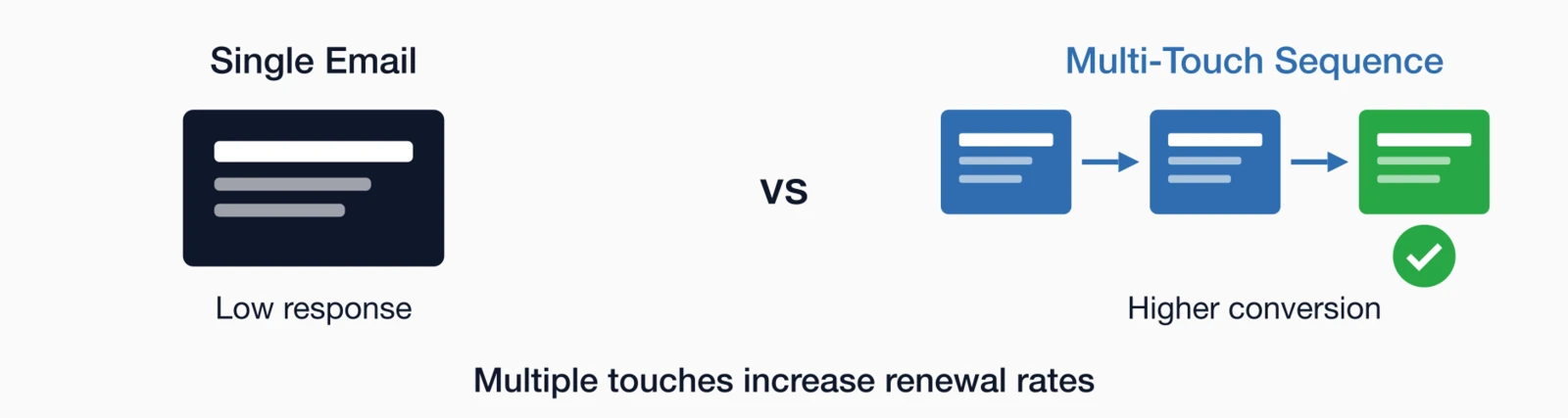
Overcoming procrastination
Members don't ignore renewal emails because they don't want to renew—they ignore them because they plan to "do it later." Multiple touches ensure they eventually take action.
Different messages for different motivations
Some members renew because of upcoming events. Others value CE credits. Others need the credential. A sequence lets you highlight different benefits across multiple emails, connecting with members' varied motivations.
Building urgency over time
A gentle reminder 90 days out shouldn't sound like an "act now or lose everything" message. But that urgent tone is appropriate at 7 days. Sequences allow tone escalation.
The numbers
The data backs this up. According to the 2025 Membership Marketing Benchmarking Report:
- 100% of associations use email in their renewal series—it's universal because it works
- 84% rate email as their most effective renewal tactic
- The average association sends 6 emails in their renewal series
- Organizations achieving 84% median renewal rates use multi-touch sequences
The renewal timeline
Here's the complete renewal email timeline we recommend for most associations. This framework has been tested across hundreds of organizations and consistently outperforms shorter or less structured approaches.
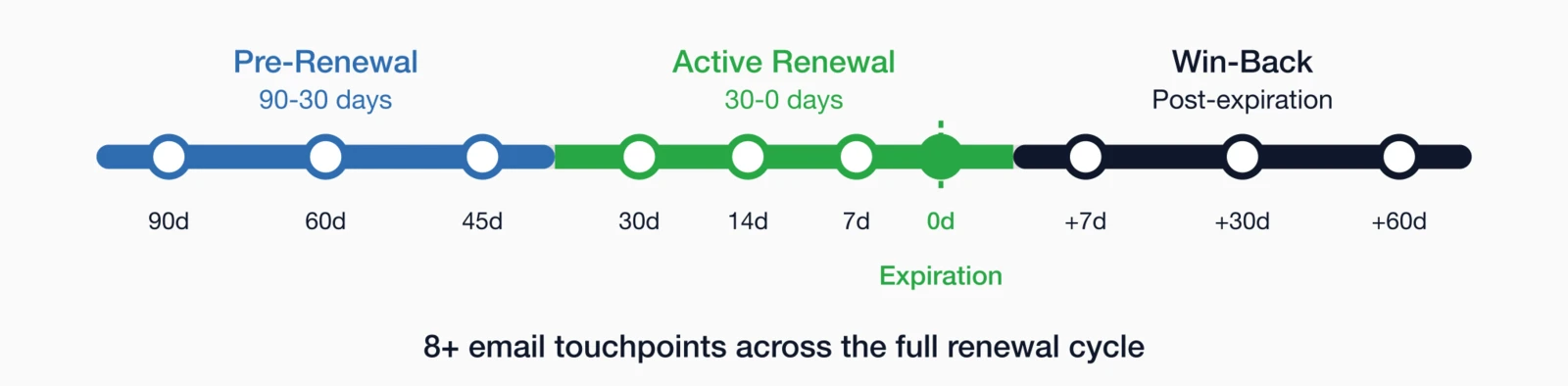
Pre-renewal phase (90-30 days before expiration)
- 90 days: Value recap—"Here's what you've accomplished this year"
- 60 days: Early renewal incentive—"Renew now and save 10%"
- 45 days: Upcoming benefits preview—"Here's what's coming next year"
Active renewal phase (30 days before through expiration)
- 30 days: Standard renewal reminder—"Your membership renews next month"
- 14 days: Urgency building—"Two weeks until your membership expires"
- 7 days: Final reminder—"One week left to renew"
- 3 days: Last chance—"Your membership expires in 3 days"
- Expiration day: Deadline—"Your membership expires today"
Post-expiration win-back phase
- 1 day after: Grace period notice—"Your membership has lapsed"
- 7 days after: Win-back offer—"We'd love to have you back"
- 30 days after: Final win-back—"Last chance: special rejoin offer"
- 60-90 days after: Survey—"Why did you leave?"
Adjust to your cycle: If you have annual renewals with a fixed date, compress this timeline. If you have rolling renewals, these touchpoints work for each individual member's renewal date.
Pre-renewal emails (90-30 days)
Pre-renewal emails focus on value and early action incentives—not urgency. The goal is to plant the seed and make renewing easy for members who prefer to act early. Many of your most engaged members fall into this category.
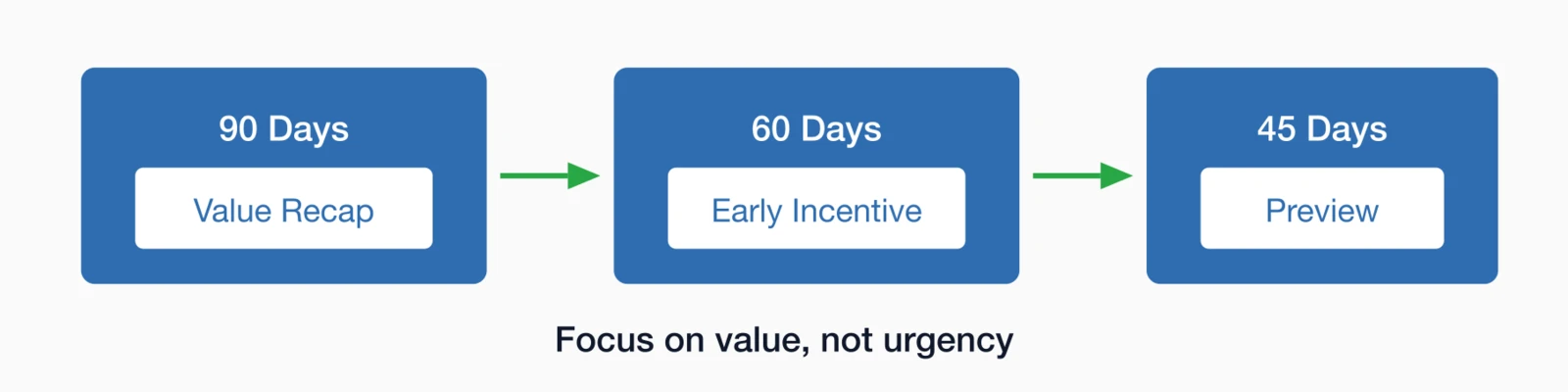
Email 1: Value recap (90 days)
This email reminds members what they've received from membership. It's not asking for renewal—it's setting up the value equation before the ask comes.
Key elements:
- Personalized summary of their engagement (events attended, CE earned, resources accessed)
- Dollar value of benefits received vs. dues paid
- Upcoming opportunities they don't want to miss
- Soft mention that renewal is coming
Email 2: Early renewal incentive (60 days)
Offer a reward for early action—a discount, a bonus, or exclusive access. This captures members who want to check the box and move on.
Key elements:
- Clear incentive for renewing now (10% discount, free webinar, bonus content)
- Deadline for the early-bird offer
- Simple one-click renewal link
A deeper look: Calculating personal value
The most powerful pre-renewal email shows members their personal ROI. If they attended two webinars ($100 value each), downloaded five resources ($25 each), and got the member discount on the annual conference ($200 savings), they received $525 in value for their $300 dues.
Modern membership management systems can calculate this automatically by tracking event attendance, resource downloads, and discount usage. When members see concrete numbers—"You received $525 in value this year"—renewal becomes an obvious decision.
Active renewal period (30-0 days)
The active renewal period is when most renewals happen. This is where your sequence earns its keep. Messages shift from value-focused to action-focused with increasing urgency as the deadline approaches.

Email 3: Standard reminder (30 days)
A straightforward renewal reminder with clear call-to-action.
Subject line examples:
- "[First Name], your membership renews next month"
- "Time to renew: keep your [Association] benefits"
- "Your membership expiration date: [Date]"
Email 4: Urgency building (14 days)
Emphasize what they'll lose if they don't act. Be specific about benefits at risk.
Key elements:
- Specific benefits they'll lose (directory listing, member pricing, CE access)
- Upcoming events or deadlines they'll miss
- Prominent renewal button
Email 5: Final week (7 days)
Urgency is appropriate now. The subject line should convey time sensitivity.
Subject line examples:
- "7 days left: Don't lose your [Association] membership"
- "Final week to renew, [First Name]"
- "Your membership expires [Date]—renew now"
Email 6: Last chance (3 days)
Short, urgent, single-purpose email.
Email 7: Expiration day
The final push. Some members wait until the last moment—give them one more chance.
Post-expiration win-back
Renewal efforts shouldn't stop at expiration. Win-back emails recover 5-15% of lapsed members—members who would otherwise be lost permanently. This is found revenue that most associations leave on the table.

Win-back email 1: Day after (grace period)
Alert them that membership has lapsed, but they can still renew easily.
Key elements:
- Acknowledge the lapse without judgment
- Explain what benefits are now unavailable
- Simple path to reinstatement
Win-back email 2: 7 days after
Offer an incentive to rejoin—discount, waived late fee, or bonus benefit.
Win-back email 3: 30 days after
Final win-back attempt with strongest offer.
Win-back email 4: 60-90 days after (survey)
If they haven't renewed, ask why. The feedback helps improve retention for others, and some members will reconsider when asked directly.
Survey questions:
- What was the primary reason you didn't renew?
- What would make you reconsider?
- How can we improve the membership experience?
For more on winning back lapsed members, see our win-back campaign strategies guide.
Email templates
Here are template frameworks you can adapt for your association. These have been refined through years of testing, but you'll want to adjust tone and specifics to match your organization's voice and member expectations.
![Key email template components: Subject Line, Personalization ([Name]), Value Copy.](/assets/images/blog/membership-renewal-email-sequences/email-template-components.webp)
Template: Value recap (90 days)
Subject: [First Name], here's what you accomplished this year
Hi [First Name],
Your [Association] membership has been working hard for you this year. Here's a quick look at the value you've received:
- Events attended: [Number] (Value: $[Amount])
- CE credits earned: [Number]
- Member discounts used: $[Savings]
- Resources accessed: [Number]
Your total value received: $[Total]
Your membership renews on [Date]. We've got exciting things planned for the coming year, and we'd love to have you continue with us.
[Renewal Button]
Template: Urgency (7 days)
Subject: 7 days left, [First Name]—don't lose your membership
Hi [First Name],
Your [Association] membership expires in just one week—[Expiration Date].
When your membership lapses, you'll lose access to:
- Member directory listing
- Member pricing on events (the annual conference is coming up!)
- Exclusive resources and CE opportunities
- [Other specific benefits]
It takes less than 2 minutes to renew and keep everything you've built:
[Renew Now Button]
Template: Win-back (7 days post-expiration)
Subject: We'd love to have you back, [First Name]
Hi [First Name],
We noticed your [Association] membership recently expired. We understand things get busy, and we'd love to make it easy for you to rejoin.
Rejoin this week and receive:
- [Incentive—discount, free webinar, waived fee, etc.]
Your colleagues miss you in the community, and there's a lot coming up you won't want to miss:
- [Upcoming event or benefit]
- [New resource or program]
[Rejoin Button]
Personalization strategies
Generic renewal emails underperform because they feel like mass communication—because they are. Personalization makes members feel seen and dramatically increases response rates. The question is how far to take it based on your technical capabilities and data quality.
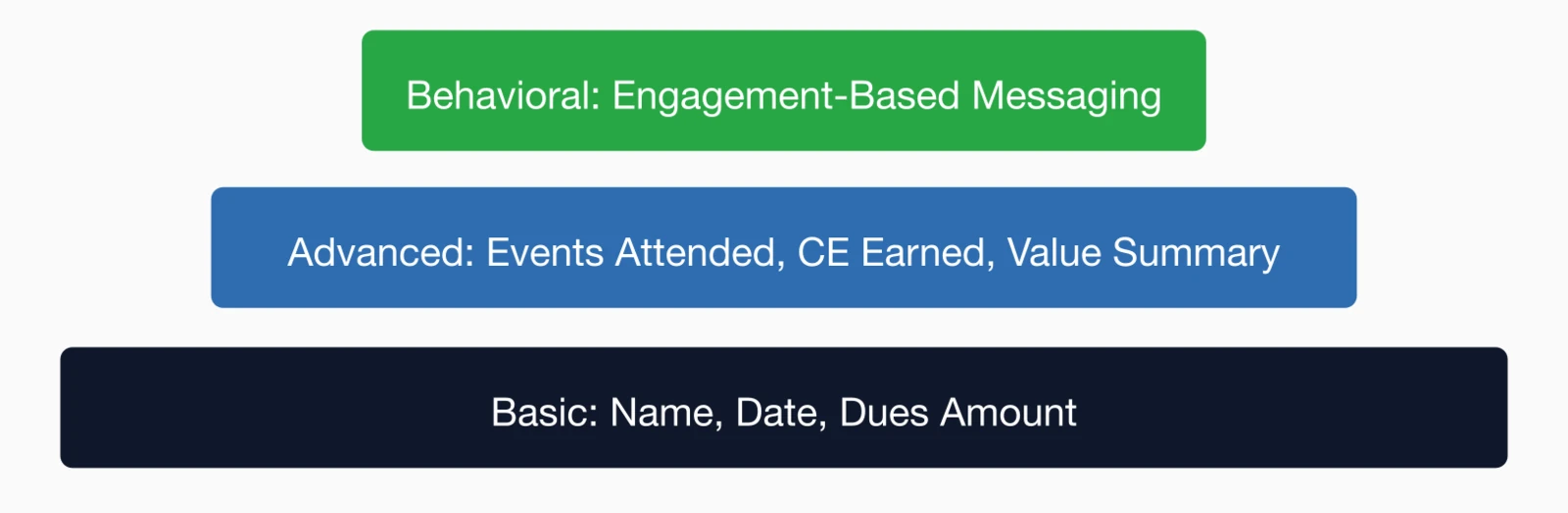
Basic personalization
- First name in subject line and greeting
- Specific expiration date
- Membership level and dues amount
- Years of membership
Advanced personalization
- Personal value summary (events attended, CE earned, resources used)
- Relevant upcoming events based on past attendance
- Benefits specific to their membership level
- Local chapter or regional information
Behavioral personalization
- High-engagement members: Thank them for participation, offer leadership opportunities
- Low-engagement members: Highlight unused benefits, offer engagement suggestions
- Event attendees: Emphasize upcoming events in renewal message
- CE-focused members: Highlight CE opportunities for the coming year
An integrated association management platform makes this personalization automatic by pulling member data directly into email templates.
Automation setup
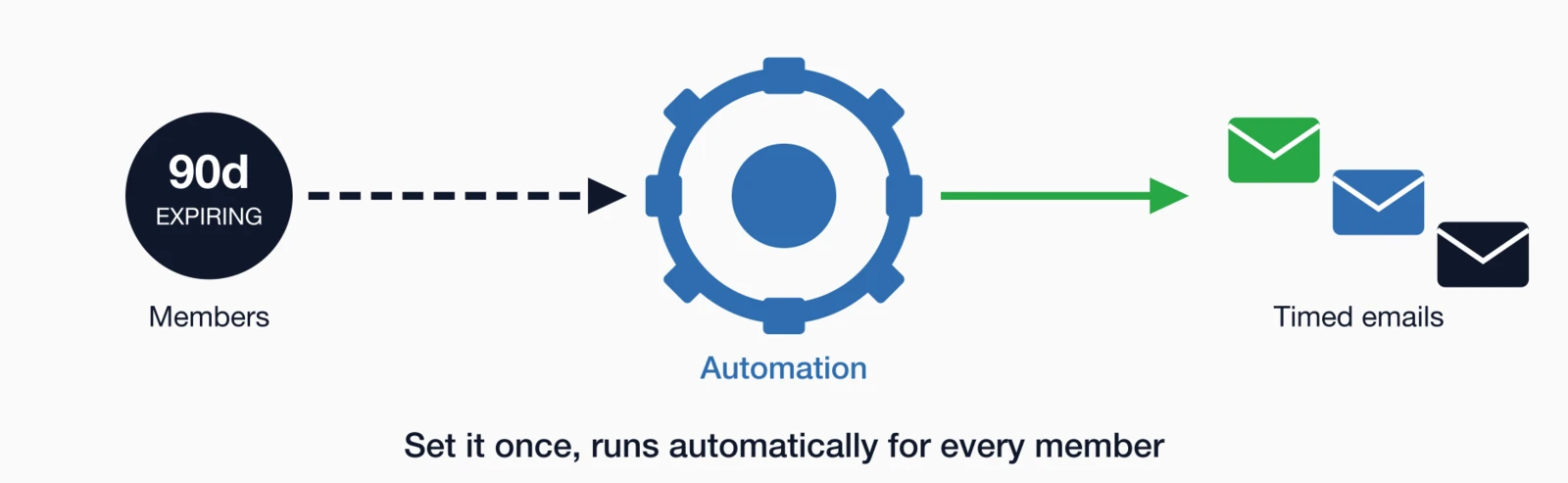
Manual renewal reminders are error-prone and time-consuming. Beyond the obvious efficiency gains, automation ensures every member receives the right message at the right time—no members falling through cracks, no embarrassing double-sends to people who already renewed.
Automation requirements
- Dynamic segments: "Members expiring in 90 days" that update automatically
- Trigger-based sends: Emails sent based on expiration date, not manual scheduling
- Exclusion logic: Stop sending renewal emails once member renews
- Personalization merge: Pull member data into templates automatically
Setting up your sequence
- Define your timeline: Decide which emails to send at which intervals
- Create the segments: Set up dynamic segments for each timing window
- Build the templates: Create each email with appropriate personalization
- Configure automation: Set up recurring sends for each segment
- Test thoroughly: Send test emails, verify personalization, confirm exclusions work
- Monitor and refine: Track open/click rates, adjust messaging based on performance
Built-in with i4a: i4a's email marketing includes pre-built segments for expiring members at 90, 60, 30, 14, and 7 days—plus lapsed member segments for win-back campaigns. Schedule your renewal emails once and they run automatically.
Turn renewal reminders into renewal results
A well-designed renewal sequence is one of the highest-ROI investments your association can make. Every percentage point improvement in renewal rate directly impacts revenue and reduces the cost of acquiring replacement members. The math is compelling: retaining existing members is always cheaper than acquiring new ones.
Start by mapping your current renewal process. When do you send reminders? How many? What do they say? Then compare against the timeline in this guide and identify gaps.
Remember: the goal isn't to annoy members into renewing—it's to remind them of value, make renewal easy, and give them multiple opportunities to act before it's too late.
For more on retention strategy, see our Membership Retention Guide or explore at-risk member identification strategies.
Key takeaways
- Start early: Begin renewal communication 90 days before expiration—not 30
- Multiple touches win: The average association sends 6 emails in their renewal series (2025 MGI Report)
- Email dominates: 100% of associations use email in their renewal series; 84% rate it most effective
- Increase urgency gradually: Friendly early, urgent later
- Don't stop at expiration: Win-back emails recover 5-15% of lapsed members
Ready to Automate Your Renewal Sequences?
i4a's platform includes pre-built renewal segments and automation—stop sending manual reminders and let the system work for you.
See Renewal Automation in ActionRelated resources
Email Segmentation for Associations
Target the right members with the right messages.
Recover lapsed members with targeted outreach.
Complete strategy guide for association email marketing.
Identify and engage members before they lapse.
