Quick Summary: Healthcare Association Retention
- Healthcare associations achieve 85-92% retention: But unique challenges—time-starved professionals, burnout, and employer-paid dues dynamics—require industry-specific strategies.
- CME/CE is your strongest retention lever: Include continuing education in membership, track completion, and show concrete value at renewal ("24 credits = $1,200 vs. $420 dues").
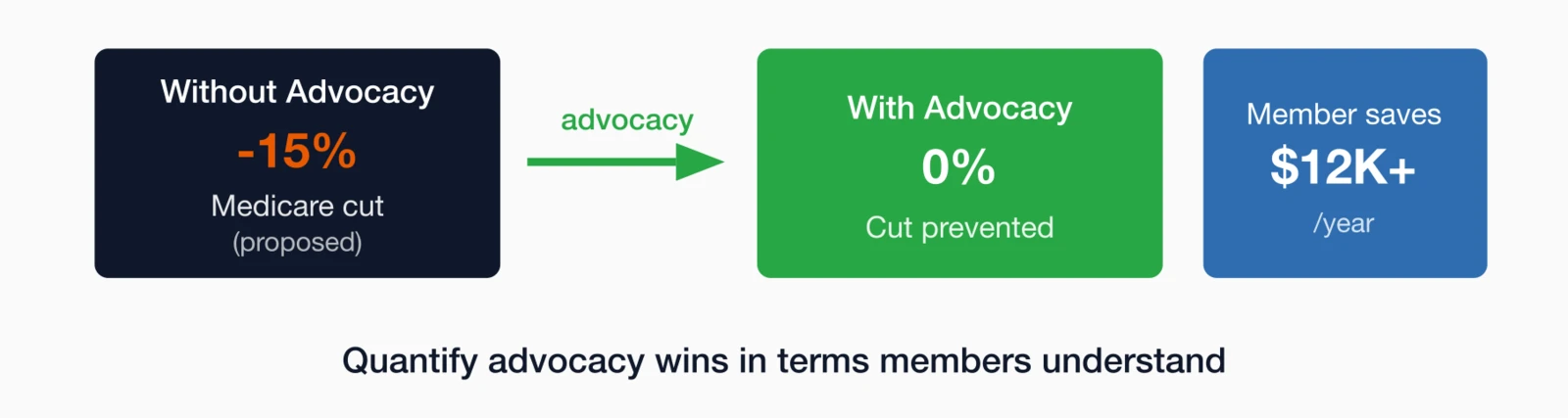
- Make advocacy wins tangible: Quantify legislative victories in dollar terms—"Our advocacy prevented a 15% Medicare cut worth $X,XXX to your practice."
- Career transitions are high-churn moments: Build specific programs for residency-to-practice transitions and approaching-retirement members to prevent lapses.
- Design for exhaustion, not engagement: Mobile-first, microlearning formats, and curated content digests respect your members' limited time and energy.
Part of our healthcare association retention guide
Healthcare association retention requires strategies tailored to time-starved physicians, CME requirements, and employer-paid dues. Medical societies with strong renewal rates focus on these industry-specific approaches.
Healthcare associations — whether representing physicians, nurses, allied health professionals, or healthcare executives — operate in one of the most complex environments for member retention. Your members are time-starved, face burnout at unprecedented rates, and navigate continuously shifting regulatory landscapes.
Here's the reality of healthcare association retention: You're not just competing with other associations — you're competing with exhaustion. When a physician works 60 hours a week, the last thing they want is another email, another login, another thing demanding their attention. The associations that thrive are the ones that make members' professional lives easier in immediately visible ways.
Yet healthcare associations also have unique retention advantages: mandatory continuing education requirements, critical advocacy needs, and strong professional identity. The key is leveraging these advantages while adapting to the realities of modern healthcare practice.
Unique retention challenges in healthcare
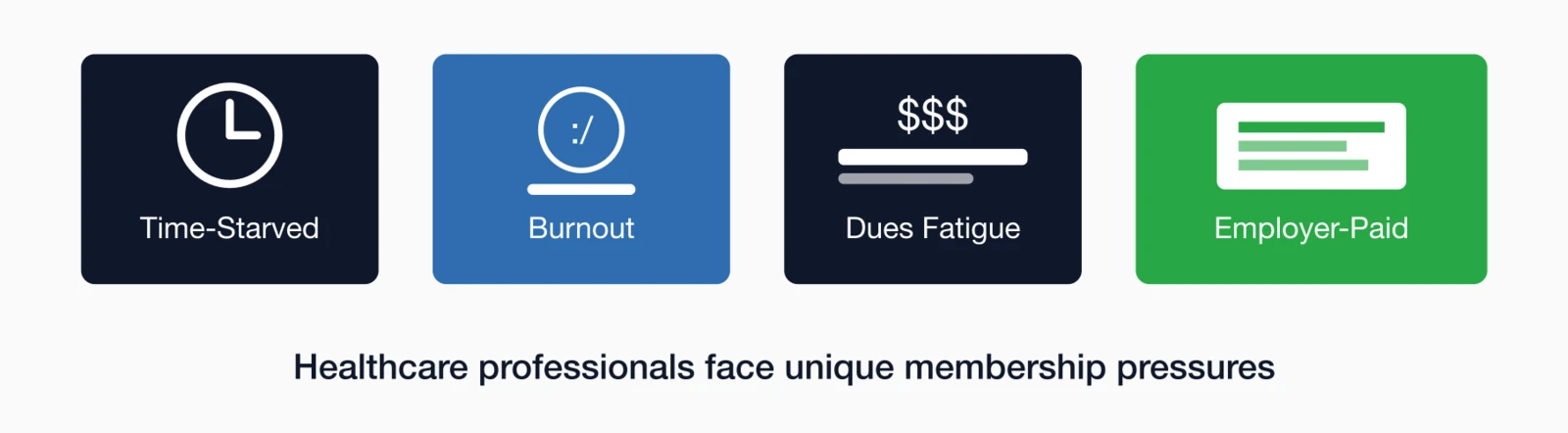
Healthcare professionals present distinct retention challenges that set this sector apart from other association markets. Understanding these dynamics is the first step toward addressing them effectively.
The time-starved professional
Healthcare professionals work some of the longest hours of any profession. When a physician is already working 60+ hours per week, every additional demand on their time—including logging into your member portal or reading your newsletter—competes with sleep, family, and basic self-care. Associations that win retention make engagement effortless and deliver value in seconds, not hours.
The burnout epidemic
Burnout rates among healthcare workers have reached crisis levels, a trend formalized in the U.S. Surgeon General's Advisory on health worker burnout. Burned-out professionals disengage from everything—including professional memberships—making wellness support a retention differentiator.
The "membership fatigue" problem
A typical physician might be asked to join their national specialty society, state medical association, local hospital medical staff organization, and subspecialty groups. Total annual dues can easily exceed $2,000-$3,000. When budget pressures hit, membership decisions become zero-sum.
The employer payment challenge
The risk landscape for dues is shifting as more healthcare professionals move from private practice to large health systems. According to the AMA's Physician Practice Benchmark Survey, over 70% of physicians are now employed rather than practice owners—meaning dues decisions often depend on employer reimbursement policies, not individual choice.
CME/CE as a retention strategy
Continuing medical education requirements are both a challenge and an opportunity. Every healthcare professional needs CE credits—that's not optional. The strategic question is whether they'll get them from your association or from somewhere else.

Making CME a retention driver
- Include CME in membership: Build CE credits into the membership value proposition, not as add-on purchases
- Track and report progress: Your membership platform should track CE completion and send renewal reminders that include credits earned
- Diversify format options: Move beyond the traditional lecture. The ACCME 2024 Annual Data Report reveals a learning enterprise increasingly focused on performance: 95% of CME activities now measure learner competence, and nearly half (46%) measure actual changes in clinical performance. Meeting members where they are—through enduring materials, podcasts, or mobile simulations—ensures your association remains the primary source for their mandatory credits.
- Mobile-first delivery: Physicians complete CME during call nights, between patients, on commutes
CME value communication
At renewal time, show members exactly what CME they received through membership:
"This year through your AMA membership, you earned 24 CME credits valued at $1,200+ if purchased individually. Your membership dues: $420."
This concrete value demonstration is far more compelling than abstract benefit lists.
CME Value Calculator
Demonstrate the CME value of membership to your members:
Use this calculation in renewal messaging: "Your dues: $420. CME value received: $1,200+"
Demonstrating advocacy value
Healthcare professionals face constant regulatory, reimbursement, and scope-of-practice challenges. Advocacy is often cited as a top reason for membership—but only when members can actually see the results. Abstract promises don't drive retention; concrete wins do.
Making advocacy tangible
- Quantify wins: "Our advocacy prevented a 15% Medicare reimbursement cut — that's $X,XXX for the average member's practice"
- Share legislative scorecards: Track and publicize voting records on healthcare issues
- Regular advocacy updates: Monthly "advocacy in action" communications showing active work
- Enable participation: Make it easy for members to contact legislators, sign petitions, or contribute to PACs
Connecting advocacy to individual impact
Move beyond "we're fighting for you" to specific, personal impact:
- "For [specialty], our advocacy work this year protected your [specific procedure] reimbursement rate"
- "We successfully defeated legislation that would have [specific negative impact on their practice]"
Career stage segmentation
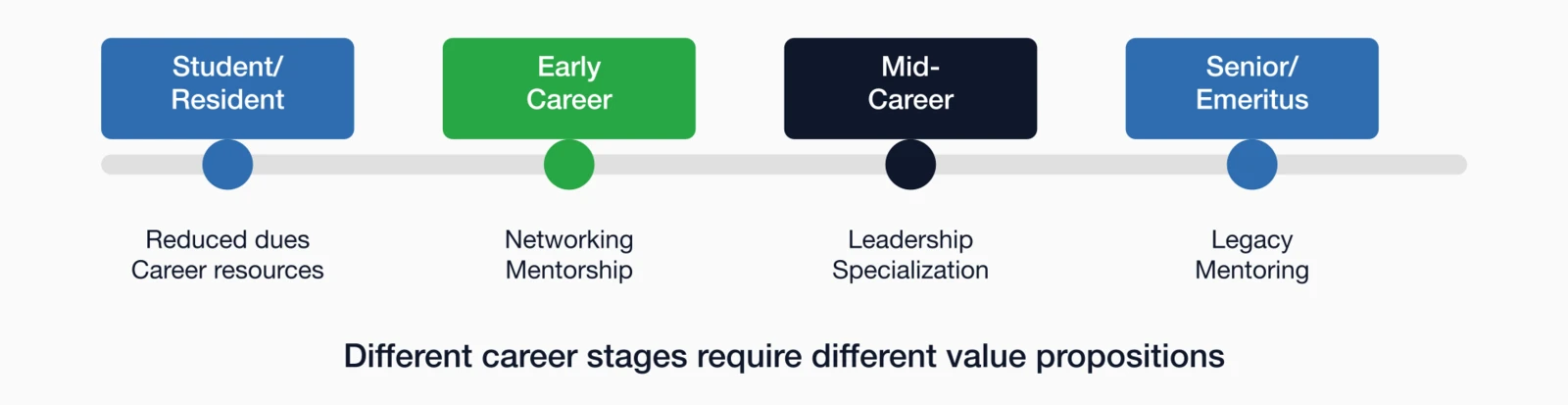
Healthcare careers span 30-40 years, and member needs change dramatically across that span. A resident-physician and a department chief may both be "members," but treating them the same guarantees you'll fail one of them. Effective retention requires different strategies for different career stages.
Transition point retention
Career transitions are high-churn moments. Focus retention efforts on:
- Residency to practice: Most critical transition. Offer graduated dues, practice startup resources
- Employment changes: When members change employers, ensure membership follows the individual
- Approaching retirement: Emeritus membership options keep connection without full dues
Time-efficient engagement strategies
Healthcare professionals don't have time for lengthy engagement—that's not a complaint, it's a design constraint. Everything must be optimized for busy schedules, or it simply won't get used.

Microlearning and quick-hit content
- 5-minute video updates on clinical guidelines
- Podcast episodes for commute listening
- Clinical pearls delivered via text or app notification
- Quick-reference apps and tools
Streamlined communication
- Curated content digests rather than multiple emails
- Mobile-optimized everything
- Clear, scannable formats (bullets, not paragraphs)
- Respect inbox limits — quality over quantity
Flexible event formats
- Hybrid options for all major events
- Recorded sessions available post-event
- Regional smaller events, not just national conferences
- Virtual networking that fits varied schedules
Specialty society considerations
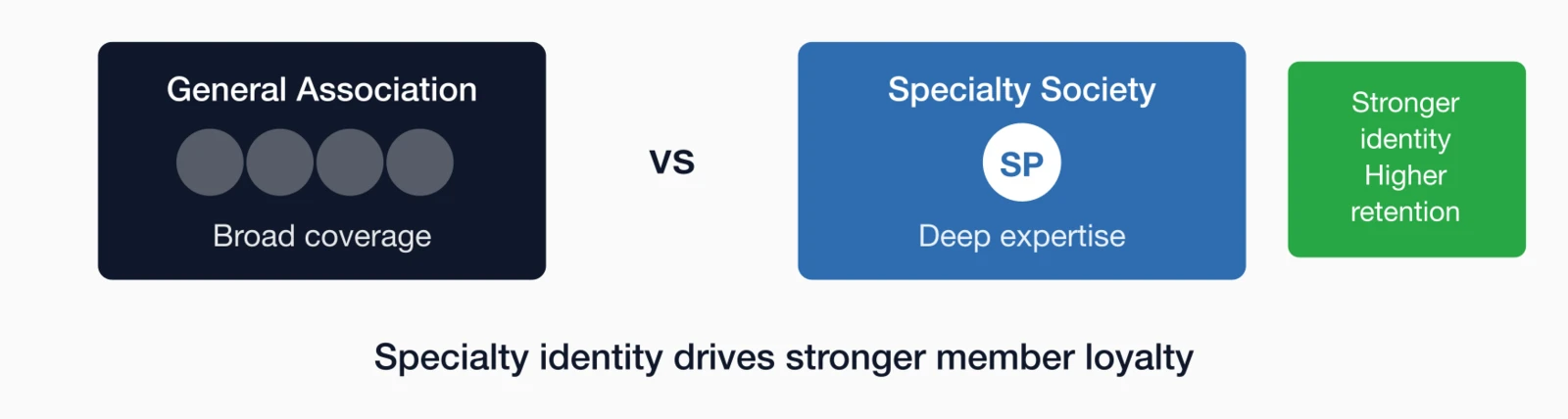
Medical specialty societies have specific retention dynamics that differ from broad-based medical associations. Understanding these distinctions helps specialty societies play to their strengths.
Subspecialty identity
Professional identity is often stronger at the specialty level than the national level. Leverage this by making specialty community the core value proposition.
Clinical content depth
Specialty societies can go deep on clinical content in ways generalist organizations cannot. Make clinical relevance the differentiator.
Certification linkage
Many specialty societies partner with certification boards. Strong board certification ties create natural retention incentives.
Measuring healthcare member retention
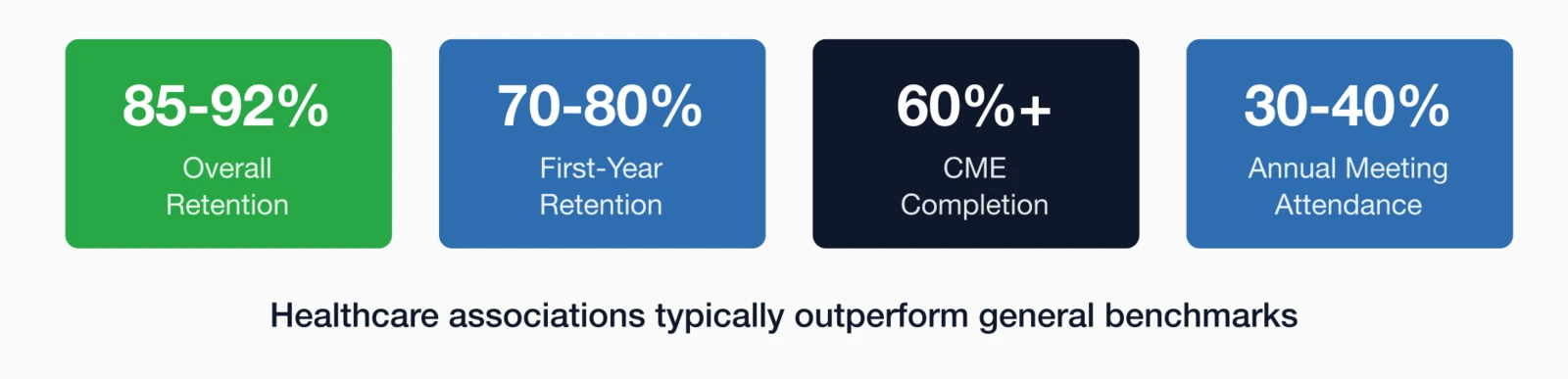
Healthcare associations should track these metrics to monitor retention health. Benchmarks here are specific to healthcare associations, which typically perform higher than general association averages.
| Metric | Healthcare Benchmark | Key Consideration |
|---|---|---|
| Overall Retention Rate | 85-92% | Track by career stage |
| First-Year Retention | 70-80% | Critical for resident transitions |
| CME Completion Rate | 60%+ using member CME | Direct value indicator |
| Event Attendance | 30-40% annual meeting | Include virtual attendance |
| Advocacy Engagement | 20%+ taking action | Track campaign participation |
The Hidden CME Tracking Cost
Healthcare associations track more data per member than almost any other association type: CME credits, certification status, practice settings, specialty credentials, advocacy engagement, and more. If your AMS charges per-contact, that data richness comes at a premium.
Some healthcare associations actually avoid adding contacts (like medical students with discounted dues) because the per-member AMS fee exceeds their dues revenue. That's backwards — students are your future full-paying members.
i4a uses flat-rate pricing with unlimited members. Add every medical student. Track every CME credit. Build complete career-long member records. Your growth strategy shouldn't be constrained by per-contact pricing.
Getting started
To improve retention in your healthcare association, start with these concrete steps:
- Audit your CME offering: Is it competitive? Convenient? Clearly valued?
- Segment by career stage: Analyze retention rates by tenure and adapt strategies accordingly
- Quantify advocacy wins: Make the return on membership dues concrete
- Optimize for time: Review all touchpoints for mobile-friendliness and time efficiency
- Address transition points: Build specific programs for residency-to-practice and retirement transitions
For general retention strategies that apply across association types, see our comprehensive Membership Retention Strategy Guide
Questions about healthcare association management? Connect with our team
Key takeaways
- CME/CE is a critical retention lever — make continuing education a core member benefit
- Time-starved members need efficiency: Mobile-first, on-demand, microlearning formats
- Advocacy matters more than ever: Regulatory and reimbursement battles drive value
- Career stage segmentation is essential: Residents, early career, mid-career, and senior physicians have different needs
- Track CE completion through your AMS to demonstrate tangible value
Ready to Improve Healthcare Member Retention?
Learn how i4a's medical association software helps healthcare organizations deliver the CE, networking, and career support that keeps members engaged.
Talk to UsRelated resources
Complete 2026 strategy guide for member retention.
10 proven strategies to reduce member churn.
Complete 90-day onboarding guide.
Calculate and track member LTV.
