Quick Summary: Multi-Association Management
- Purpose-built platforms save 30–40%: AMCs using unified systems reduce operational overhead vs. managing separate software per client.
- True data isolation matters: Separate databases per client guarantee security by architecture—no risk of cross-client data leakage.
- Staff learn one interface: A consistent system across all clients eliminates retraining and reduces context-switching costs.
- Templates accelerate onboarding: New client setup drops from weeks to days when configurations can be cloned and customized.
- Financial separation is essential: Per-client payment processing and accounting feeds keep each association's funds isolated.
Part of our AMS evaluation guide
Multi-association management lets AMCs run 5, 10, or 50 different associations from one platform—each with their own members, boards, events, and financial accounts—without drowning in complexity. Purpose-built platforms save significantly on operational overhead vs. separate systems per client.
I've worked with AMCs and membership organizations for over 30 years, and the pattern is clear: those using purpose-built multi-association platforms save 30-40% on operational overhead compared to those cobbling together separate systems for each client. That's not a rounding error—it's the difference between profitable growth and operational gridlock.
What is multi-association management?
Multi-association management is a specialized operational model that allows organizations to access professional management and high-end technology at a fraction of the cost of dedicated staff. As defined by the AMC Institute (AMCI) model, this structure provides associations with economies of scale—sharing resources like executive leadership and technology platforms to drive organizational growth.
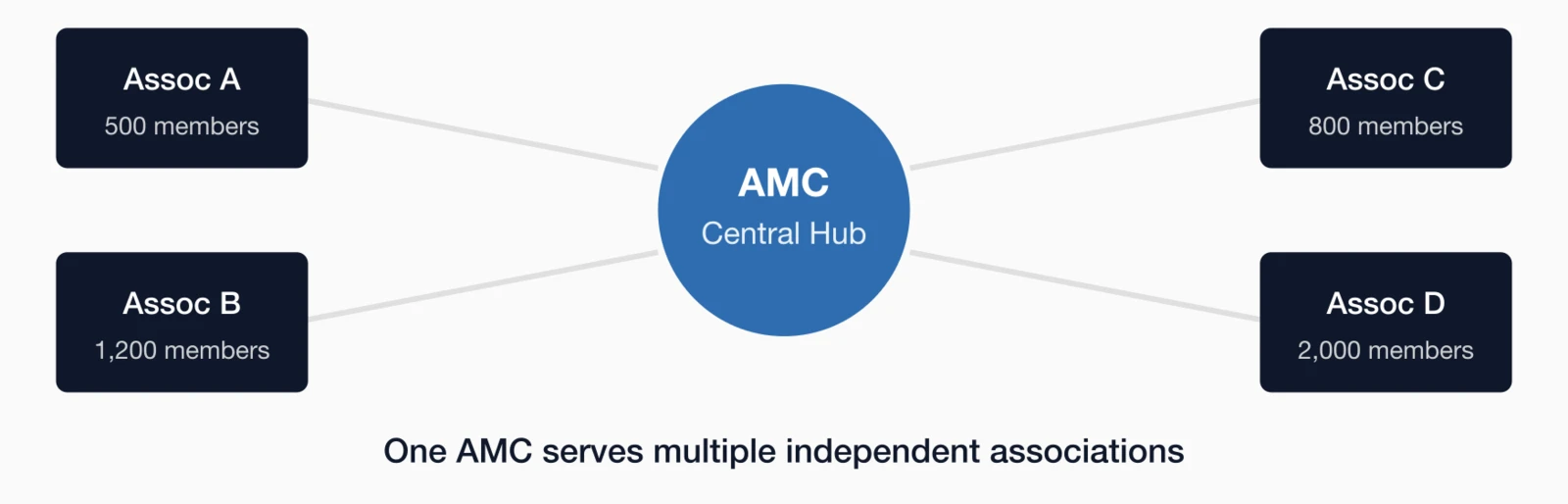
The AMC business model
AMCs exist because many associations are too small to justify dedicated staff for every function. A 500-member trade association probably can't afford a full-time IT person, finance director, events coordinator, AND membership manager. But share those roles across 10 similar-sized associations, and suddenly you have economies of scale that work for everyone.
Here's what a typical AMC manages for each client:
- Membership operations: Applications, renewals, dues collection, member services
- Events: Annual conferences, webinars, chapter meetings, board retreats
- Communications: Newsletters, email campaigns, website updates, social media
- Governance: Board meetings, committee coordination, elections, policy management
- Finances: Accounting, budgeting, accounts receivable/payable, financial reporting
- Advocacy: Government relations, lobbying, public affairs (for some clients)
The challenge? Doing all of this for multiple associations simultaneously without losing your mind—or your staff.
The AMC technology challenge
I've walked into AMCs that are managing 15 associations with 15 different AMS platforms. One login for Client A's basic membership software, another for Client B's mid-tier platform, a third for Client C's custom CMS setup. Staff spend half their day just logging in and out of systems. This is the problem unified platforms solve.
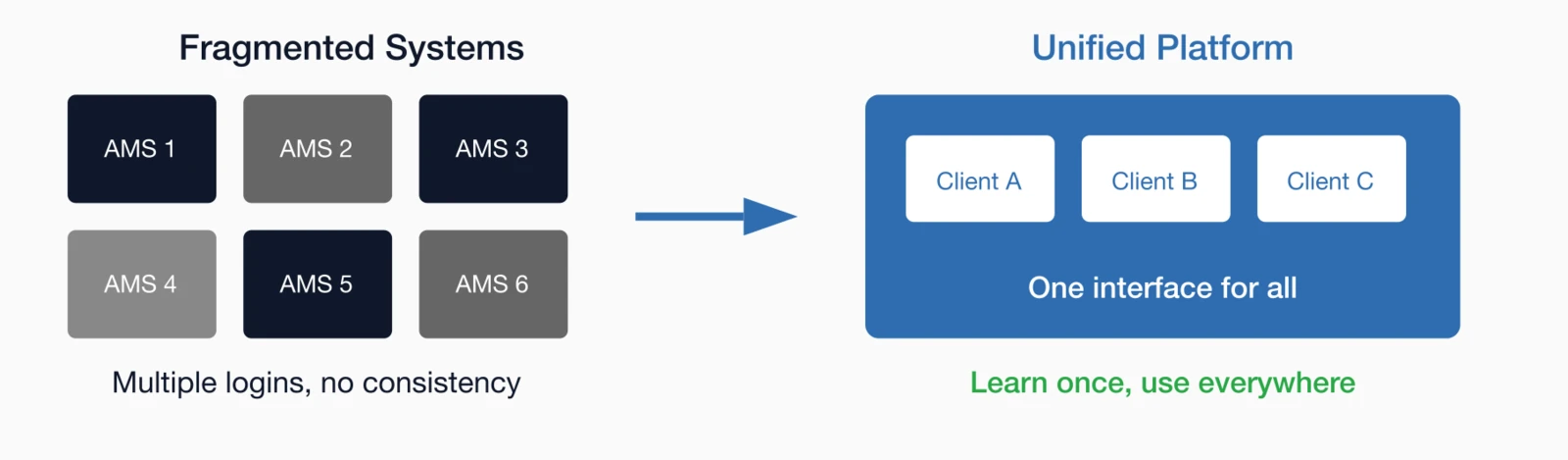
The separate systems problem
When each client runs on a different platform:
- Training becomes impossible: Every new staff member needs to learn multiple systems
- No workflow consistency: Renewal processes work differently for each client
- Integration nightmares: Connecting accounting, email, and payment systems 15 different ways
- Reporting gaps: No way to see AMC-wide metrics without manual aggregation
- Context switching costs: Staff lose 20-30 minutes per day just switching between systems
The real cost of managing 15 different systems isn't just the license fees—it's the cognitive load. Research from the American Psychological Association on multitasking shows that switching between complex tasks can cost as much as 40% of someone's productive time. For a membership coordinator juggling disparate software interfaces, that mental tax adds up to hours of lost productivity every week.
The real cost
A mid-sized AMC with 10 clients and 8 staff members using separate systems typically loses:
- 2-3 hours per staff member per week on system switching and duplicate data entry
- $40,000-$60,000 annually in software licensing across multiple platforms
- Countless hours in training when onboarding new staff
- Strategic visibility—leadership can't see the big picture
Platform architecture for AMCs
The solution is an AMS platform designed specifically for AMCs. The architecture you choose determines how efficiently your staff can work across clients—and how well-protected each client's data remains.
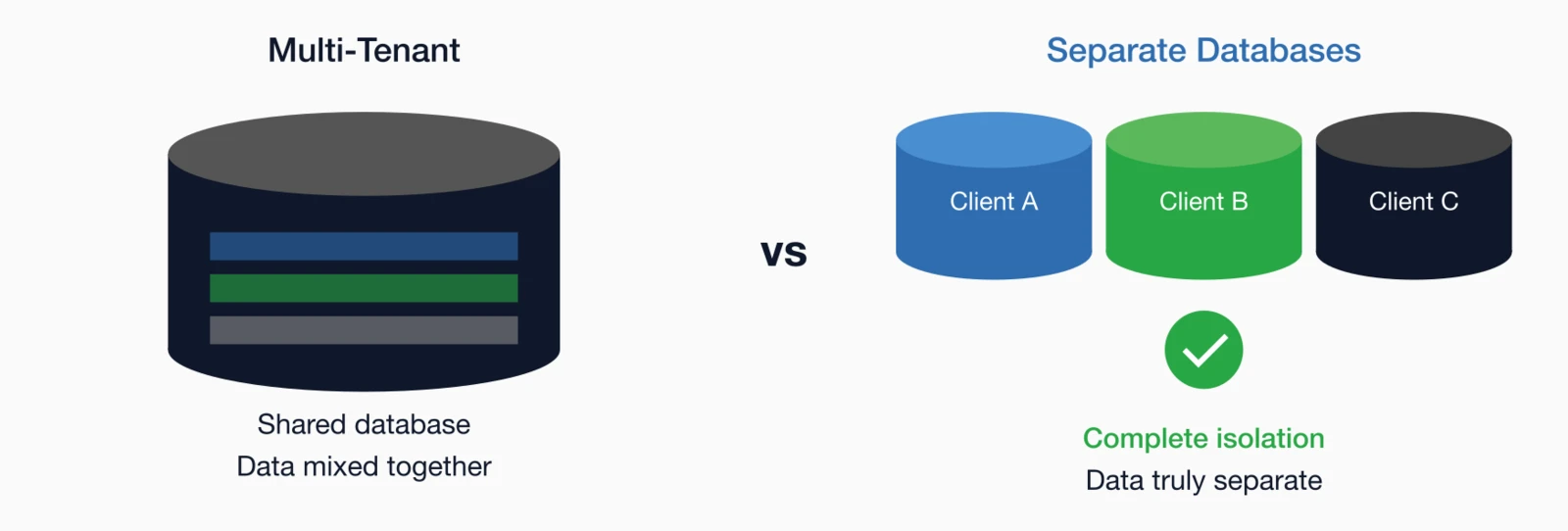
Two architectural approaches
There are two main ways platforms handle multiple associations:
Multi-tenant (shared database): All client associations exist within a single database, with data separation enforced at the application level. Staff switch between clients from a single dashboard. This can be convenient but introduces risk—a bug or security issue potentially affects all clients simultaneously.
Separate databases per client: Each association has its own isolated database and site instance. Data separation is absolute—there's no possibility of cross-contamination. Staff learn one consistent interface and can use the same credentials across client sites, but each client's data lives in complete isolation.
The case for true data isolation
Think of the difference like this: multi-tenant is an apartment building where everyone shares infrastructure and a master key exists somewhere. Separate databases are like individual houses—each has its own foundation, its own locks, and no shared access points.
For AMCs handling sensitive member data, financial information, and confidential board materials, true database isolation offers meaningful advantages:
- Security breaches are contained: A vulnerability in one site can't cascade to other clients
- No accidental data leakage: It's technically impossible for Client A's data to appear in Client B's reports
- Independent maintenance: Updates can be tested and rolled out per-client if needed
- Simpler compliance: Auditors can verify complete data isolation easily
Consistent experience across clients
Regardless of architecture, what matters for staff efficiency is consistency. The key features to look for:
- One interface to learn: Staff master a single system that works identically for every client
- Consistent credentials: Staff can use the same username and password across all client sites
- Isolated member portals: Each association has its own branded member-facing portal
- Separate financials: Each client has its own payment processing, accounting codes, and financial reports
- Transferable templates: Email templates, configurations, and workflows developed for one client can be adapted for others
How i4a Handles Multi-Association: i4a uses separate databases for each AMC client, providing true data isolation while maintaining a consistent interface. Staff learn one system that works identically across all clients, can use consistent credentials, and benefit from transferable configurations and templates—all while knowing each client's data is completely isolated at the database level.
Shared resources & operational efficiency
One of the biggest advantages of a unified platform is the ability to share resources across clients. When you create something that works well for one association, you shouldn't have to rebuild it from scratch for the next one. This leverage is where AMCs gain their competitive advantage.
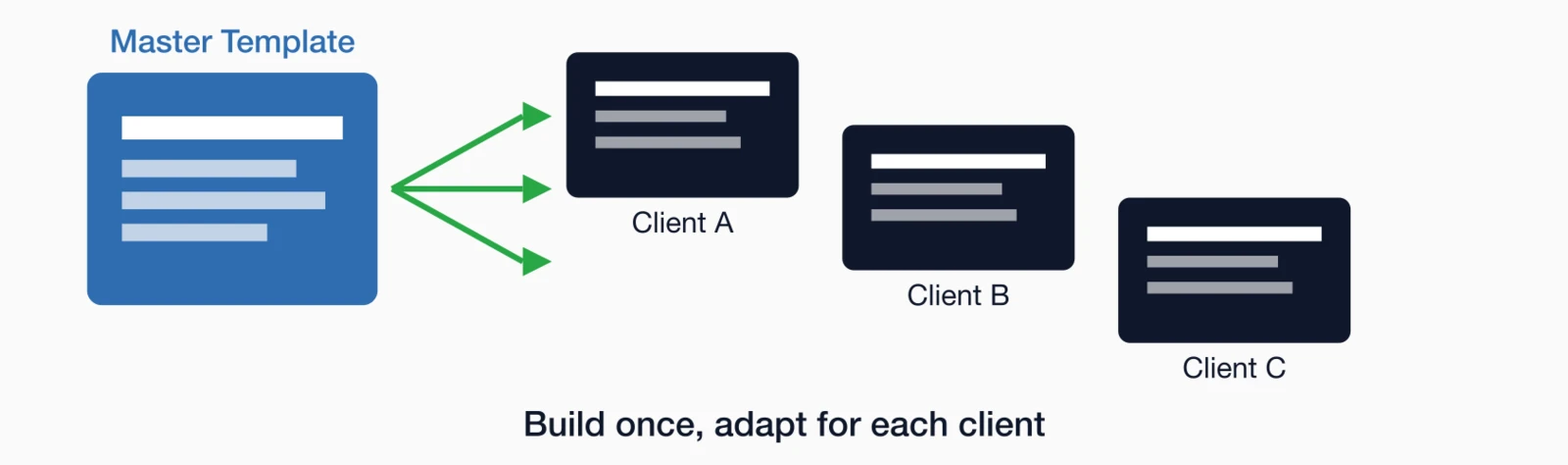
What can be shared
Email Templates:
- Renewal reminder sequences that work across associations (with per-client branding)
- Event confirmation templates that can be cloned and customized
- Welcome email series that follow the same structure but adapt to each association's voice
Workflow Configurations:
- Membership application processing rules
- Dues grace period settings
- Automated notification triggers
- Event registration workflows
Report Templates:
- Standard board reports that can be generated per client
- Financial summary formats
- Membership trend analyses
Integration Configurations:
- QuickBooks sync settings (customize accounts per client, share the connection)
- Email service configurations
- Payment gateway setups
New client onboarding
When you bring on a new association client, a unified platform dramatically accelerates setup. Instead of building everything from zero:
- Clone an existing similar client's configuration as a starting template
- Customize branding, membership types, and dues structures
- Import member data using your standard import process
- Activate the client portal with their branding
What takes weeks with a new separate system can be done in days with a unified platform.
Data separation & security
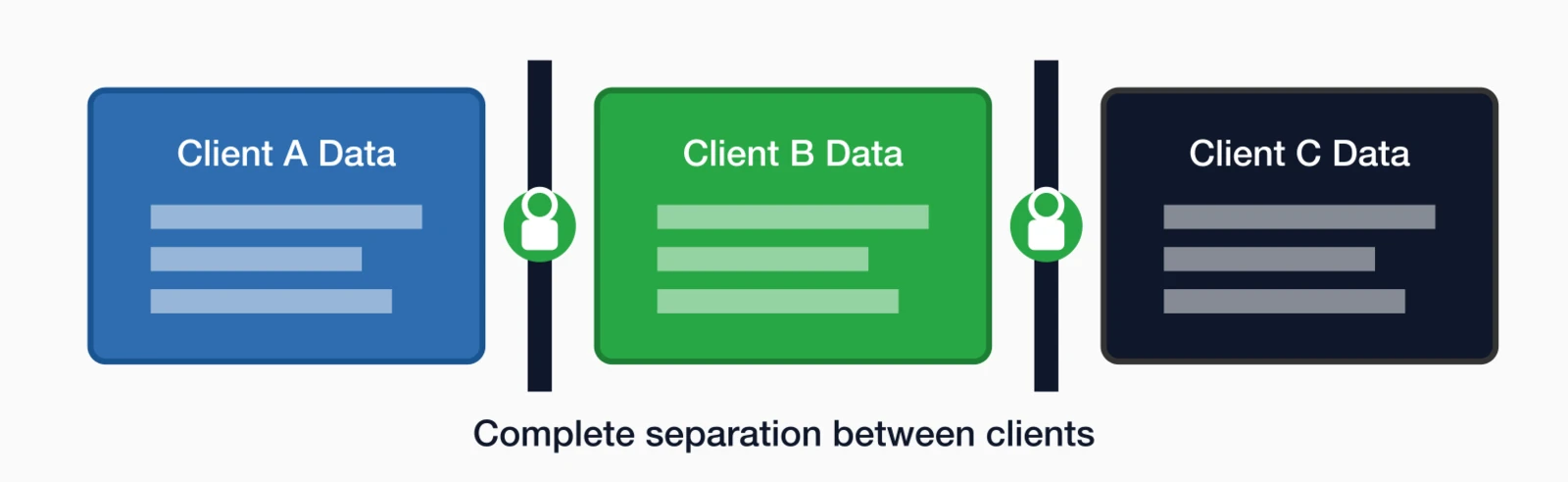
The most common concern I hear from AMC prospects: "How do I know Client A's data won't accidentally end up in Client B's reports?" It's a valid question, and the architecture behind the answer matters more than most vendors acknowledge.
How data isolation works
With separate databases per client, data isolation isn't enforced by application logic—it's guaranteed by architecture. Each client has their own database instance, meaning:
- Physical separation: Client A's data literally doesn't exist in the same database as Client B's
- No query filtering required: There's no risk of a bug exposing the wrong data because there's no wrong data to expose
- Independent backups: Each client's data can be backed up, restored, or migrated independently
- Audit trails per client: Activity logs are inherently separate—they live in different databases
Compare this to multi-tenant systems where data separation relies on application-level filtering. Those systems work, but they depend on every query being written correctly—and one mistake can leak data across clients.
What members see
From a member's perspective, they have no idea other associations exist on the platform. They log into their association's branded portal, see only their membership information, and interact only with their organization's content.
What boards see
Board members and volunteer leaders access only their association's data through permissions you control. They can run reports, view membership statistics, and access documents—but only for their organization.
Security certifications
Look for platforms with:
- SOC 2 Type II compliance (data security and availability controls)
- PCI DSS compliance for payment processing
- Architecture aligned with OWASP Cloud Tenant Isolation best practices
- Regular third-party security audits
- Data encryption at rest and in transit
Staff workflows across clients
How do your staff actually work when they're responsible for multiple associations? The platform needs to support real-world workflows, not force artificial constraints. This is where theoretical features meet operational reality.
The typical AMC staff day
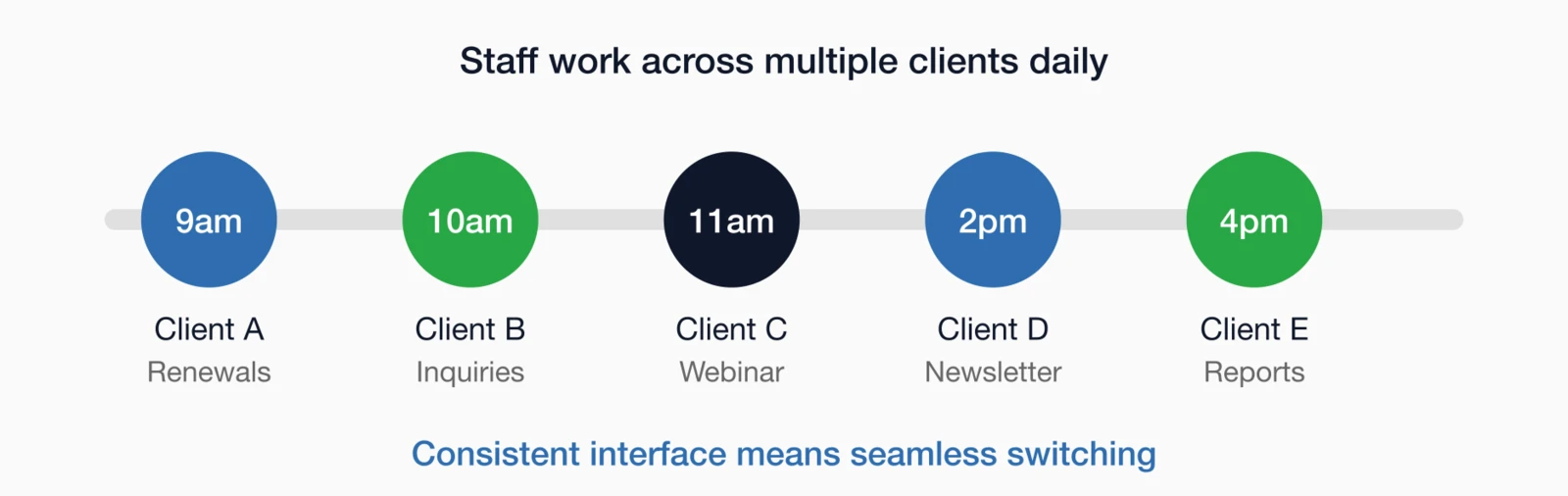
A membership coordinator at an AMC might handle:
- Morning: Process membership applications for 3 different associations
- Mid-morning: Respond to member inquiries across 5 clients
- Afternoon: Set up a webinar for Client A, then create a newsletter for Client B
- Late afternoon: Run month-end reports for the clients that close on the 15th
The key to efficiency isn't a single dashboard—it's a consistent interface. When staff know exactly where to find everything because every client site works the same way, switching between clients becomes seamless even with separate logins.
What makes staff efficient
- One interface to master: Every client site looks and works identically—learn it once, use it everywhere
- Consistent credentials: Staff use the same username and password across all client sites
- Muscle memory transfers: The renewal process, email builder, and report generator work the same for Client A as Client F
- Browser bookmark organization: Staff can bookmark each client's admin panel for quick access
Permission structures
Not every staff member needs access to every client. Set up permission groups that match your organization:
- Client-specific access: Sarah handles Clients A, B, and C; James handles Clients D, E, and F
- Function-specific permissions: Within each client, membership staff can process applications but not access financials
- Role consistency: A staff member's role and permissions can be replicated across all their assigned clients
Financial management for AMCs
Money flows differently in an AMC environment. Each client association has its own dues, events, and revenue streams—but the AMC often handles the processing. Getting this right is non-negotiable, and mistakes here create compliance and relationship problems.
Per-client financial isolation
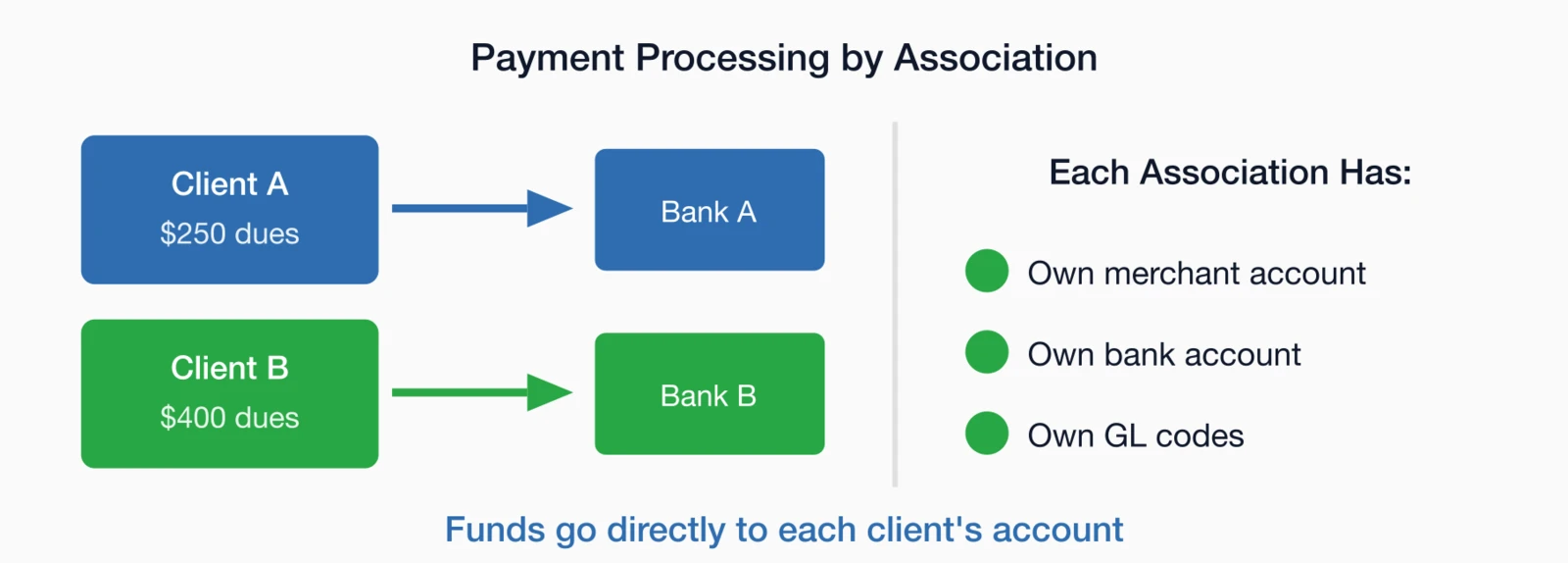
Each association needs:
- Separate merchant accounts: Client A's credit card payments go to Client A's bank account, not the AMC's
- Distinct GL account codes: Map revenue and expenses to each association's chart of accounts
- Independent financial reporting: Generate P&L, balance sheet, and cash flow by association
- Dues revenue tracking: Know exactly what each association collected in membership dues
Payment processing models
There are two common approaches:
1. Client-Owned Merchant Accounts:
- Each association has their own payment processing account
- Money flows directly to client bank accounts
- AMC never touches client funds
- Cleaner for audits and governance
2. AMC Master Account with Splits:
- All payments process through AMC's merchant account
- Funds are allocated and disbursed to clients
- Simpler to set up but creates accounting complexity
- Requires careful tracking and regular disbursements
Most AMCs I work with prefer client-owned merchant accounts—it's cleaner and clients appreciate knowing their money goes directly to their account.
Accounting integration
Look for platforms that integrate with accounting software at the per-client level:
- QuickBooks sync for each association's company file
- Automated revenue recognition by dues period
- Deferred revenue handling for annual memberships
- Invoice and payment matching
AMC Budget Calculator
Planning your technology costs? Our free calculator helps you estimate software expenses across your entire client portfolio—accounting for member counts, feature needs, and pricing models.
Cross-client reporting for AMC leadership
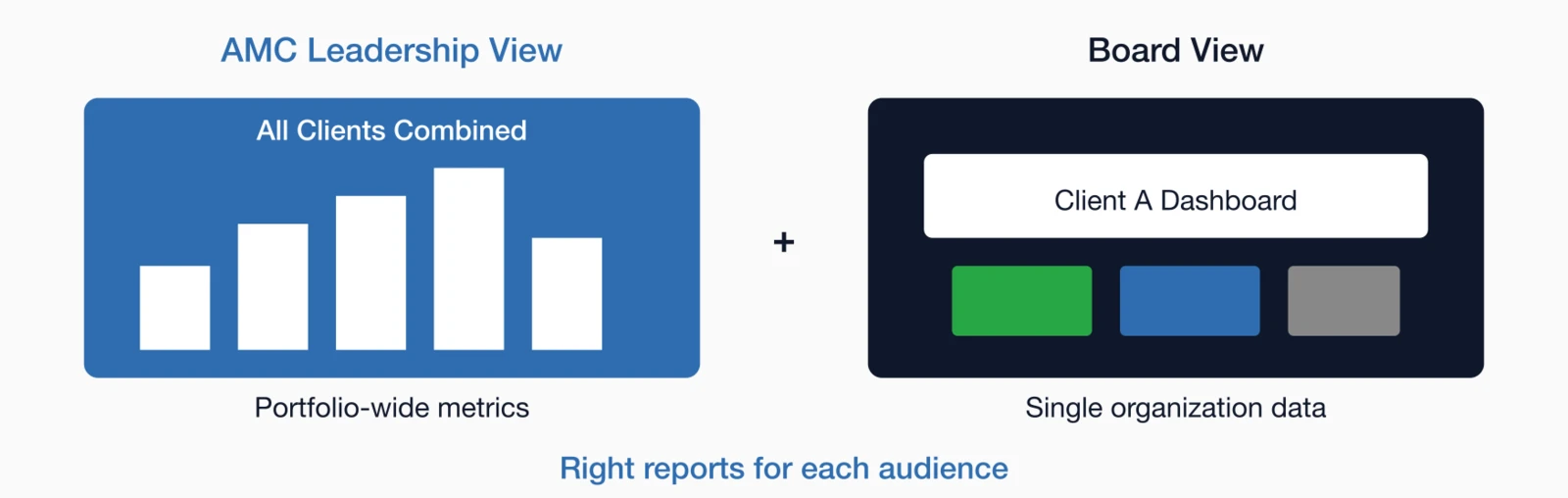
Individual association boards need reports on their organization. But AMC leadership needs something entirely different: visibility across the entire portfolio for resource planning, staffing decisions, and business development. A good multi-tenant platform supports both perspectives.
AMC-level metrics
- Total members under management: How many members across all clients?
- Combined revenue processing: Total dues and event revenue processed monthly
- Retention rates by client: Which associations are thriving vs. struggling?
- Event activity: Upcoming events across all clients for resource allocation
- Support load: Member inquiries by client to balance staff workloads
Strategic portfolio analysis
Cross-client reporting enables strategic questions:
- Which clients are growing? Which are declining?
- What's the average revenue per member across your portfolio?
- Which service areas (events, membership, communications) consume the most staff time?
- Are there clients with unusually high support requirements?
Board-ready reports
For individual association boards, you need reports that focus on their organization alone:
- Membership trend reports (joins, renewals, lapses)
- Financial summaries with year-over-year comparisons
- Event attendance and revenue reports
- Engagement metrics (email opens, event participation, portal logins)
Scaling your AMC
The best time to think about scale is before you need it. AMCs that grow successfully have technology that grows with them—and the constraints become visible only when growth starts to strain the system.
Signs you've outgrown your current setup
- Adding a new client takes weeks of setup instead of days
- Staff are spending more time on system administration than member service
- You can't produce cross-client reports without manual spreadsheet work
- Software licensing costs are becoming a significant line item
- New staff take months to become productive
What scalable multi-association management looks like
- Flat pricing per client or unlimited associations: Predictable costs as you grow
- Template-based client setup: New associations configured in days, not weeks
- Shared knowledge base: Training materials and processes that apply across clients
- API access: Connect additional tools and build custom integrations as needed
i4a's membership platform offers unlimited member pricing—a critical feature for AMCs where member counts vary dramatically across clients.
Choosing the right multi-association platform
Not every AMS supports multi-association management. Even among those that do, capabilities vary widely. Here's what to evaluate when comparing vendors.
Must-have features for AMCs
Security guaranteed by architecture, not application logic
Staff learn one system that works identically everywhere
Each association's funds go to their own accounts
Operational efficiency—adapt proven setups for new clients
Control who accesses which clients and functions
Each association's portal reflects their identity
Costs don't explode as you add clients or members
Questions to ask vendors
- How is data separated between associations? Is it at the application level or database level?
- Is the interface consistent across all client sites, or do different clients run different versions?
- How does your pricing work for AMCs? Per client? Per member? Flat rate?
- Can we set up separate payment processing per association?
- How long does it take to onboard a new association client?
- Can staff use consistent credentials across client sites?
The AMC efficiency advantage
Multi-association management is what makes the AMC model work. Your ability to serve multiple associations efficiently—without proportional increases in overhead—is your competitive advantage. The technology you choose either enables that efficiency or destroys it.
Separate systems per client create fragmentation and waste. A purpose-built multi-association platform creates leverage.
Here's the bottom line: AMCs running on unified multi-association platforms typically operate with 30-40% lower overhead than those using fragmented systems. That efficiency translates directly into profitability—and into better service for your association clients.
Key takeaways
- Separate databases per client provide true data isolation—security guaranteed by architecture, not application logic
- Consistent interface means staff learn one system that works identically across all clients
- Transferable templates and configurations reduce setup time for new clients significantly
- Same credentials across sites simplify staff access while maintaining complete data separation
- Per-client financials remain isolated with separate payment processing and accounting feeds
i4a for Association Management Companies
i4a was built with AMCs in mind. Our association management platform provides true database-level isolation for each client, a consistent interface your staff can master once and use everywhere, transferable templates and configurations, and unlimited members pricing.
Talk to UsRelated resources
Complete guide to automating association operations—applicable across your entire client portfolio.
Estimate technology costs across your association client portfolio.
How to Automate Membership Processes
Save time and reduce errors by automating repetitive membership tasks.
Ensure a smooth transition when moving member data to a new platform.
