Quick Summary: Member Onboarding
- First-year retention is your biggest gap: New members renew at 75% vs. 84% overall—a 9-point difference that structured onboarding can close.
- The 90-day window is decisive: Members who don't engage in their first three months are 60-70% more likely to churn at renewal.
- Structured programs deliver measurable lift: Associations with formal onboarding see 25-40% higher first-year retention than those without.
- Three phases drive success: Welcome (Days 1-7), Activate (Days 8-30), and Integrate (Days 31-90) create progressive engagement.
- Automation ensures consistency: Manual onboarding fails when staff gets busy; triggered sequences ensure every member gets the same experience.
Part of our member onboarding and retention guide
New member onboarding is your biggest retention opportunity: first-year members typically renew at lower rates than established ones. This 90-day framework guides new members from signup to active engagement, closing that first-year retention gap.
For too many associations, the answer is "not much." A welcome email gets sent, maybe a membership card arrives in the mail, and then... silence. The new member is left to figure things out on their own, often never discovering the full value of their membership.
Here's what I've learned over 30 years: Most associations spend 10x more effort acquiring new members than retaining them. There's a better approach. You've already done the hard work of convincing someone to join — make sure they stick around to experience the value.
This approach is costing associations tens of thousands of dollars in preventable churn. Research consistently shows that members who don't engage within their first 90 days are 60-70% more likely to leave at renewal time. Industry research confirms first-year member retention is the strongest predictor of long-term association health—yet 55% of associations are experiencing flat or declining retention overall. The solution? A structured, intentional onboarding program that guides new members from signup to active engagement. Whether you're a professional association, trade association, or membership nonprofit
Why onboarding matters for retention
The data on onboarding's impact is compelling. According to the 2025 Membership Marketing Benchmarking Report from Marketing General Inc., first-year members renew at just 75% compared to the 84% overall renewal rate—a 9-point gap that represents your single biggest retention opportunity.

Associations are responding: 84% now use welcome emails, 37% send welcome kits, and 29% make personal welcome calls. Most significantly, 25% of associations started new onboarding programs in 2024, recognizing this as a high-ROI investment. Associations with formal onboarding programs typically see:
- 25-40% higher first-year retention rates compared to those without structured programs
- 50% faster time to first engagement (attending an event, joining a committee, etc.)
- 3x higher likelihood of members referring colleagues
- Significantly higher satisfaction scores on member surveys
The psychology behind this is straightforward: new members are in a "discovery mindset" during their first weeks. They're actively looking for value, trying to understand what they've purchased, and forming opinions about whether they made the right decision. This window of openness doesn't last forever.
After about 90 days, members have typically formed their opinion about your association. If they haven't found value by then, they've mentally checked out — even if they don't officially leave until their renewal date approaches.
I've seen this pattern play out hundreds of times over my career. The associations with the best retention aren't necessarily the ones with the best benefits—they're the ones that help new members discover and use those benefits quickly.
Quick Onboarding ROI Calculator
See the financial impact of improving your onboarding:
A 20% improvement in first-year retention often pays for your entire AMS investment. Membership management tools
The 90-day onboarding framework
Effective onboarding isn't a single welcome email — it's a carefully orchestrated sequence of touchpoints designed to guide members from "just joined" to "fully engaged." Based on work with hundreds of associations, we recommend breaking onboarding into three distinct phases:

Each phase has specific goals and touchpoints. Let's break them down in detail.
Phase 1: Welcome (days 1-7)
The first week sets the tone for the entire member relationship. Your goals during this phase are simple but critical:

- Confirm the member's decision — reassure them they made the right choice
- Provide immediate access — get them into the member portal and using benefits
- Set expectations — preview what's coming and what value they can expect
Day 1: The welcome email
This is often your first post-purchase communication. Make it count. For template ideas, see our welcome email series templates. An effective welcome email should:
- Thank them warmly and personally (use their name, reference their member type)
- Provide login credentials and a direct link to the member portal
- Highlight 2-3 immediate benefits they can access right now
- Include a personal touch — a note from the Executive Director or President
- Set expectations for the onboarding journey ahead
Days 2-3: Access confirmation and quick win
Send a follow-up that confirms their account is set up and provides one specific action they can take immediately:
- Complete their member profile (with explanation of why it matters)
- Download a valuable resource
- Access the member directory
- Watch a short welcome video
Days 5-7: The orientation invitation
Invite them to a new member orientation — whether live or on-demand. This can be:
- A monthly live webinar for new members
- An on-demand video orientation
- A virtual coffee chat with staff
- An in-person welcome event (for local associations)
Pro Tip: Personalize based on member type. A young professional joining for career development needs different messaging than a 30-year veteran joining for industry advocacy. Your membership management system
Phase 2: Activate (days 8-30)
Once you've welcomed them, it's time to get them participating. The activation phase focuses on driving first-time engagement with core member benefits.
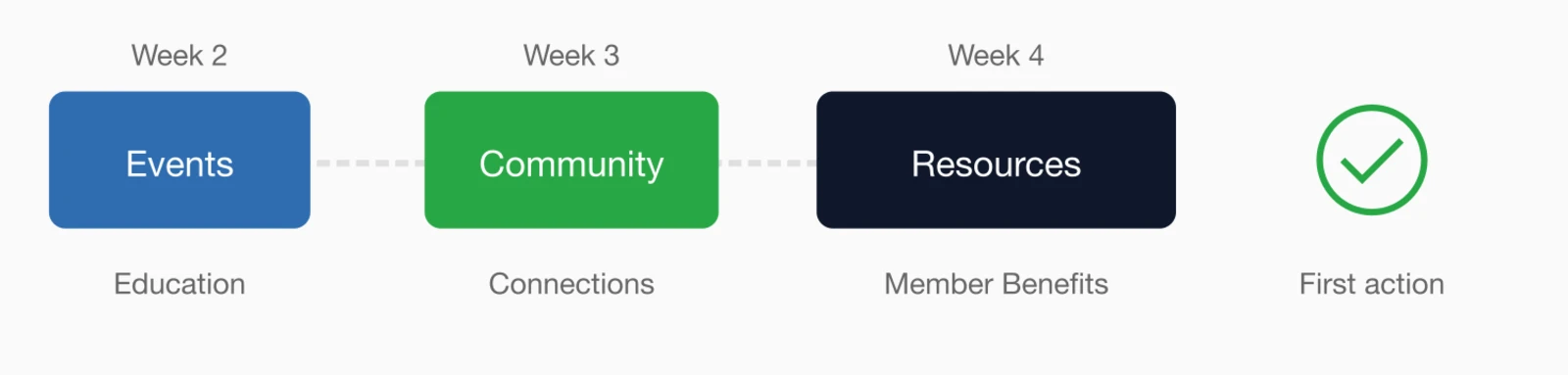
Week 2: Event and education spotlight
Highlight upcoming events and educational opportunities. Be specific about what's coming up in the next 30-60 days that's relevant to them. Include:
- Upcoming webinars or virtual events
- Registration discounts for members
- On-demand learning opportunities
- Registration links for your upcoming events
Week 3: Community and networking
Introduce community engagement options:
- Interest groups or special sections they can join
- Committee volunteer opportunities
- Mentorship programs
- Online community and discussion forums
Week 4: Resource deep dive
Showcase member-exclusive content and tools:
- Industry reports and research
- Best practice guides from the resource library
- Templates and toolkits
- Member discounts and partner offers
Phase 3: Integrate (days 31-90)
By day 30, engaged members have typically taken at least one action. The integration phase focuses on deepening that engagement and building habits that lead to long-term retention.
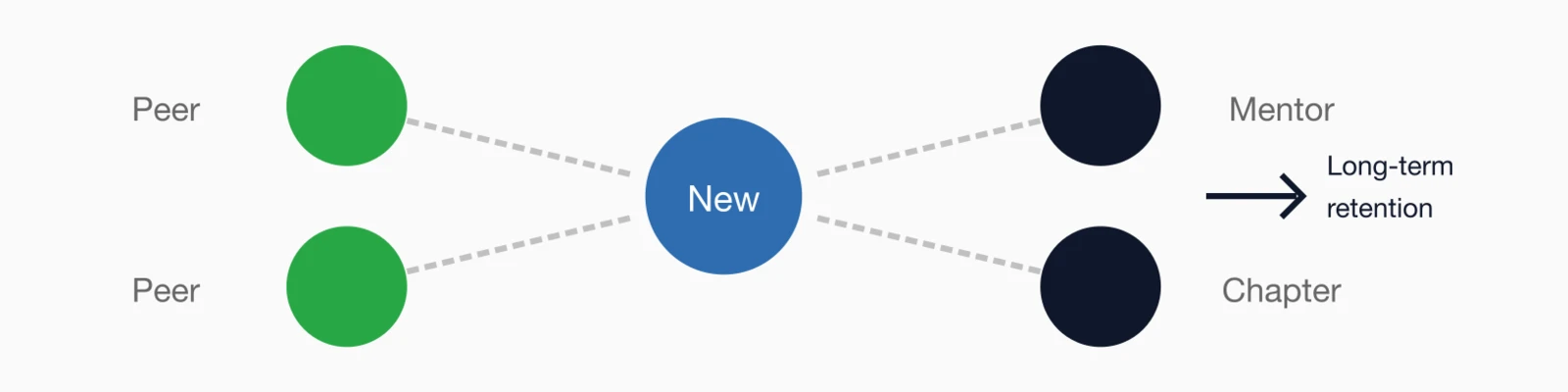
Weeks 5-8: Peer connection
Members who connect with peers are significantly more likely to renew. Facilitate these connections through:
- New member meetups (virtual or in-person)
- Buddy or mentor matching programs
- Regional chapter introductions
- Interest-based networking opportunities
Weeks 9-12: Feedback and forward look
Close the onboarding loop by gathering feedback and pointing toward renewal:
- Send a "How's it going?" survey at 60-75 days
- Address any concerns or unmet expectations immediately
- Preview upcoming annual events or benefits
- Begin soft messaging about the value they've received
Automation strategies that scale
Manual onboarding doesn't scale. With new members joining throughout the year, you need automation to ensure every member receives the same quality experience.
Real Talk: We often see small-staff associations (2-5 people) trying to manually onboard members. It rarely works long-term. Someone goes on vacation, a busy season hits, and suddenly new members fall through the cracks. Automation isn't about being impersonal — it's about being consistent. Your 200th member of the year deserves the same experience as your first.
A modern association management platform should enable:
Triggered Email Sequences
Set up emails that automatically send based on join date, member type, and engagement actions. Your entire 90-day welcome sequence can run hands-free, ensuring every new member gets timely, relevant messages without staff having to remember to send them.
Behavioral Triggers
Smart automation adapts based on what members actually do. Already attended an event? Skip the reminder. Haven't logged in after two weeks? Trigger a friendly nudge. This keeps messaging relevant and prevents the "we just sent you that" awkwardness.
Progress Tracking
Dashboards that show exactly where each member is in their onboarding journey. Quickly spot members falling behind milestones so staff can intervene before disengagement sets in. No more guessing who needs attention.
Segment-Specific Paths
Different member types need different onboarding experiences. Students, professionals, and organizational members each have unique needs. Create tailored tracks that speak to their specific goals and highlight the benefits most relevant to them.
Measuring onboarding success
You can't improve what you don't measure. Track these key metrics to evaluate your onboarding program:

Key metrics to track
- Profile Completion Rate: Target 70%+ within 14 days — indicates initial engagement
- First Login Rate: Target 85%+ within 7 days — shows they're accessing benefits
- First Event Attendance: Target 40%+ within 90 days — predicts long-term retention
- Email Engagement: Target 50%+ open rate on onboarding emails — indicates content relevance
- First-Year Renewal Rate: Target 80%+ (the 2025 MGI benchmark median is 75%) — ultimate success measure
Benchmarks by phase
- End of Phase 1 (Day 7): 80% have logged in, 60% completed profile
- End of Phase 2 (Day 30): 50% attended an event or webinar, 70% accessed resources
- End of Phase 3 (Day 90): 40% connected with a peer, 30% expressed interest in volunteering
Use your membership reporting tools
Common onboarding mistakes to avoid
As you build your onboarding program, watch out for these common pitfalls:
Information Overload
Don't try to tell new members everything in the first email. Spread information across the 90-day journey, introducing concepts when they're most relevant.
Generic Messaging
A one-size-fits-all approach ignores the reality that different members join for different reasons. Segment your onboarding based on member type, career stage, and interests.
Stopping Too Soon
A welcome email isn't onboarding. Members need sustained engagement throughout their first 90 days to form lasting habits.
Ignoring Non-Responders
If a member isn't engaging with your onboarding sequence, don't just keep sending the same emails. Trigger alternative touchpoints — a phone call, a different email approach, or a direct mail piece.
No Human Touch
Automation is essential for scale, but don't lose the human element. Include personal outreach from staff or volunteer leaders for high-value members.
The Biggest Mistake I See? Treating onboarding as a "nice to have" that gets deprioritized when staff gets busy. In one implementation, a state association had a beautiful onboarding plan designed but never executed because their ED was also running events, managing the board, and handling member services. If you can't automate it, it won't happen. That's not a criticism of your staff — it's just reality.
Getting started
Building an effective onboarding program doesn't happen overnight. Start with the basics:
- Audit your current process — Map every touchpoint a new member currently receives
- Define your milestones — What actions indicate successful onboarding?
- Build the welcome phase first — Get the first week right before expanding
- Automate progressively — Start with basic triggered emails, then add sophistication
- Measure and iterate — Track metrics and continuously improve
The investment in onboarding pays dividends for years. Members who complete a structured onboarding program don't just renew at higher rates — they become advocates who refer colleagues, volunteer for committees, and champion your organization in the industry.
Key takeaways
- The first 90 days are critical — members who don't engage have 60-70% higher churn risk at first renewal
- Structured onboarding increases retention by 25-40% compared to ad-hoc approaches
- Use the 3-phase framework: Welcome (Days 1-7), Activate (Days 8-30), Integrate (Days 31-90)
- Automate the sequence through your AMS platform to ensure consistency
- Track key milestones — profile completion, first event, committee interest, peer connections
How i4a Helps With Member Onboarding
i4a gives you the tools to build and automate your onboarding program with automated email sequences, member portal with self-service profile completion, engagement tracking, event integration, and custom reporting to measure onboarding completion rates.
Talk to Us About Improving Member OnboardingRelated resources
Complete 2026 strategy guide for improving retention across the entire member lifecycle.
Proven tactics to identify at-risk members and prevent churn before it happens.
Complete guide to renewal automation that reduces churn and saves staff time.
Estimate your investment in association management software.
