Quick Summary: Non-Dues Revenue
- Benchmark: 40–60% non-dues: Industry guidance suggests this range provides financial stability and reduces reliance on membership dues.
- Events often lead: Annual conferences generate significant revenue through registration fees, sponsorships, and exhibit halls.
- Education has high margins: Certification programs and online courses deliver 70–85% margins after initial development costs.
- Diversification reduces risk: Multiple revenue streams protect against economic downturns and membership fluctuations.
- Start small and scale: Pick 2–3 streams aligned with existing strengths; most programs take 18–24 months to reach full potential.
Part of our non-dues revenue guide
Non-dues revenue is essential for association financial stability and growth. These 10 proven strategies—from events and certifications to sponsorships and job boards—help you diversify beyond membership dues.
Many association finance benchmarks suggest aiming for roughly 40–60% of total revenue from non-dues sources, depending on your size, industry, and business model. According to the MGI 2025 Association Outlook Report, 63% of associations expect an increase in non-dues revenue in the coming year—a clear signal that diversification remains a top strategic priority. This diversification provides financial stability, enables investment in better programs, and often adds value that strengthens member retention.
Whether you're a trade association, professional association, membership nonprofit, or AMC, these creative non-dues revenue ideas will help you build a more sustainable financial foundation.
Why non-dues revenue matters
Membership dues alone rarely cover the full cost of delivering exceptional value, let alone funding innovation and growth. Organizations that depend too heavily on a single revenue source find themselves vulnerable to economic downturns, industry disruptions, and shifting member priorities—any of which can suddenly destabilize their financial foundation. The associations that thrive over the long term are those that build multiple income streams, each reinforcing the others while spreading risk across diverse sources.
Beyond financial stability, non-dues revenue often creates a virtuous cycle: programs that generate income frequently deliver significant member value, which in turn strengthens retention and attracts new members. When your education programs, events, and career services are both profitable and genuinely useful, you build an organization that members cannot imagine leaving. The right membership management software helps you track which programs drive the most value and revenue.

Here's why diversification should be a strategic priority:
- Financial stability: Multiple revenue streams reduce risk
- Member value: Many non-dues sources provide benefits to members
- Competitive pricing: Non-dues revenue subsidizes lower membership fees
- Growth investment: Funds innovation and program expansion
- Market resilience: Cushion against economic downturns
- Mission advancement: More resources to achieve organizational goals
Industry Benchmark: Many industry experts recommend that membership organizations aim for 50-60% of revenue from non-dues sources. Events, education, and sponsorships are commonly cited as the top three categories—though actual results vary widely by organization type and size.
Keep It Mission-Aligned: Ensure non-dues programs provide value to members. Revenue generation should support, not undermine, your organizational purpose.
Events and conferences
For many associations, events represent the single largest non-dues revenue opportunity—and often the most visible expression of organizational value. A well-executed annual conference can generate significant income through registration fees, sponsorships, exhibit hall sales, and add-on workshops, while simultaneously reinforcing member loyalty and attracting new prospects. The right event management software makes it possible to treat events not as isolated occurrences but as year-round revenue engines with multiple monetization touchpoints.
The most successful associations have moved beyond the traditional conference model to create diversified event portfolios. This includes flagship annual meetings, regional workshops, virtual summits, intensive training bootcamps, and exclusive networking retreats. Each format serves different audience segments and price sensitivities, allowing you to capture revenue from members who might not attend your main event.
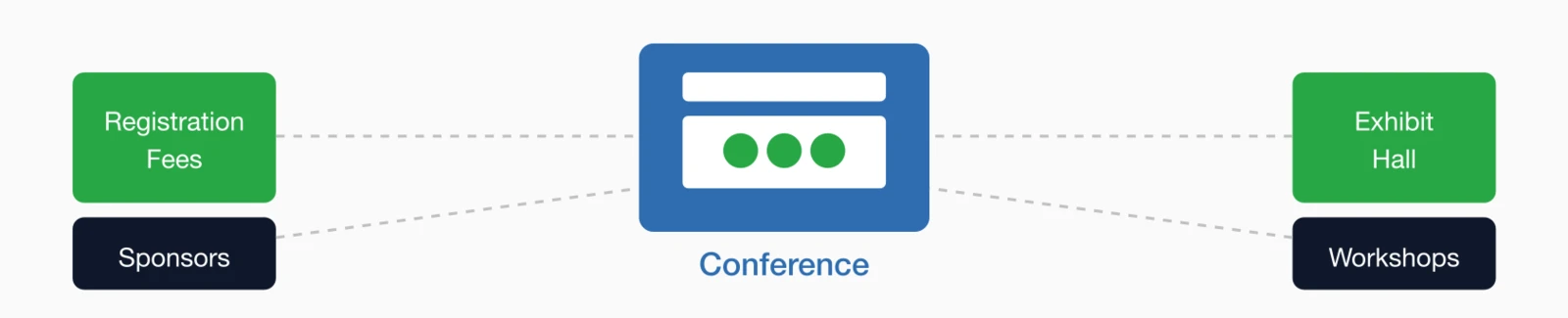
Revenue opportunities within events:
- Registration fees: Tiered pricing (early bird, regular, late) with member/non-member differentials
- Pre-conference workshops: Premium sessions with specialized content or certifications
- Exhibit hall: Booth sales with tiered packages based on size and visibility
- Sponsorships: Session sponsors, networking event sponsors, app sponsors, badge sponsors
- Recordings and materials: Sell access to session recordings for non-attendees
- Mobile app advertising: In-app banner ads and push notification sponsorships
- Networking events: Ticketed dinners, tours, or exclusive receptions
Pro Tip: Create a "virtual pass" option for members who cannot attend in person. Even at a lower price point, virtual attendance expands your addressable market and creates an entry point for future in-person attendees.
Education and professional development
Education is where associations can truly leverage their unique position as trusted industry authorities. Unlike commercial training providers, your organization possesses deep subject matter expertise, access to leading practitioners, and credibility that comes from serving your profession or industry for years or decades. This positions you to command premium pricing for content that members genuinely need for career advancement and professional competence. Education management software helps you deliver these programs efficiently while tracking certifications and credits. Education programs also tend to have high margins once initial development costs are recovered.
The education landscape has expanded dramatically beyond traditional in-person seminars. Today's learners expect on-demand access, mobile-friendly delivery, and credentials they can display to employers and clients. Associations that build robust learning management systems and certification programs create recurring revenue streams that compound over time as your content library grows and your credentials gain industry recognition.
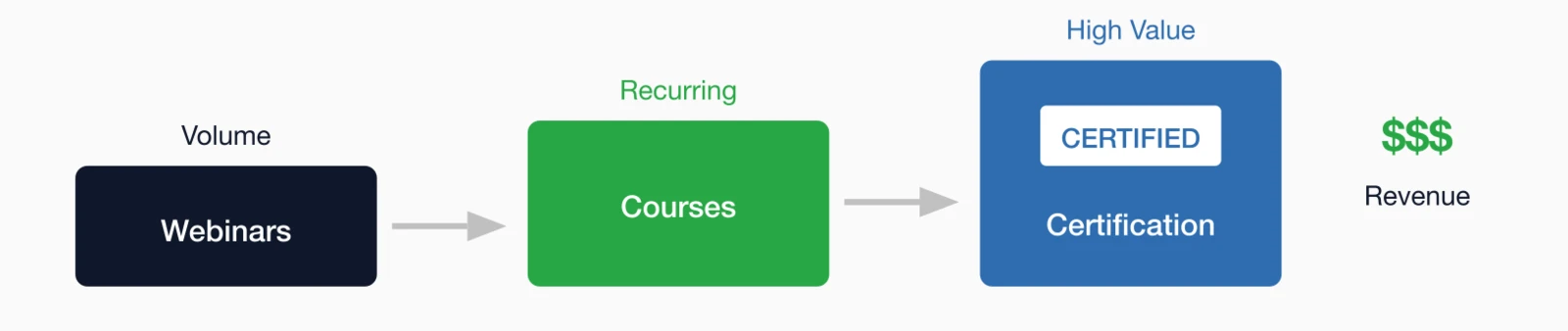
Education revenue models:
- Certification programs: Initial certification fees, study materials, exam fees, and recertification renewals (particularly valuable for medical associations and credentialing bodies)
- Online courses: Self-paced learning modules sold individually or as bundles
- Webinar series: Live educational sessions with replay access
- Learning subscriptions: All-access passes to your education library for an annual fee
- Corporate training packages: Bulk licensing for employers to train their teams
- Continuing education credits: Partner with other organizations to accept your credits
- Mentorship programs: Structured programs connecting experienced professionals with newcomers
Revenue Insight: Certification programs often generate the highest margins of any education offering. After initial development, the incremental cost per candidate is minimal, while fees can range from hundreds to thousands of dollars depending on your industry.
Sponsorships and advertising
Your association sits at the center of a valuable network—members who make purchasing decisions, influence their organizations, and represent concentrated buying power in your industry or profession. Companies that serve your market will pay for access to this audience, making sponsorships and advertising a natural revenue stream that requires minimal operational overhead once relationships are established. The challenge lies in creating sponsorship packages that deliver measurable value to sponsors while maintaining trust with your members.
Effective sponsorship programs go far beyond logo placement and banner ads. Today's corporate partners want engagement, data, and demonstrable ROI. The associations that command premium sponsorship rates are those that can offer exclusive access, thought leadership positioning, lead generation opportunities, and clear metrics on reach and engagement. Building these capabilities takes time, but the revenue potential makes it worthwhile.

Sponsorship and advertising opportunities:
- Event sponsorships: Tiered packages from platinum to bronze with escalating benefits
- Publication advertising: Print and digital ads in magazines, newsletters, and journals
- Website advertising: Banner ads, sponsored content sections, and resource directory listings
- Email sponsorships: Sponsored content blocks in member communications via your email marketing platform
- Webinar sponsorships: Branded educational sessions with sponsor integration
- Content sponsorships: Whitepapers, research reports, and guides with sponsor branding
- Community sponsorships: Branded areas within your member community platform
- Annual partnership programs: Year-round visibility packages with bundled benefits
Building a compelling sponsorship program:
- Create detailed audience demographics and engagement data to share with prospects
- Develop tiered packages at multiple price points to accommodate different budgets
- Offer custom sponsorship opportunities for partners with specific goals
- Provide post-sponsorship reports with concrete metrics and outcomes
- Build relationships with sponsor contacts beyond transactional interactions
Publications and content
Content has always been at the heart of association value, but monetization strategies have evolved significantly. While traditional print publications face declining advertising revenue and rising production costs, digital content opens new revenue channels that can be more profitable and scalable. The key is recognizing that your organization's accumulated knowledge, curated perspectives, and authoritative voice are valuable assets that audiences will pay to access. Whether through premium subscriptions, paywalled archives, or specialized publications, content monetization rewards organizations that invest in quality.
The most successful content revenue strategies balance free content that builds audience and demonstrates value with premium offerings that justify payment. This might mean offering basic industry news for free while charging for in-depth analysis, proprietary research, or practical tools. Some associations have found success with membership-gated content that provides a tangible reason to join, while others sell publications separately to reach non-member audiences.

Publication revenue streams:
- Print magazines and journals: Subscription fees and advertising revenue
- Digital subscriptions: Premium newsletter tiers with exclusive content
- Books and guides: Authored or curated publications sold to members and the public
- Special reports: In-depth research publications on specific topics
- Content licensing: Allow other organizations to republish your content for a fee
- Sponsored content: Branded articles, guides, or reports with sponsor support
- Archive access: Premium access to historical content and back issues
Content Strategy: Consider creating a "content pyramid" where free blog posts and social content feed interest in premium guides and research, which in turn support your highest-value certification and education programs.
Affinity programs
Affinity programs leverage your association's collective buying power and trusted brand to offer members discounted products and services while generating royalty revenue for your organization. When structured correctly, these programs create genuine win-win scenarios: members receive better pricing or exclusive benefits they could not access individually, partner companies gain access to a qualified customer base, and your association earns ongoing revenue with minimal operational burden. The challenge lies in selecting partners whose offerings truly benefit members and align with your organizational values.
The most successful affinity programs focus on products and services that members actually need, rather than generic discounts that fail to move the needle. Insurance programs—particularly professional liability, health, and disability coverage—often generate the most significant revenue because the savings are substantial and the products are essential. But creative associations have found success with everything from office supplies to travel services to financial products.

Common affinity program categories:
- Insurance products: Professional liability, health, life, disability, and property coverage
- Financial services: Credit cards, retirement plans, and member loan programs
- Technology discounts: Software, hardware, and service provider partnerships
- Office and business services: Shipping, printing, office supplies, and equipment
- Travel benefits: Hotel, rental car, and airline discount programs
- Professional services: Legal, accounting, and consulting referral networks
- Personal benefits: Entertainment, wellness, and lifestyle discounts
Keys to affinity program success:
- Vet partners carefully to ensure quality and member satisfaction
- Negotiate royalty structures that provide fair ongoing revenue
- Promote programs actively—most fail due to lack of awareness, not lack of value
- Track usage and satisfaction to identify underperforming partnerships
- Review and renegotiate agreements regularly as market conditions change
Job boards and career services
Career advancement is a primary reason professionals join associations, making job boards and career services a natural fit that serves member needs while generating revenue. Employers in your industry are willing to pay premium rates to reach qualified candidates who have demonstrated commitment to the profession through association membership. A well-designed association job board becomes a valuable member benefit that differentiates your organization while creating a sustainable revenue stream from employer postings and services.
Modern career services extend far beyond basic job listings. The most effective programs combine job boards with resume databases, career coaching, salary surveys, and professional development resources. This comprehensive approach creates multiple monetization opportunities while positioning your association as the definitive career hub for your industry or profession. Consider how each component can be priced and packaged to maximize both revenue and member value.

Job board and career service revenue:
- Job postings: Per-posting fees or subscription packages for frequent employers
- Featured listings: Premium placement and enhanced visibility for additional fees
- Resume database access: Employer subscriptions to search your member directory and resume database
- Career fairs: Virtual or in-person events with employer booth fees
- Recruitment advertising: Banner ads and sponsored content targeting job seekers
- Career coaching: Individual coaching services for members seeking advancement
- Salary surveys: Sell comprehensive compensation data to employers and members
Pricing Strategy: Consider tiered posting packages that offer discounts for volume. An employer who posts 10 jobs per year at a discounted rate generates more total revenue than occasional single-post customers.
Consulting and advisory services
Your association's staff and volunteer experts possess knowledge that organizations outside your membership would pay to access. Consulting and advisory services allow you to monetize this expertise while expanding your influence and building relationships with potential future members. These services work particularly well for associations with specialized technical, regulatory, or operational knowledge that is difficult to find elsewhere. The key is identifying what you know that others need and packaging it in ways that justify professional service fees.
Consulting services require careful consideration of scope, pricing, and potential conflicts. You will need to determine what services to offer, how to price them competitively, and how to manage situations where consulting clients may be competitors to your members. Many associations address this by focusing on services to organizations outside their traditional membership base—government agencies, international organizations, or companies in adjacent industries that need your expertise.

Consulting and advisory offerings:
- Standards development: Help organizations implement industry standards and best practices
- Regulatory compliance: Guide companies through complex regulatory requirements
- Benchmarking services: Provide comparative analysis using your industry data
- Strategic planning: Facilitate planning processes using industry expertise
- Technical assistance: Offer specialized technical support and guidance
- Training development: Create custom training programs for organizations
- International expansion: Help foreign organizations enter your market or vice versa
Staffing Consideration: Consulting services can be staff-intensive. Consider whether to build in-house capacity, engage member experts on a contract basis, or partner with consulting firms who pay referral fees for introductions.
Merchandise and products
Association merchandise and branded products serve dual purposes: they generate revenue while reinforcing member identity and organizational visibility. From practical professional tools to branded apparel and gifts, product sales through your association online store allow members to display their affiliation while supporting your organization. While merchandise alone rarely constitutes a major revenue stream, it contributes to overall financial diversification and strengthens the emotional connection members feel with your brand.
The most successful merchandise programs focus on items that members actually want and will use regularly. Generic promotional items often sit in drawers unused, while thoughtfully designed products that reflect professional pride get displayed and worn. Consider your members' work environments, professional culture, and personal preferences when selecting what to offer. Quality matters more than quantity—a few well-made items generate more revenue and satisfaction than a catalog full of mediocre options.

Merchandise and product categories:
- Professional tools: Industry-specific calculators, reference cards, or equipment
- Branded apparel: Quality polo shirts, jackets, and accessories with your logo
- Recognition products: Award plaques, certificates, and milestone gifts
- Event merchandise: Conference-specific items, commemorative products
- Office supplies: Branded notebooks, pens, and desk accessories
- Digital products: Templates, checklists, and downloadable tools
- Gift items: Products suitable for member recognition and corporate gifts
Operational Tip: Consider print-on-demand and dropshipping services to minimize inventory investment and fulfillment burden. Modern vendors can produce and ship individual orders, eliminating the need to stock products.
Data and research
Your association has access to something invaluable: aggregated data about your industry or profession that no single organization could collect on its own. Salary surveys, benchmarking studies, industry trend reports, and market research represent significant revenue opportunities because this information helps members make better decisions and helps companies understand the markets they serve. Data products also position your organization as the authoritative source for industry intelligence, reinforcing your relevance and value.
Effective research programs require investment in methodology, analysis, and presentation, but the payoff can be substantial. A comprehensive salary survey, for example, might cost $20,000-$50,000 to produce but generate multiples of that in sales to employers, recruiters, and members. The key is identifying what data your members and stakeholders desperately need, then building the systems and expertise to collect, analyze, and present it compellingly.

Data and research revenue opportunities:
- Salary and compensation surveys: Detailed wage data by role, region, and experience
- Industry benchmarking studies: Operational and financial comparisons across organizations
- Market research reports: Analysis of trends, challenges, and opportunities
- Economic impact studies: Quantifying your industry's contribution to the economy
- Member surveys and insights: Aggregated data on attitudes, behaviors, and preferences
- Custom research: Tailored studies commissioned by sponsors or clients
- Data licensing: Allow third parties to incorporate your data into their products
Pricing Model: Consider tiered pricing based on how data will be used. Individual members might pay less than corporate subscribers, while data licensing for commercial use commands premium rates.
Grants and fundraising
While grants and fundraising may feel more like nonprofit territory, many associations successfully tap these revenue sources for specific programs and initiatives. Foundation grants can fund research, education, advocacy, and charitable activities that align with both grantor priorities and your organizational mission. Fundraising campaigns—whether for scholarships, disaster relief, or special projects—engage members who want to give back to their profession while generating resources for meaningful work.
The key to success with grants and fundraising is focusing on activities that genuinely advance your mission rather than chasing dollars for their own sake. Foundations and donors want to support impactful work, not subsidize operational expenses. When you can articulate clear outcomes—students educated, research conducted, communities served—you unlock funding sources that complement rather than compete with your dues and program revenue.
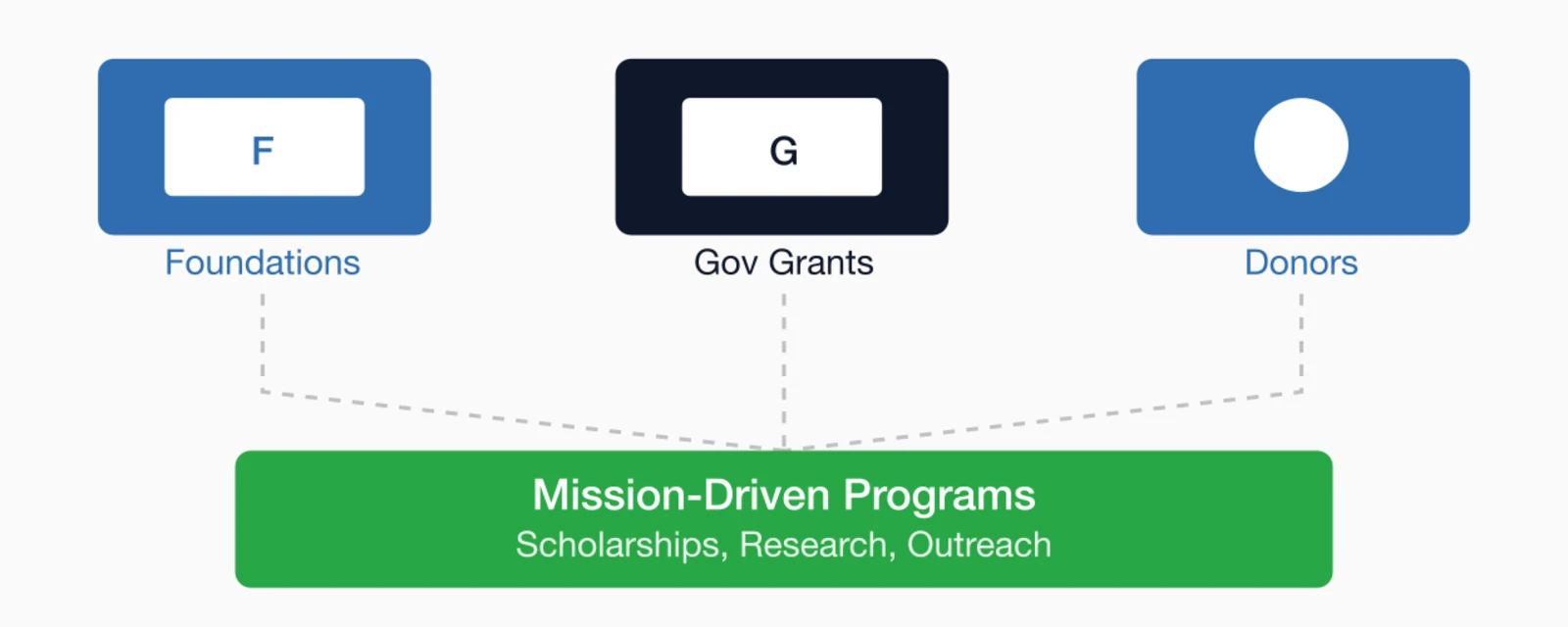
Grant and fundraising opportunities:
- Foundation grants: Funding for research, education, and charitable programs
- Government grants: Support for workforce development, research, and public benefit programs
- Corporate philanthropy: Donations from companies that support your mission
- Scholarship funds: Member contributions to support students and early-career professionals
- Memorial and tribute giving: Donations in honor of industry leaders
- Capital campaigns: Major fundraising for facilities, endowments, or special initiatives
- Planned giving: Bequests and estate gifts from longtime members
Foundation Strategy: If your association has significant charitable activities, consider establishing a separate foundation. This can unlock additional funding sources and provide tax benefits for donors while keeping charitable and business activities appropriately separated.
How to implement new revenue streams
Starting new non-dues revenue programs requires thoughtful planning and realistic expectations. Too many associations launch initiatives with enthusiasm but insufficient preparation, leading to disappointing results that discourage future innovation. A systematic approach to implementation increases your odds of success while managing risk and resource investment. Start with opportunities that build on existing strengths, test assumptions before scaling, and give programs adequate time to mature before judging their viability.
The implementation process should balance ambition with pragmatism. Every new revenue stream requires investment—whether in staff time, technology, marketing, or partnerships—and most take 12-24 months to reach their potential. Prioritize initiatives where you have competitive advantages, clear market demand, and reasonable resource requirements. Build in evaluation milestones to assess progress and make course corrections before committing extensive resources to underperforming programs.

Implementation steps:
- Assess opportunities: Evaluate each revenue stream against your resources, capabilities, and member needs
- Prioritize strategically: Select 2-3 programs that align with your strengths and offer the best risk-adjusted returns
- Develop business plans: Create detailed projections for revenue, costs, timeline, and success metrics
- Start with pilots: Test new programs on a small scale before full commitment
- Allocate resources: Ensure adequate staff, budget, and technology to execute effectively
- Market actively: Programs fail more often from lack of promotion than lack of quality
- Measure and optimize: Track key metrics and refine based on results
- Scale successes: Invest more heavily in programs that demonstrate strong performance
Timeline Reality: Most new revenue programs take 18-24 months to reach meaningful scale. Build patience into your planning and protect promising initiatives from premature cancellation during the development phase.
Key considerations for non-dues revenue
Enthusiasm for new revenue opportunities should be tempered by practical considerations that determine whether programs succeed or struggle. Every revenue stream comes with its own operational requirements, tax implications, resource demands, and potential impact on member perception. The associations that build sustainable non-dues programs are those that think through these factors before launching, not after problems emerge.
Taking time to address these questions upfront prevents costly mistakes and positions your programs for long-term success. Here are the critical areas to evaluate for any new revenue initiative:
Tax implications:
- Some non-dues revenue may be subject to Unrelated Business Income Tax (UBIT)
- Consult with tax professionals to ensure compliance
- Structure programs to minimize tax liability when possible
Resource requirements:
- Do you have staff capacity to manage new programs?
- What technology or infrastructure is needed? (An integrated association management platform simplifies this)
- Will you need to hire specialists or contractors?
Member perception:
- Will members see these programs as valuable benefits?
- Are prices fair and competitive?
- Does this align with member expectations?
Market demand:
- Is there sufficient market for this program?
- What are competitors charging?
- How will you promote and sell this offering?
Measuring non-dues revenue success
What gets measured gets managed—and in non-dues revenue, rigorous measurement separates thriving programs from costly distractions. Too many associations track only gross revenue, missing crucial insights about profitability, efficiency, and sustainability. A comprehensive measurement approach helps you identify which programs deserve additional investment, which need optimization, and which should be sunset to free resources for better opportunities.
Effective measurement requires tracking both financial and operational metrics over time. Short-term results can be misleading; a program that loses money in year one may become highly profitable by year three as you refine operations and build market awareness. Establish baselines, set realistic targets, and review performance quarterly to catch problems early and capitalize on successes.
Track these metrics for each revenue stream:
- Gross revenue: Total income generated (e.g., $125,000)
- Net revenue: Revenue minus direct costs (e.g., $87,500)
- Profit margin: Net revenue as percentage of gross (e.g., 70%)
- Growth rate: Year-over-year increase (tracked via membership reporting) (e.g., +12%)
- Customer acquisition cost: Cost to acquire each customer (e.g., $45)
- Lifetime value: Total revenue per customer over time (e.g., $580)
- Participation rate: Percentage of members who purchase (e.g., 23%)
- Member satisfaction: Feedback on value and quality (e.g., 4.2/5)
Sample metrics shown—plug in your own real numbers for accurate reporting.
Build financial resilience through diversification
Non-dues revenue isn't just about making more money—it's about building a more stable, sustainable, and mission-driven organization. The best non-dues programs create win-win scenarios where your organization generates revenue while delivering exceptional value to members and stakeholders.
Key takeaways:
- Start with programs that leverage existing assets and expertise
- Focus on quality and member value, not just revenue
- Test new ideas on a small scale before major investment
- Track metrics and optimize based on data
- Ensure alignment with mission and member expectations
- Diversify across multiple revenue streams
- Reinvest non-dues revenue in programs that serve members
The organizations that thrive in the coming years will be those that develop diverse, sustainable revenue models. Start exploring one or two of these strategies today, and build from there. Learn more about why associations choose i4a to power their non-dues revenue programs. Your financial future depends on it.
Key takeaways
- Typical benchmark: 40-60% non-dues revenue: Many industry consultants recommend this range for financial stability, though the ideal mix varies by organization size, industry, and business model
- Events are often the #1 non-dues revenue source: Annual conferences can potentially generate significant revenue (ranging widely from tens of thousands to millions depending on size) through registration fees, sponsorships, exhibitor booths, and additional workshops or certifications
- 10 proven revenue streams: Events/conferences, education/certifications, sponsorships/advertising, publications/content, affinity programs (insurance, credit cards), job boards, consulting services, merchandise, proprietary research/data, grants/fundraising
- Start small and scale: Pick 2-3 revenue streams aligned with your mission and member needs—test with pilot programs before full rollout to minimize risk and validate demand
Grow Non-Dues Revenue with the Right Tools
i4a's AMS software supports multiple non-dues revenue streams—events, education, job boards, e-commerce, and more—all integrated into one platform so you can easily manage and grow diverse income sources.
Discuss Revenue OpportunitiesRelated resources
Free tool: Calculate your revenue mix risk and model what-if scenarios.
Event Registration Best Practices
Maximize event attendance and revenue with better registration.
Online Learning Revenue Strategies
Build profitable e-learning programs for your association.
Sponsorship Packages for Associations
Design programs that attract corporate partners.
Certification & Credentialing Revenue
Build high-margin professional development programs.
