Quick Summary: Online Member Forums
- Launch strategy determines success: Seed with 15-20 committed founding members and 10-15 discussion threads before opening to the public.
- Fewer forums mean more activity: Start with 3-5 categories maximum—an active forum signals vitality while empty ones signal abandonment.
- Questions drive participation: Frame forums as places to get help; "Ask the community" is easier than "Start a discussion."
- Balance moderation carefully: Over-moderation stifles conversation while under-moderation lets toxicity drive away quality participants.
- Tie access to membership: Members-only forums create genuine exclusivity and compelling renewal incentives.
Part of our engagement strategies resource
Online member forums succeed or fail based on launch strategy, not technology. Seed with a core group of committed founding members, establish content before going public, and maintain consistent moderation—or watch your forum become another ghost town.
The difference isn't the technology. It's the approach. Successful forums are seeded intentionally, moderated thoughtfully, and promoted consistently. Failed forums are built on the assumption that "if we build it, they will come."
They won't.
This guide shares what actually works—based on patterns I've seen across associations of all sizes and industries. Whether you're launching a new forum or reviving a struggling one, these practices will help you build an online member community where members actively participate and find real value.
Why forums still matter in the age of social media
With professional social networks, chat platforms, and countless other options available, why would members use your association's forum? I hear this question frequently. The answer matters, because if you can't articulate your forum's unique value, members won't see it either.
The value of peer-to-peer exchange is growing. LinkedIn's Workplace Learning Report consistently finds that employees rank learning from colleagues among their most valuable development opportunities—and your forum can be where that happens for your profession.
What forums offer that social media can't
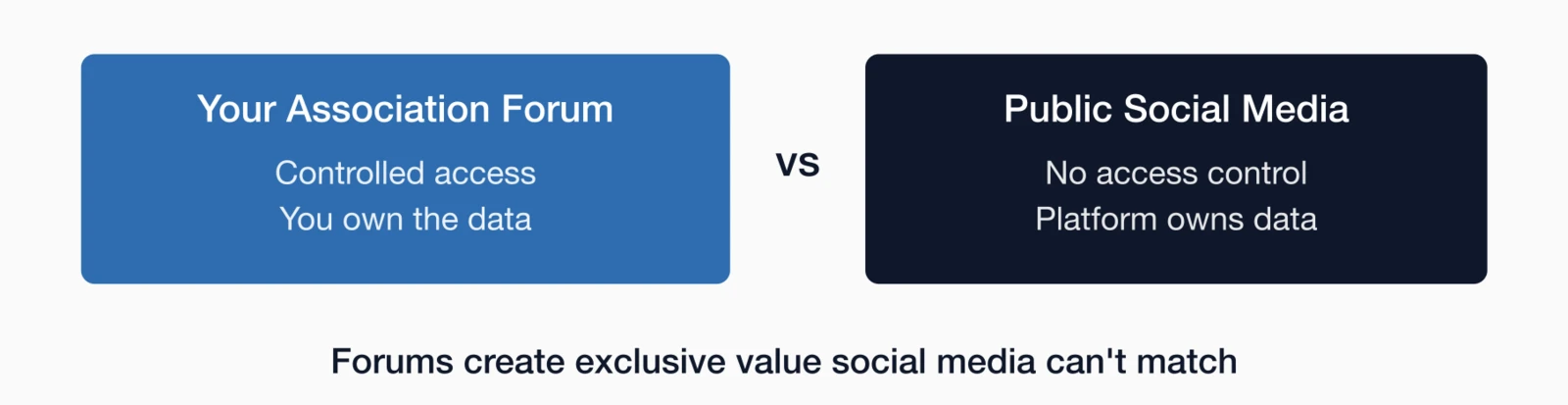
Membership-controlled access. Social media groups can't automatically revoke access when someone's membership lapses. Public platforms can't restrict viewing to paid members only. Your forum can. This creates exclusivity and a genuine renewal incentive—lapsed members lose access to valuable conversations and connections.
Focused professional discussion. Social media platforms mix professional content with personal feeds, vacation photos, and algorithm-driven distractions. Your forum is a dedicated space for professional exchange without the noise.
Searchable knowledge base. Over time, forums become searchable repositories of collective wisdom. New members can find answers to questions that were answered months or years ago. Social media posts disappear into the feed; forum threads persist.
You own the data and relationships. When discussions happen on public social media, you're building value on someone else's platform. They can change the rules anytime. On your own forum, you control the experience, the data, and the community connections.
Strategic insight: The most successful forums I've seen don't try to compete with social media—they complement it. Use public social networks for broad industry discussion and visibility, but keep your deepest, most valuable conversations in your members-only forum.
Launching a forum that succeeds
The first 90 days determine whether your forum becomes vibrant or vacant. Most failed forums share the same origin story: launched with a splash announcement, empty from day one, and abandoned because nobody wants to be the first to post in an empty room.
Pre-launch preparation
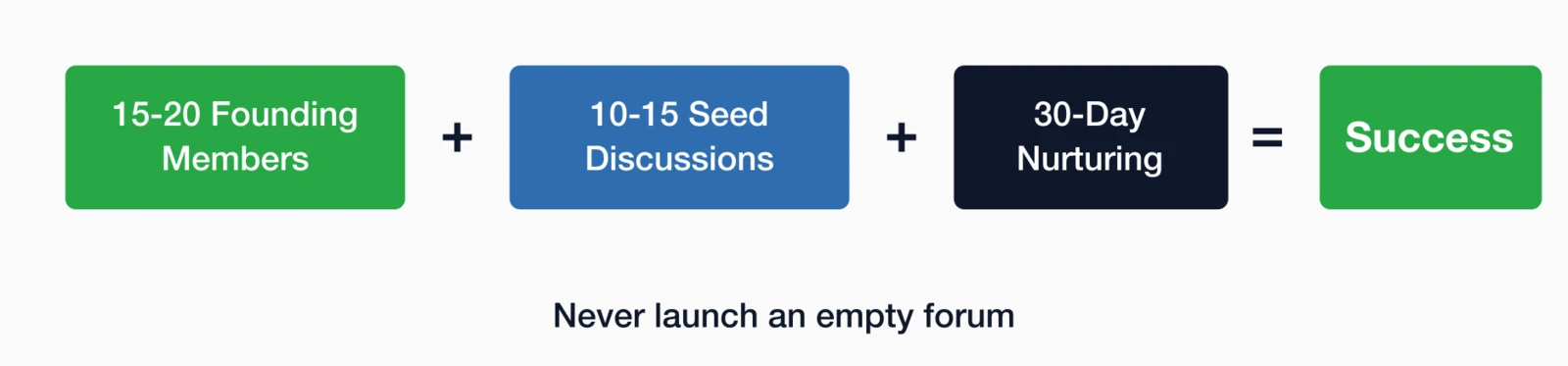
Recruit your founding community. Before launching publicly, identify 15-20 members who will commit to participating in the first month. These aren't just any members—look for people who are naturally helpful, already active in other channels, and genuinely interested in connecting with peers. Personal invitations work better than mass emails.
Seed with real content. Never launch an empty forum. Work with your founding community and staff to create 10-15 initial discussion threads. These should be genuine questions and topics, not manufactured marketing content. Good seed content includes:
- Questions staff actually receives from members ("What's everyone using for X?")
- Topics from recent conference sessions that sparked discussion
- Industry news that invites member perspective
- Welcome threads for introductions
Establish community guidelines. Create clear, friendly community guidelines before launch. Cover expectations for professional conduct, what's appropriate to post, and how disputes will be handled. Having this in place from day one prevents problems later.
A deeper look: The critical first 30 days
I've seen too many associations announce their forum, get some initial signups, and then wait passively to see what happens. What happens is usually nothing—or worse, one enthusiastic member posts and gets no response, signaling to everyone that this isn't an active space.
Your first 30 days require intensive nurturing. Assign specific staff members to monitor the forum daily, respond to every post within 24 hours, and actively encourage responses. When someone asks a question, don't just answer it yourself—reach out to members you know have relevant expertise and ask them to contribute.
Post discussion prompts every few days. Not generic "What do you think about X?" posts, but specific questions tied to real challenges: "We're hearing members struggle with [specific issue]. How are you handling this at your organization?"
Track early participants closely. Send personal thank-you notes to people who post. Highlight valuable contributions in your newsletter. The members who engage early need to feel their participation is noticed and appreciated.
After 30 days, you can reduce intensity—but never disappear entirely. Successful forums require ongoing staff presence and curation.
Forum structure and organization
The impulse to create lots of categories is understandable but counterproductive. Too many forums spread conversation thin, making every space feel inactive. Start small and expand only when discussion volume demands it.
Start simple
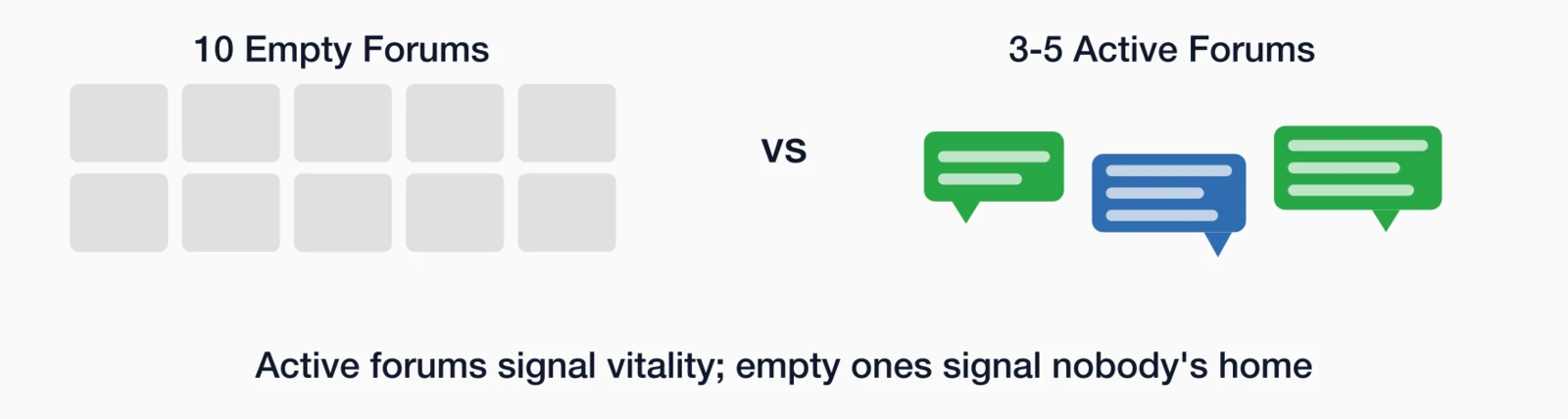
Begin with 3-5 forums at most:
- General Discussion: Catch-all for topics that don't fit elsewhere
- Member Introductions: Welcome space for new members to introduce themselves
- Industry News & Trends: Current events and their impact
- Career & Professional Development: Job-related discussions (if relevant to your membership)
- One topic-specific forum: Based on your members' primary shared interest
When to add more forums
Add new forums only when:
- A topic is generating so much discussion that it drowns out other conversations
- Members are specifically requesting a dedicated space
- You have volunteers committed to moderating and seeding the new space
It's much better to have three active forums than ten quiet ones. An active forum signals vitality; an empty forum signals that nobody's home.
Practical tip: If you have an existing forum with too many categories, consider consolidating. Move threads from underused forums into broader categories and archive the empty ones. A shorter list of active forums is more inviting than a long list of inactive ones.
Moderation best practices
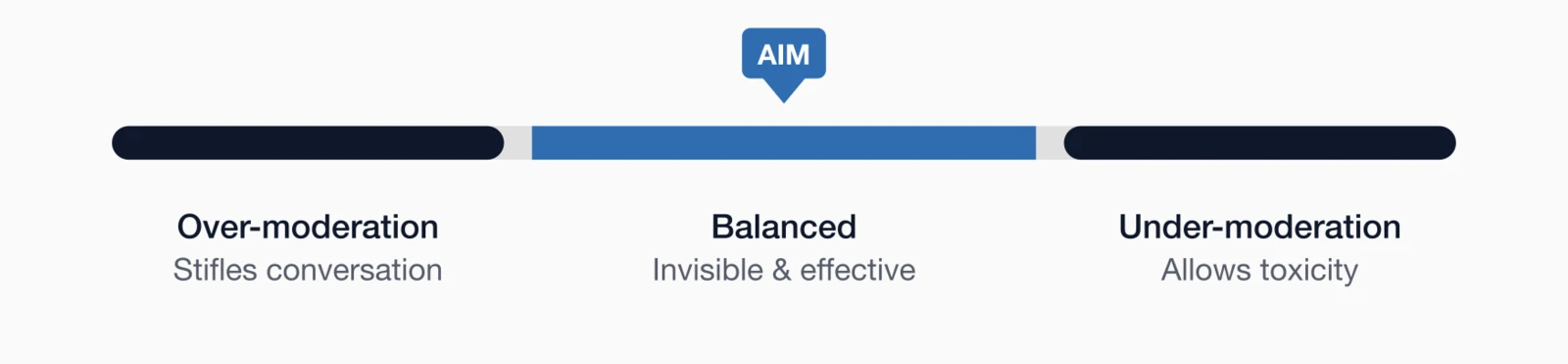
Good moderation is invisible—members barely notice it's happening. Bad moderation either stifles conversation (over-moderation) or allows toxicity to drive away participants (under-moderation). Finding the right balance takes judgment and practice.
The moderator's role
Effective moderators do more than police bad behavior. They:
- Welcome newcomers: Respond to introduction posts, help new members navigate
- Facilitate discussion: Ask follow-up questions, tag experts, synthesize long threads
- Recognize great contributions: Call out helpful posts, thank active participants
- Guide off-topic threads: Redirect gently rather than deleting
- Address problems quickly: Remove spam, handle conflict privately, enforce guidelines consistently
Moderation guidelines
| Situation | Recommended Action |
|---|---|
| Off-topic post in wrong forum | Move to appropriate forum with a friendly note |
| Promotional/sales post | Remove; contact member privately about guidelines |
| Heated but civil disagreement | Monitor but don't intervene unless it escalates |
| Personal attack or insult | Remove immediately; contact both parties privately |
| Question with no responses | Answer yourself or tag members who could help |
| Repeat policy violator | Progressive warnings, then temporary or permanent ban |
A deeper look: Building a volunteer moderator team
Staff time is limited. The most successful forums I've seen leverage volunteer moderators—trusted members who help keep the community healthy. But building a volunteer moderator team requires care.
Selection matters enormously. Look for members who are already helpful and engaged, who demonstrate good judgment in their posts, and who represent your membership's diversity. Avoid members who seem to want moderator status for the title or authority. The best moderators are motivated by wanting to help their peers, not by wanting to enforce rules.
Provide training and guidelines. Don't just give someone moderator access and hope for the best. Walk through common scenarios. Explain the philosophy behind your community guidelines. Make clear what actions they can take independently versus what should be escalated to staff.
Check in regularly. Hold monthly calls or exchanges with your moderator team. Share what's working, discuss challenging situations, and let moderators support each other. This creates community among your community leaders.
Recognize their contribution. Moderators are volunteers doing real work for your organization. Thank them publicly, give them perks like complimentary conference registration, and acknowledge their service in your annual report. This recognition also helps attract future volunteers.
Driving ongoing engagement
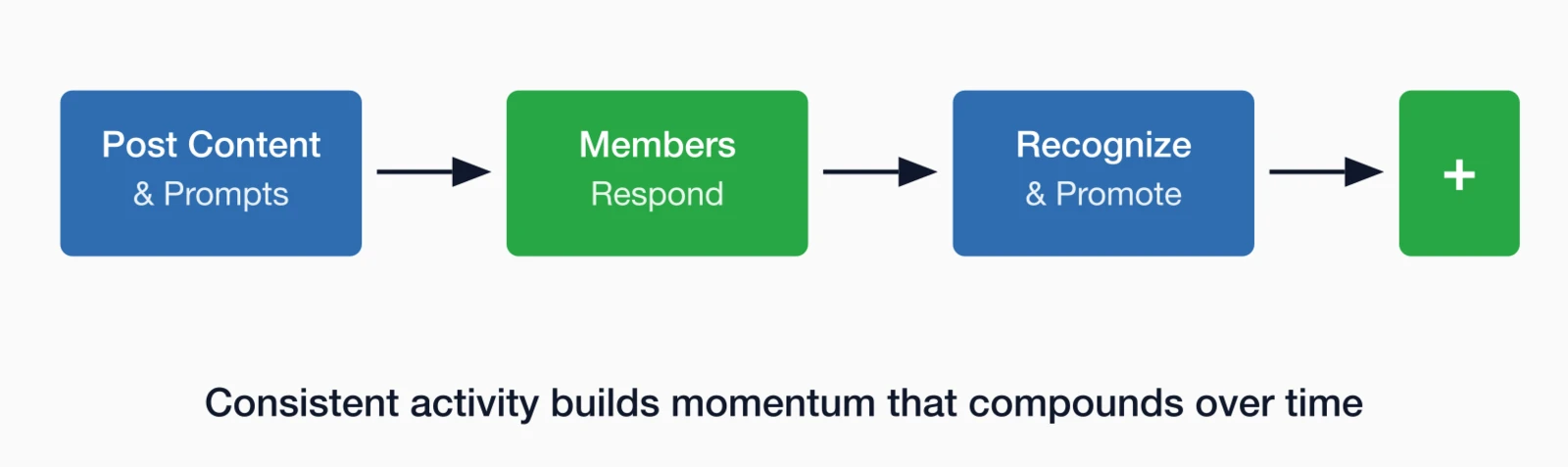
Launching successfully is only half the battle—the real work begins afterward. Even the most promising forums can fade into silence without consistent attention and engagement strategies. A forum can't run on autopilot, and even thriving communities need ongoing nurturing to maintain their energy. Here are proven tactics to keep discussion flowing and members coming back.
Regular discussion prompts
Don't wait for members to start conversations. Post weekly discussion prompts tied to:
- Industry news or regulatory changes
- Seasonal topics (annual planning, budget cycles, conference prep)
- Member challenges you're hearing about in other channels
- Follow-ups to popular past discussions
Cross-promote everywhere
Members can't participate in a forum they forget exists. Weave forum promotion into everything:
- Email newsletters: "Hot Topic This Week" highlights from forum discussions
- Conference sessions: "Continue this conversation in our online forum"
- Member portal: Show recent forum activity on the member dashboard
- New member onboarding: Introduce the forum as a key benefit
- Social media: Tease forum discussions to drive members to your platform
Make questions easy
Asking a question is easier than sharing an opinion. Lower the barrier by explicitly framing forums as places to get help. Use language like "Ask the Community" rather than "Start a Discussion." When members get helpful answers, they become participants who eventually contribute back.
Empowering member leaders
Staff-driven forums plateau quickly because staff time is limited and members sense when conversations feel manufactured. The healthiest forums are member-led, where engaged participants take ownership of their community and naturally encourage others to participate. Your role as an organization is to identify potential leaders, give them opportunities to contribute, and create conditions for organic leadership to emerge and thrive.
Identify natural leaders
Watch for members who:
- Consistently provide helpful, thoughtful responses
- Welcome newcomers and answer basic questions patiently
- Stay constructive even in disagreements
- Generate discussion by asking interesting questions
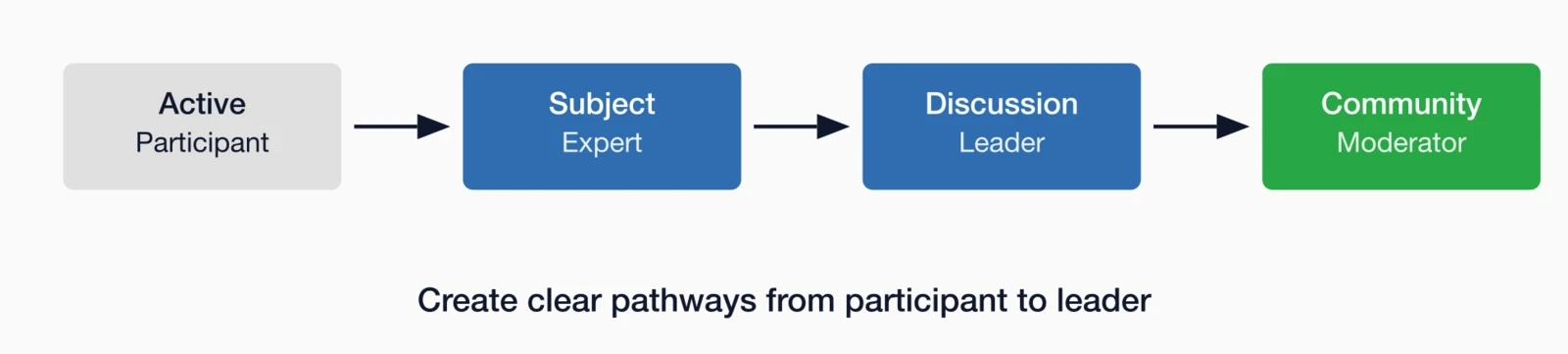
Create pathways to leadership
Once you identify engaged members, give them opportunities to deepen their involvement:
- Subject matter expert designation: Tag them when their expertise is relevant
- Discussion leader roles: Ask them to host themed discussions or AMA sessions
- Forum moderator positions: Formal responsibility for specific forums
- Advisory roles: Invite input on community direction and policies
Each level of involvement deepens their connection to your organization—and members who lead in your forum renew at rates far above average.
Access control strategies
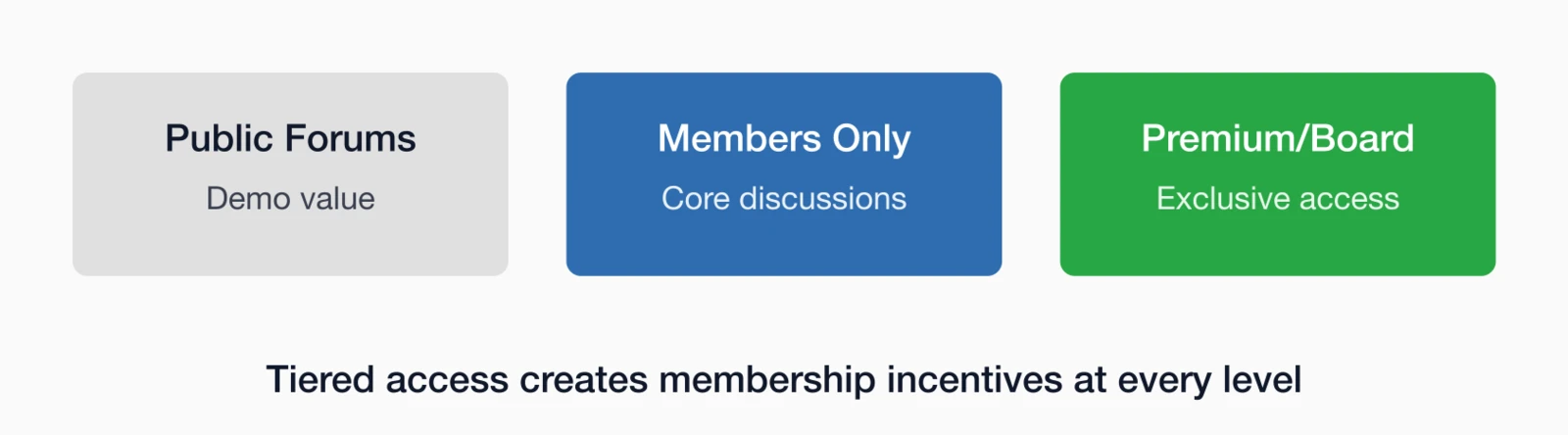
One of the most powerful aspects of association forums—and one that distinguishes them from public platforms—is your ability to control access based on membership status. How you structure that access shapes both member perception of value and their renewal behavior. Members-only access creates genuine exclusivity; tiered access can drive upgrades to premium membership levels; and strategic use of open forums can demonstrate value to prospects. The right approach depends on your specific goals and member expectations.
Members-only forums
Most valuable discussions should be members-only. This creates genuine exclusivity and a clear renewal incentive—when membership lapses, access disappears. With integrated membership management software, access control happens automatically—no manual intervention required when members join, renew, or lapse.
Tiered access by member type
Some forums should be restricted further:
- Board member forums: Confidential governance discussions
- Committee workspaces: Task forces and working groups
- Premium tier forums: If you have membership levels, exclusive content for higher tiers
- Regional forums: Local discussions for chapter members
Open forums (strategic use)
Consider making one or two forums visible to non-members—but not all. This can:
- Demonstrate community value to prospective members
- Allow industry-wide discussions that benefit everyone
- Give lapsed members a taste of what they're missing
The key is contrast: if everything is open, there's no membership incentive. If premium forums are clearly more valuable, prospects see the benefit of joining.
Measuring forum success
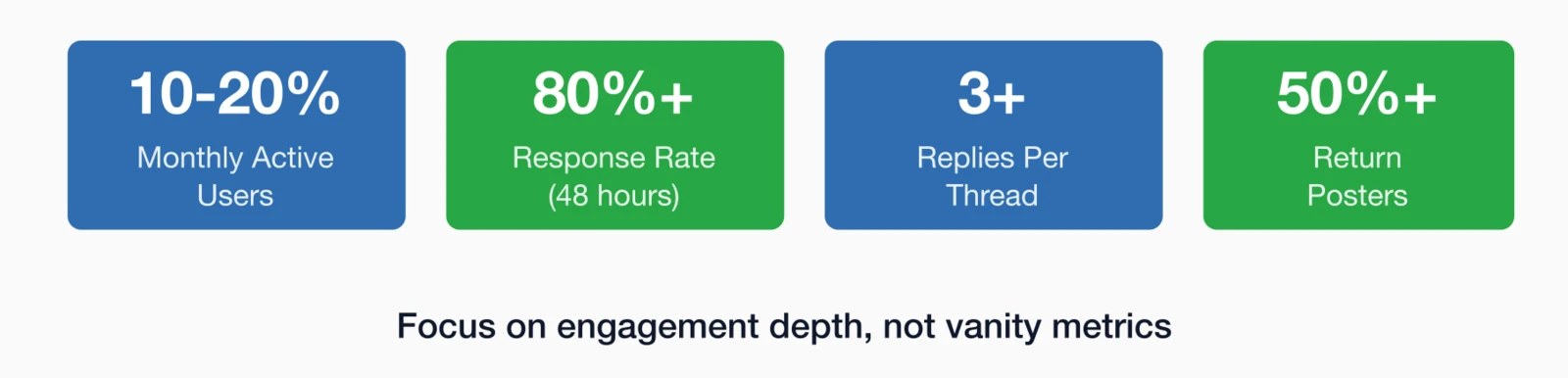
It's tempting to celebrate raw numbers—total registered users, total posts, page views—but vanity metrics don't tell you whether your forum is actually working. Total registered users means nothing if nobody's posting, and high post volume can mask problems if the same three people generate all the content. Meaningful forum measurement focuses on engagement depth: are questions getting answered? Are new members participating? Are active users coming back? These metrics reveal whether you're building a genuine community.
When measuring success, understand participation inequality. Nielsen Norman Group's 90-9-1 rule suggests that in most online communities, 90% of users lurk without contributing, 9% participate occasionally, and just 1% create most of the content. Your forum will likely follow similar patterns—and that's normal.
Key metrics to track
| Metric | Why It Matters | Healthy Benchmark |
|---|---|---|
| Monthly active users | How many members actually engage | 10-20% of membership |
| Posts per month | Content generation rate | Varies by size; trending up |
| Response rate | Do questions get answered? | 80%+ within 48 hours |
| Average responses per thread | Discussion depth | 3+ responses average |
| New participant rate | Are new members joining in? | 5-10% of new members post within 90 days |
| Returning participants | Do people come back? | 50%+ of posters post again within 30 days |
Connecting forums to retention
The ultimate measure of forum success is its impact on member retention. Compare renewal rates between:
- Members who participated in forums vs. those who didn't
- Active forum users vs. passive readers
- Members who received helpful answers vs. those whose questions went unanswered
If your forum participants renew at significantly higher rates—and they almost certainly do—you can quantify the ROI of your community investment. See our guide on calculating member lifetime value for methods to measure this impact.
Common mistakes to avoid
After watching countless associations launch online forums over the years, I've seen the same mistakes repeated again and again. Most forum failures follow predictable patterns—and the good news is they're avoidable once you know what to watch for.
Launching without critical mass
An empty forum is worse than no forum. If you're not ready to invest in seeding content and recruiting founding participants, wait until you are.
Creating too many categories
More forums means thinner discussion. Start with 3-5 and expand only when volume demands it. It's easier to split a busy forum than to revive a dead one.
Over-moderating
Deleting borderline posts, editing member language, and constantly jumping in with "official" answers stifles organic conversation. Let members talk to each other.
Under-moderating
The opposite problem: letting spam pile up, ignoring personal attacks, and allowing self-promotional posts. These drive away quality participants quickly.
Treating forums as marketing channels
Forums are for member-to-member exchange, not organization-to-member promotion. If every staff post is a pitch, members will tune out.
Expecting it to run itself
Even mature forums need ongoing attention. Someone needs to monitor activity, prompt discussions, welcome newcomers, and address issues.
Building forums that last
A thriving forum becomes one of your most valuable member benefits—a place where professionals solve real problems together, build relationships that last beyond their membership, and find community in their career.
But you don't get there by accident. It takes intentional launching, consistent nurturing, thoughtful moderation, and ongoing investment. The associations that build lasting forums treat community as core to their mission, not a nice-to-have add-on.
Start small, launch strong, and build momentum over time. The community you create will strengthen retention, deepen engagement, and make your organization indispensable to the professionals you serve.
For more on building engaged member communities, explore our complete Member Engagement Guide or learn about i4a's integrated community features.
Key takeaways
- Never launch an empty forum: Seed with content and recruit 15-20 committed members before going live
- Fewer forums are better: Start with 3-5 focused categories; expand only when discussion warrants it
- Questions drive engagement: "Ask the community" is easier than posting opinions—make it simple to seek help
- Volunteer moderators are essential: Staff can't monitor everything; empower trusted members to help
- Tie access to membership: Forums that become members-only create a compelling renewal incentive
Ready to Build an Active Member Forum?
i4a includes discussion forums, member blogs, and direct messaging—all integrated with your membership database for automatic access control.
Talk to Us About Community FeaturesRelated resources
Strategies for Building a Thriving Member Community
Proven strategies for fostering connections and engagement.
Complete guide to building active, loyal communities.
How to Reduce Membership Churn
Proven strategies for improving retention rates.
Association Member Communities
Build online communities where members connect.
