Quick Summary: AMS Pricing Models
- Per-contact pricing penalizes growth: Your software costs increase as you succeed—often by 50-100% over five years.
- Your database exceeds membership: You pay for lapsed members, prospects, and historical records—not just active members.
- Flat-rate provides predictability: Budget confidently when costs don't change based on member count.
- Calculate 5-year TCO: The starting price matters less than total cost of ownership over the software's lifecycle.
Part of our membership software selection guide
Per-contact vs flat-rate pricing determines whether your software costs increase substantially over 5 years as you grow—or stay predictable. Use our calculator to compare models and find your true total cost of ownership.
Ask the right question first. The initial debate between per-contact and flat-rate pricing misses the bigger picture. What truly matters is how your costs evolve as your association scales—whether you are adding 500 members or 5,000 over the next five years.
Most membership management software
This guide and calculator reveal the full financial impact, including implementation, support, and scaling fees. Factor in total cost of ownership (TCO)—not just monthly bills, but migration, training, and integrations—to see how per-contact models can double expenses over time while flat-rate keeps planning simple and growth-focused.
Understanding the two pricing models
Before diving into the numbers, it's important to understand what you're actually comparing. The pricing model your AMS vendor uses fundamentally shapes your long-term costs and operational flexibility. These two approaches—per-contact and flat-rate—represent different philosophies about how software should be priced, and your choice has implications that extend far beyond the monthly bill.
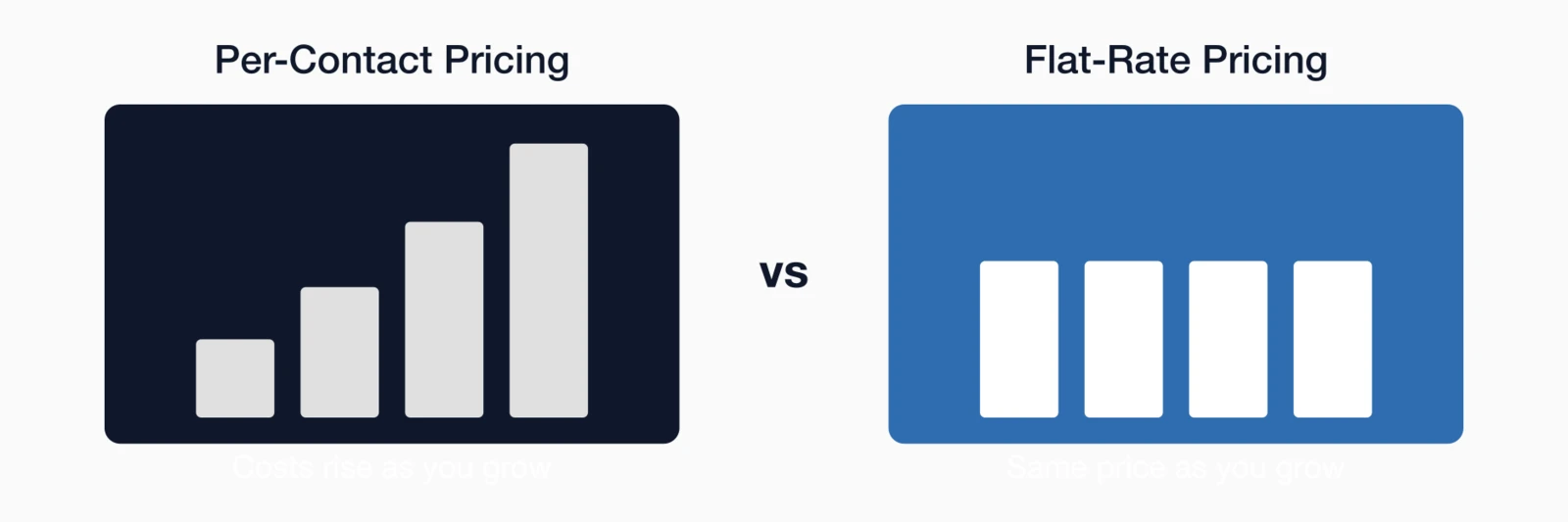
Per-contact pricing
With per-contact pricing, you pay based on the number of records in your database. This typically includes:
- Active members (current, paid-up members)
- Lapsed members (former members you want to win back)
- Prospects (people who attended events or downloaded resources)
- Historical records (members from years past)
Common per-contact pricing tiers look something like this:
| Contact Count | Typical Monthly Cost | Annual Cost |
|---|---|---|
| Up to 500 | $100-150 | $1,200-1,800 |
| 501-2,500 | $200-400 | $2,400-4,800 |
| 2,501-5,000 | $400-600 | $4,800-7,200 |
| 5,001-10,000 | $600-900 | $7,200-10,800 |
| 10,001-25,000 | $900-1,500 | $10,800-18,000 |
Flat-rate pricing
With flat-rate pricing, you pay a predictable monthly or annual fee regardless of how many member records you have. Your costs don't increase when:
- You run a successful membership drive
- You keep historical records for reporting
- You import prospect lists from events
- Your membership grows year over year
For example, i4a's pricing
The key difference: with flat-rate pricing, your success doesn't increase your costs. With per-contact pricing, every new member adds to your bill.
The real cost of per-contact pricing
Here's what most vendors don't tell you during the sales process: your database will grow faster than your active membership.
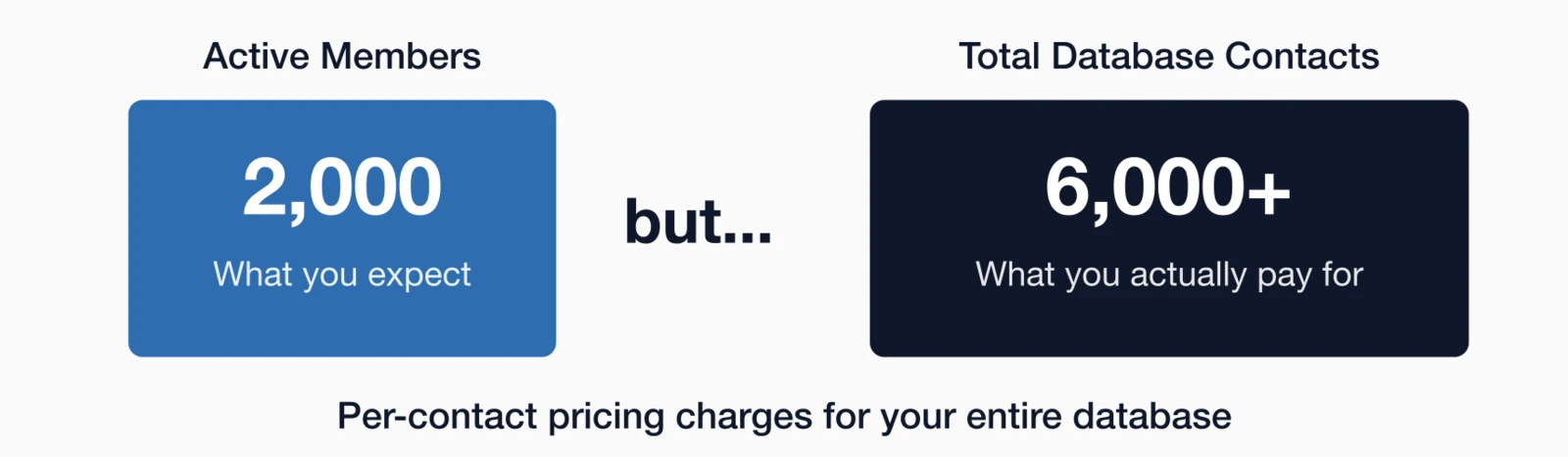
Your database is bigger than your membership
A typical association with 2,000 active members actually has 4,000-8,000 contacts in their database:
- Active members: 2,000
- Lapsed members (last 3 years): 800-1,200
- Event attendees (non-members): 500-1,500
- Newsletter subscribers: 300-800
- Historical records: 500-2,000
With per-contact pricing, you're paying for every single record—not just active members.
Real Talk: I've watched associations delete years of historical member data just to keep their software costs down. That's data that could power win-back campaigns, industry research, and strategic planning. When your pricing model forces you to choose between data and budget, something's wrong with the model.
Growth compounds the problem
Let's say you're successful. Your association grows 10% annually. Here's what happens to your software costs with per-contact pricing:
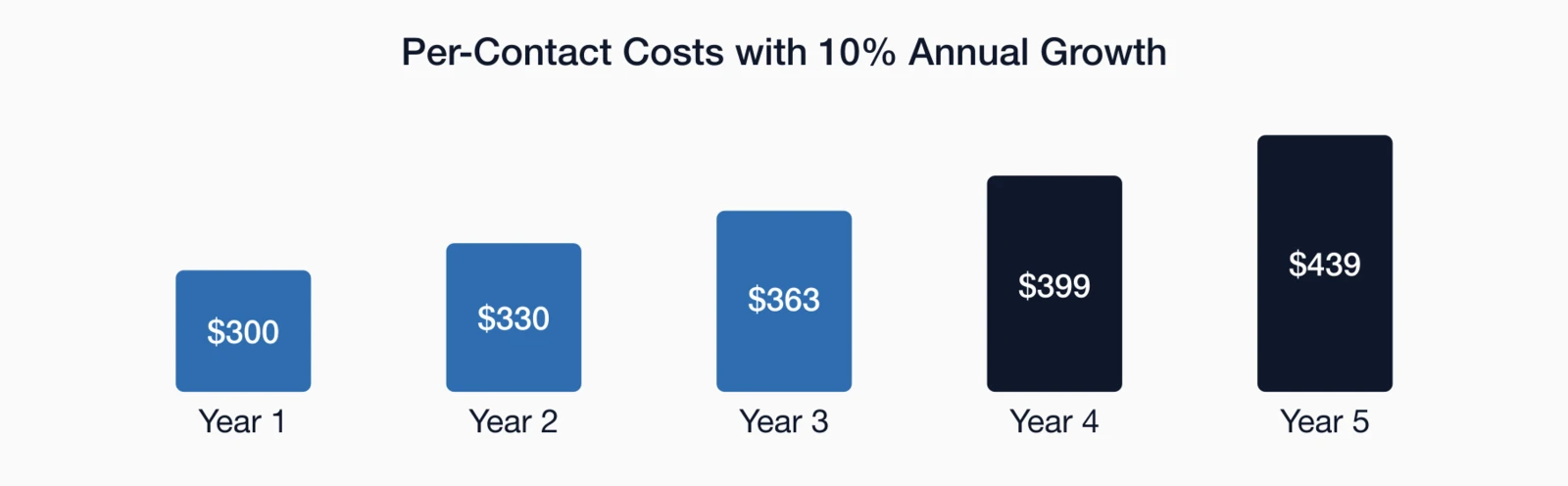
With per-contact pricing and 10% annual growth, an association starting at $300/month could be paying $480/month by year five—a 60% increase for the same software.
5-year total cost of ownership calculator
Use this calculator to compare your actual costs. Enter your current database size and expected growth rate to see the difference.
Calculate Your 5-Year TCO
Per-Contact: 5-Year Total
Flat-Rate: 5-Year Total
Decision framework: Which pricing model actually supports your association?
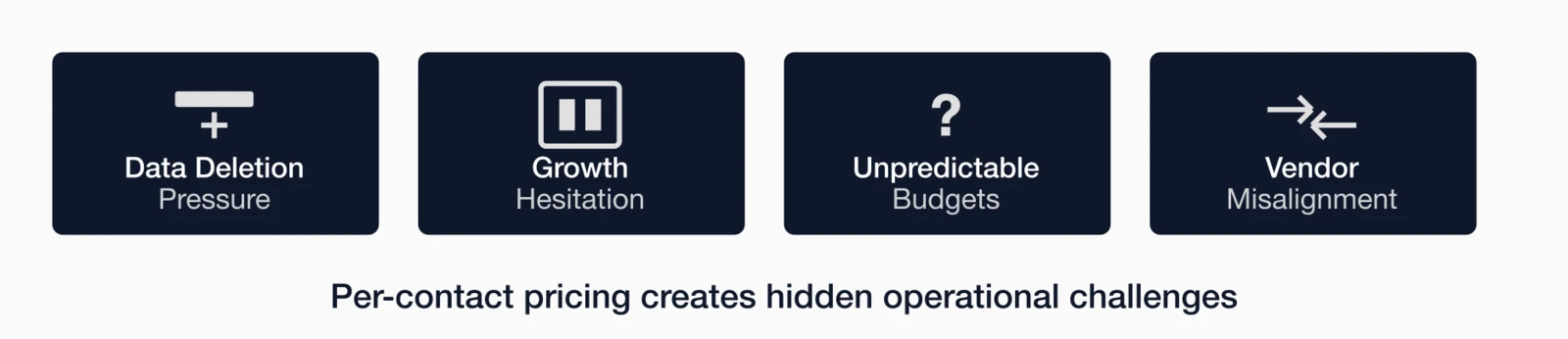
Per-contact pricing is a legacy model built for vendors, not growing associations. It quietly penalizes success—every new member, event attendee, or prospect increases your costs, forces data tradeoffs, and makes long-term budgeting unpredictable. Flat-rate pricing removes those constraints. It's designed for modern associations that expect to grow, value their data, and plan to stay in their software for the long haul.
Use the framework below to pressure-test which model aligns with how you actually operate.
When per-contact pricing might make sense
Per-contact pricing is only viable in narrow, short-term scenarios. It may work if:
- Your membership is very small and static (typically under ~500 contacts)
- You do not expect meaningful growth in members, events, or prospects
- You are comfortable deleting historical data to control costs
- You need the lowest possible entry price and are optimizing purely for the short term
If any of these change, per-contact pricing quickly becomes a liability.
When flat-rate pricing is the better long-term choice
Flat-rate pricing is designed for how most associations actually operate. It's the better fit if:
- You have growth goals (or want the option to grow without penalty)
- You want to retain historical data for reporting, forecasting, and board insight
- You need predictable, CFO-friendly budgeting year over year
- You plan to use this software for three years or more
- You run events that generate large prospect or attendee lists
- You want to re-engage lapsed members through win-back and nurture campaigns
In practice, these needs describe the majority of established and growing associations.
Questions every association should ask vendors about pricing
Before committing to any pricing model, ask these questions—and pay close attention to the answers:
- "What exactly counts as a 'contact' for pricing purposes?"
- "If I import 1,000 event attendees, how does that impact my bill?"
- "What happens to my pricing if we grow 20% this year?"
- "Can you show projected costs at 5,000, 10,000, and 25,000 contacts?"
- "Do you offer unlimited contacts at any tier—or does growth always increase cost?"
The goal isn't just to understand today's price—but to understand how your costs scale as your association succeeds.
The bottom line
After evaluating hundreds of software decisions with associations, I've seen how pricing model choices play out over time. The associations that struggle aren't necessarily those with limited budgets—they're the ones who didn't account for how their costs would change as they grew. Here's what you need to remember:
- Per-contact pricing penalizes growth. Your software costs increase as your association succeeds—often by 50-100% over five years.
- Your database is bigger than your membership. You pay for lapsed members, prospects, and historical records—not just active members.
- Flat-rate pricing provides predictability. Budget with confidence when your costs don't change based on member count.
- The operational impacts matter. Per-contact pricing creates pressure to delete valuable data and hesitation around growth initiatives.
- Calculate your 5-year TCO. The starting price matters less than your total cost of ownership over the software's lifecycle.
If you're evaluating association management software
Key takeaways
- Per-contact pricing penalizes growth: Your software costs increase as your association succeeds—often by 50-100% over five years
- Your database is bigger than your membership: You pay for lapsed members, prospects, and historical records—not just active members
- Flat-rate pricing provides predictability: Budget with confidence when your costs don't change based on member count
- The operational impacts matter: Per-contact pricing creates pressure to delete valuable data and hesitation around growth initiatives
- Calculate your 5-year TCO: The starting price matters less than your total cost of ownership over the software's lifecycle
Ready to Stop Paying Per Contact?
i4a offers flat-rate pricing with unlimited members included. See how much you could save.
View PricingRelated resources
2026 Membership Software Buyer's Guide
Practical steps to evaluate, compare, and select the ideal membership management platform.
Association Management Software
See how i4a's platform helps associations manage members, events, and communications.
Unlimited Members Software: Complete Guide
Learn how unlimited member pricing works and why it benefits growing associations.
Hidden Costs of Membership Software
Discover fees that can double your total cost of ownership.
