Quick Summary: Post-Event Follow-Up
- Speed matters most: Thank-you emails within 24 hours, surveys within 48 hours—response rates drop dramatically after that.
- Repurpose content: Session recordings become blog posts, podcasts, social clips, and your on-demand library.
- Debrief within 2 weeks: Meet with your team while details are fresh—document what to start, stop, and continue.
- Announce next year immediately: Save-the-date emails while attendees are engaged lock in early commitments.
Part of our post-event follow-up guide
Post-event follow-up timing determines survey response rates—they drop significantly after the first day or two. Here's the complete timeline: when to survey attendees, share recordings, thank sponsors, and debrief your team for maximum conference ROI.
Effective post-event follow-up accomplishes multiple goals: it reinforces the value of attendance, captures feedback while memories are fresh, extends the reach of your content, and sets the stage for strong registration next year. Yet I've seen associations wait weeks to send surveys, never share recordings, and let momentum fade completely.
This guide covers what to do in the hours, days, and weeks after your event to maximize its impact.
Post-event follow-up timeline
Structure your follow-up with clear deadlines. Here's a framework that works:
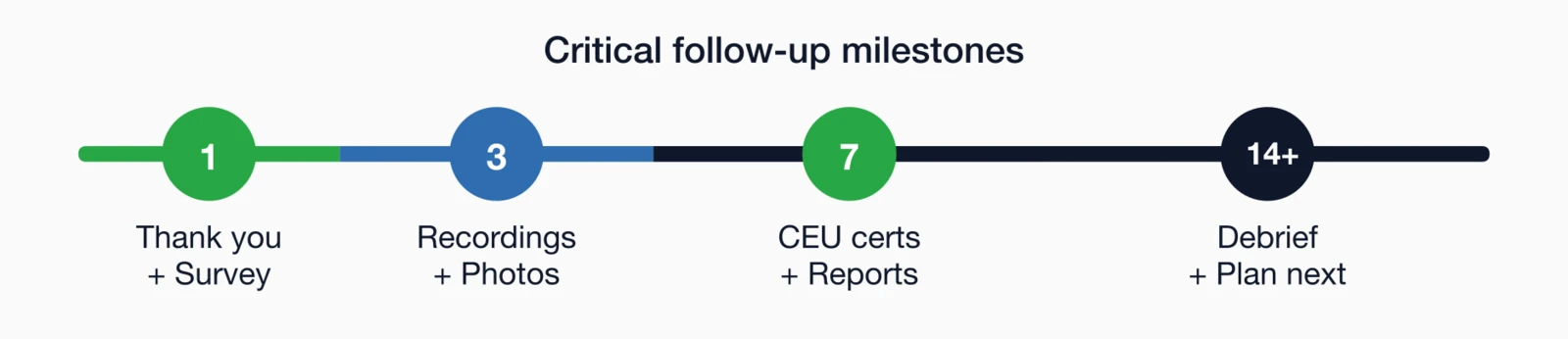
Day 1 (within 24 hours)
- Send thank-you emails to all attendees
- Launch post-event survey
- Post event highlights on social media
- Send personalized thank-yous to speakers and sponsors
Days 2-3
- Share session recordings or slides (if available)
- Post attendee photos to social media and member portal
- Send survey reminder to non-responders
Week 1
- Issue CEU/CME certificates
- Compile initial survey results
- Send final survey reminder
- Begin sponsor fulfillment reports
Weeks 2-3
- Close survey and analyze feedback
- Deliver sponsor reports with metrics and ROI data
- Conduct internal staff debrief
- Finalize event financials
Week 4 and beyond
- Document lessons learned for next year
- Secure next year's venue and dates
- Send "save the date" to this year's attendees
- Begin early planning for next event cycle
Attendee surveys that get responses
Survey response rates drop dramatically with each passing day. Send your survey within 24-48 hours of the event closing.
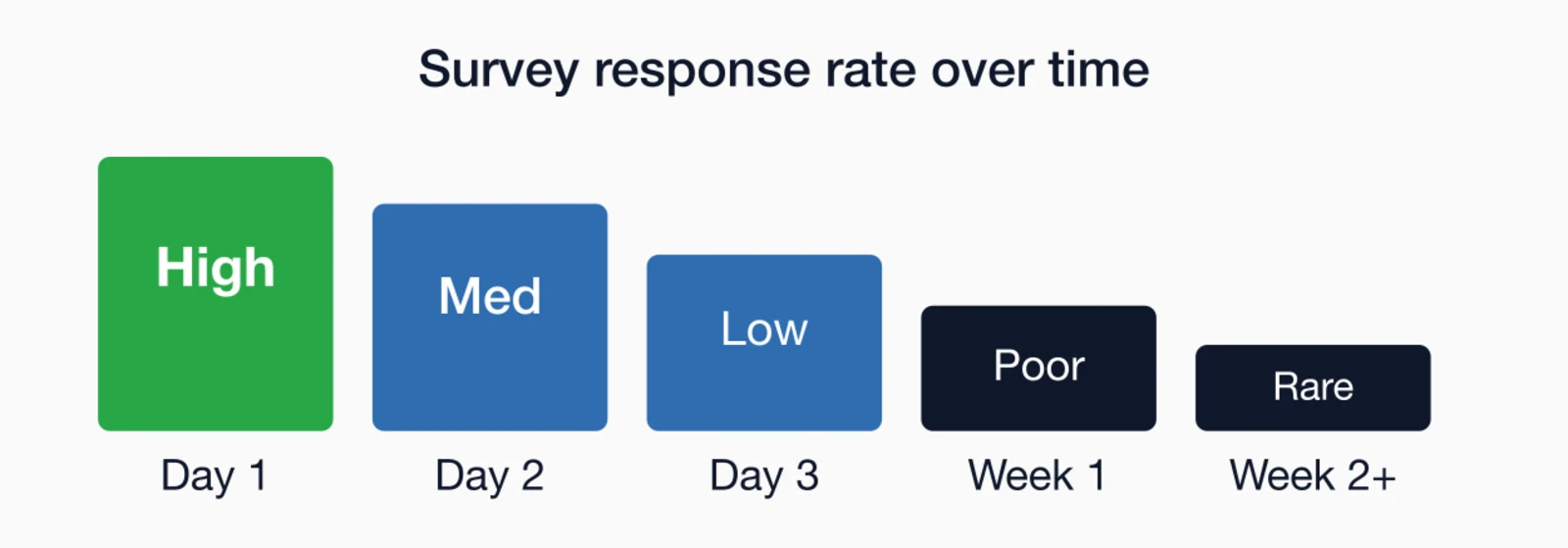
Survey timing strategy
Timing is the single biggest factor in survey accuracy. Industry research from SurveyMonkey
- Initial send: Within 24 hours of event close
- First reminder: Day 3-4 for non-responders
- Final reminder: Day 7 with "last chance" messaging
- Close survey: Day 10-14
What to ask
Keep surveys focused. Long surveys get abandoned. Essential questions:
- Overall satisfaction: Simple rating (1-5 or 1-10 scale)
- Net Promoter Score: "How likely are you to recommend this event?"
- Session ratings: Which sessions they attended and how they rated them
- Most valuable: Open-ended question about what they valued most
- Improvement suggestions: What would make it better?
- Intent to return: "Will you attend next year?"
Increasing response rates
- Keep it short: 5-10 minutes maximum
- Mobile-friendly: Many will complete on their phones
- Explain the value: "Help us make next year even better"
- Incentive (optional): Entry into a drawing for completing
- Personalize: Address by name, reference sessions they attended
A deeper look: Getting honest feedback, not just praise
Most event surveys are designed—unintentionally—to collect praise rather than insight. And praise doesn't help you improve. Here's how to structure surveys that surface the truth.
The problem with most surveys is timing and framing. Send a survey right after your closing keynote when everyone's feeling good, and you'll get inflated ratings. Ask "What did you like best?" and you'll get compliments. Neither tells you what to fix.
Start with behavior-based questions before opinion questions. "Which sessions did you attend?" "Did you visit the exhibit hall?" "Did you attend the networking reception?" These factual questions are easy to answer and reveal engagement patterns. Someone who attended one session and skipped the networking probably had a different experience than someone fully engaged—their overall rating means something different.
When you do ask opinions, avoid leading language. "How would you rate our amazing keynote speaker?" is going to skew positive. "How relevant was the keynote content to your professional needs?" gets at something useful.
The most valuable question on any event survey is an open-ended one: "If you could change one thing about this event, what would it be?" This surfaces the single biggest frustration for each respondent. When you see the same answer from 40 people, you've found something important.
Finally, create psychological safety for honest feedback. Some attendees worry their criticism will be taken personally or held against them. Include a statement like: "We genuinely want to hear what we could do better. Constructive criticism helps us improve and is always welcome." And then actually respond to criticism constructively—word gets around if you punish honesty.
Pro Tip: Segment your analysis. Compare first-time vs. returning attendee feedback, and member vs. non-member perspectives.
Content distribution
Your event generated hours of valuable educational content, captured dozens of memorable moments, and produced materials that members couldn't attend in person would pay to access. Letting all of that disappear after the closing session is a missed opportunity—both for member value and for non-dues revenue. Strategic content distribution extends the life of your event far beyond its original dates and gives you marketing assets for months to come.

Session recordings
- Processing time: Have recordings ready within 5-7 days
- Access strategy: Free for attendees, paid or member-only for others
- On-demand library: Build a resource that grows year after year
- CE credit: If applicable, enable CE for on-demand viewing
Presentation materials
- Slide decks: Share with attendee permission
- Handouts: Digital versions of any printed materials
- Research papers: If presenters shared original research
- Resource lists: Curated links and references
Photos and video
- Photo gallery: Share on website and social media
- Highlight reel: Short video recap for promotion
- Speaker clips: Soundbites for future marketing
- Attendee testimonials: Captured on-site or from social media
Stakeholder communications
Your event touched many different groups—attendees, sponsors, speakers, volunteers, board members—and each has different needs and expectations for follow-up communication. A generic "thanks for coming" email doesn't cut it. Tailored, thoughtful communication to each stakeholder group reinforces relationships, captures valuable feedback, and sets the stage for future engagement.
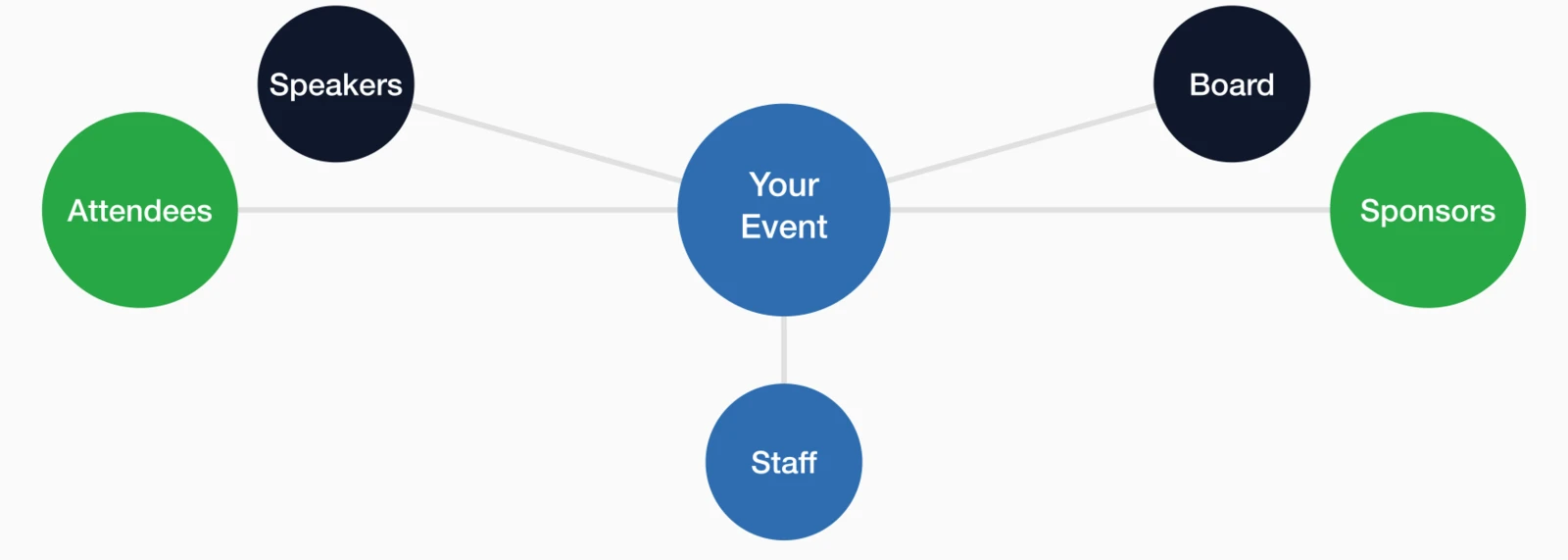
Attendees
- Thank you: Genuine appreciation for their participation
- Recordings access: How to access session recordings
- CE certificates: If applicable, how to download/access
- Survey request: Link to feedback survey
- Save the date: Next year's event dates
Sponsors and exhibitors
- Thank you: Acknowledge their support
- Fulfillment report: What you delivered (impressions, leads, etc.)
- Photos: Their booth, signage, sponsored elements
- Renewal invitation: Early opportunity to commit for next year
Speakers
- Thank you: Personal note of appreciation
- Session feedback: Share relevant evaluation comments
- Recording link: Access to their session recording
- Future invitation: Interest in having them back
Board and leadership
- Summary report: Key metrics and highlights
- Financial overview: Revenue, expenses, net result
- Attendance analysis: Who came, trends, demographics
- Feedback highlights: What attendees said
- Recommendations: What to consider for next year
Team debrief
When you're exhausted after an event, the last thing you want is another meeting. But the team debrief is arguably the most important internal activity in your post-event timeline. Memories fade quickly, small problems get forgotten, and the insights that could make next year significantly better slip away. Schedule your debrief meeting within two weeks of the event—any longer and you'll lose the details that matter most.
Debrief agenda
- What went well: Celebrate successes, document what to repeat
- What didn't go well: Honest assessment of problems
- Surprises: Things you didn't anticipate, good or bad
- Vendor performance: Which vendors to use again, which to replace
- Venue assessment: Return or look elsewhere?
- Process improvements: How to work more efficiently next time
Documentation
- Written summary: Create a document for future reference
- Timeline notes: What deadlines were missed, which were unnecessary
- Budget notes: What came in over/under and why
- Vendor contacts: Updated list with performance notes
A deeper look: Running a debrief that actually improves things
Most event debriefs are venting sessions that feel productive but don't lead to change. Here's how to run one that actually improves next year's event.
First, separate emotional processing from operational learning. After an intense event, people need to decompress. That's legitimate. But mixing "I was so stressed during registration" with "We need to change the registration process" produces confused conversations. Consider having two meetings: an informal "let it out" session within a few days, and a structured operational review a week or two later.
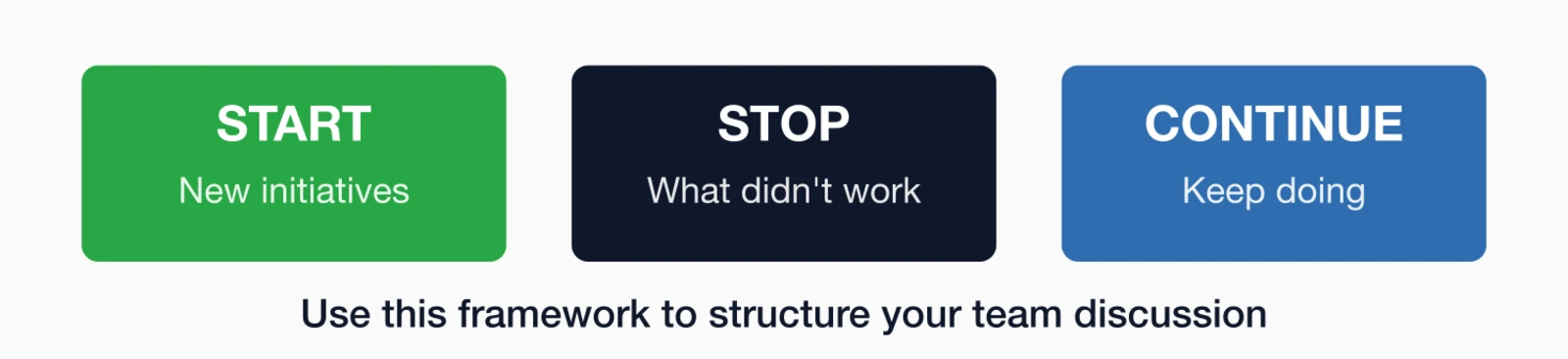
For the operational review, use a "Start, Stop, Continue" framework:
- Start: What should we do next year that we didn't do this year?
- Stop: What should we eliminate because it's not worth the effort?
- Continue: What's working well and should definitely happen again?
Have each team member prepare written input before the meeting. This prevents the debrief from being dominated by the loudest voices and ensures quieter team members contribute their observations.
The most important part of a debrief is assigning ownership for improvements. Every "we should do X next year" needs a name attached and a deadline for the decision to be made. Otherwise, you'll have the same debrief conversation next year, wondering why nothing changed.
Create a "debrief document" template that you use consistently year after year. Over time, this becomes an invaluable historical record. You can look back and see: "We had this same AV problem in 2023. What did we do about it?" Institutional memory is fragile; documentation makes it durable.
Create a "Next Year" File: As issues arise, add them to a running document. By planning time next year, you'll have a ready-made improvement list.
Leveraging event content year-round
Most associations treat event content as a one-time asset—valuable during and immediately after the event, then forgotten. That's a waste. A single 45-minute session can become a blog post, a podcast episode, social media clips, newsletter content, and a piece of your on-demand learning library. Repurposing event content keeps your association visible between events and provides ongoing value to members who couldn't attend—or want to revisit what they learned.

Content repurposing ideas
- Blog posts: Transform sessions into written articles
- Podcast episodes: Audio versions of popular talks
- Social media clips: Short video highlights
- Newsletter content: Key takeaways and quotes
- Webinar series: Deeper dives on popular topics
- Member resources: Add to your knowledge base
Building the on-demand library
Each year's recordings add to a growing resource:
- Organize by topic, not just by event year
- Make content searchable
- Highlight evergreen content that remains relevant
- Consider packaging into learning tracks or certificates
Setting up next year's success
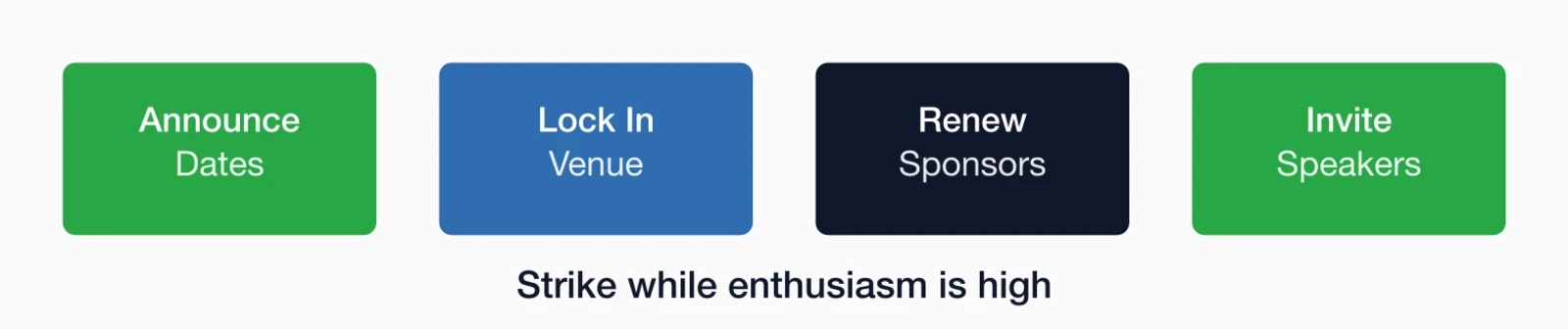
It might feel premature to think about next year when you're still recovering from this year, but the weeks immediately following your event are actually the best time to lay groundwork for the next one. Attendee enthusiasm is at its peak, sponsors are still engaged, speaker availability is being decided, and your team has the clearest possible view of what worked and what didn't. Acting quickly locks in advantages that become harder to secure later.
Announce early
- Dates: If you know next year's dates, announce at closing session
- Save the date: Email within the first week after
- Early bird: Open early registration while interest is high
Lock in venue
- Evaluation: Decide quickly whether to return
- Contract: If returning, lock in dates and rates
- Site selection: If moving, start the search immediately
Sponsor renewal
- Early outreach: Contact sponsors while the event is fresh
- Renewal incentives: Early commitment pricing
- Feedback incorporation: Address any concerns they raised
Speaker pipeline
- Top performers: Invite back before they commit elsewhere
- Attendee suggestions: Review survey feedback for topic ideas
- Call for proposals: Set timeline for next year's CFP
Closing the loop
Post-event follow-up isn't optional—it's essential. The weeks after your conference determine whether attendees remember a great experience, sponsors renew for next year, and your team learns from what happened.
Following up isn't just a courtesy—it's a retention strategy. According to recent ASAE research
Build follow-up into your event planning from the start. Pre-write emails, pre-create surveys, and schedule the debrief meeting before the event even begins. That way, when you're exhausted after the event, you can execute the plan instead of starting from scratch.
Your event doesn't end when the last session closes. It ends when you've captured its full value.
For the complete event planning picture, see our Association Event Management Guide
Key takeaways
- Speed matters: Thank-you emails within 24 hours, surveys within 48 hours—while the experience is still fresh
- Content is valuable: Session recordings extend event value and attract future attendees
- Debrief promptly: Meet with your team within 2 weeks before details are forgotten
- Start next year now: Announce next year's dates while attendees are still engaged
- Measure impact: Track registrations influenced, members converted, and sponsors retained
Ready to Improve Your Events?
i4a's event management tools help you track attendance, distribute content, and maintain attendee records—making post-event follow-up faster and more effective.
See How It WorksRelated resources
12-month checklist for successful conferences.
Track the metrics that demonstrate event value.
Create packages that attract and retain sponsors.
Complete resource for association event planning and execution.
