Quick Summary: Membership Churn Reduction
- Onboarding is the biggest lever: First-year members renew at only 75% vs. the 84% overall median, making the first 90 days the highest-impact retention window.
- Engagement—not price—drives churn: 52% of associations cite lack of engagement as the top reason members don't renew.
- Community reduces attrition: Members active in committees, forums, or events churn at significantly lower rates than isolated members.
- Friction kills renewals: Auto-pay, saved payment methods, and multi-email reminders prevent last-minute drop-offs.
- Win-back works: Targeted outreach to recently lapsed members can recover 5–15%, especially after job or life changes.
Part of our member retention best practices guide
Reducing membership churn compounds over time—even modest improvements grow your base significantly within years. These 10 strategies—from at-risk identification to frictionless renewals—cut member loss within the first year.
Here's the reality: It costs significantly more—often many times more—to acquire a new member than to retain an existing one. Yet many organizations pour resources into recruitment while treating retention as an afterthought. This is backwards.
The good news? Churn is preventable. In our experience, organizations that implement strategic churn reduction programs often cut member loss substantially within the first year. This guide provides a comprehensive, data-driven approach to identifying, preventing, and recovering from membership churn.
Understanding membership churn
Every organization experiences member turnover, but not every organization understands why it happens or what it's truly costing them. Churn is more than a number on a report—it represents real people who once believed in your mission and decided to walk away. Understanding the mechanics of churn, its common patterns, and its compounding financial impact is the essential first step toward building an effective retention strategy. Before diving into solutions, let's define what we're fighting.
What is churn?
Churn rate is the percentage of members who don't renew their membership during a given period (typically annually). It's the inverse of your retention rate.
What's a "normal" churn rate?
Based on data we've gathered from hundreds of associations using i4a—along with broader industry research from ASAE and membership sector studies—here's a general guide:
- Typical range: Most associations see annual churn somewhere between 15-25%
- High-performing organizations: Often achieve churn rates closer to 10-15%
- Warning zone: Churn above 25% usually signals systemic issues
- Crisis level: Churn above 35% requires immediate attention
The broader picture isn't encouraging: industry research shows 55% of associations are experiencing flat or declining retention—with 41% flat and 14% actually declining. That means the majority of associations are treading water at best when it comes to keeping members.
According to the 2025 Membership Marketing Benchmarking Report from Marketing General Inc., the median overall membership renewal rate across associations is 84%, meaning typical churn runs around 16%. However, first-year members renew at only 75%—a 25% churn rate that makes onboarding your highest-impact retention opportunity.
Why churn matters more than you think
The good news: 45% of associations reported membership increases in 2024, according to the MGI report. But that growth came with a hidden cost—52% of associations cite "lack of engagement with the organization" as the top reason members don't renew. In other words, members aren't leaving because of price or value—they're leaving because they never connected.
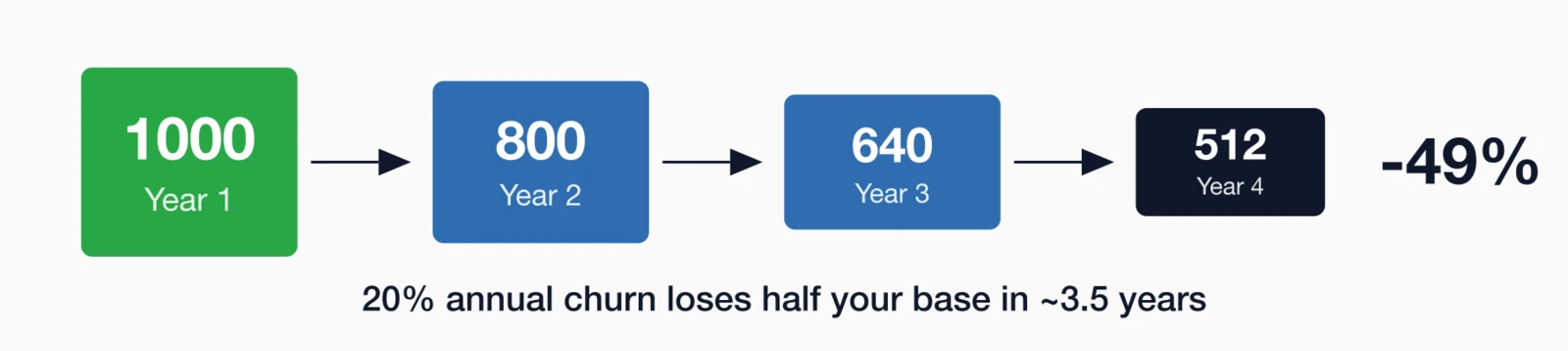
- Compounding loss: 20% annual churn means you lose half your membership every 3.5 years
- Revenue impact: A 1,000-member organization with $200 dues loses $40,000/year at 20% churn vs. $20,000/year at 10% churn
- Recruitment treadmill: High churn forces constant recruitment just to maintain current size
- Reputation damage: High churn signals problems to prospects and current members
- Lost advocacy: Churned members don't refer new members or defend your organization
In my 30 years working with associations, I've watched organizations pour time and money into recruitment campaigns while ignoring the members quietly slipping out the back door. The math never works. You can't grow if you're constantly replacing people you already had.
Identify at-risk members early
The most effective churn reduction happens before members decide to leave—not after they've already made up their minds. Members rarely wake up one morning and spontaneously quit; instead, they disengage gradually over weeks or months, leaving a trail of behavioral signals that predict non-renewal. Organizations that learn to read these signals can intervene while there's still time to re-engage, often recovering a significant portion of members who would otherwise have been lost. In our experience, members showing early signs of disengagement often exhibit warning signs several months before renewal.
A few years ago, I worked with a healthcare association that was puzzled by their retention numbers. They had great programming, competitive dues, and members who seemed satisfied—yet they were losing about a quarter of their membership each year. When we dug into the data, the pattern was clear: members who churned had stopped opening emails and logging into the portal months earlier. The association had all the warning signs in front of them, but nobody was watching for them. Once they started tracking engagement and flagging at-risk members proactively, they turned things around.
Key warning signs of churn risk
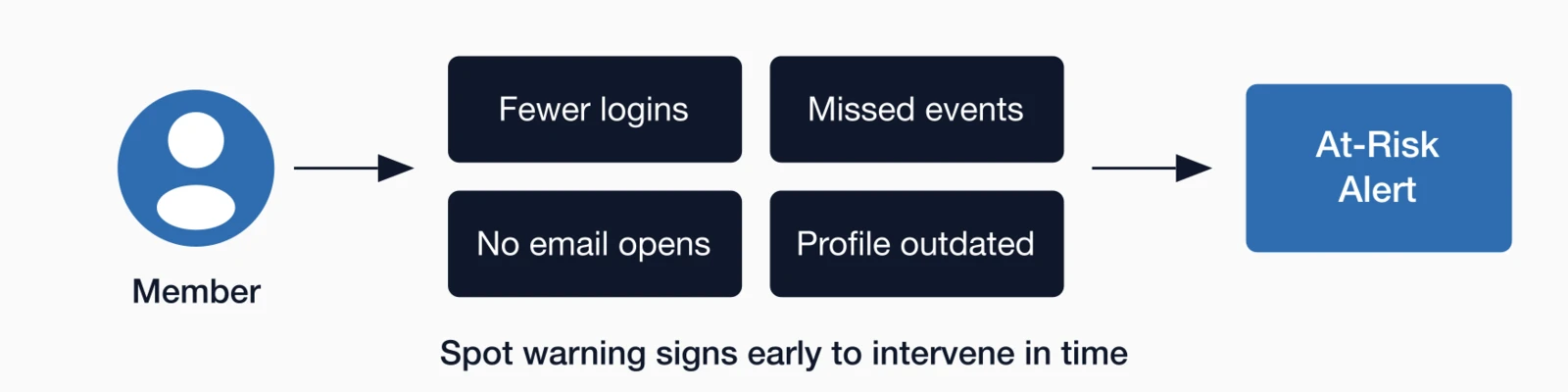
The clearest red flags are behavioral: declining login frequency (members who used to log in weekly now appear monthly or not at all), dropping event attendance, and lower email engagement where opens and clicks trail off or stop entirely. These three signals alone can predict a significant portion of non-renewals.
Beyond that, watch for members who aren't accessing resources they previously used, those with incomplete or outdated profiles, and anyone with recent payment issues like failed auto-renewals. And don't overlook reduced volunteer participation—when previously active committee members start stepping back, that's often an early indicator that they're mentally checking out.
How to track at-risk members
Create an Engagement Score:
- Assign points for activities: logins (5 pts), event attendance (10 pts), email opens (2 pts), resource downloads (5 pts)
- Calculate monthly engagement scores for each member
- Flag members whose scores drop 50%+ from their average
- Create "at-risk" segment for members below threshold score
Monitor Renewal Timing:
- Track when members typically renew (30 days before expiration? 60 days?)
- Flag members who haven't renewed within their normal window
- Identify members who switched from auto-renew to manual renewal
How i4a Helps Identify At-Risk Members: i4a's membership management system
Perfect your onboarding process
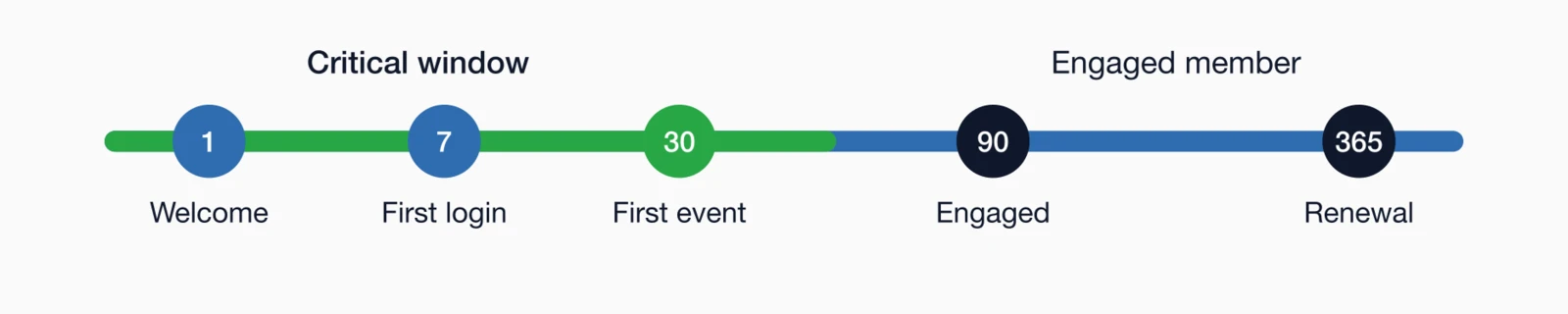
Onboarding is your single greatest opportunity to shape member behavior and expectations for years to come. New members arrive with enthusiasm and curiosity—but that window closes quickly. If they don't experience value, make a connection, or understand how to engage in their first few weeks, the likelihood they'll drift away increases dramatically. The initial three months of membership are critical. According to retention research across the association sector—and consistent with what we've observed in our own customer data—members who don't engage during onboarding are significantly more likely to churn at first renewal. The MGI 2025 report confirms this: while the overall median renewal rate is 84%, first-year members only renew at 75%—a 9-point gap that represents your biggest retention opportunity.
Here's where associations are focusing their efforts, according to the MGI 2025 Membership Marketing Benchmarking Report: 84% use welcome emails to new members, 37% send welcome kits, and 29% make welcome calls. The opportunity? 25% of associations started new onboarding programs in 2024, recognizing this as the highest-ROI retention investment.
The optimal onboarding journey
Week 1: Immediate Value
- Day 1: Welcome email with "get started" checklist and quick wins
- Day 2: How to access member portal and top resources
- Day 3: Upcoming events and networking opportunities
- Day 5: Success story from member in similar role/industry
- Day 7: Survey: "What made you join? What do you hope to achieve?" (see our member satisfaction survey questions)
Weeks 2-4: Engagement
- Invitation to new member orientation webinar
- Introduction to relevant special interest groups or chapters
- Personalized content recommendations based on profile
- Peer connection: introduce to member with similar interests
Monthly Milestones: Check-ins
- 30-day: "How's it going?" email with support resources
- 60-day: Highlight benefits they haven't used yet
- End of onboarding window: Satisfaction survey and request for feedback
Onboarding success metrics to track
- % of new members who complete profile within 7 days (target: 60%+)
- % who attend orientation or event within 30 days (target: 40%+)
- % who download a resource within 14 days (target: 50%+)
- % who log in 3+ times in their first three months (target: 70%+)
- First-year retention rate compared to overall retention (should be higher, not lower)
How i4a Supports Onboarding: i4a allows you to create automated email sequences triggered when new members join, with personalized content based on member type, industry, or custom fields. Schedule a series of welcome emails to introduce benefits, highlight resources, and encourage early engagement during the critical first weeks of membership.
Deliver consistent, measurable value
Organizations often have tremendous value to offer, but fail to deliver it in ways members actually perceive and appreciate. A member who pays $200 in dues but only attends one webinar will question whether their membership is worthwhile—even if they have access to resources worth far more. The challenge isn't just creating value; it's ensuring members encounter it regularly and understand what they're receiving. Members churn when they stop experiencing value. The key word is "experiencing"—value must be tangible and regular, not theoretical and occasional.
The value delivery framework
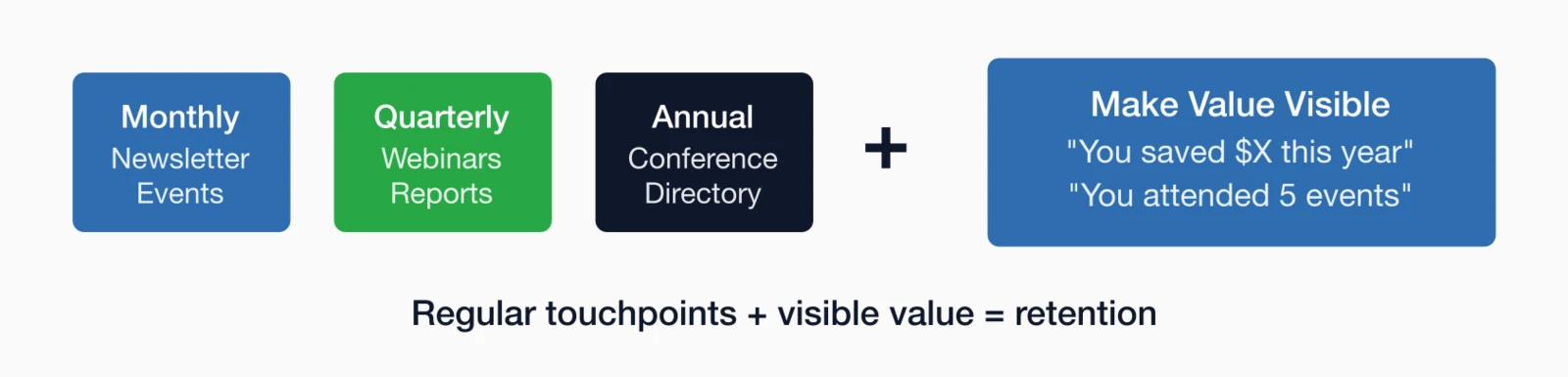
Monthly Value Touchpoints (minimum):
- Educational content: Newsletter with industry insights, research, or how-to guides
- Networking opportunity: Virtual coffee chat, local chapter meeting, or online forum discussion
- Exclusive resource: Template, tool, database access, or member-only content
- Community activity: Forum post, member spotlight, or peer discussion
Quarterly Value Milestones:
- Major event (conference, webinar series, training)—see our professional association renewal strategies for more ideas
- Significant content release (white paper, industry report, trend analysis)
- Member benefit enhancement or new service launch
Annual Value Anchors:
- Flagship conference or annual meeting
- Advocacy win or industry achievement
- Major certification or professional development program
Make value visible
Members often don't realize how much value they're receiving. Make it explicit:
- Value dashboards: Show members "This year you've attended 3 events, downloaded 12 resources, and saved $X with member discounts"
- Renewal reminders: List specific value received in renewal emails
- ROI calculations: Compare dues cost to value of benefits used
- Usage reports: Send quarterly summaries of member activity and benefits accessed
Build strong community connections
Benefits and resources matter, but relationships create true stickiness. When members form genuine connections with peers—through committees, events, or online discussions—leaving the organization means leaving a community, not just canceling a subscription. This emotional bond is far harder to replace than any individual benefit and represents one of the most powerful retention forces available to associations. Members with real peer relationships are much less likely to churn than isolated members. People don't leave communities they're embedded in.
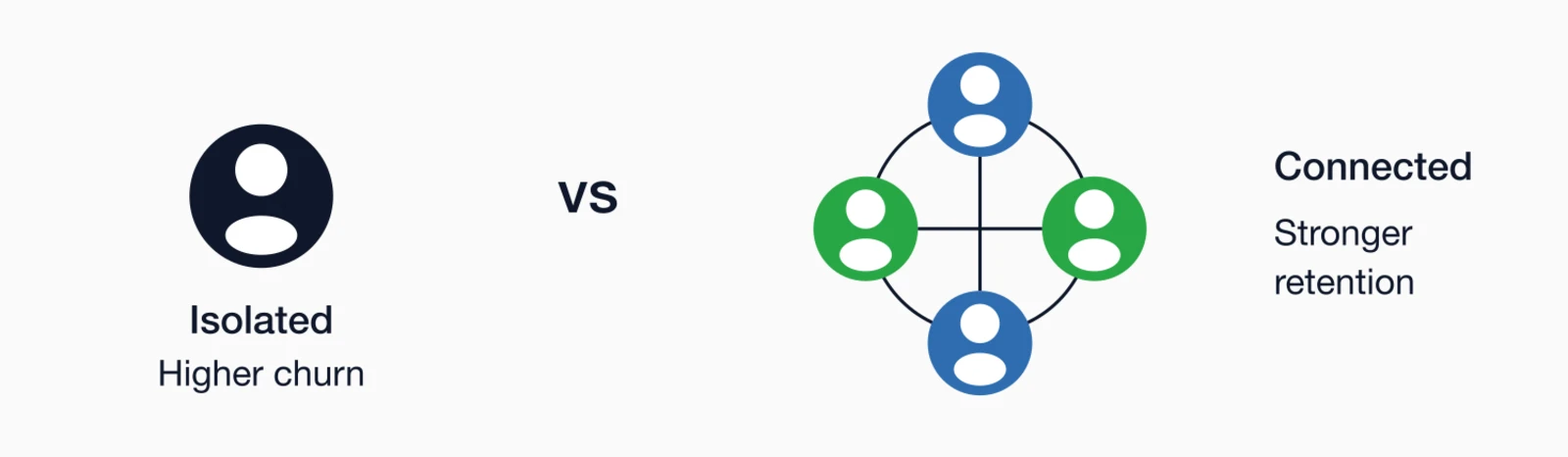
I think about a trade association I've worked with for years (see our guide on trade association member retention
Community-building strategies
Create Multiple Connection Points:
- Online forums: Discussion boards for questions, advice, and peer support
- Special interest groups: Sub-communities around specific topics, industries, or roles
- Local chapters: Geographic communities for in-person connection
- Mentorship programs: Pair experienced members with newer ones
- Volunteer opportunities: Committees, task forces, content contribution
- Social events: Not everything needs to be educational—social bonds matter
Facilitate Introductions:
- Match new members with established members in similar roles
- Create "buddy system" for onboarding
- Host virtual coffee chats with randomized pairings
- Feature member spotlights to help members discover peers
Measure Community Strength:
- % of members active in forums or groups (target: 30%+)
- % attending networking events (target: 40%+)
- Average connections per member (target: 5+)
- Volunteer participation rate (target: 15%+)
How i4a Builds Community: i4a's member community features
Personalize the member experience
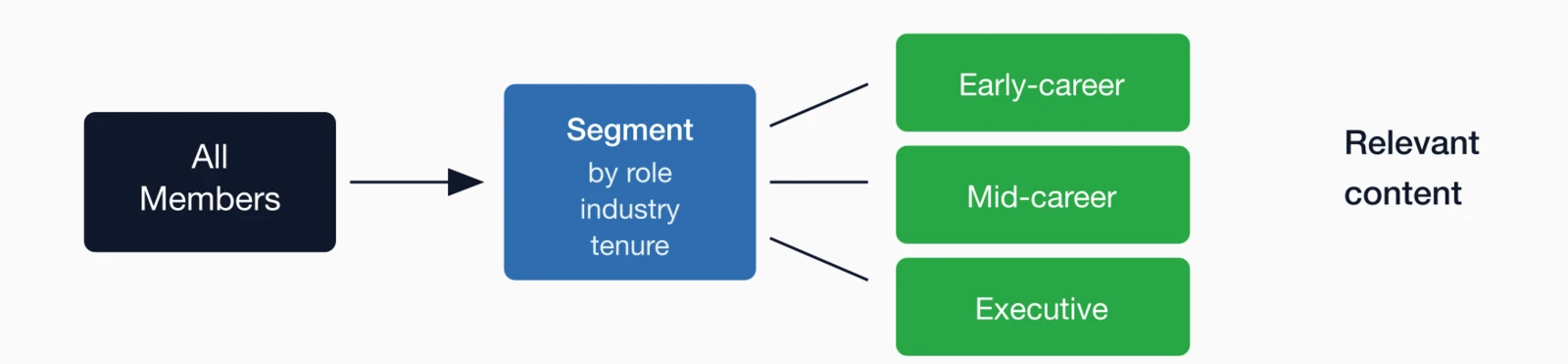
Members today expect the same personalized experiences they receive from consumer brands and digital services. When every email, event invitation, and resource recommendation feels relevant to their specific role, industry, or career stage, members feel understood and valued. Conversely, irrelevant communications signal that you don't really know who they are—making membership feel transactional rather than personal. Generic, one-size-fits-all experiences lead to disengagement and churn. Personalization shows members you understand their unique needs.
Segmentation strategies
Demographic Segmentation:
- Member type (student, professional, retired, corporate)
- Industry or specialty
- Geographic location
- Career level (early-career, mid-career, executive)
- Organization size (for organizational memberships)
Retention strategies also vary by organization type. See our specialized guides on trade association member retention and healthcare association retention
Behavioral Segmentation:
- Engagement level (highly engaged, moderately engaged, at-risk)
- Content preferences (education-focused, networking-focused, advocacy-focused)
- Event attendance patterns (frequent attendees, occasional, never)
- Tenure (new members, 1-3 years, 3-5 years, 5+ years)
Lifecycle Segmentation:
- New members (early weeks of membership)
- Active members (engaged regularly)
- At-risk members (declining engagement)
- Renewal pending (within 3 months of expiration)
- Recently lapsed (expired within the last quarter)
Personalization tactics
- Customized content recommendations: "Based on your interests, here are 3 resources for you"
- Targeted event invitations: Only send event invites relevant to member's location, role, or interests
- Personalized emails: Use name, membership type, tenure, and past behavior in communications
- Custom member journeys: Different onboarding and engagement paths for different member types
- Preference centers: Let members choose which communications they receive
The impact of personalization
Industry research consistently shows personalization improves key metrics:
- Noticeably higher email open rates
- Stronger click-through rates on targeted content
- Measurable reduction in churn
- Higher member satisfaction scores
Communicate strategically and regularly
Members who don't hear from you forget about you—and forgotten members don't renew. But communication isn't just about frequency; it's about delivering the right message to the right person at the right time. Strategic communication means balancing consistent touchpoints with relevance, ensuring members receive enough contact to stay connected without feeling overwhelmed by noise. Out of sight, out of mind. Regular, strategic communication keeps your organization visible and prevents members from forgetting their membership value.

Optimal communication frequency
- Weekly or bi-weekly newsletter: Keeps organization top-of-mind without overwhelming
- Monthly value summary: "Here's what you accessed this month"
- Quarterly impact report: Advocacy wins, new benefits, organizational achievements
- Event-driven communications: Registrations, confirmations, reminders, follow-ups
- Behavioral triggers: Automated emails based on member actions or inaction
Communication best practices
- Segment your messaging: Send targeted content to relevant member groups
- Value-first approach: Lead with what members gain, not what you want them to do
- Multi-channel strategy: Email, social media, portal notifications, occasional direct mail
- Mobile optimization: Most emails today are opened on mobile devices
- Clear calls-to-action: Make it obvious what members should do next
- Test and optimize: A/B test subject lines, send times, content formats
Don't forget renewal communications
The 2025 MGI report confirms email is essential: 100% of associations use email in their renewal series, and 84% rate email as their most effective renewal tactic. The average association sends 6 emails in their renewal series—if you're sending fewer, you're likely leaving renewals on the table.
- 90 days before: "Your renewal is coming up" with value reminder
- 60 days before: Main renewal push with one-click renewal link
- 30 days before: Urgency-based reminder emphasizing deadline
- 14 days before: Final reminder with payment options highlighted
- Expiration day: "Don't lose access" message
- Grace period: Gentle reminders during grace period
Here's something I often tell associations: the organizations with the best retention aren't necessarily the ones with the best benefits—they're the ones that stay in front of their members consistently. When members forget you exist, they don't renew. It's that simple.
Make renewal frictionless
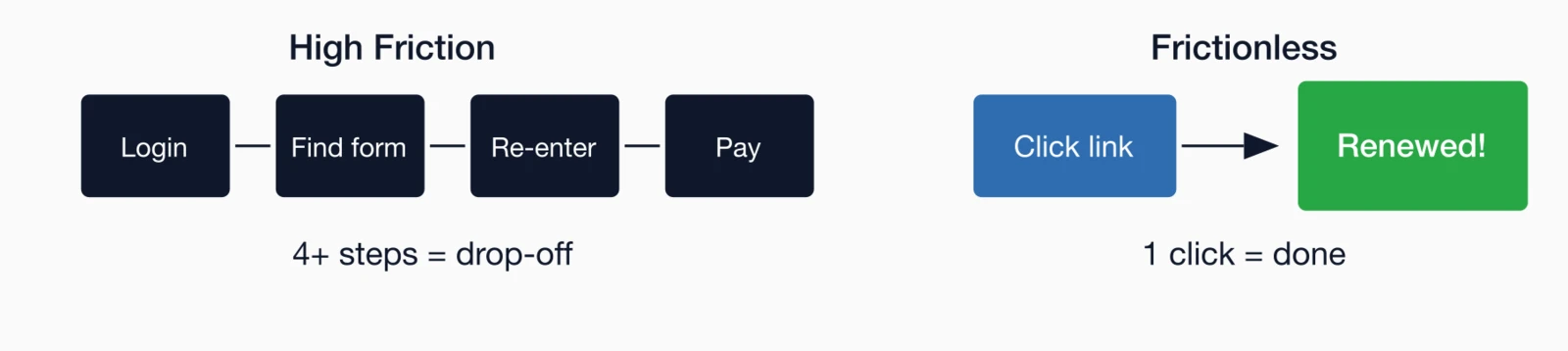
Renewal is the moment of truth for retention, and any obstacle—no matter how small—can tip a wavering member toward non-renewal. When renewal requires hunting for login credentials, re-entering payment information, or navigating a confusing checkout process, you're giving members reasons to procrastinate or abandon the process entirely. The goal is to make renewal so simple that it happens almost automatically. Every friction point in the renewal process increases churn risk. Make renewal as easy as possible.
Remove renewal barriers
- Auto-renewal options: Let members opt into automatic billing on renewal date
- Saved payment methods: One-click renewal with stored payment info
- Multiple payment options: Credit card, eCheck, invoicing, installment plans
- Mobile-friendly process: Renewal works perfectly on phones and tablets
- Pre-filled forms: Members shouldn't re-enter information you already have
- Grace periods: Don't cut off access on expiration day while processing renewals
- Clear pricing: Show exact renewal amount upfront
Renewal incentives
Consider offering early renewal discounts—even a modest 5-10% off for members who renew 60+ days before expiration can boost your on-time renewal rate. Multi-year discounts work well too, giving members a reason to commit for two or three years at a time. Some associations offer a small bonus or discount for enabling auto-renewal, which locks in retention and reduces your reminder workload. And don't underestimate loyalty recognition: a "thank you" gift or special perk for 5-year or 10-year members costs little but builds goodwill.
How i4a Makes Renewal Easy: i4a includes automated renewal reminders, saved payment methods for faster checkout, auto-renewal functionality, grace period configuration, and multiple payment options including installment plans. Members can renew 24/7 through the self-service portal with instant confirmation.
Create proactive intervention campaigns
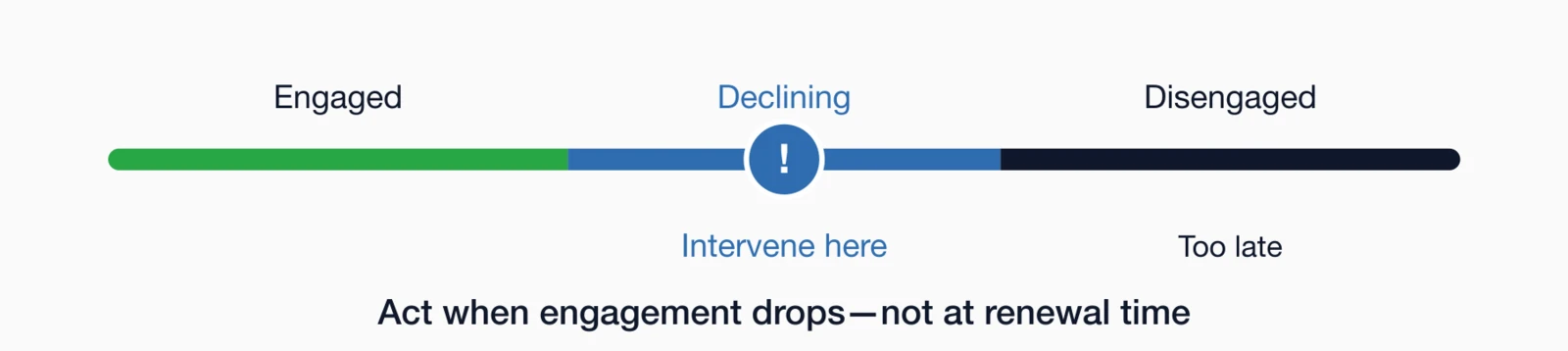
Waiting until renewal time to address disengagement is like treating a disease after it's progressed to its final stages—by then, the damage may be irreversible. Proactive intervention means reaching out when engagement drops, not when the invoice goes unpaid. Members who receive timely, relevant outreach when they start drifting away often re-engage and renew, while those left alone continue their slide toward the exit. When members show churn warning signs, proactive intervention can recover a substantial portion of those who are disengaging—often a third or more.
Intervention triggers
Automatically trigger intervention when members:
- Drop below engagement score threshold
- Haven't logged in for three months or more
- Haven't attended an event in 12+ months
- Email engagement stops (no opens in 6+ consecutive emails)
Payment and renewal signals are especially predictive. Watch for members who switch from auto-renew to manual renewal—that's often a sign they're reconsidering—and anyone who experiences a failed payment attempt. Members within 60 days of renewal who haven't yet renewed deserve immediate attention.
Intervention tactics
Email Intervention Sequence:
- Email 1 (Day 1): "We noticed you haven't been active lately. Here's what you're missing."
- Email 2 (Day 7): "Can we help? Here are resources you might find valuable."
- Email 3 (Day 14): Survey: "What can we do better? Your feedback matters."
Personal Outreach:
- Phone calls from staff to high-value members showing warning signs
- Peer outreach from volunteer leaders to committee members showing disengagement
- Executive director calls to long-term members considering non-renewal
Special Retention Offers:
- Extended grace period for members with payment issues
- Installment payment plans for members citing cost concerns
- Temporary membership pause option (3-6 months) instead of cancellation
- Discounted renewal rate for members threatening to leave
Measure intervention success
- % of flagged members who re-engage after intervention (target: 30%+)
- Retention rate of intervened members vs. non-intervened members showing warning signs
- ROI of intervention programs (staff time vs. retained revenue)
Conduct exit interviews and win-back campaigns
Even with the best retention efforts, some members will leave. But departure isn't necessarily the end of the relationship—it's an opportunity to learn and potentially reconnect. Exit interviews reveal systemic issues you can fix for remaining members, while win-back campaigns give former members a reason to return when circumstances change. Members who leave temporarily due to budget cuts, job changes, or competing priorities are often open to rejoining with the right invitation. Not every member will renew. Learn from those who leave and create pathways for them to return.

Consider this scenario: an association discovers through exit surveys that a surprising number of non-renewals are simply members who changed jobs and let their membership lapse during the transition—not because they were dissatisfied, but because renewal fell off their radar. Armed with that insight, they launch a win-back campaign specifically targeting lapsed members with a "welcome back" offer and a streamlined rejoin process. Even recovering 5-10% of those members represents people who would have been lost for good without that outreach.
Exit interview process
Contact Within One Month of Lapse:
- Email survey: "Can you help us understand why you didn't renew?"
- Phone interviews: For long-term or high-value members
- Incentivize feedback: Enter respondents in drawing for gift card
Key Questions to Ask:
- Primary reason for not renewing (cost, lack of value, changed careers, other)
- Which benefits did you use? Which did you want but weren't available?
- What could we have done differently to keep you as a member?
- Would you consider rejoining in the future? Under what circumstances?
- Would you recommend us to others despite not renewing yourself?
Use Exit Data to Improve:
- Track reasons for leaving by frequency
- Identify patterns by member segment
- Address systemic issues revealed in feedback
- Report findings to leadership quarterly
Win-back campaign sequence
One Month After Lapse:
- "We miss you" email with survey
- Highlight new benefits added since they left
- Soft invitation to return
Two Months After Lapse:
- Special reinstatement offer (waived application fee, first month free, discount)
- Testimonials from members who rejoined
- Clear, easy reinstatement process
Three Months After Lapse:
- Final outreach emphasizing what they're missing
- Case studies or success stories relevant to their interests
- Limited-time reinstatement offer
Win-back success metrics
Based on our analysis of win-back campaigns run by i4a customers:
- Win-back campaigns typically recover somewhere between 5-15% of lapsed members, depending on timing and approach
- Recently lapsed members (within the first few months) are far more likely to return than those who've been gone a year or more
- Members who left due to temporary circumstances (job change, budget cuts) are most likely to return
Use data to continuously improve
Retention isn't a problem you solve once and forget about—it's a capability you build and refine over time. The organizations that achieve lasting retention improvements treat churn reduction as an ongoing discipline, continuously measuring results, testing new approaches, and adapting based on what the data reveals. Without data, you're guessing; with data, you're strategizing. Reducing churn is an ongoing process, not a one-time project. Data-driven organizations that consistently track and act on retention metrics tend to see meaningful improvements within their first year.
The biggest difference I see between associations that struggle with retention and those that master it? The successful ones actually look at their data. Too many organizations collect all this information and never use it. Your database knows who's about to leave—you just have to ask the right questions.
Critical churn metrics to track
Overall Churn Rate:
- Track monthly and annually
- Industry benchmark: typically 15-25% annual churn for most associations
- Calculate: (Members Lost ÷ Total Members at Start) × 100
Churn Rate by Segment:
- By member type (student, professional, corporate, etc.)
- By tenure (first-year, 1-3 years, 3-5 years, 5+ years)
- By engagement level (highly engaged, moderate, low, inactive)
- By acquisition source (referral, website, event, partner)
- By geographic region
Leading Indicators:
- Average engagement score trend
- % of members in at-risk category
- Event attendance rates
- Email engagement rates (opens, clicks)
- Portal login frequency
Financial Metrics:
- Member Lifetime Value (LTV): Average revenue per member over their entire tenure
- Cost to acquire vs. cost to retain: Retention is almost always significantly cheaper than acquisition
- Revenue impact of churn: Annual revenue lost to non-renewals
Turn data into action
Monthly Reviews:
- Review churn rate and at-risk member count
- Identify which interventions are working
- Adjust tactics based on what data shows
Quarterly Deep Dives:
- Analyze churn by segment to find patterns
- Review exit interview feedback themes
- Present findings to leadership with recommendations
A/B Testing:
- Test different onboarding sequences
- Test renewal reminder timing and messaging
- Test intervention campaign approaches
- Test communication frequency
How i4a Provides Churn Analytics: i4a's custom reporting tools let you build reports to track churn rate overall and by segment, identify members showing warning signs, and analyze engagement patterns over time. Export data to Excel or QuickBooks for deeper analysis and board reporting.
Common retention mistakes to avoid
Even organizations with good intentions often undermine their retention efforts with avoidable missteps. Recognizing these common pitfalls can help you sidestep the traps that catch so many associations and keep your retention strategy on track. Over the years, I've seen the same mistakes derail retention efforts again and again. Here's what not to do:
Treating retention as a once-a-year renewal task
If you only think about retention when renewal notices go out, you've already lost. Retention is a year-round effort that starts the day someone joins.
Sending the same email to every member
A 20-year veteran and a first-year member have completely different needs. Blasting the same message to everyone signals that you don't really know your members.
Over-automating without personalization
Automation is powerful, but members can tell when they're getting a generic drip campaign. Balance efficiency with genuine human touches—especially for high-value or at-risk members.
Waiting until members lapse to reach out
By the time someone doesn't renew, they've mentally left months ago. Intervention needs to happen when engagement starts declining, not after the expiration date passes.
Ignoring exit feedback
If you're not asking why members leave—and actually acting on what they tell you—you're missing your best source of intelligence for preventing future churn.
Focusing only on acquisition
I've watched associations pour resources into recruitment campaigns while their retention rate quietly eroded. Keeping members is almost always more cost-effective than finding new ones.
Conclusion: The compounding impact of churn reduction
The math of retention is compelling: even modest improvements in churn rate compound dramatically over time, translating into larger membership bases, more dues revenue, and reduced pressure on recruitment. Understanding these numbers makes the business case for investing in retention crystal clear. Let's look at the long-term impact of reducing churn with a real association platform example:
Example organization:
- 1,000 members at $200 annual dues
- $200,000 annual dues revenue
- Current: 20% annual churn (80% retention)
- Goal: 15% annual churn (85% retention)
Year 1 impact of 5% churn reduction:
- 50 additional members retained (200 losses → 150 losses)
- $10,000 additional revenue in Year 1
3-year compounding impact:
Assuming steady recruitment of 200 new members per year:
- At 20% churn: 1,000 members after 3 years, $200,000 revenue
- At 15% churn: 1,250 members after 3 years, $250,000 revenue
- Difference: 250 additional members, $50,000 additional annual revenue
Additional benefits:
- Reduced recruitment pressure: Need fewer new members to grow
- Higher member satisfaction: Lower churn signals healthier organization
- Increased referrals: Satisfied long-term members refer others
- Staff efficiency: Less time processing exits, more time delivering value
- Stronger reputation: High retention attracts prospects
Getting started
You don't have to implement all 10 strategies at once. Start with the highest-impact opportunities:
Quick Wins (Implement First):
- Set up at-risk member tracking and alerts
- Improve onboarding email sequence
- Add friction-reducing renewal options (auto-renew, saved payments)
Medium-Term (Implement Next 3-6 Months):
- Create intervention campaigns for members showing warning signs
- Implement exit interview process
- Start tracking churn by segment
Long-Term (Build Over 6-12 Months):
- Comprehensive personalization and segmentation
- Community-building programs
- Advanced analytics and A/B testing
The organizations that win at retention don't have a secret weapon—they have disciplined execution of proven strategies, consistent measurement, and a culture that values retention as much as recruitment.
How i4a helps reduce churn
Implementing these strategies requires the right technology foundation—software that tracks engagement, automates outreach, and makes renewal seamless. i4a's membership management platform gives you the tools to build and execute your retention strategy:
- Custom Reporting: Track churn rates, identify at-risk member segments, and monitor engagement patterns
- Scheduled Email Sequences: Automated onboarding emails that reach new members based on their join date
- Frictionless Renewal: Auto-renew, saved payment methods, and grace periods reduce renewal friction
- Exit Surveys: Custom forms for collecting feedback from departing members
- Segmentation Tools: Target communications based on any member data field
- Report-Based Targeting: Pull lists of at-risk or lapsed members for win-back outreach
Plus, with unlimited members and contacts, you can track all your retention data without worrying about hitting usage limits or paying extra fees.
Key takeaways
- Even modest churn reductions have outsized revenue impact—retained members generate predictable revenue and are more likely to upgrade, attend events, and refer others
- Members who don't engage during their initial weeks are far more likely to churn at first renewal—making onboarding the highest-impact retention opportunity
- At-risk members typically show warning signs months before leaving including decreased logins, declining event attendance, and lower email engagement—enabling proactive intervention
- Tracking churn by segment helps organizations identify patterns and target interventions to high-risk groups, often leading to significant retention improvements within a year
Ready to Reduce Member Churn?
i4a's membership software helps you automate renewal reminders, create targeted email sequences for new members, and make renewal frictionless with auto-pay and saved payment methods—so you can focus on retention, not manual follow-up.
See How It WorksRelated resources
Complete guide to membership databases, automated renewals, and retention tools built into modern membership software.
Learn how integrated AMS platforms support retention with connected membership, events, and engagement tracking.
How to Automate Membership Renewals: The Complete 2026 Guide
Step-by-step guide to renewal automation that reduces churn through friction-free renewals.
How to Use Member Data to Make Better Decisions
Use analytics to identify at-risk members and measure retention program effectiveness.
10 Ways to Improve Member Experience for Associations | 2026 Guide
10 proven strategies to boost engagement, personalize communications, and increase retention through a better member experience.
