Quick Summary: Small Association Software
- Small doesn't mean simple: 500-member associations face the same operational complexity as larger ones—just with fewer staff and budget.
- Focus on core features: Member database, renewals, events, and email marketing cover 90% of small association needs.
- Pricing model matters more: Per-contact fees hurt small associations disproportionately as they grow.
- Choose platforms that scale: Pick software you can grow into, not software you need to grow out of.
Part of our small association software guide
Small association software should multiply limited resources, not add complexity. With 500 members, you need professional-grade capabilities without enterprise pricing—and without per-contact fees that punish growth.
Small associations face unique challenges. Unlike larger organizations with dedicated IT teams and budgets, groups under 500 members typically operate with volunteer boards, part-time staff, and tight finances. You need software that delivers core features—membership management, event registration, email campaigns, and basic reporting—without steep learning curves, endless customizations, or fees that spike as you grow. Per-contact pricing, common in many platforms, can double your costs when membership hits 300 or 400, turning success into a budget strain. Flat-rate or unlimited models keep expenses predictable, letting you invest in programs instead.
Manual data entry is a drain on your association's most valuable asset: professional expertise. Whether it's a staff member or a board volunteer, time spent on administrative tasks has a high "opportunity cost." Using the Independent Sector 2025 benchmark of $34.79/hr
Recapturing that value requires a platform built for the realities of small-staff operations—a challenge I have seen play out repeatedly over my career.
I've worked with associations of all sizes
This guide breaks down the best options, pricing comparisons, and red flags to avoid—so you select software that scales with you, not against you.
Small doesn't mean simple
One of the most persistent myths in association software is that smaller organizations have simpler needs. The reality is quite different: a 500-member association often handles the same fundamental challenges as one with 5,000 members—renewals, events, communications, reporting—just with a fraction of the staff and budget. This mismatch between operational complexity and available resources is exactly what makes software selection so critical for small associations. Let's be clear about something: a 500-member professional association isn't "simple." You're running a real organization with real complexity:
- Members who expect professional service and communication
- Annual renewals that need to happen reliably
- Events that need registration and management
- A board that wants reports and financial accountability
- Volunteers and committees that need coordination
- Limited staff (often just one or two people) handling everything
The challenge for small associations isn't that your needs are simple—it's that you need to accomplish professional-level operations with limited resources. That's exactly why the right software matters so much.
For a small staff, software isn't just a tool; it's a capacity-builder. According to TechSoup's 2025 Digital Trends research
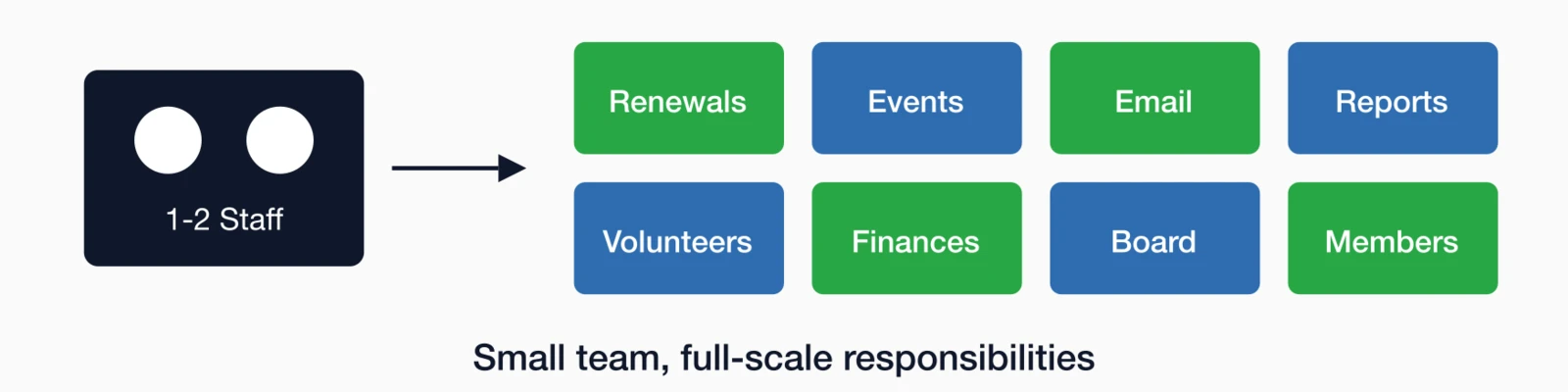
The best software for small associations multiplies your limited resources—automating what can be automated so you can focus on what requires a human touch.
Essential features for small associations
Not all features matter equally, especially when resources are limited. Small associations should prioritize capabilities that automate repetitive tasks, reduce manual work, and enable professional-grade member service without requiring dedicated IT staff. The features below represent the foundation that makes everything else possible—get these right, and most daily operations become manageable. When you're evaluating membership software, focus on these core capabilities that make the biggest difference for small organizations:
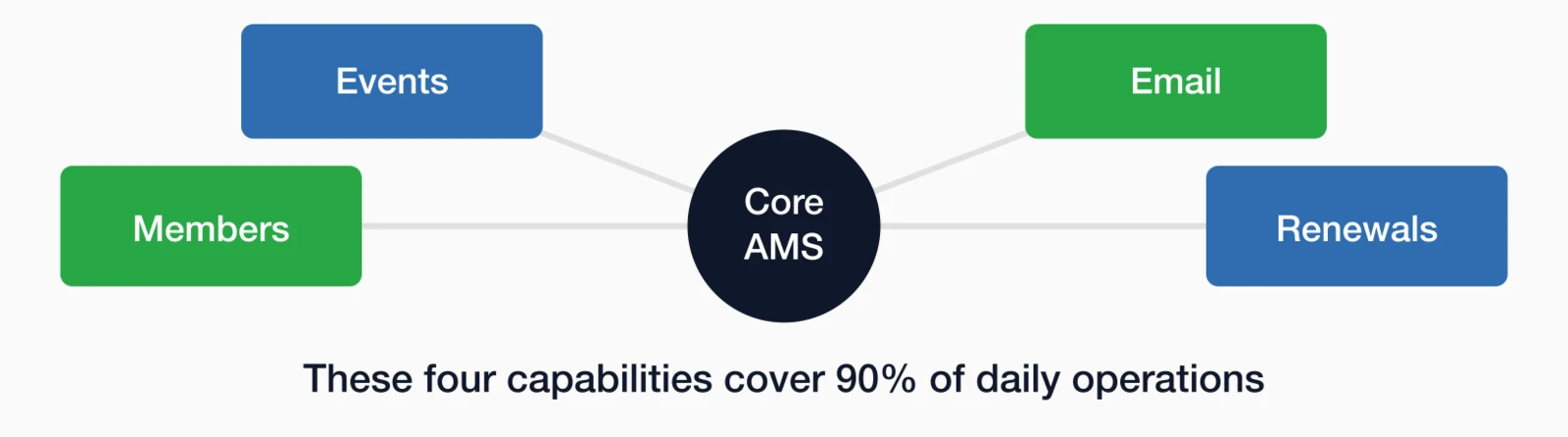
Must-have features
Member Database
- Centralized member records
- Contact history and notes
- Custom fields for your data
- Easy search and filtering
- Duplicate detection
Renewal Automation
- Automatic renewal reminders
- Online payment processing
- Grace period handling
- Lapse notifications
- Renewal reporting
Email Communications
- Member email campaigns
- Template-based emails
- Segmentation by member type
- Open and click tracking
- Automated sequences
Basic Event Management
- Event registration forms
- Member vs. non-member pricing
- Payment collection
- Attendee management
- Basic reporting
Nice-to-have features
- Member portal — Self-service profile updates, renewal, event registration
- Member directory — Searchable listing of members
- Committee tracking — Manage volunteer and committee assignments
- Basic reporting — Membership trends, financial summaries
- Website integration — Member login, member-only content
Avoiding overkill: Features you probably don't need
In software demos, more features can seem better—impressive dashboards, complex workflow builders, and sophisticated reporting tools create a compelling presentation. But for small associations, unused complexity becomes a liability: it increases costs, extends learning curves, and clutters interfaces with options you'll never touch. The smartest choice is often the platform that does less, but does it exceptionally well. Enterprise-level platforms often include features that add cost and complexity without providing value for small associations. Be wary of paying for:
Choosing software that is too complex can actually lower your "Tech Adoption Score." NTEN's Tech Accelerate framework
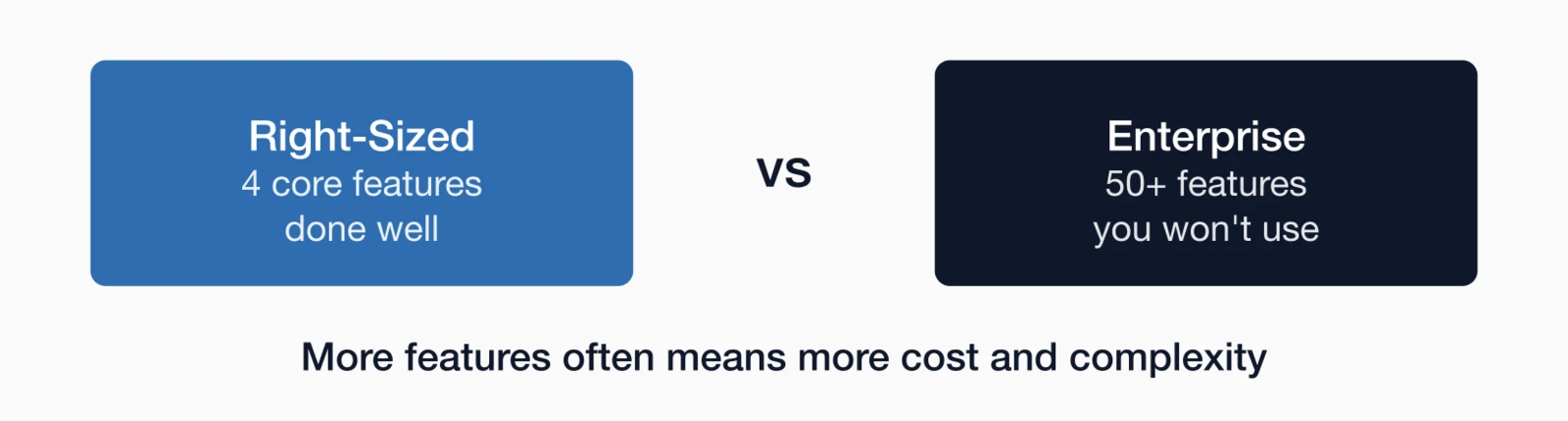
Usually Overkill
For multi-chapter organizations
Multiple credential types, compliance reporting
Custom multi-step approval processes
Complex dashboards you won't use
For international organizations
Complex technical connections
Focus On Instead
Figure it out without extensive training
Days or weeks, not months
Responsive help when you need it
Reliable, intuitive basics
Affordable at your size
Features available when you need them
Watch out: If a vendor spends most of the demo showing features you'll never use, that's a sign the platform isn't designed for organizations like yours.
Why pricing model matters more for small associations
Price isn't just about what you pay today—it's about what happens to your costs as you succeed. Many small associations select software based on current pricing only to discover that growth triggers dramatic price increases. The difference between per-contact and flat-rate pricing models becomes especially significant for organizations operating on tight budgets where predictability matters. For small associations, the pricing structure can make or break affordability—not just today, but as you grow.
The per-contact problem
Many platforms charge per contact. At small member counts, this seems reasonable. But watch what happens as you grow:
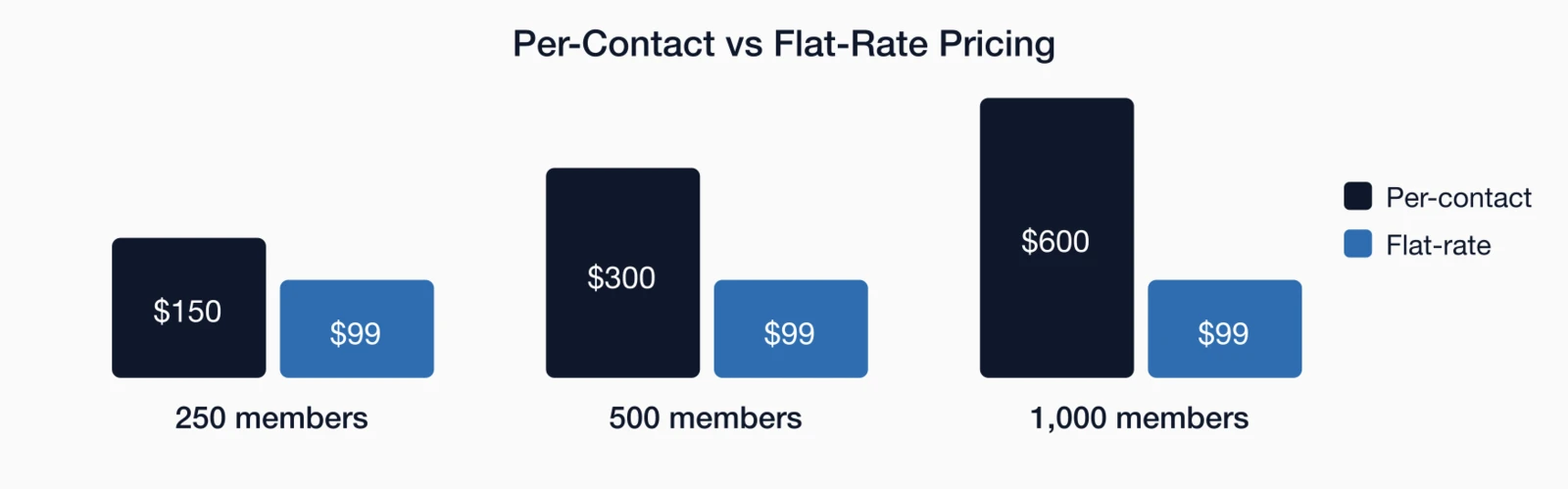
Calculate your savings: See our Per-Contact vs Flat-Rate Pricing Calculator
Choosing a growth-ready platform
Software migrations are expensive and disruptive—both in direct costs and in the time and energy they consume. The smartest approach is to select a platform that fits your current needs while offering room to grow, so you're not facing another migration in two or three years when your organization outgrows its tools. A growth-ready platform isn't necessarily the most feature-rich; it's one designed to scale gracefully with your organization. Today you have 500 members. But what about next year? Choose software you can grow into—not software you'll need to replace when you succeed.
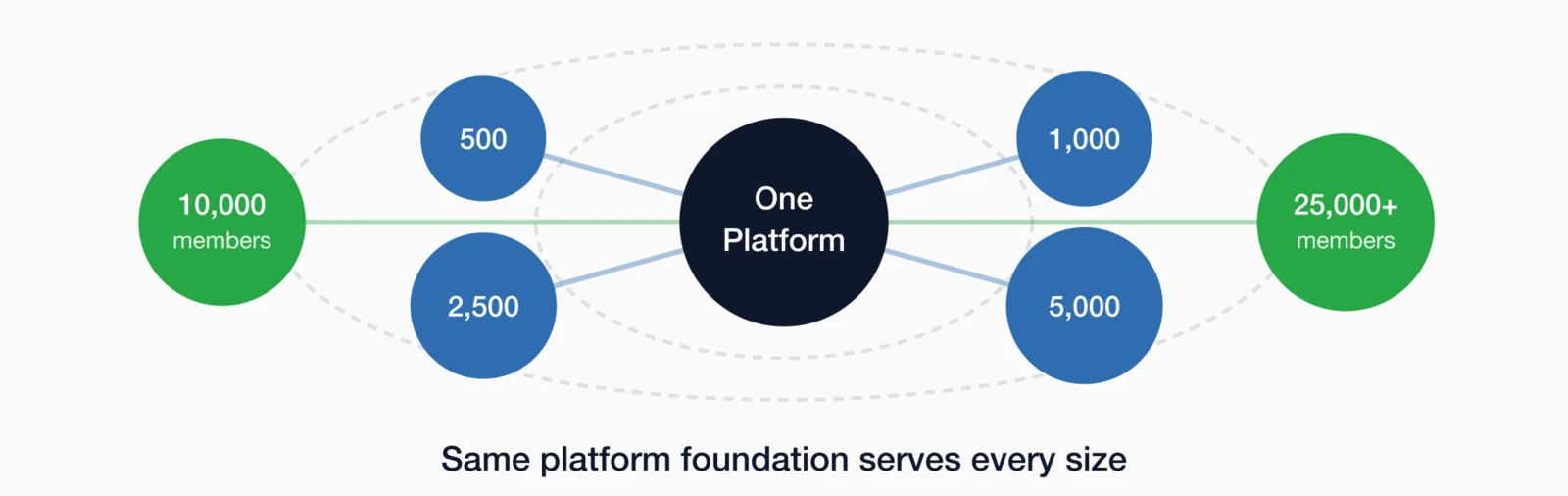
Signs of a growth-ready platform
- Scalable pricing — Costs don't explode as you grow (flat-rate is ideal)
- Feature headroom — Advanced features available when you need them
- Proven track record — Other associations have grown on the platform
- No arbitrary limits — No caps on members, emails, or events
- Strong support — Help available as your needs become more complex
Red flags for outgrowing
- Free tier with strict limitations
- "Starter" pricing that jumps dramatically at thresholds
- Missing features only available in expensive enterprise tiers
- No path to more sophisticated capabilities
- Primarily designed for very small organizations
i4a serves associations from 500 to 50,000+ members on the same platform. Start with what you need today; the features are there when you grow.
Evaluation criteria for small associations
Small associations face a unique evaluation challenge: you need enterprise-capable software on a limited budget, with minimal time for selection and implementation. This framework prioritizes the factors that matter most when resources are constrained—ease of use, fast implementation, and sustainable costs—while ensuring you don't sacrifice the capabilities you actually need. Use this framework to evaluate platforms for your small association:

| Criteria | What to Look For | Why It Matters |
|---|---|---|
| Ease of Use | Intuitive interface, minimal training needed | You don't have IT staff or weeks for training |
| Implementation Time | 30-60 days, not 6+ months | You can't wait months to solve current problems |
| Total Cost | Affordable at current AND projected size | Budget constraints are real; growth shouldn't break the bank |
| Support Quality | Responsive, included in subscription | When things go wrong, you need fast help |
| Core Features | Members, renewals, events, email—all included | These basics should be standard, not add-ons |
| Growth Path | Advanced features available when needed | You don't want to switch platforms as you grow |
Security is no longer just an IT checkbox; it's a governance priority. Smaller organizations are often more vulnerable to security lapses due to limited oversight. To mitigate this risk, associations should align their internal policies with the NIST Small Business Cybersecurity Corner
The bottom line
Finding the right software for a small association isn't about settling for less—it's about finding the right fit. The ideal platform amplifies your limited resources rather than consuming them, handles professional-level operations without requiring professional-level staff, and remains affordable as you grow. Here's what to remember when choosing software for your small association:
- You need real software. Spreadsheets and free tools create more work, not less.
- Focus on core features done well. Member management, renewals, events, email—these matter most.
- Avoid expensive complexity. Enterprise features add cost without value for small organizations.
- Pricing model matters. Flat-rate pricing protects you as you grow.
- Choose for the future. Pick software you can grow into, not out of.
- Prioritize support. When your one-person staff has a question, fast answers matter.
The right software for a small association isn't a stripped-down version of enterprise software. It's purpose-built to do more with less—to multiply your limited resources and let you punch above your weight.
Key takeaways
- Small associations need real software: Spreadsheets and basic tools become limiting quickly—professional membership management matters at any size
- Focus on core features: Member database, renewals, basic events, and email marketing cover 90% of small association needs
- Avoid overbuying: Complex enterprise features add cost and confusion without adding value for smaller organizations
- Pricing model matters more: Per-contact fees hurt small associations disproportionately as they grow
- Choose platforms that scale: Pick software you can grow into, not software you need to grow out of
Right-Sized Software for Growing Associations
i4a is built for associations like yours—professional features without enterprise complexity. Starting at $99/month with unlimited members, it's affordable today and stays affordable as you grow.
See PricingRelated resources
Per-Contact vs Flat-Rate Pricing
Calculate your costs at different member counts.
What to expect when switching platforms.
Software Selection Guide for Associations
Practical steps to evaluate and select the right AMS.
Association Management Software
Everything you need to know about AMS platforms.
