Quick Summary: Unlimited Members Software
- Predictable costs: Pay a flat rate regardless of database size—no surprise tier bumps or overage fees when membership grows.
- Growth becomes free: Run aggressive membership drives without worrying about software cost increases.
- Data stops being a liability: Keep historical records, lapsed members, and event attendees without budget pressure.
- Verify "unlimited" claims: Ask vendors directly about caps, limits, and what happens as you scale.
Part of our unlimited members software guide
Unlimited members software charges the same flat rate at 1,000 or 10,000 members—eliminating the per-contact fees that penalize growth. Here's how to evaluate "unlimited" claims and avoid marketing gimmicks.
Every year, I have conversations with association executives who are genuinely confused about their software bills. "We only added 300 members," they tell me, "but our software costs went up by $2,000." The culprit? Per-contact pricing—the industry's most common (and most problematic) pricing model.
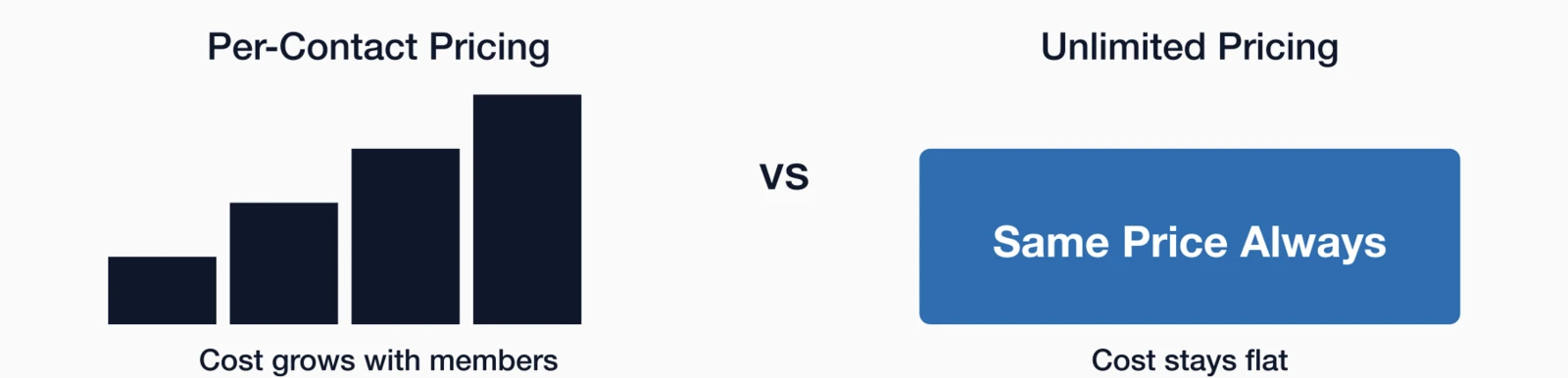
There's a better way. Unlimited member pricing flips the model entirely: pay a predictable flat rate regardless of how many member records you maintain. Your costs stay the same whether you're serving 500 members or 50,000.
What is unlimited member pricing?
Unlimited member pricing is straightforward: you pay a flat monthly or annual fee for your association management software, regardless of how many member records you store. No per-contact fees, no tier jumps, no surprises.
What's included in "unlimited"
With true unlimited member pricing, you can store as many records as you need:
- Active members — Current, dues-paying members
- Lapsed members — Former members you want to win back
- Prospects — People who've shown interest but haven't joined
- Event attendees — Non-members who attended conferences or webinars
- Historical records — Past members and contacts for institutional memory
- Multiple contacts per organization — For trade associations with organizational memberships
The power of unlimited pricing isn't just about cost savings—it's about freedom. Freedom to grow, freedom to keep data, and freedom from surprise bills.
Why this pricing model matters
The pricing model you choose affects more than your budget. It influences your association's culture around growth, data management, and strategic planning in ways that may not be immediately obvious. When staff members hesitate to import a prospect list because it might "cost too much," you've created an organizational culture where growth is viewed as a liability rather than a goal. The right pricing model removes these mental barriers and aligns everyone around what actually matters—building and serving your membership community.
The per-contact problem
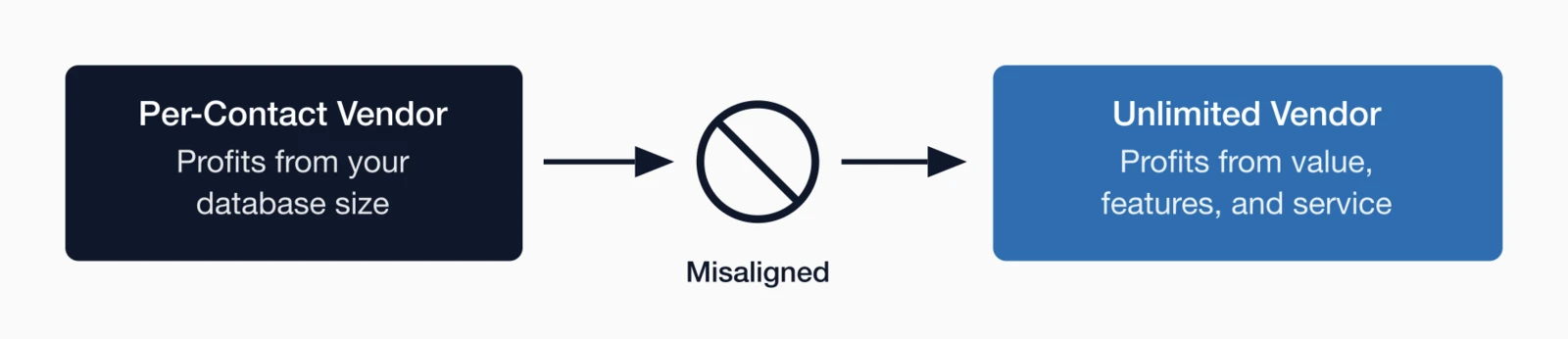
Think about what per-contact pricing actually means: your software vendor makes more money every time you add a member. Their financial incentive is for your database to grow—regardless of whether that growth serves your organization's goals. This creates several problems:
- Growth becomes expensive — Your membership success directly increases your technology costs
- Data hoarding becomes costly — Keeping historical records and lapsed members pushes you into higher pricing tiers
- Budget unpredictability — You can't know your software costs until you know your member count
- Perverse incentives — Staff may hesitate to import prospect lists or event attendees because it increases costs
Data is the fuel for future AI-driven member experiences. However, Forrester's 2026 software predictions highlight that organizations paying per-record are increasingly deleting historical data to control costs—undermining their ability to leverage AI and analytics down the road.
The unlimited advantage
With unlimited member pricing, the vendor's incentive shifts to providing value through features, support, and service—not counting your contacts. Your success and their success become aligned.
Real Talk: Per-contact pricing creates a perverse incentive: your software vendor profits when your database grows, regardless of whether that growth serves your goals. With unlimited pricing, the vendor's incentive shifts to providing value through features, support, and service—not counting your contacts.
7 benefits of unlimited member pricing
Growing associations are increasingly choosing unlimited member platforms, and the reasons go beyond simple cost savings. The benefits compound over time as your organization scales, creating advantages that per-contact pricing simply cannot match. From budget predictability to data retention freedom, these seven benefits explain why the flat-rate model has become the preferred choice for associations focused on long-term growth.
As we head into 2026, the "era of cheap software" has officially ended. Research from SaaStr documents how major platforms raised prices 20-40% in 2025 alone—making predictable flat-rate pricing more valuable than ever.
Budget predictability
Present your board with exact technology costs—not estimates. Know precisely what you'll pay this year and next year, making financial planning straightforward.
Freedom to grow
Run aggressive membership drives without worrying about software cost increases. Your growth goals and technology budget are no longer in conflict.
Complete data retention
Keep every record—lapsed members, historical contacts, event attendees. Your data is an asset, not a cost center.
Better win-back campaigns
When keeping lapsed members doesn't cost extra, you can run sophisticated win-back campaigns using years of historical data.
Event prospect import
Import thousands of conference attendees or webinar registrants without hesitation. Convert them to members over time without paying for the privilege.
Superior long-term ROI
Your 5-year total cost of ownership is dramatically lower. The savings compound as your association grows.
Simpler vendor relationship
No more reviewing invoices for contact overages, negotiating tier bumps, or wondering if this quarter's membership success will blow your budget.
Real-world cost comparison
Theory is useful, but numbers tell the real story. The difference between per-contact and flat-rate pricing becomes dramatic as your organization grows—and the gap widens every year. What starts as a modest savings at 1,000 members becomes a massive cost advantage at 10,000 members. These comparisons assume typical per-contact rates and illustrate why the pricing model decision has long-term financial implications far beyond the initial purchase.
Technology is the second largest expense for most associations after payroll. Gartner's 2026 IT Spend Forecast projects enterprise software spending will exceed $6 trillion globally—making cost predictability a strategic priority for budget-conscious organizations.
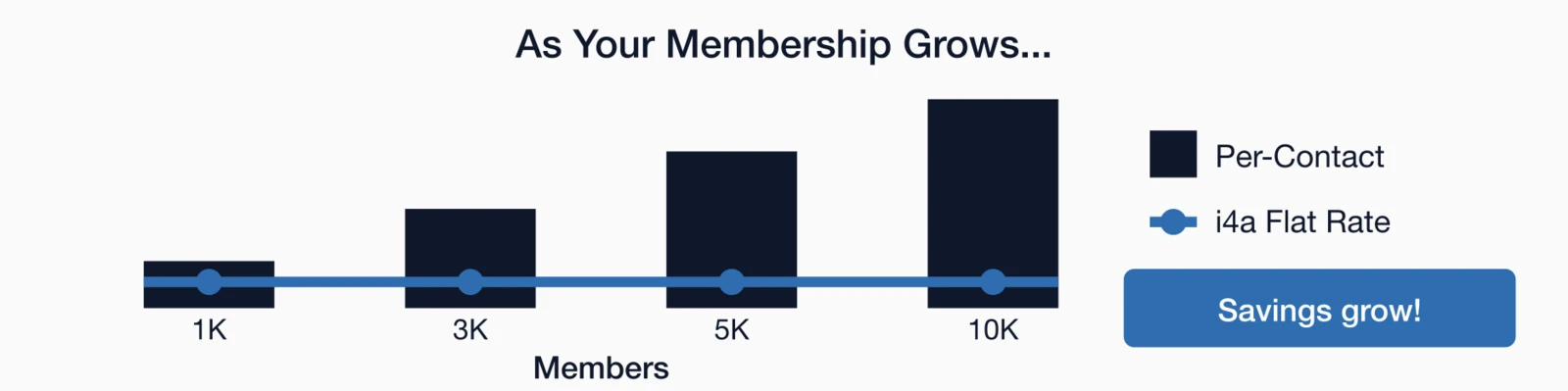
| Members | Per-Contact @ $1/member/mo | i4a Core (Flat Rate) | Annual Savings |
|---|---|---|---|
| 1,000 | $12,000/year | $1,188/year | $10,812 |
| 3,000 | $36,000/year | $1,188/year | $34,812 |
| 5,000 | $60,000/year | $1,188/year | $58,812 |
| 10,000 | $120,000/year | $1,188/year | $118,812 |
See your exact savings: Use our 5-Year TCO Calculator
Evaluating unlimited member platforms
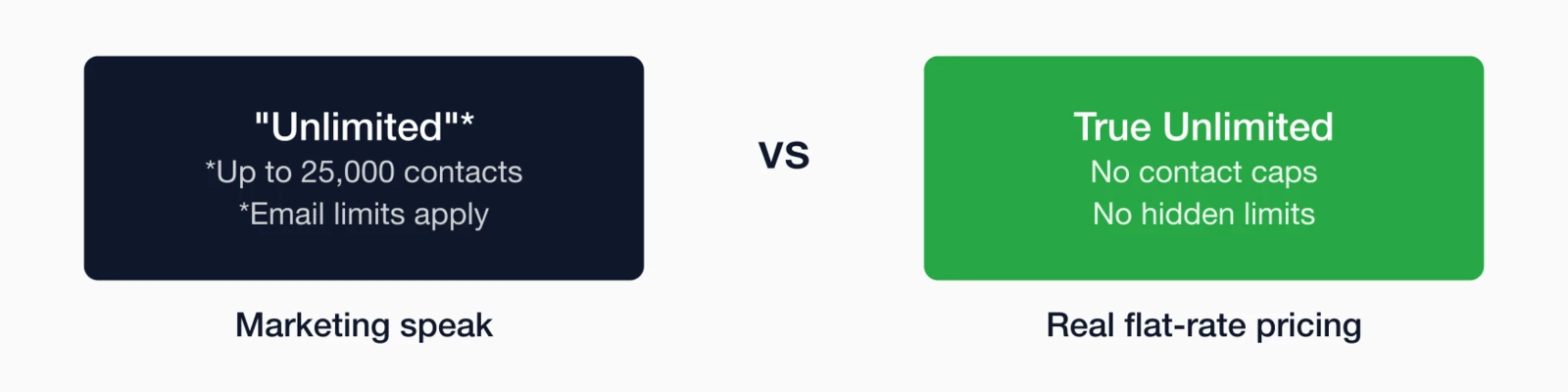
Not all "unlimited" claims are created equal. Some vendors use the word as marketing language while burying limitations in their terms of service or imposing caps on related resources like email sends or storage. Others offer genuinely unrestricted databases but gate important features behind higher tiers. Learning to distinguish true unlimited pricing from creative marketing requires asking the right questions and reading the fine print carefully.
Red flags to watch for
- "Unlimited" with fine print — Some vendors say "unlimited" but cap at 25,000 contacts or charge for "active" vs. "inactive" records
- Feature gating by size — Basic tier has unlimited contacts, but you need premium for features that only matter at scale
- Storage limits — Unlimited contacts but limited storage for documents, images, or email archives
- Email send limits — Unlimited database but charges per email sent or caps monthly sends
- API call limits — Restrictions that become painful when integrating with other systems at scale
Green flags that signal true value
- Simple pricing page — Clear flat rate without asterisks or "starting at" language
- All contact types included — Active, lapsed, prospects, historical all treated the same
- No per-email fees — Email communications included in the platform cost
- Transparent feature access — Know exactly what you get at each tier
- Long-term customer references — Can speak with organizations that have grown significantly while using the platform
Questions to ask vendors
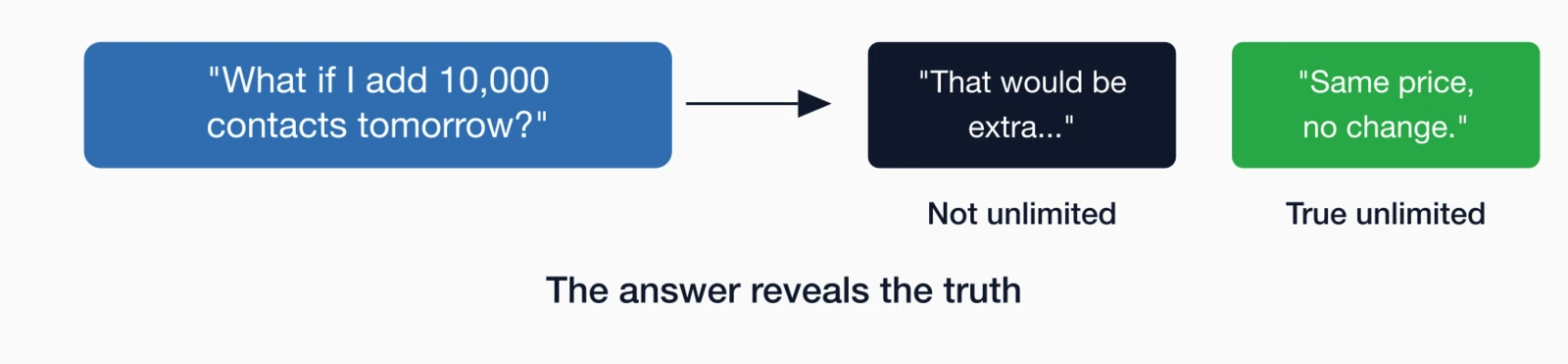
When evaluating platforms that claim unlimited member pricing, the right questions can expose limitations that sales materials gloss over. Vendors rarely volunteer information about caps, exceptions, or scenarios where costs might increase—you have to ask directly. These six questions are designed to test whether "unlimited" means what you expect it to mean and to surface any hidden constraints before you sign a contract.
-
"What exactly counts toward my contact limit?"
Some platforms only count "active" contacts or exclude certain record types. Get clarity on what's actually unlimited.
-
"If I import 10,000 event attendees tomorrow, what happens to my bill?"
This scenario tests whether "unlimited" is truly unlimited.
-
"Show me your pricing at 5,000, 25,000, and 100,000 contacts."
If the answer is the same for all three, it's truly unlimited.
-
"Are there any features that unlock based on database size?"
Some platforms gate advanced features behind higher tiers that correlate with size.
-
"Can you connect me with a client who has grown significantly while on your platform?"
References from organizations that have tested the "unlimited" claim are invaluable.
-
"What's the total annual cost with no surprises?"
Get it in writing. No overage fees, no tier bumps, no surprises.
The bottom line
Choosing between pricing models is one of the most consequential decisions in your software selection process. The implications extend far beyond annual invoices—they shape how your organization thinks about growth, data retention, and long-term technology investment. Here's what you need to remember as you evaluate your options and make this critical decision for your association's future.
- Unlimited member pricing = predictable costs. Pay a flat rate regardless of database size—your costs don't increase as you grow.
- It aligns vendor incentives with your goals. Your software vendor succeeds by providing value, not by counting your contacts.
- Data retention becomes an asset. Keep historical records, lapsed members, and prospects without budget pressure.
- Growth becomes unconstrained. Run membership drives and import prospect lists without watching the cost meter.
- Verify "unlimited" claims carefully. Ask direct questions about caps, limits, and what happens as you scale.
Your association's technology should support your growth, not penalize it. If you're currently paying per-contact fees, it's worth calculating what you could save with a truly unlimited platform. The numbers often speak for themselves.
Key takeaways
- Unlimited = predictable costs: Pay a flat monthly rate regardless of database size—no surprise tier bumps or overage fees when your membership grows
- Growth becomes free: Run aggressive membership drives without worrying about software cost increases—add 1,000 new members with zero additional technology expense
- Data retention stops being a liability: Keep historical records, lapsed members, and event attendees without budget pressure—your data becomes an asset, not a cost center
- i4a offers true unlimited pricing: Starting at $99/month with unlimited members included, whether you have 500 or 50,000 contacts
Experience True Unlimited Member Pricing
i4a offers flat-rate pricing with unlimited members included—whether you have 500 or 50,000. See how it works and calculate your potential savings.
View Pricing & Calculate SavingsRelated resources
Choosing the Right Membership Platform
Practical steps to evaluate, compare, and select the ideal membership management platform.
Association Management Software
Everything you need to know about AMS platforms: features, pricing, and implementation.
Per-Contact vs Flat-Rate Pricing
Calculate your 5-year total cost of ownership with our interactive TCO calculator.
Hidden Costs of Membership Software
Uncover the fees vendors don't advertise and how to ask the right questions.
