Quick Summary: Association Volunteer Management
- Volunteers renew at near-100% rates: Converting members to volunteers is one of the most effective retention strategies available.
- Personal invitations outperform mass appeals: A direct ask from someone the prospect respects yields dramatically higher response rates than generic calls for volunteers.
- Clear role definitions prevent frustration: Define time commitment, term length, and responsibilities upfront so volunteers can commit confidently.
- Meaningful work beats meetings: Volunteers want to contribute, not attend—give them real responsibilities with visible impact.
- Recognition should be timely and specific: A personal thank-you within 48 hours of a contribution matters more than annual awards ceremonies.
Part of our member engagement best practices guide
Volunteer management for associations directly impacts retention—members who volunteer renew at dramatically higher rates. Here's how to recruit, onboard, and recognize volunteers in ways that extend your capacity while building lasting loyalty.
In my experience, members who volunteer for associations—whether on committees, as conference speakers, or in chapter leadership—renew at rates approaching 100%. The act of volunteering creates a sense of ownership and investment that transforms members from customers into stakeholders.
Yet many associations struggle to recruit and retain volunteers. They issue generic calls for help and wonder why nobody responds. They give volunteers busywork instead of meaningful projects. They fail to show appreciation until volunteers quietly disappear.
This guide covers what actually works for building a volunteer program that serves both your organization's needs and your volunteers' desire to make a meaningful contribution. Whether you're a professional association with individual member volunteers or a membership nonprofit
The strategic value of volunteers
Before diving into tactics, let's be clear about why volunteers matter strategically—beyond just "free labor." Viewing volunteers primarily as a cost-savings measure undervalues what they actually bring to your organization and leads to programs that fail to attract or retain them. Volunteers contribute expertise that staff can't replicate, provide member perspective that improves your programs, and build the kind of organizational ownership that translates directly into long-term loyalty. Understanding this strategic value is essential for building a program that serves both your organization and your volunteers.
To understand the true scale of volunteer impact, we must look at the numbers. According to the Independent Sector
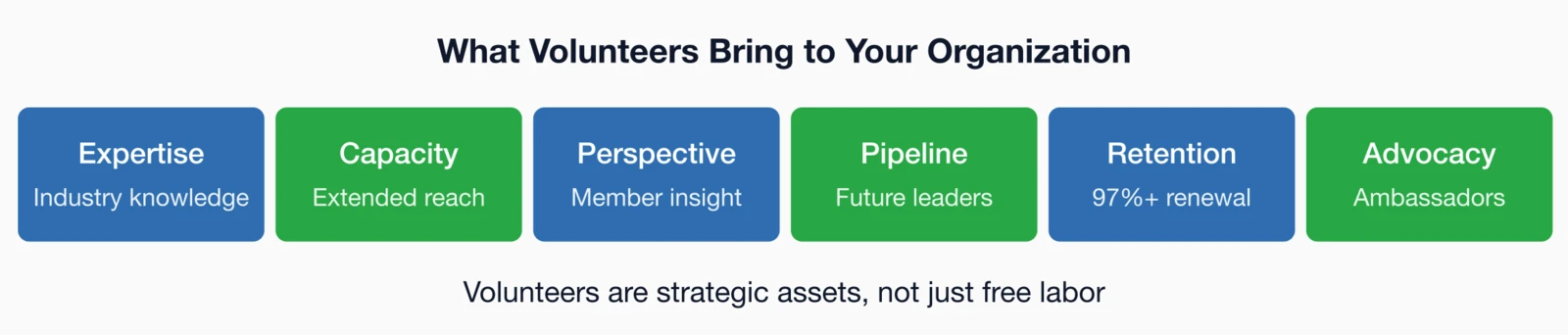
What volunteers bring
- Expertise: Practicing professionals bring current, credible knowledge that staff may not have
- Capacity: Volunteers extend what your organization can accomplish beyond staff limitations
- Member perspective: Volunteers understand member needs because they are members
- Leadership pipeline: Today's committee volunteer is tomorrow's board member—use committee tracking tools to manage this progression
- Retention impact: Engaged volunteers renew at dramatically higher rates
- Advocacy: Committed volunteers become your most passionate ambassadors
The retention math
Let's quantify this. If your overall retention rate is 85% but volunteers retain at 97%, every member you convert to an active volunteer represents significantly more lifetime value. A member who volunteers for just two years before returning to "regular" membership is still more likely to remain loyal long-term because of the connection they built.
This is why volunteer engagement isn't just an operational consideration—it's a retention strategy. Resources spent recruiting and supporting volunteers often deliver better ROI than many marketing investments.
Volunteer recruitment strategies
The typical association approach to volunteer recruitment—blast email asking for volunteers—rarely works. The people who respond are either already over-committed or looking for something the role doesn't offer. Effective recruitment requires understanding what motivates potential volunteers, targeting the right members for specific roles, and making asks that address both organizational needs and individual motivations. The associations with thriving volunteer programs have moved beyond generic appeals to strategic, personalized recruitment approaches.
We are seeing a renewed era of civic participation. According to the AmeriCorps CEV Dashboard
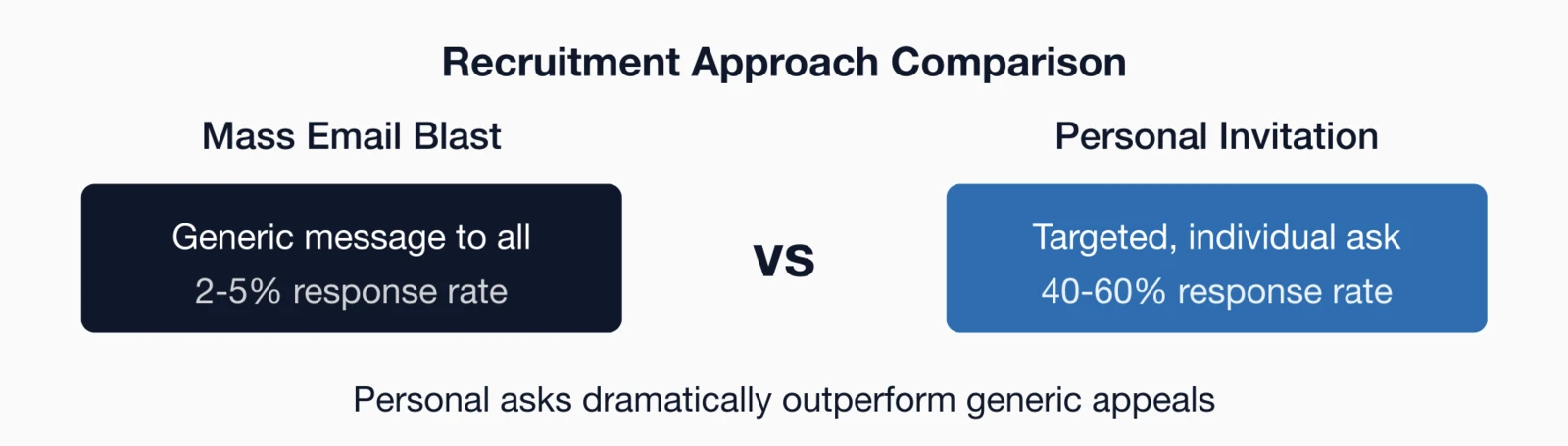
Personal invitation
The most effective recruitment technique is personal invitation from someone the prospect knows and respects. When a board member, committee chair, or staff member personally asks a member to volunteer—explaining why they'd be perfect for the role—response rates are dramatically higher than generic appeals.
Build this into your process. When you have a volunteer opening, identify 3-5 specific members who would be good fits and assign someone to personally invite each one. This takes more effort than sending an email blast, but the results justify it.
Interest forms and volunteer banks
Capture volunteer interest year-round, not just when you have openings. Include a "volunteer interests" section in your member portal where members can indicate what types of activities interest them, how much time they could commit, and what skills they bring. An association form builder
When a need arises, you have a pre-qualified pool to draw from—and you can reach out to people who have already expressed interest, making the ask much warmer.
New member onboarding
Introduce volunteer opportunities during onboarding. New members are often enthusiastic about getting involved but don't know how. A "Ways to Get Involved" section in welcome materials plants the seed; a follow-up email at 90 days—once they've gotten oriented—can prompt action.
A deeper look: Why people volunteer (and why they don't)
Understanding volunteer motivation helps you recruit more effectively. People volunteer for various reasons:
- Professional development: Learning new skills, building leadership experience
- Networking: Meeting peers, building relationships with industry leaders
- Visibility: Raising their profile within the profession
- Giving back: Contributing to a profession that's been good to them
- Influence: Shaping the direction of the organization or industry
When recruiting, tailor your pitch to what motivates the specific person you're asking. A mid-career professional might respond to leadership development opportunities; a senior leader might be motivated by legacy and giving back.
People decline volunteer opportunities for equally important reasons:
- Unclear time commitment or open-ended obligations
- Past experiences with disorganized volunteer programs
- Don't see how they'd add value or what they'd gain
- Never been asked personally
Address these barriers directly. Be specific about time expectations. Reference improvements you've made to volunteer support. Explain exactly why they're needed and what they'd get from the experience.
Defining volunteer roles
Vague volunteer roles lead to frustrated volunteers and unmet organizational needs. Every volunteer position should have clear definition before recruitment begins—not just for your benefit, but because clarity is what enables volunteers to say yes with confidence. When prospective volunteers can't understand what they're committing to, they decline or accept reluctantly and disengage quickly. Well-defined roles attract the right people, set appropriate expectations, and create the foundation for meaningful contribution.
Role description elements
| Element | What to Include |
|---|---|
| Purpose | What does this role accomplish for the organization? |
| Responsibilities | Specific tasks and deliverables expected |
| Time commitment | Hours per month, meeting frequency, peak periods |
| Term length | Start and end dates; renewal options if applicable |
| Skills/qualifications | What background or abilities are needed |
| Staff support | Who they'll work with and what support is provided |
| Benefits | What the volunteer gains from the role |
Variety of commitment levels
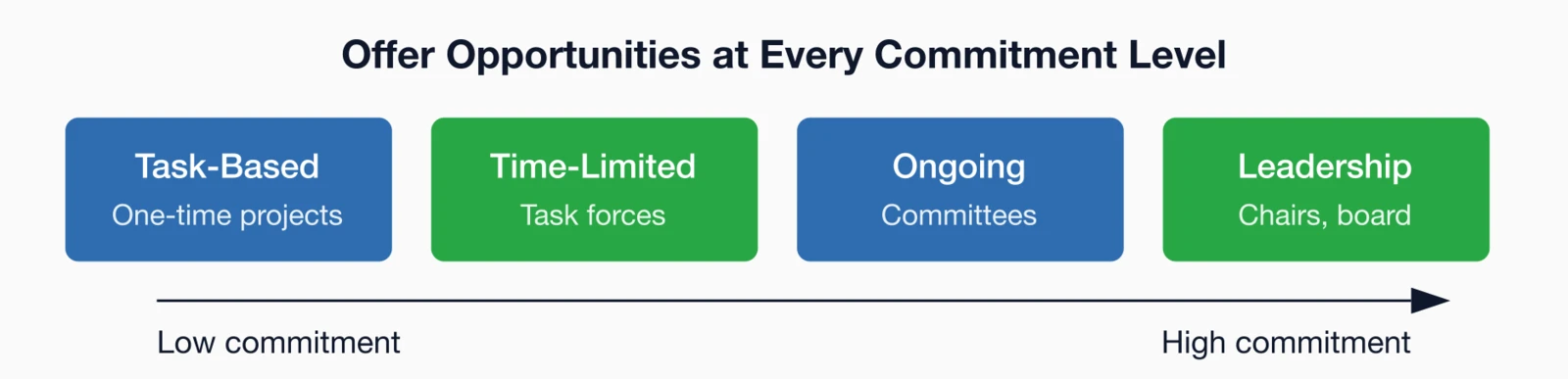
Not everyone can commit to a year-long committee role. Create opportunities at multiple levels:
- Task-based: One-time projects with defined deliverables (review a document, speak on a panel, mentor one person)
- Time-limited: Short-term task forces or working groups with end dates
- Ongoing committees: Traditional committee service with annual terms
- Leadership roles: Committee chairs, board positions, chapter leaders (see our committee management best practices)
Members who can't commit to committee service might enthusiastically contribute to a two-month task force. Give them that option.
Volunteer onboarding
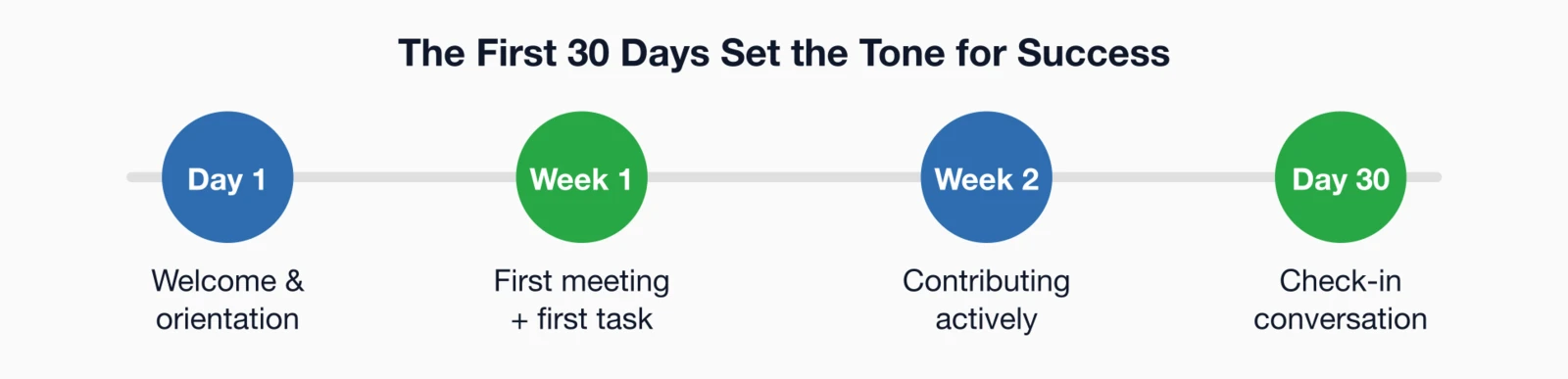
Volunteer onboarding is often neglected—we assume volunteers know what they're doing because they're professionals. This is a mistake. Even experienced volunteers need orientation to your organization's specific context, processes, and expectations. The first weeks of a volunteer's experience set the tone for their entire term. A well-designed onboarding process helps new volunteers contribute quickly, builds their connection to the organization, and prevents the confusion and frustration that lead to early disengagement.
Onboarding elements
- Organization overview: Mission, strategy, current priorities—not just the committee's work
- Role expectations: Review the role description; clarify any questions
- Key contacts: Who's the staff liaison? Who else is on the committee?
- Tools and resources: How to access shared documents, communication channels, calendars
- Historical context: What has this committee done in the past? What's been tried?
- Current projects: What's in progress? What can they jump into immediately?
First 30 days
The first month sets the tone. Ensure new volunteers:
- Attend their first meeting (or get a one-on-one briefing if timing doesn't work)
- Receive a welcome from the chair or staff liaison
- Get a specific task or contribution opportunity immediately
- Have a check-in conversation at day 30 to address questions
Common mistake: Bringing new volunteers onto a committee and then having them sit passively in meetings for months before contributing. This kills enthusiasm. Give them something meaningful to do right away, even if it's small.
Keeping volunteers engaged
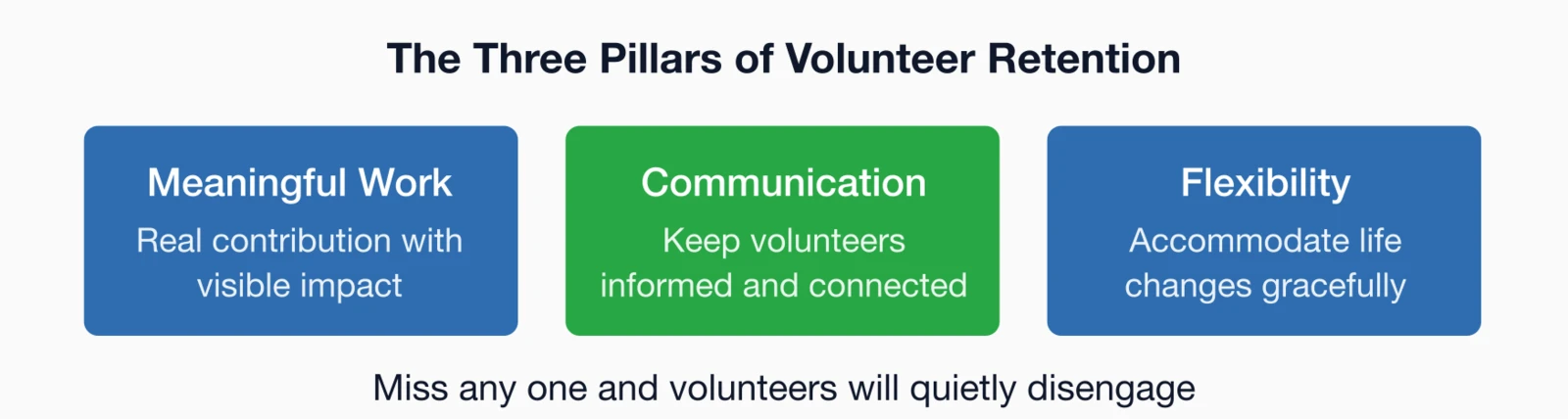
Recruiting volunteers is only half the challenge. Keeping them engaged and productive—so they complete their terms and want to continue—requires ongoing attention. Volunteers who feel their time is wasted, their contributions unappreciated, or their input ignored will quietly disengage long before their term officially ends. The associations with the strongest volunteer retention focus relentlessly on providing meaningful work, maintaining clear communication, and showing flexibility when life circumstances change.
To keep volunteers engaged, associations must move beyond busywork. As explored in Psychology Today
Meaningful work
Volunteers want to contribute, not attend meetings. If your committee meetings are primarily information-sharing with little actual work happening, volunteers will disengage. Structure work so that:
- Meetings focus on discussion and decisions, not status updates
- Work happens between meetings, with clear assignments
- Volunteers see the impact of their contributions
- Projects have clear deliverables and deadlines
Communication
Volunteers who feel out of the loop disengage. Keep them informed about:
- Organization news and developments that affect their work
- How their committee's work connects to broader strategy
- Impact of their contributions—when their work is used, recognized, or makes a difference
- Changes that affect their role or expectations
Flexibility
Life happens. Volunteers who temporarily can't fulfill their commitments should have options other than disappearing or resigning. Allow for:
- Temporary reduced involvement during busy periods
- Trading responsibilities with other committee members
- Virtual participation when travel isn't possible
- Graceful exit when circumstances change permanently
Recognition and appreciation
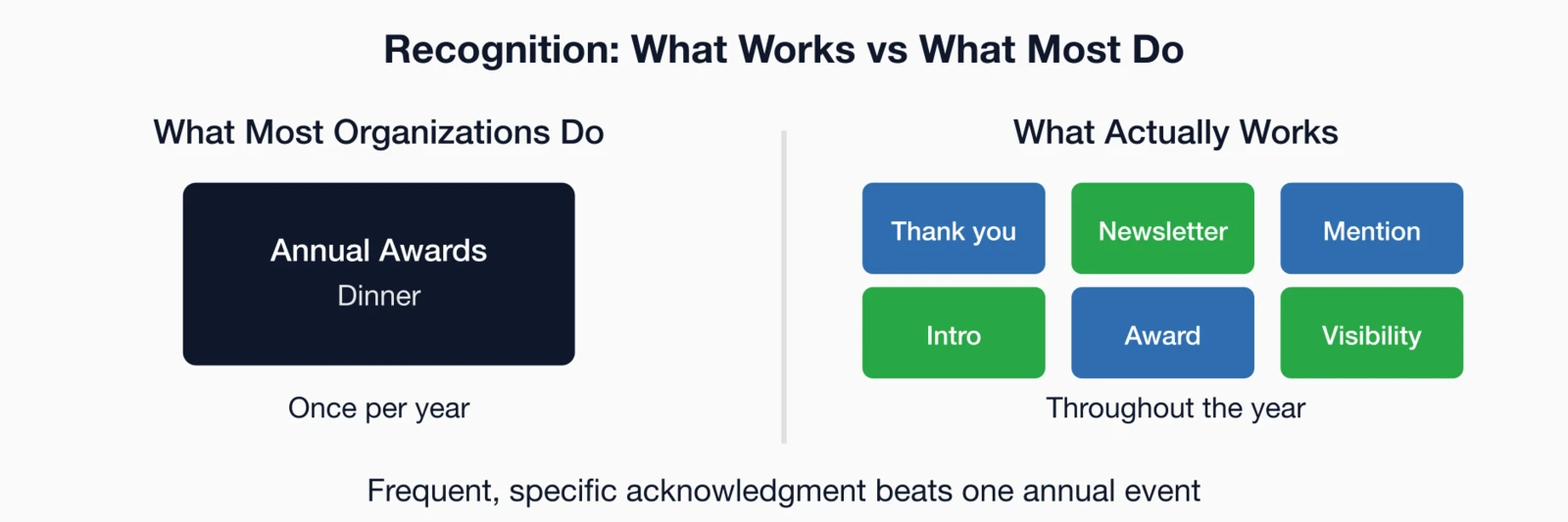
Volunteers don't expect payment, but they absolutely notice when their contributions go unacknowledged. Recognition doesn't have to be elaborate—consistency and sincerity matter more than grandeur. The associations that retain volunteers year after year have built recognition into their culture, not just their annual awards programs. They acknowledge contributions promptly and specifically, creating a pattern of appreciation that makes volunteers feel genuinely valued for their time and expertise.
Types of recognition
- Personal thanks: A note from the CEO, board chair, or committee chair acknowledging specific contributions
- Public recognition: Listing volunteers in newsletters, annual reports, and conference programs
- Event acknowledgment: Recognizing volunteers at conferences and member meetings
- Awards: Formal volunteer of the year or service awards
- Perks: Complimentary conference registration, special access, or exclusive events
- Professional visibility: Speaking opportunities, publication credits, professional recommendations
Making recognition meaningful
Generic recognition feels hollow. Make it specific:
- Reference specific contributions: "Your work on the certification review..."
- Acknowledge the sacrifice: "We know this came during your busy season..."
- Connect to impact: "Because of your input, we were able to..."
A deeper look: The thank-you that actually matters
I've observed associations spend significant budget on volunteer appreciation dinners while failing at the recognition that actually matters most: timely, specific acknowledgment of contributions.
When a volunteer completes a significant deliverable—reviews a policy document, leads a webinar, mentors a new member—they should hear "thank you" within 48 hours, ideally from someone senior in the organization. Not a generic "thanks for all you do" but a specific acknowledgment: "The policy recommendations you developed were exactly what we needed, and the board used them directly in their decision."
This kind of recognition costs nothing but takes intentionality. Build it into your processes. When a committee delivers a product, who sends the thank-you? When a volunteer speaks at a conference, who follows up to acknowledge their contribution? These moments matter more than annual awards ceremonies.
Succession and transitions
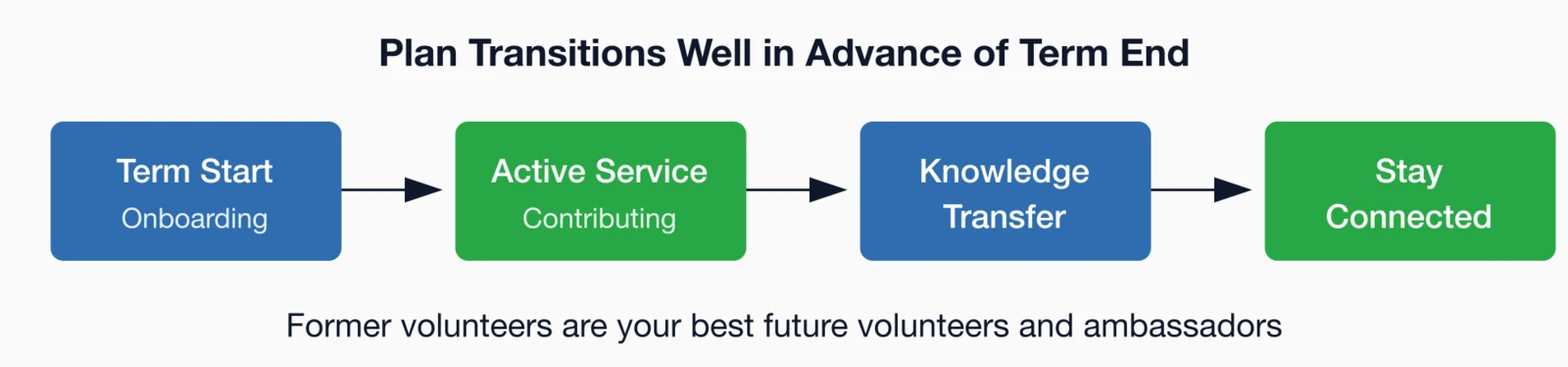
Volunteer terms should have clear endings—both to prevent burnout and to create opportunities for new volunteers. Managing transitions well protects institutional knowledge and maintains program continuity. Too many associations treat volunteer transitions as afterthoughts, losing valuable knowledge when experienced volunteers leave and leaving successors to figure things out on their own. A structured approach to succession ensures smooth handoffs, maintains organizational memory, and keeps former volunteers connected for future opportunities.
Term limits
Define term lengths for all volunteer roles:
- Committee members: 2-3 year terms, with option to extend once
- Committee chairs: 1-2 year terms, often following committee service
- Board members: 2-3 year terms with defined limits
Term limits prevent burnout, create leadership opportunities for new volunteers, and ensure fresh perspectives. They also make it easier for volunteers to say no when asked to continue—the term is ending, not "I don't want to keep doing this."
Knowledge transfer
When a volunteer's term ends, capture what they know:
- Exit conversations to discuss what worked, what didn't, and advice for successors
- Documentation of ongoing projects, key contacts, and institutional history
- Introduction between outgoing and incoming volunteers
- Overlap period where both serve together briefly
Staying connected
Former volunteers should remain engaged even after their terms end. Keep them connected through:
- Alumni recognition and events
- Invitations to contribute in smaller ways
- First consideration for future opportunities
- References and recommendations for their professional advancement
Technology for volunteer management
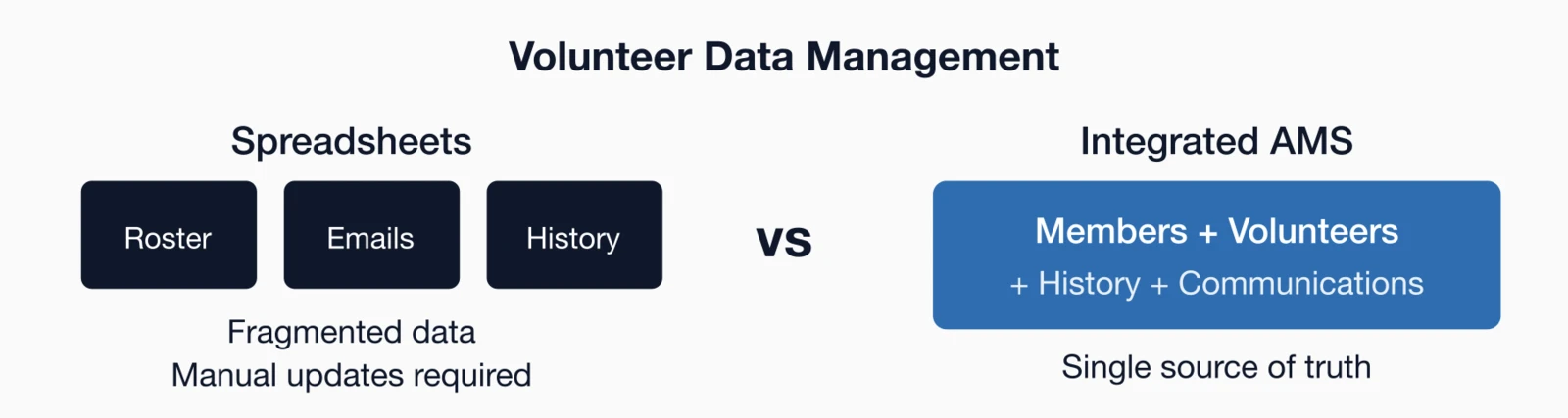
The right technology makes volunteer management easier for staff and better for volunteers. The wrong technology (or no technology) creates friction that discourages engagement. Modern volunteer management requires tracking who's serving, when their terms end, how to contact them, and what they've contributed over time. When this information lives in spreadsheets or staff memory, it becomes fragmented and unreliable. Integrated technology centralizes volunteer data alongside member records, enabling better recruitment, tracking, and recognition.
Essential capabilities
- Volunteer interest tracking: Capture and search member volunteer preferences
- Committee rosters: Track who's serving, term dates, and contact information
- Attendance tracking: Record meeting attendance and participation
- Document sharing: Central location for committee materials and resources
- Communication tools: Email lists, discussion forums, or collaboration spaces for each group
- Historical records: Past service records for recognition and reference
With an integrated membership management system, volunteer data connects to member records—so you can see engagement holistically and identify patterns between volunteer service and retention. Dedicated committee and board tracking software
Measuring volunteer impact
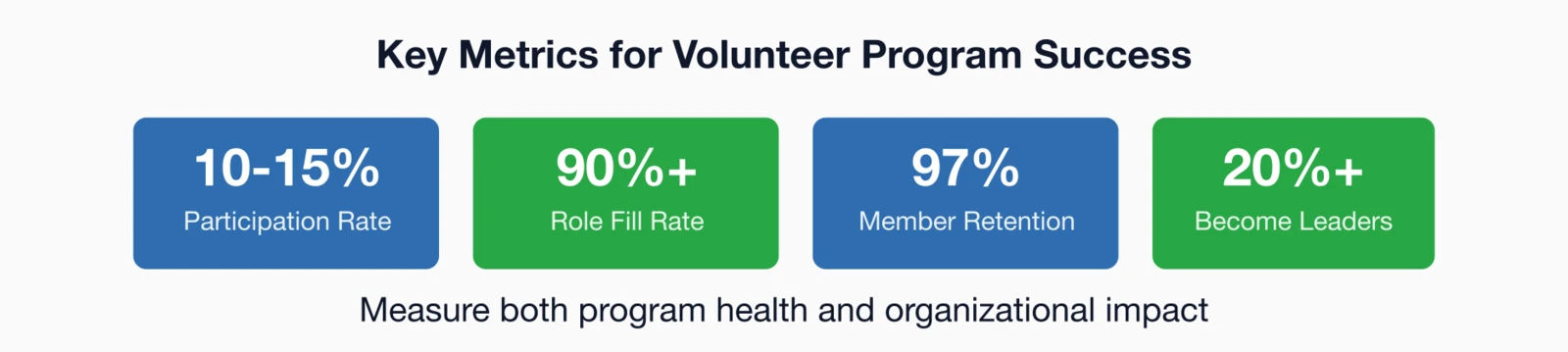
Track metrics that reflect both program health and organizational impact. Without measurement, you can't identify problems in your volunteer program or make the case for additional investment in volunteer support. The most valuable metrics connect volunteer engagement to outcomes that matter—retention rates, leadership pipeline development, and the capacity your volunteers add to what staff can accomplish alone. Here's what to track and why it matters.
Program health metrics
| Metric | What It Tells You |
|---|---|
| Volunteer participation rate | What % of members volunteer? (10-15% is typical) |
| Role fill rate | Are volunteer positions being filled? How quickly? |
| Retention rate | Do volunteers complete their terms? Do they return? |
| Satisfaction scores | Are volunteers satisfied with their experience? |
| New volunteer recruitment | Are you bringing in new volunteers or relying on the same people? |
Impact metrics
- Volunteer-to-leader conversion: How many committee volunteers eventually become chairs or board members?
- Retention comparison: Compare renewal rates of volunteers vs. non-volunteers
- Hours contributed: Quantify volunteer contribution to understand capacity extension
- Project completion: Are volunteer-led initiatives meeting their objectives?
The most important metric is retention correlation. If your volunteers renew at 97% while non-volunteers renew at 80%, that's a powerful argument for investing in volunteer recruitment. See our guide on Calculating Member Lifetime Value
Building a volunteer culture
Effective volunteer management isn't a program—it's a culture. Organizations that excel at engaging volunteers see them as essential partners in the mission, not free labor to exploit. They invest in volunteer support, respect volunteer time, and celebrate volunteer contributions visibly. Building this culture requires intentional effort and consistent attention from leadership, but the payoff is transformative for both organizational capacity and member loyalty.
The payoff is enormous. Volunteers extend your capacity. They bring expertise and credibility. They provide member perspective on your work. And they become your most loyal, long-term members—the ones who renew year after year and encourage others to join.
Start by auditing your current volunteer experience. Are roles clearly defined? Is onboarding adequate? Are volunteers getting meaningful work and appropriate recognition? The answers will point you toward your biggest opportunities for improvement.
For more on engaging members at every level, explore our Member Engagement Guide or learn about committee management best practices
Key takeaways
- Volunteers renew at near-100% rates: Volunteer engagement is the strongest predictor of long-term retention
- Meaningful work beats time commitment: Volunteers want to contribute, not attend meetings—give them real responsibilities
- Personal invitations work: Generic "call for volunteers" gets poor response; personal asks from staff or board members succeed
- Clear expectations prevent burnout: Define time commitment, term length, and responsibilities upfront
- Recognition matters more than you think: Volunteers don't expect payment, but they absolutely notice being taken for granted
Ready to Build a Stronger Volunteer Program?
i4a helps you manage volunteers alongside your member data—so you can recruit the right people, track participation, and recognize contributions that build lasting loyalty.
Let's Discuss Your Volunteer NeedsRelated resources
Committee Management Best Practices
Run productive committees that retain engaged volunteers.
Complete guide to building active, loyal communities.
How to Reduce Membership Churn
Retention strategies that keep members renewing.
Transform your membership list into an engaged community.
