Quick Summary: Win-Back Campaigns
- Win-back is cheaper than acquisition: Recovering lapsed members costs 5-25x less than acquiring new ones, with 10-20% response rates vs. 1-3% for cold prospects.
- The 30-90 day window is optimal: Members contacted within this timeframe after lapse show the highest response rates—too soon feels pushy, too late means they've moved on.
- Use a multi-touch sequence: A 5-touch campaign over 60 days—reconnect, value reminder, soft offer, strong offer, final notice—consistently outperforms single emails.
- Segment for better results: Prioritize by tenure, prior engagement level, and known lapse reasons to tailor messaging and allocate resources effectively.
- Automate for consistency: Manual campaigns get deprioritized when staff is busy; automation ensures every lapsed member receives timely, personalized outreach.
Part of our win-back campaign guide
Win-back campaigns recover lapsed members at a fraction of new acquisition costs. Here's the multi-touch sequence, timing framework, and incentive strategies that bring former members back to your association.
That's why they work so well: They already know who you are. They've already experienced your value (at least some of it). They've already made the decision to join once before. The barriers to getting them back are significantly lower than convincing a completely new prospect.
Here's what I've learned: Most associations spend far more on acquisition than win-back. I've seen associations pour $50,000 into marketing campaigns to attract new members while a database of 500 lapsed members sits untouched — members who could be recovered with a $2,000 email campaign. There's a better way.
Yet most associations treat member lapse as final. Once someone doesn't renew, they're removed from communications and effectively abandoned. This is a mistake that costs associations significant revenue.
Why win-back campaigns work
The economics of win-back campaigns are compelling—and often dramatically better than what associations spend on new member acquisition. Lapsed members already know your organization, have already made the decision to join once before, and don't require the same level of education and trust-building as cold prospects. When you understand the numbers, it becomes clear why every association should have an active win-back program.
The financial case for win-back is undeniable. Research frequently cited by Harvard Business Review suggests that acquiring a new customer costs 5-25 times more than retaining an existing one. The same principle applies to membership organizations—and win-back campaigns let you recapture that value.
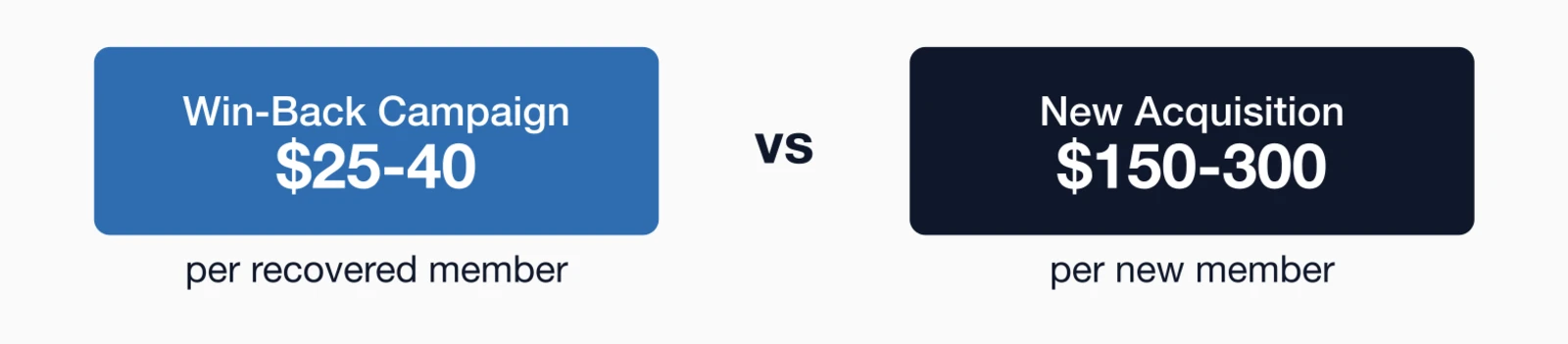
- Lower acquisition cost: You already have their contact information and history
- Higher conversion rates: 10-20% of lapsed members will rejoin with proper outreach vs. 1-3% for cold prospects
- Faster decision cycle: They don't need education about your association
- Valuable feedback: Win-back campaigns reveal why members leave, helping you fix retention issues
The key is implementing a systematic approach rather than occasional one-off emails.
Win-Back ROI Calculator
See the potential revenue from a win-back campaign vs. new member acquisition:
Based on $150-300 new member acquisition cost vs. win-back campaign cost.
Real Talk: Most Associations Give Up Too Early
I see associations that send one "we miss you" email, get a 2% response, and conclude that win-back doesn't work. That's not a failed campaign — that's an incomplete one.
The associations that get 15-20% win-back rates are running systematic multi-touch sequences with escalating offers. They're not sending one guilt-trip email; they're running a 60-90 day campaign with personalized messaging. The difference in results is dramatic.
Optimal timing strategy
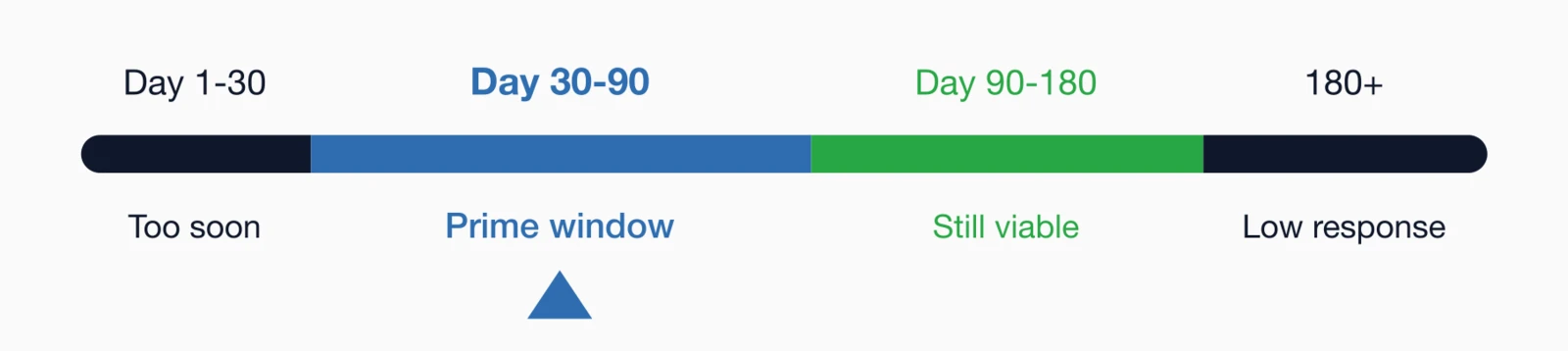
When you reach out to lapsed members matters significantly. Too soon feels pushy; too late means they've moved on mentally and emotionally. Research and experience suggest a specific timing window where response rates are highest and messages are most likely to resonate. Understanding this window helps you structure a campaign that reaches members when they're most likely to reconsider their decision.
Recommended timing framework
- Days 1-30 (Post-Lapse): Avoid aggressive outreach. They just made the decision not to renew. One gentle "we'll miss you" acknowledgment is sufficient.
- Days 30-90: Prime win-back window. Launch your main campaign sequence here.
- Days 90-180: Still viable but declining response rates. Consider stronger offers.
- 180+ days: Much lower response rates. May need "we've changed" messaging or significant incentives.
- 12+ months: Treat more like new prospect acquisition. They've been gone long enough that re-education may be needed.
Segmenting lapsed members
Not all lapsed members are equal. A first-year member who never engaged has very different recovery potential than a ten-year veteran whose company went through layoffs. Segmenting your lapsed members allows you to craft targeted messaging that addresses their specific situations, prioritize your highest-value recovery targets, and allocate resources where they'll have the greatest impact.
By tenure length
- First-year lapses: Likely never found value or had poor onboarding. Consider a fresh start approach with better onboarding promises.
- 2-5 year members: Had a reason to leave. Need to address that reason or highlight what's new.
- Long-tenured (5+ years): Life circumstances often drove the lapse. High value targets — they were loyal for a reason.
By engagement level (before lapse)
- Highly engaged (events, committees, content): Something specific changed. Worth personal outreach to understand why.
- Moderately engaged: May have felt value was slipping. Remind them of benefits they used.
- Minimally engaged: Probably never found their use case. Try a different value proposition.
By lapse reason (if known)
- Price/budget concerns: May respond to discounts or payment plans
- Career change/retirement: May need different membership category
- Didn't use benefits: Need education on what they missed
- Poor experience: Need to demonstrate improvements made
Going Deeper: Build a Win-Back Priority Score
Most associations treat all lapsed members equally. That's a mistake. Here's a simple scoring framework to prioritize your win-back efforts:
| Factor | High Score (3 pts) | Medium (2 pts) | Low (1 pt) |
|---|---|---|---|
| Tenure | 5+ years | 2-4 years | 1 year |
| Engagement | Events + content | Some activity | Minimal |
| Recency | 30-60 days | 60-180 days | 180+ days |
| Lapse Reason | Budget/timing | Unknown | Bad experience |
Priority tiers: 10-12 points = High priority (personal outreach), 7-9 = Medium (automated + phone), 4-6 = Standard (automated sequence only), 1-3 = Low (annual reactivation only)
The win-back campaign sequence
A successful win-back campaign uses multiple touches across channels—not a single "we miss you" email that gets ignored and forgotten. Here's a proven 5-touch sequence that progressively increases urgency and incentives. Each touch has a specific purpose in the overall arc of the campaign, building from relationship to value to offer.

The reconnect (day 30)
A warm, non-salesy message that acknowledges they've left and expresses genuine interest in their reason. Ask for feedback — it shows you care and provides valuable intelligence.
The value reminder (day 45)
Highlight specific benefits they used to access, new offerings they're missing, or upcoming events relevant to their interests. Make the value concrete and personal.
The soft offer (day 60)
Introduce a modest incentive — perhaps a discount on rejoining or waived administrative fees. This is also a good time for a direct mail piece that stands out from email.
The strong offer (day 75)
Your best offer. Significant discount, extended trial, bonus benefits — whatever makes sense for your association. Create urgency with a deadline.
Final notice (day 90)
Last chance messaging. After this, they move to a lower-touch "dormant" communication track. Make it clear this is their final opportunity for the special offer.
Crafting effective messaging
Win-back messaging should feel personal, not transactional. Generic "we miss you" emails get deleted; messages that demonstrate you know the member and understand their situation get read and considered. The difference between a 2% win-back rate and a 15% rate often comes down to how well you craft your messaging. These principles will help you connect authentically with lapsed members.
Acknowledge the lapse (don't ignore it)
Pretending nothing happened feels inauthentic. Acknowledge that they left and that you'd like them back.
Focus on what's new or improved
If they left because something wasn't working, show them what's changed. New programs, improved technology, expanded benefits — give them a reason to reconsider.
Personalize based on history
"We noticed you used to attend our monthly webinars" is more compelling than generic messaging. Use their engagement history from your membership platform
Create appropriate urgency
Limited-time offers work, but they must be credible. If your "last chance" offer keeps appearing, members learn to ignore it.
Your final campaign touches should leverage the psychological principle of loss aversion. According to The Decision Lab, people feel the pain of losing something about twice as strongly as they feel the pleasure of gaining it. Frame your final messages around what they're losing access to—not just what they could gain by rejoining.
Pro Tip: Include a P.S. line in your emails — it's one of the most-read parts. Use it for your strongest point or clearest call-to-action.
Incentive strategies that convert
The right incentive can significantly boost win-back conversion—but incentives should never be your first move. Start with value messaging and relationship; save financial incentives for later touches when members haven't responded to other approaches. When you do deploy incentives, structure them thoughtfully to avoid devaluing membership or creating expectations for future discounts.
- Percentage Discount (15-25%): Best for budget-conscious lapses, but don't go too high or you devalue membership
- Extended Membership (13-15 months for price of 12): Preserves price integrity while adding value
- Fee Waivers: Waive application or reinstatement fees — low cost to you, meaningful to them
- Bonus Benefits: Free event registration or premium content access
- Payment Plans: Monthly or quarterly options for cash flow concerns
Incentive best practices
- Don't lead with discounts: Start with value messaging; save incentives for later touches
- Escalate offers: Start with soft incentives, increase if needed
- Set clear expirations: Open-ended offers lack urgency
- Track what works: A/B test different incentive types and amounts
Automating your win-back program
Manual win-back campaigns are inconsistent and labor-intensive. When staff gets busy, win-back efforts get deprioritized, and lapsed members slip further away. Automation ensures every lapsed member receives the same quality outreach regardless of staff workload, and it removes the burden of remembering to trigger campaigns at the right time. A well-automated win-back program runs continuously in the background, recovering members without constant attention.
Your association management platform should enable:
- Automatic trigger: Campaign launches X days after membership lapse
- Suppression rules: Stop sequence if member rejoins or unsubscribes
- Personalization tokens: Insert member name, past engagement data, specific benefits
- Multi-channel orchestration: Coordinate email, direct mail, and phone touchpoints
- Performance tracking: Report on open rates, click rates, and conversion by touch
How i4a Helps: i4a's email marketing tools
The Hidden Reason Your Win-Back Program Is Broken
Here's something most associations don't realize: if your AMS charges per-contact or per-member, you're being penalized for keeping lapsed member data. Some associations actually delete lapsed member records to save on AMS costs.
Think about that. Those records are your most valuable asset for win-back campaigns. Deleting them to save $2/contact means losing $250/member in potential recovered dues.
This is one reason i4a uses flat-rate pricing with unlimited members. Keep all your historical data. Run all your win-back campaigns. Never make a business decision based on your AMS pricing model penalizing member retention.
Measuring campaign success
Track these metrics to evaluate and improve your win-back efforts over time. The associations that achieve the best win-back rates don't just launch a campaign and hope for results—they measure, test, and refine based on data. Understanding which touches convert and which incentives resonate allows you to optimize your program for increasingly better performance.
To gauge your success, compare your results against real-time data. Current Constant Contact benchmarks
- Win-Back Rate: Target 10-20% of lapsed members contacted
- Email Open Rate: Target 25-35% for win-back emails
- Click-Through Rate: Target 3-8% clicks to rejoin page
- Cost Per Win-Back: Should be less than 25% of annual dues
- Second-Year Retention: Track if won-back members renew again (target 70%+)
Getting started
You don't need a perfect campaign to start recovering lapsed members. Begin with these steps:
- Identify your lapsed member pool — How many members lapsed in the past 12 months?
- Segment by recency — Prioritize the 30-90 day lapsed members first
- Create a simple 3-email sequence — You can expand later
- Define one clear offer — Keep it simple to start
- Set up tracking — Know how many rejoin from your efforts
For more on preventing lapses in the first place, see our guide on reducing membership churn and our comprehensive Membership Retention Strategy Guide
Key takeaways
- Win-back campaigns typically recover 10-20% of lapsed members when done well
- Timing matters: Contact lapsed members 30-90 days after lapse for best results
- Segment your lapsed members by tenure, engagement level, and lapse reason
- Use a 3-touch minimum: Initial outreach, value reminder, final offer
- Automate the sequence in your AMS for consistent execution
Automate Your Win-Back Campaigns
i4a's AMS includes automated win-back sequences that trigger based on lapsed member status—no manual tracking required. Segment your lapsed members, personalize your messaging, and track your success rates all in one platform.
See How Win-Back Automation WorksRelated resources
Complete 2026 strategy guide for improving retention across the entire member lifecycle.
Proven tactics to identify at-risk members and prevent churn before it happens.
Complete guide to renewal automation that reduces churn and saves staff time.
Complete 90-day framework to turn new members into engaged advocates.
