Quick Summary: Young Professional Engagement
- 47% of associations haven't adapted: While Millennials represent 25% of members and Gen Z 11%, nearly half of associations haven't modified engagement strategies for younger generations.
- Career advancement drives decisions: Young professionals join for skills, credentials, and connections that advance their careers—abstract "community" benefits resonate less at this career stage.
- Price barriers are real: Entry-level salaries and student debt make dues feel like a luxury; graduated pricing and payment plans help.
- Mentorship drives exceptional retention: Personal relationships with experienced members make membership feel irreplaceable.
- Digital experience signals relevance: Clunky websites and outdated technology suggest an organization that isn't relevant to their world.
Part of our member engagement strategies guide
Young professional member engagement requires different strategies than established members—many associations haven't adapted for younger generations, yet Millennials and Gen Z are a growing share of the workforce. Here's how to attract and retain the next generation.
And that concern is legitimate: If your average member age increases by one year every year, you're not replacing members who age out or leave the profession. Eventually, you have a membership crisis.
But here's what I've also observed: associations that struggle to engage young professionals often aren't failing at marketing—they're failing at delivering value that resonates with early-career professionals. They're offering what their current (older) members value, not what the next generation needs. Modern online community features can help bridge this gap by creating the digital-first experiences younger members expect.
This guide explores how to genuinely engage young professionals—not just recruit them, but retain them and develop them into the next generation of association leaders. Whether you're a professional association or an education organization, these strategies will help you build a sustainable pipeline of engaged younger members.
The young professional challenge
The generational composition of associations is shifting rapidly, and the implications for organizational sustainability are significant. Associations that fail to attract and retain early-career professionals will find their membership aging, their leadership pipeline empty, and their relevance declining. Understanding the scope of this challenge—and why traditional approaches often fail—is the essential first step toward developing strategies that actually work.

The generational composition of associations is shifting rapidly. According to the 2025 Membership Marketing Benchmarking Report from Marketing General Inc.:
- Baby Boomers: 27% of members (born 1946-1964)
- Gen X: 29% of members (born 1965-1980)
- Millennials: 25% of members (born 1981-1996)
- Gen Z: 11% of members (born 1997-2012)
Yet 47% of associations haven't modified their recruitment or engagement strategies for different generations. That gap represents both a challenge and an opportunity.
Let's be honest about the challenges associations face with young professional engagement:
Why young professionals don't join
- Cost concerns: Entry-level salaries and student debt make dues feel like a luxury
- Unclear value: They don't see how membership advances their immediate career goals
- Time constraints: Early career often means long hours with little flexibility
- Digital alternatives: Professional social networks, video platforms, and free online content compete for attention
- Culture mismatch: Association events and communications feel oriented toward older professionals
- Employer decisions: Young employees often don't control professional development budgets
Why young professionals leave
- Didn't find community: Joined but never connected with anyone
- No immediate value: Benefits didn't help with day-to-day work challenges
- Felt excluded: Events and conversations centered on senior professionals
- Career changed: Job transitions disrupted connection to the profession
- Forgot they joined: Low engagement meant renewal wasn't a priority
Understanding these barriers is the first step to addressing them. Too many associations try to solve young professional engagement with a discount code and a "student/young professional" membership tier—without changing anything else about what they offer or how they communicate.
What young professionals expect
Young professionals aren't a monolith, but research and experience reveal consistent patterns in what they value. Their expectations have been shaped by consumer experiences—seamless digital tools, personalized recommendations, and on-demand access to everything. They're also navigating career uncertainty, financial pressure, and information overload in ways previous generations didn't face at the same career stage. Meeting their expectations requires understanding these patterns and adapting accordingly.
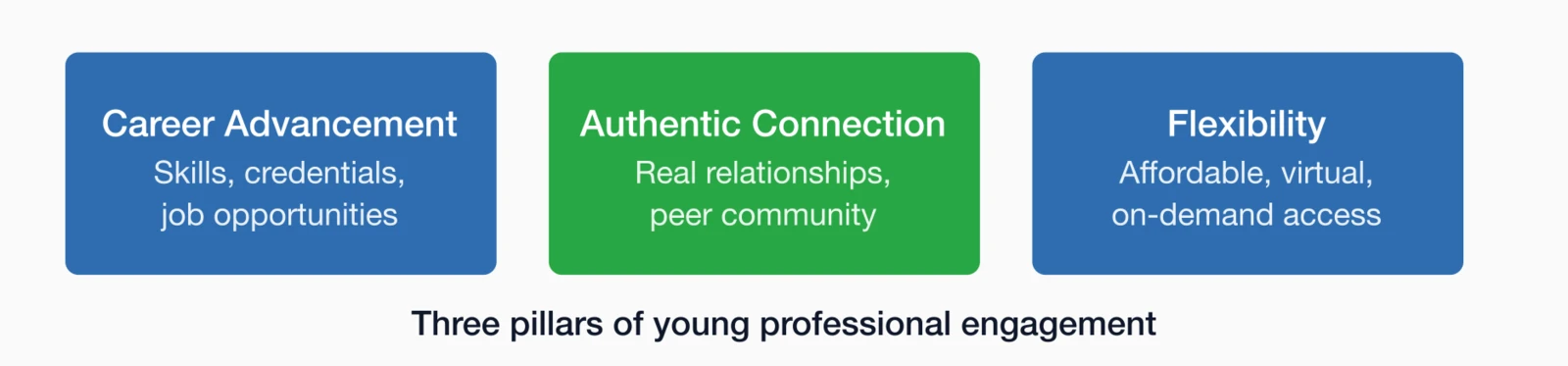
Career advancement
This is the primary driver. Young professionals join associations that help them:
- Build skills employers value
- Make connections that lead to opportunities
- Gain credentials that enhance their resume
- Find mentors who can guide their careers
- Access job opportunities through member networks
Abstract benefits like "supporting the profession" and "belonging to a community" matter less until they've established themselves. Career advancement is concrete and immediate.
Authentic connection
Young professionals want real relationships, not networking theater. They can spot performative community-building from a mile away—forced mixers, empty slogans, and "engagement" that goes nowhere. What they're actually looking for is connection that feels human and earned. That means:
- Authentic relationships built over time, not transactional exchanges or one-off introductions
- Shared purpose or craft, where people come together around real work, learning, or impact—not just titles
- Psychological safety, where they can ask questions, admit uncertainty, and grow without posturing
- Access to mentors and peers who are genuinely invested, not just collecting contacts
- Consistency and continuity, so community isn't something you "drop into" once, but something you belong to
- Reciprocity, where giving and receiving support is mutual and visible
- Honesty about value, with clear reasons to show up beyond vague promises of "networking"
In short, they want communities that do something together, not stages where everyone is performing connection.
Flexibility and accessibility
Young professionals' lives are often far less structured—and far more volatile—than those of established professionals. Early-career stages are defined by experimentation, transition, and constraint, which means traditional, rigid models of engagement don't fit. To be relevant, organizations and communities must meet them where they are:
- Frequent job changes: Career mobility is the norm, not the exception. Association involvement should be tied to the individual, not the employer, so participation and benefits travel with them across roles, industries, and organizations.
- Demanding and irregular schedules: Long hours, side projects, caregiving responsibilities, and unpredictable workloads make fixed meeting times and heavy time commitments unrealistic. Engagement options need to be flexible—offering asynchronous participation, multiple time slots, and varying levels of involvement.
- Tight financial realities: Student loans, rising housing costs, and early-career salaries limit discretionary spending. Pricing, dues, and event fees must reflect this reality, with transparent value, tiered options, and low-barrier ways to participate without financial pressure.
- High geographic mobility: Relocation for jobs, remote work, or life changes is common. Virtual and hybrid options aren't "nice to have"—they're essential for continuity, inclusion, and sustained engagement regardless of location.
Ultimately, flexibility and accessibility signal respect. They show early-career members that the community understands their constraints and is designed to support their lives as they actually are—not as legacy structures assume them to be.
Crafting your value proposition
Your value proposition for young professionals should be different from your general membership pitch. Speak to their specific needs and circumstances in language that resonates with where they are in their careers—not where your established members are. The messaging that convinces a 25-year veteran to renew won't convince a recent graduate to join. Getting this right requires understanding both what to emphasize and what to deliberately de-emphasize in your young professional marketing.
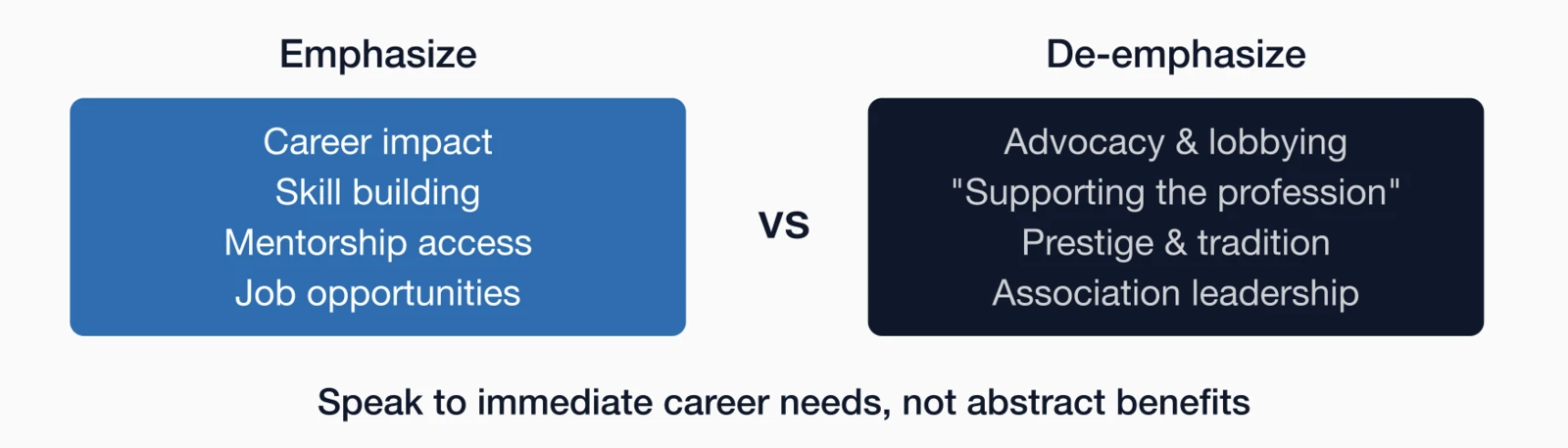
What to emphasize
- Career impact: "Members advance faster than non-members" (if you have data)
- Skill building: Specific competencies they'll develop
- Mentorship: Access to experienced professionals who can guide them
- Peer network: Connect with others at the same career stage
- Job opportunities: Job boards, referral networks, career resources
- Credentials: Certifications that enhance employability
What to de-emphasize
These matter to established professionals but may not resonate with early-career members:
- Industry advocacy and lobbying
- Supporting "the profession"
- Prestige and tradition
- Leadership at the association level (too distant from where they are)
A deeper look: Speaking their language
I've reviewed marketing materials from dozens of associations trying to attract young professionals. Most make the same mistake: they describe benefits in abstract terms that don't connect to concrete outcomes.
"Access to a professional network" doesn't mean much to someone who hasn't experienced the power of professional networks. "Build skills that advance your career" is better—but "Learn the negotiation techniques that helped members increase their salaries by an average of 15%" is better still.
Young professionals are skeptical of marketing language. They've been marketed to their entire lives and have developed strong filters. Claims without evidence get ignored. Specificity and proof points break through.
The most compelling marketing for young professionals often comes from young professionals themselves. Testimonials from early-career members about specific ways the association helped them—"I landed my current job through a connection I made at the regional meetup"—carry more weight than anything staff writes.
Pricing and accessibility
Pricing is a genuine barrier for many young professionals. Student loans, entry-level salaries, and lack of employer support create real financial constraints that differ fundamentally from established professionals' situations. But price resistance also often reflects unclear value—not just inability to pay. The associations that succeed with young professionals address both the genuine financial barriers and the value perception challenges with thoughtful strategies.

Pricing strategies
- Graduated pricing: Lower rates for first 3-5 years of membership that increase as careers progress
- Student transitions: Discounted rates for recent graduates joining within 1-2 years of graduation
- Employer payment options: Make it easy for employers to pay; provide justification templates
- Payment plans: Monthly payment options reduce the barrier of annual lump sums
- Scholarship programs: Funded by senior members or sponsors for those with genuine financial need
Value demonstration
Price resistance often reflects unclear value, not inability to pay. Someone paying $60/month for streaming services can afford $200 annual dues if they see the value. Focus on demonstrating concrete ROI:
- Calculate the value of included benefits (CE credits, event discounts, resources)
- Share salary data showing member vs. non-member career trajectories
- Highlight success stories of young professionals who attribute career progress to membership
Pricing insight: Many associations find that young professionals who start at discounted rates transition to full dues rates successfully—if they've actually engaged during those early years. The discount buys time to demonstrate value; engagement locks in retention.
Engagement tactics that work
Getting young professionals to join is only the first challenge. Keeping them engaged requires intentional programming and community-building that addresses their specific needs while also creating bridges to the broader membership. The goal isn't to create a separate, siloed young professional experience—it's to welcome them into the full association community while respecting their unique circumstances and interests.
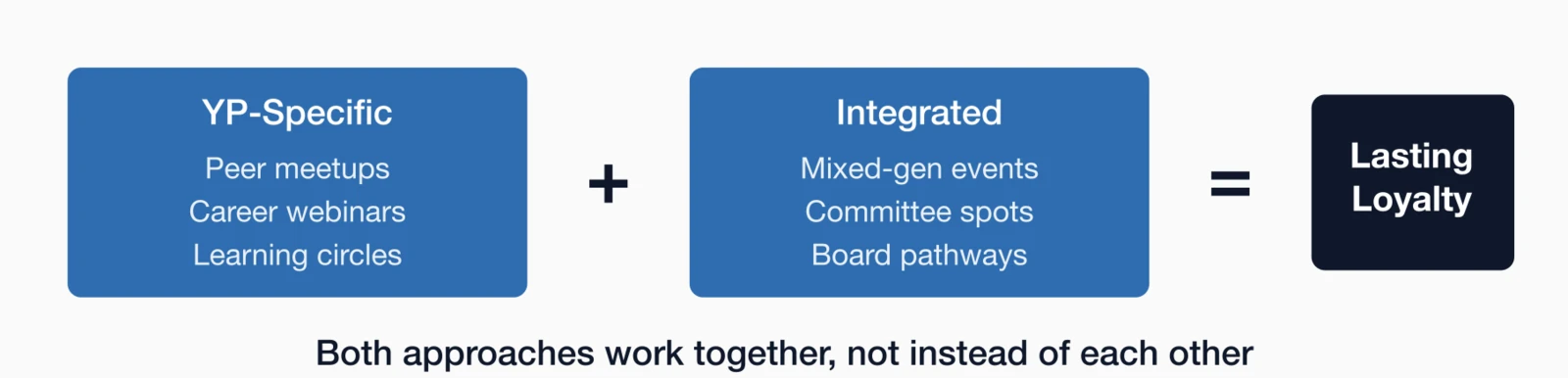
Young professional-specific programming
- Early-career webinars: Topics like salary negotiation, career planning, transitioning from school to work
- Young professional meetups: Networking events specifically for early-career members
- Peer learning circles: Small groups of young professionals supporting each other
- Career-focused content: Blog posts, podcasts, videos addressing their challenges
Integration with broader community
Separate young professional programming is important, but so is integration with the broader membership:
- Mixed-generation events: Create opportunities for cross-generational connection
- Young professional voices: Include early-career perspectives in conference panels and publications
- Committee participation: Reserve spots on committees for young professionals
- Board pathways: Clear routes from young professional engagement to governance roles
Onboarding that works
New member onboarding is especially critical for young professionals who may not understand how associations work:
- Explain what the association does and how to get value from membership
- Connect them with other young professionals immediately
- Invite them to upcoming events with personal outreach
- Check in at 30 and 90 days to ensure they're finding their footing
Mentorship programs
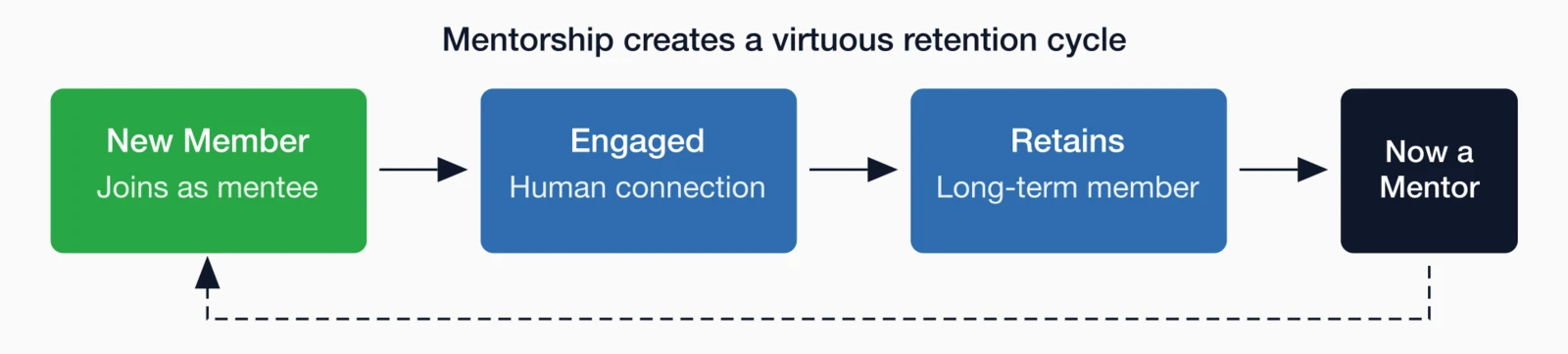
Mentorship is perhaps the most powerful tool for young professional engagement. It delivers exactly what they're looking for—guidance from experienced professionals—while creating connection that drives retention. Done well, mentorship programs benefit both mentees and mentors, creating multigenerational bonds that strengthen the entire association. The associations with the strongest young professional retention almost always have robust mentorship programs.
Structured vs. informal mentorship
| Structured Program | Informal Facilitation |
|---|---|
| Formal matching process | Enable connections through directory and events |
| Defined time commitment | Organic relationships develop naturally |
| Program guidelines and support | Lower administrative burden |
| Measurement and evaluation | Harder to track outcomes |
| Higher commitment barrier | Lower commitment barrier |
Many associations find success with a hybrid approach: a formal program for those who want structure, plus facilitation of informal connections through events, the member directory, and online communities.
Program design elements
- Clear expectations: How often pairs should meet, what topics to cover, time commitment
- Matching criteria: Career interests, geography, personality—various approaches work
- Support resources: Conversation guides, check-ins, issue resolution
- Time limits: 6-12 month programs work better than open-ended commitments
- Feedback collection: Evaluate satisfaction and outcomes to improve the program
A deeper look: Why mentorship drives retention
The retention impact of mentorship programs goes beyond the obvious value to mentees. When a young professional has a personal relationship with an experienced member, several retention factors activate:
First, they have a human connection to the association, not just a transactional relationship. Letting membership lapse means disconnecting from someone who has invested in them—a much harder decision than canceling a subscription.
Second, mentees often become mentors themselves as their careers progress. The program creates a cycle where engagement deepens over time rather than fading.
Third, mentors themselves often report that mentoring is one of the most rewarding aspects of their membership. It's not just a benefit for young professionals—it's a benefit for established members who want to give back.
The associations I've seen with strongest young professional retention almost always have robust mentorship programs. It's one of the highest-ROI investments you can make.
Leadership pathways
Young professionals who can see a path from member to leader become long-term members. Those who feel shut out of leadership circles eventually leave. Creating visible, accessible pathways to leadership communicates that young professionals are valued not just as members today but as the leaders of tomorrow. This investment in their development builds the loyalty and commitment that translates into decades of membership.
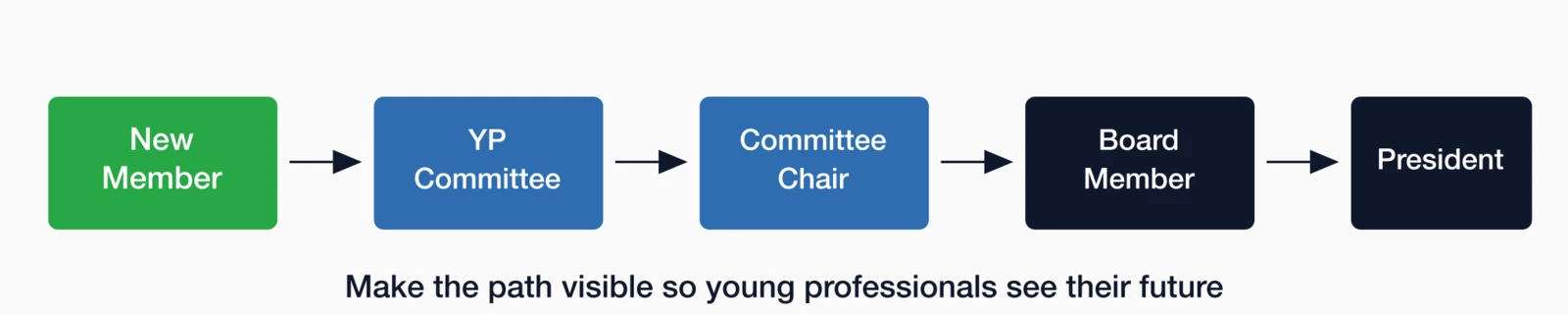
Creating visible pathways
- Young professional committee: A committee run by and for young professionals
- Reserved committee spots: Require young professional representation on standing committees
- Leadership training: Programs that develop young professionals for future leadership roles
- Board pathway communication: Make clear how people progress to governance positions
- Young professional board seat: Some associations reserve a board position for early-career members
Avoiding common pitfalls
- Token inclusion: One young professional on a committee dominated by senior members doesn't create genuine inclusion
- Seniority requirements: If board service requires 15+ years of membership, you've told young professionals leadership isn't for them
- Cultural barriers: Are meetings at times young professionals can attend? Is discussion welcoming of new voices?
Digital experience expectations
Young professionals have grown up with seamless digital experiences. They have low tolerance for clunky websites, difficult-to-navigate portals, and outdated technology—and they often interpret poor digital experiences as a signal about organizational relevance overall. Your technology is a proxy for your association's modernity and competence. Meeting these expectations isn't optional; it's table stakes for engaging the next generation.

Digital expectations
- Mobile-first: Everything should work on a phone, including registration, community, and content
- Modern design: Dated design signals a dated organization
- Easy navigation: Don't make them hunt for information or click through multiple pages
- Fast performance: Slow sites get abandoned
- Intuitive processes: Join, renew, register—all should be simple
Communication preferences
- Email remains important: But subject lines and content must earn attention
- Social media presence: Be where they already are
- Texting/SMS: For event reminders and time-sensitive communications
- Community platforms: Real-time chat channels or discussion forums for ongoing engagement
- Video content: Younger audiences consume video heavily; consider podcasts and video platforms
Digital signal: Your technology is a proxy for organizational relevance. If your website looks like it was built in 2010, young professionals wonder if your content and community are equally outdated. Investment in modern association management software signals that your organization is current and forward-thinking.
Measuring young professional engagement
Track metrics specific to young professional engagement to understand what's working and where to invest. Without dedicated measurement, young professional initiatives get launched with enthusiasm and then fade—because there's no data showing impact and no accountability for results. The associations that succeed with young professionals treat it as a strategic priority with the same rigor and measurement discipline they apply to other key objectives.
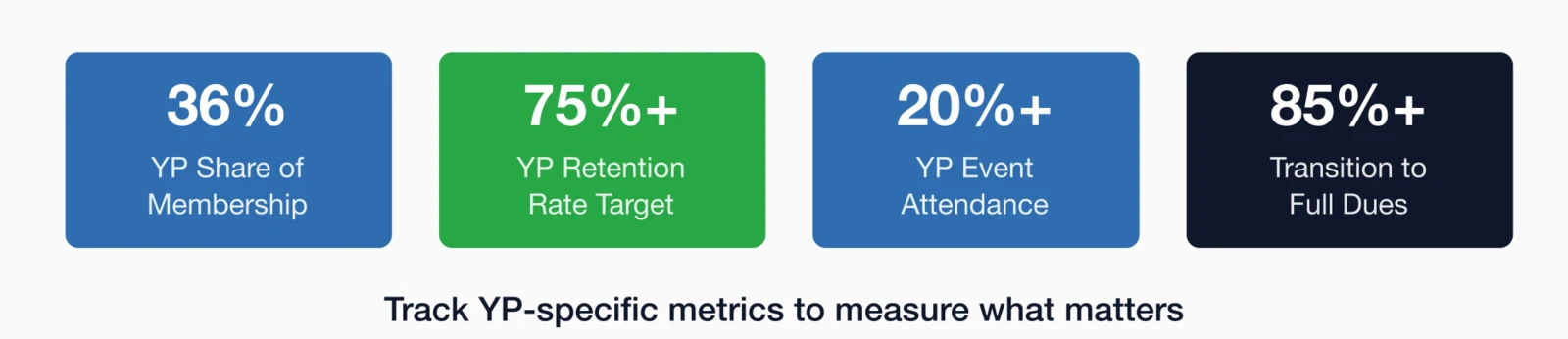
Key metrics
| Metric | Why It Matters |
|---|---|
| Young professional % of membership | Are you attracting the next generation? |
| Young professional retention rate | Are you keeping them? (Often lower than overall) |
| Conversion from student to professional | Are student members transitioning when they graduate? |
| Event participation by age | Are young professionals attending? |
| Volunteer/committee participation | Are young professionals getting involved? |
| Mentorship program enrollment | Is mentorship reaching its potential? |
| Transition to full dues | Are discounted members graduating to regular pricing? |
Segment analysis
Don't just track overall numbers—segment your young professional data:
- Compare engagement levels between those who use mentorship vs. those who don't
- Track which recruitment sources produce the most engaged young professionals
- Identify which benefits young professionals actually use
- Survey young professionals specifically about satisfaction and needs
Investing in your association's future
Young professional engagement isn't just about today's membership numbers—it's about the long-term sustainability of your organization. Today's young professionals are tomorrow's committee chairs, board members, and association champions.
The associations that succeed with young professionals take their needs seriously. They offer relevant value, not just discounted dues. They create genuine community, not token inclusion. They invest in mentorship and leadership development. And they deliver modern digital experiences that meet expectations.
This takes sustained investment. Young professional programs that launch with enthusiasm and fade away do more harm than good—they teach young professionals that they're not a priority. Commit to the long haul.
The payoff is an association that renews itself each generation, with fresh perspectives, expanding capacity, and continued relevance to the profession it serves.
For more on engaging all members, explore our Member Engagement Guide
Key takeaways
- Generational shift is real: According to the 2025 MGI Report, Millennials now represent 25% of association members, Gen Z 11%, while Baby Boomers make up 27%
- Price sensitivity is real: Early-career professionals have student loans and entry-level salaries; pricing must reflect that
- Digital expectations are high: Clunky websites and outdated technology signal an organization that isn't relevant to their world
- Most associations aren't adapting: 47% of associations haven't modified strategies for different generations—a missed opportunity
- Create leadership pathways early: Young professionals who see a path to involvement become long-term members; those who feel shut out leave
Ready to Engage the Next Generation?
i4a provides the modern member portal, online community, and flexible pricing tools that help associations attract and retain young professionals—all in one integrated platform.
Let's Talk About Young Professional EngagementRelated resources
Complete guide to building active, loyal communities.
Strategies for Building a Thriving Member Community
Strategies for fostering connections across generations.
Set new members up for long-term engagement.
Proven strategies to improve retention across member segments.
