Quick Summary: Association Email Marketing
- Email outperforms all channels: 51% of associations rate email as their most effective recruitment channel—more than events, calls, or conferences combined.
- Segment for relevance: Stop sending the same message to everyone; segment by career stage, engagement level, tenure, or interests to dramatically improve performance.
- Automate essential sequences: Welcome series, renewal reminders, and event follow-ups should run automatically—saving staff time and ensuring consistent touchpoints.
- Fix deliverability first: Configure SPF, DKIM, and DMARC authentication; clean your list quarterly; remove inactive subscribers to protect your sender reputation.
- Measure clicks, not just opens: Open rates are increasingly unreliable; focus on click-through rates, conversions, and revenue per email for actionable insights.
Email as your most valuable marketing asset
Email remains the single most effective digital communication channel for associations. Yet despite its proven ROI, many organizations struggle with declining open rates, poor deliverability, and campaigns that fail to drive member action.
After three decades of helping associations communicate with their members, I've watched channels come and go—from print newsletters to social media platforms that promised to change everything. Here's what I've learned: email isn't just surviving, it's thriving. Why? Because it's the one channel you actually own.
The data confirms email's dominance: according to MGI's 2025 Membership Marketing Benchmarking Report, 51% of associations rate email as their most effective channel for new member recruitment—more than events, personal calls, or conferences combined. Yet despite this, 61% of associations still don't personalize their renewal notices, leaving significant engagement and retention gains on the table.
Here's the challenge: 52% of lapsed members cite "lack of engagement with the organization" as their reason for not renewing. That means every email you send—or don't send—directly impacts your bottom line. This comprehensive guide provides the strategic framework your association needs to transform email from a routine communication tool into a powerful engine for member engagement, event registration, and revenue generation. The right association management system makes implementing these strategies straightforward.
Deep Dive: Member Communications Best Practices
Why email still matters for associations
Despite the proliferation of communication channels, email continues to outperform social media, direct mail, and phone outreach for association communications. Your annual conference may get all the attention, but loyalty is actually built between events—and that battle is won or lost in the inbox.
I see this pattern consistently: associations invest heavily in their annual conference, then go quiet for months. When renewal time comes, members struggle to remember what value they received. Email bridges that gap. It keeps your association top-of-mind during the 355 days between conferences.
Rate email as most effective recruitment channel
Use email as primary renewal method
Meaningful interactions needed per year outside events
Association-specific advantages
Here's why email works so well for associations specifically:
- Direct ownership: Unlike social media followers, you own your email list and aren't subject to algorithm changes
- Professional context: Members expect and welcome professional emails during work hours
- Measurable engagement: Track opens, clicks, and conversions with precision
- Personalization at scale: Deliver tailored content to thousands of members simultaneously—see how membership platforms enable this
- Automation efficiency: Set up once, deliver value continuously
Email strategy varies by organization type. Professional associations often send individual-focused content like career resources and certification updates. Trade associations may need to communicate with both organizational contacts and their member companies' employees. Membership nonprofits balance member communications with donor engagement and advocacy campaigns.
Essential email types for associations
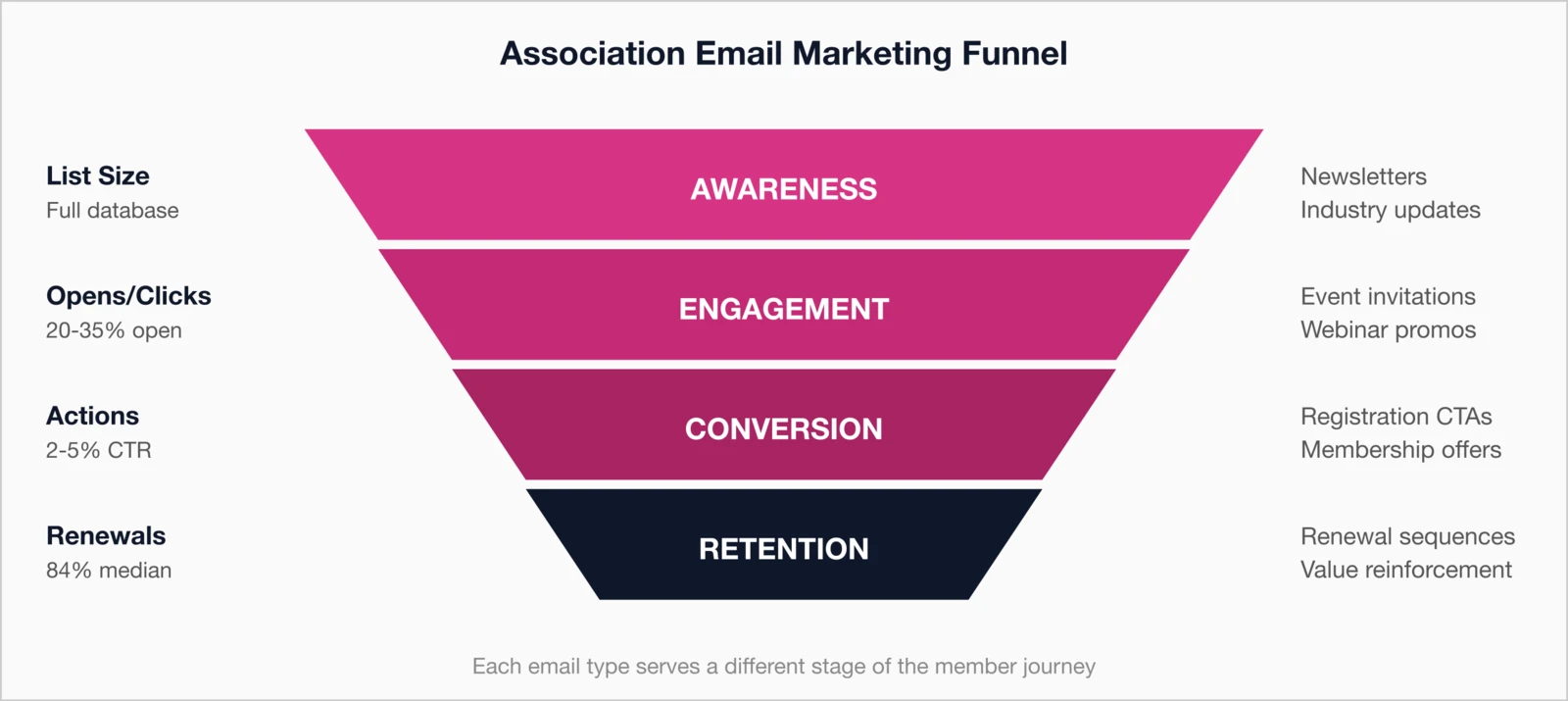
Successful association email programs incorporate multiple email types, each serving a specific purpose in the member journey. According to MGI's 2025 Association Outlook Report, 77% of associations emphasize networking opportunities and 64% emphasize access to specialized information—your emails need to deliver on those value propositions consistently.
1. Newsletters
The cornerstone of member communication. Newsletters should:
- Publish on a consistent schedule (weekly, bi-weekly, or monthly)
- Curate the most relevant industry news and association updates
- Balance educational content with promotional messages (80/20 rule)
- Include clear sections for easy scanning
- Feature member spotlights and success stories
Deep Dive: Association Newsletter Tips & Best Practices
2. Event promotion sequences
Multi-touch campaigns for conferences, webinars, and local events. This matters more than ever: according to MGI's benchmarking data, only 53% of associations report stable or rising in-person event attendance—down from 62% in 2023.
- Save the date: 8-12 weeks before event
- Early bird announcement: 6-8 weeks before
- Speaker/agenda highlights: 4-6 weeks before
- Registration deadline: 2 weeks before
- Final reminder: 1 week before
- Last chance: 2-3 days before
3. Renewal & retention emails
Critical for maintaining membership levels. First-year retention is the strongest predictor of long-term success—but the median first-year renewal rate is just 75%. That means one in four new members doesn't return.
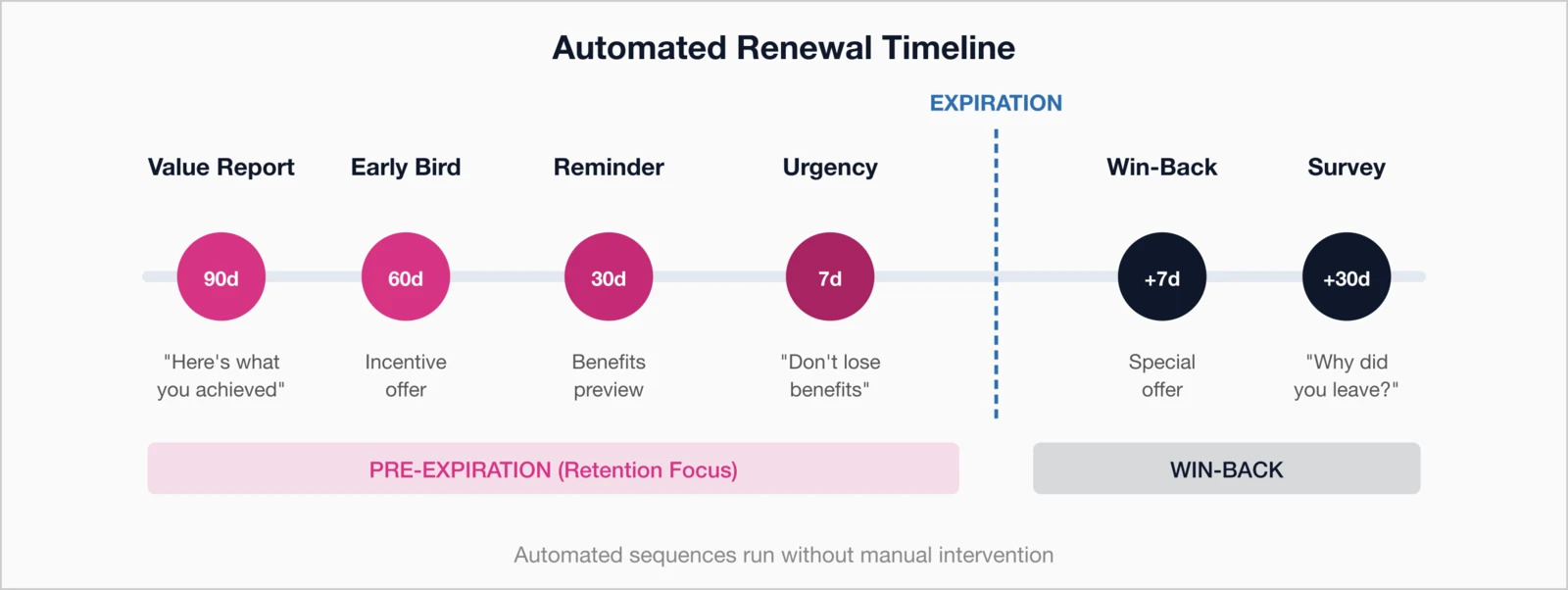
- 90-day pre-renewal value summary
- 60-day renewal reminder with benefits recap
- 30-day deadline notice
- Expiration day urgent reminder
- Lapsed member win-back series (30, 60, 90 days post-lapse)
4. Welcome & onboarding series
Set the foundation for long-term engagement. Only 25% of associations initiated new member onboarding programs in the past year—a missed opportunity to combat that 75% first-year renewal rate. In my experience, the first 30 days after joining are make-or-break. Members who engage early stay longer.
- Immediate welcome with login credentials
- Day 3: Benefits overview and quick wins
- Day 7: Community introduction and engagement opportunities
- Day 14: First event or webinar invitation
- Day 30: Feedback request and deeper engagement prompt
5. Transactional emails
Transactional emails are tied to a specific action a member just took, which makes them some of the most trusted and frequently opened messages in your entire program. Because members expect and rely on them, they are a prime opportunity to reinforce value, reduce support issues, and gently invite deeper engagement.
Unlike marketing emails, transactional messages must primarily deliver the information the member requested—such as a receipt or password reset—but you can still layer in helpful links, reminders, and light next steps without turning them into promotions.
Why transactional emails matter
- Very high open rates: Transactional emails commonly see open rates far above typical marketing campaigns because recipients are actively waiting for them.
- Member trust moments: These messages confirm that an action worked (payment, registration, password reset), which is critical for confidence in your systems and staff.
- Built-in engagement surface: Since members are paying attention, small, relevant prompts (like "view your benefits" or "add this to your calendar") can drive extra clicks and conversions.
Key transactional email types
Payment Confirmations
Payment receipts reassure members that their transaction went through and provide a clear record for their finances or employer reimbursements.
Essentials: Amount paid, what it covers (e.g., membership term, event name), billing details, and contact info if something looks wrong.
Engagement add-ons: Links to "View invoice," "Update billing info," or "Explore member benefits you unlocked."
Event Registration Confirmations
Registration confirmations close the loop after someone signs up for a conference, webinar, or course.
Essentials: Event name, date, time, location or access link, cancellation policy, and calendar file if applicable.
Engagement add-ons: "Add to calendar," "View full agenda," "Invite a colleague," or "Book related sessions."
Certificate and Credential Delivery
When members earn a certificate or complete CE credits, the delivery email is a high-pride, high-attention moment.
Essentials: Download or access link, what was earned (title, credits, date), and guidance on how to use it (e.g., add to profile, share with employer).
Engagement add-ons: Prompts to "Update your member profile," "Share your achievement on LinkedIn," or "Continue your learning path."
Password Resets
Password resets are security-sensitive and highly time-critical, so clarity and speed are everything.
Essentials: A clear reset link, time limit for the link, security tips, and confirmation that the email was triggered by a request.
Engagement add-ons: After the reset, subtle links to "Review your account details" or "Set up multi-factor authentication" help improve security and reduce future issues.
Profile and Preference Update Confirmations
When members change contact details, preferences, or roles, a confirmation email acts as both a receipt and a security check.
Essentials: A summary of what was changed, when, and how to revert or contact support if it was not them.
Engagement add-ons: Links to "Complete your profile," "Set your content preferences," or "Tell us more about your interests" to improve segmentation data.
Best practices for transactional emails
- Deliver instantly: Members expect these messages within seconds or minutes of their action; delays erode trust and drive support tickets.
- Make the purpose obvious: Use clear subject lines like "Your Membership Renewal Receipt" or "Your Webinar Registration Details" so inboxes and members recognize them as transactional.
- Keep them primarily transactional: Any cross-sell or upsell content should be secondary and clearly relevant to the original action.
- Design for mobile: Assume members will view confirmations on their phones; keep layouts simple, buttons large, and key details visible without scrolling.
- Accept replies: Use monitored "from" or reply-to addresses so members can easily respond with questions or issues.
List management & hygiene
A healthy email list is the foundation of successful campaigns. Here's the thing: according to MGI research, 63% of associations believe eligible prospects don't join because they don't understand the value. But if your emails aren't reaching inboxes in the first place—or worse, reaching people who don't care—you've lost before you started.
I've seen associations hesitate to remove inactive subscribers because "what if they come back?" The truth is, keeping disengaged contacts hurts your deliverability for everyone else. A smaller, engaged list outperforms a large, unresponsive one every time.
Building your list
- Double opt-in for new subscribers
- Clear value proposition on signup forms
- Preference center for content selection
- Regular re-engagement campaigns
- Event attendee follow-up sequences
- Purchasing email lists
- Adding contacts without consent
- Ignoring unsubscribe requests
- Keeping inactive subscribers indefinitely
- Sharing lists with partners without permission
List hygiene protocol
Implement a quarterly list cleaning process:
- Identify inactive subscribers: No opens in 6+ months
- Run re-engagement campaign: "We miss you" series with compelling offer
- Remove hard bounces immediately: Invalid addresses hurt deliverability
- Suppress soft bounces after 3 attempts: Temporary issues become permanent
- Honor unsubscribes within 24 hours: Legal requirement and trust builder
Segmentation strategies that drive results
Segmentation is the single most impactful tactic for improving email performance. Sending relevant content to specific groups dramatically outperforms generic broadcasts in revenue generation.
Yet Sequence Consulting's 2026 Association Trends Report found that 50% of associations fail to tailor communications for early-career professionals—a critical oversight given that Millennials now make up 25% of association memberships and growing. Gen Z already represents 11% of members. If you're sending the same emails to a 25-year-old early-career professional and a 55-year-old industry veteran, you're doing it wrong.
Start simple. You don't need 20 segments on day one. Begin with two or three—perhaps by career stage or engagement level—and expand from there. The associations I work with see immediate improvements when they stop treating their entire membership as one homogeneous group.
Essential segmentation criteria
| Segment Type | Examples | Use Cases |
|---|---|---|
| Membership Level | Individual, Professional, Corporate | Tiered content, upgrade campaigns |
| Engagement Score | Highly engaged, Moderate, At-risk | Retention campaigns, VIP recognition |
| Career Stage | Student, Early career, Executive | Career resources, mentorship programs |
| Industry/Specialty | Healthcare, Technology, Finance | Specialized content, relevant events |
| Geographic Location | Region, State, Metro area | Local events, chapter communications |
| Tenure | New (0-1 yr), Mid (1-5 yr), Veteran (5+ yr) | Onboarding, recognition, leadership |
| Event Attendance | Conference attendees, Webinar only, Never attended | Event promotion, content delivery |
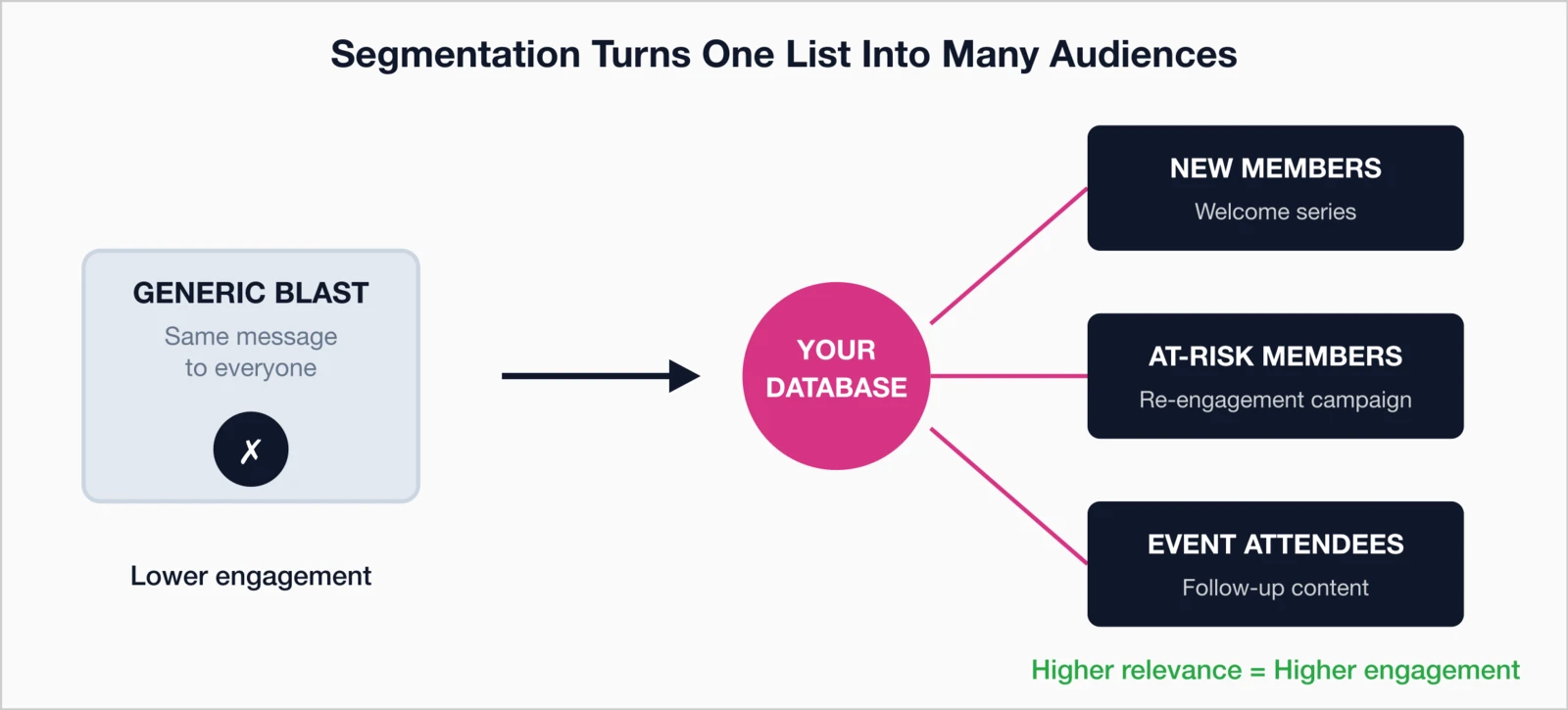
Advanced segmentation: Behavioral triggers
Move beyond demographics to behavior-based targeting:
- Website activity: Visited certification page → Send certification info
- Email engagement: Clicked event link → Add to event reminder sequence
- Purchase history: Bought webinar → Promote related courses
- Renewal proximity: 90 days to renewal → Start renewal sequence
- Engagement decline: Opened last 3 emails → Didn't open recent 3 → Re-engagement
Automation & drip campaigns
Email automation delivers the right message at the right time without manual intervention. This matters because Sequence Consulting found that 52% of associations cite limited staff capacity as a barrier to revenue growth. Automation lets small teams operate like large ones.
Well-designed automated sequences can handle the majority of routine member communications. With 45% of associations having only 1 full-time equivalent for membership work, automation isn't a luxury—it's a survival strategy.
Here's what I tell associations just getting started: pick one automated sequence and do it well. Your welcome series is the perfect place to start. Once that's running smoothly, add renewal automation. You'll be surprised how quickly your "set it and forget it" emails start outperforming your manual ones.
Essential automated workflows
New Member Welcome Sequence
Email 1 (Immediate): Welcome + login credentials + quick start guide
Email 2 (Day 2): Top 3 member benefits + how to access
Email 3 (Day 5): Community introduction + member directory
Email 4 (Day 10): Educational resources + upcoming events
Email 5 (Day 21): Engagement opportunities + volunteer info
Email 6 (Day 30): Feedback survey + "How are we doing?"
Renewal automation framework
Automate the entire renewal journey. Remember: 24% of lapsed members simply forgot to renew. Automation ensures that never happens.
Event attendee nurture sequence
Maximize event ROI with post-event automation:
- Same day: Thank you + session recordings access
- Day 3: Key takeaways summary + resources
- Day 7: Speaker presentations + additional materials
- Day 14: Related upcoming events invitation
- Day 30: Event feedback survey
Deliverability best practices
Deliverability is the quiet backbone of your email program: if inbox providers do not trust your messages, even the smartest campaigns will vanish into spam folders. This section focuses on the technical foundations, reputation signals, and content choices that determine whether your emails reliably reach members' primary inboxes.
Technical requirements
- SPF (Sender Policy Framework): DNS record authorizing sending servers
- DKIM (DomainKeys Identified Mail): Cryptographic signature verifying sender
- DMARC (Domain-based Message Authentication): Policy for handling authentication failures
- BIMI (Brand Indicators for Message Identification): Display your logo in supporting inboxes
i4a supports SPF, DKIM, and DMARC for associations using our email tools.
Sender reputation factors
- Bounce rate: Keep under 2% (hard bounces under 0.5%)
- Complaint rate: Keep under 0.1% (1 per 1,000 recipients)
- Engagement signals: Opens, clicks, replies improve reputation
- List quality: Consent-based, regularly cleaned lists perform better
- Sending consistency: Regular sending patterns build trust
Content considerations
Avoid spam triggers:
- Excessive punctuation (!!!) or ALL CAPS
- Spam trigger words ("Free," "Act now," "Limited time")
- Image-heavy emails with minimal text
- Misleading subject lines
- URL shorteners (use full, branded URLs)
Deep Dive: Email Deliverability Guide for Associations
Email content that converts
Your members' top reason for joining? According to MGI research, networking with others in the field (64%). Second? Continuing education (39%). Your email content should reflect these priorities—not just promote your next event.
Subject line optimization
Your subject line is the gatekeeper to the rest of your message, and small tweaks here can dramatically change whether members ever see your content. For associations, the most effective subject lines are clear, benefit-focused, and tailored to what your members value most.
- Curiosity: "The membership trend we can't ignore"
- Benefit: "Earn 5 CEUs from home this month"
- Urgency: "Early bird ends Friday—save $200"
- Personalization: "[Name], your renewal benefits inside"
- Numbers: "7 sessions you can't miss at Annual Conference"
- Keep under 50 characters (mobile-friendly)
- Front-load key information
- Test emoji use (works for some audiences)
- Use preheader text strategically
- A/B test consistently
Email body best practices
- Lead with value: First sentence should answer "What's in it for me?"
- One primary CTA: Clear, prominent call-to-action per email
- Scannable format: Short paragraphs, bullet points, headers
- Mobile-first design: Single column, large buttons, readable fonts
- Personal tone: Write like a colleague, not a corporation
Call-to-action optimization
CTAs drive conversion. Optimize with:
- Action-oriented verbs: "Register Now," "Download Guide," "Join Today"
- Contrasting button colors that stand out
- Adequate white space around buttons
- Minimum 44x44 pixel touch targets for mobile
- Urgency elements when appropriate: "Only 12 spots left"
Measuring email success
The median membership renewal rate across associations is 84%. But that number hides a critical detail: 32% of associations have first-year renewal rates below 60%. Email metrics help you identify at-risk members before they become statistics.
I'm a firm believer that what gets measured gets managed. But don't drown in data. Focus on the metrics that connect directly to member behavior and revenue—clicks, conversions, and renewals matter more than vanity metrics like list size.
Key performance indicators
| Metric | Association Benchmark | Top Performer Target |
|---|---|---|
| Open Rate | 20-25% | 35%+ |
| Click-Through Rate | 2-3% | 5%+ |
| Click-to-Open Rate | 10-15% | 20%+ |
| Unsubscribe Rate | <0.5% | <0.2% |
| Bounce Rate | <2% | <0.5% |
| Complaint Rate | <0.1% | <0.05% |
Beyond opens: Meaningful metrics
Because more email apps now hide or distort tracking, open rates have turned into a rough estimate, not a precise headcount of who actually read your message. Sometimes they are inflated, sometimes they are underreported, so treat opens as a general trend line and put more trust in harder signals—what people click, what they register for, what they buy, and how your list is growing over time.
- Click engagement: More reliable than open rates
- Conversion rate: Registrations, renewals, purchases from email
- Revenue per email: Total attributed revenue divided by emails sent
- List growth rate: New subscribers minus unsubscribes
- Engagement over time: Trend analysis more valuable than point-in-time
Deep Dive: Association Email Metrics & Benchmarks
Email marketing tools & technology
Only 29.7% of associations successfully integrate their engagement tools. That means 70% are managing disconnected systems—leading to data silos, inconsistent messaging, and wasted staff time.
The technology question comes up in nearly every conversation I have with association leaders. My advice? Don't let perfect be the enemy of good. An integrated solution that your staff will actually use beats a sophisticated platform that collects dust.
Integrated vs. standalone solutions
Associations face a key decision: use their AMS's built-in email tools or integrate with specialized email platforms.
Advantages:
- Real-time member data sync
- Automatic segmentation from membership data
- Unified reporting and analytics
- Simplified workflow—one system
Best for: Associations prioritizing simplicity and data integrity
Advantages:
- Advanced automation features
- More template options and design flexibility
- Sophisticated A/B testing
- Better deliverability tools
Best for: Associations with complex marketing needs and IT resources for integration
The AI factor
AI is transforming email marketing. According to MGI's 2025 Membership Marketing Benchmarking Report, 18% of associations now use AI for membership marketing—up from 11% in 2024. Among those using AI, 88% employ it for content generation. That includes subject line optimization, content personalization, and send-time optimization.
Frequently asked questions
Taking your email program to the next level
The data tells a clear story: email remains the most effective communication channel for associations, but only when executed strategically. With 55% of associations experiencing flat or declining retention and only 11% describing their value proposition as "very compelling," the opportunity for differentiation through excellent email marketing is significant.
After 30 years in this industry, I've seen associations transform their member relationships through email. The ones that succeed share a common trait: they treat every email as an opportunity to demonstrate value, not just broadcast information. Your members' inboxes are crowded. Earn your place by being genuinely useful.
Here's what to do next:
- Audit your current program against the benchmarks in this guide
- Implement segmentation starting with career stage and engagement level
- Build your first automated sequence—start with welcome or renewal
- Measure what matters—clicks and conversions over vanity metrics
- Test continuously—subject lines, send times, content formats
The equation is simple: no perceived value, no renewal. Your email program is your best tool for demonstrating value between events and renewals.
If you take one thing from this guide, let it be this: every email is a chance to prove your association's worth. Make every send count.
Ready to transform your email marketing?
See how i4a's integrated email marketing tools help associations increase open rates, automate member communications, and drive measurable engagement—all within your AMS.
Schedule a Free DemoRelated articles
Browse all articles on association marketing strategies
Strategies to deepen member relationships and participation
