Quick Summary: Membership Retention
- Retention beats recruitment: A 5-point improvement in retention often delivers more net growth than doubling your recruitment budget at a fraction of the cost.
- First 90 days matter most: Members who engage during onboarding renew at significantly higher rates—track profile completion, logins, and event attendance.
- Automate renewal sequences: Build a 90/60/30/14-day reminder sequence with personalized value recaps and one-click renewal links.
- Identify at-risk members early: Watch for declining logins, event absences, and fading email engagement—2+ warning signs means it's time to act.
- Win-back within 90 days: Lapsed members are most likely to return in the first 30-60 days—use exit surveys to address common concerns.
Why membership retention beats recruitment
Membership retention is the quiet engine of sustainable growth. New member campaigns may feel more exciting, but they simply cannot keep up if a large share of your existing members are slipping away each year. Recruitment fills the bucket; membership retention keeps it from leaking.
After 30 years working with associations on their membership management strategies, I've seen this pattern repeat itself: organizations pour resources into acquisition campaigns while their existing members quietly slip away. The math never works. A 5-point improvement in retention often delivers more net growth than doubling your recruitment budget—and it costs a fraction as much.
Focusing on keeping more of the members you already have reduces pressure on your marketing team, stabilizes revenue, and gives staff more time to deliver value instead of constantly replacing departures.
This guide explains why even small changes in churn have outsized impact on your membership base and budget. It also shows how long-tenured members contribute in ways new members cannot—through leadership, referrals, and institutional knowledge—and why shifting some energy from acquisition to membership retention can transform the trajectory of your association.
Sequence Consulting's 2026 Association Trends Report reveals 55% of associations face flat or declining retention, with only 11% offering a "very compelling" value proposition. Simple math shows the stakes: 1,000 members at 20% churn requires 200 new ones to break even. Cut churn to 10%, and you need just 100.
Retained members compound value beyond numbers:
- Predictable revenue from reliable renewals.
- Higher engagement through events and benefits.
- Referrals from satisfied advocates.
- Volunteer leaders from your loyal base.
- Stronger community with institutional knowledge.
Core membership retention metrics
Before you can improve membership retention, you need a clear picture of where you stand today. High-level renewal rates are a start, but they often hide meaningful differences between first-year members and longtime loyalists, or between one acquisition channel and another. Getting specific about how you measure membership retention, churn, and first-year performance helps you see whether you have a pricing problem, an onboarding problem, or an engagement problem.
In this membership retention guide, you define the core formulas, see how your numbers compare to common benchmarks, and learn why segmenting membership retention by tenure, type, and source unlocks better decisions. The goal is to move from "we think retention is okay" to "we know exactly where we are strong and where we are leaking members."
Key metrics
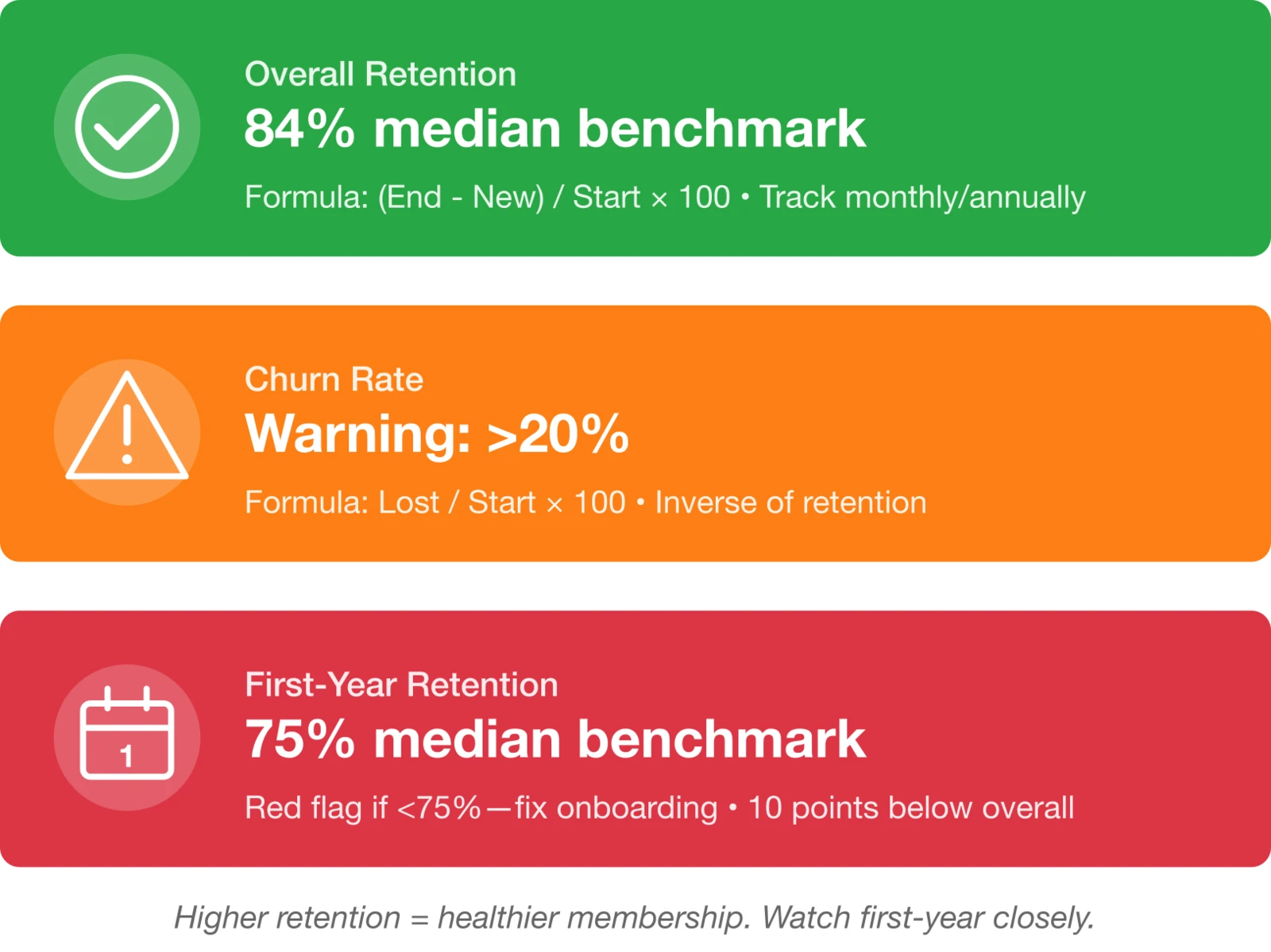
Overall retention rate: Percentage who renew in a period.
- Formula: (End members - New) / Start × 100
- Benchmark: 84% median per MGI's 2025 Membership Marketing Benchmarking Report. Track monthly and annually.
Churn rate: Inverse—the percentage who lapse.
- Formula: Lost / Start × 100
- Warning: Above 20% demands action.
First-year retention: New members renewing for year two.
- Benchmark: 75% median—10 points below overall (MGI, 2025). Red flag if under 75%: fix onboarding.
Segment for insights
Break membership retention by tenure, type, engagement, source, or region. Trade associations see corporate cycles; professional associations leverage credentials.
Higher retention signals health. Watch first-year metrics closely.
Calculate Your Retention Rate
Use our free calculator to measure your retention rate, compare against industry benchmarks, and see the revenue impact of improving retention.
Try the Retention CalculatorDeep Dive: Calculating Member Lifetime Value (LTV) for Associations — Understand the true revenue impact of retention improvements.
Retention zones
<65% retention
65-75% retention
75-85% retention
85-92% retention
First 90 days: Onboarding for membership retention
The onboarding period is when new members decide whether your organization is going to be part of their professional life—or just another renewal notice a year from now. Those first weeks set expectations about responsiveness, value, and community. A structured, multi-touch onboarding journey helps new members find their way to the benefits that matter most to them instead of leaving them to figure it out alone.
Here's the thing: when I review associations' onboarding processes, I find most are essentially hoping members figure things out on their own. A welcome email lands, maybe a link to the member portal, and then silence for months. That's not onboarding—that's abandonment. The associations that retain first-year members at high rates treat onboarding as a structured journey, not a single touchpoint.
This membership retention guide walks through a practical 90-day sequence that starts with quick wins in week one, builds momentum through targeted invitations and introductions, and ends with check-ins and feedback. You will see which early actions to encourage, how to measure whether onboarding is working, and where to intervene when new members stall—because early engagement is the #1 predictor of membership retention.
Week 1: Immediate value
- Day 1: Welcome with quick-start checklist (3-5 actions).
- Day 2: Portal access and profile update guide.
- Day 3: Event registration links.
- Day 5: Peer success story.
- Day 7: Onboarding survey.
Weeks 2-4: Build momentum
- New member orientation (live/recorded).
- Interest group introductions.
- Personalized resources.
- Peer connections.
Months 2-3: Stay connected
- Day 30: Progress check-in.
- Day 60: Unused benefit highlights.
- Day 90: Satisfaction survey.
Onboarding targets
New members hitting 3+ benchmarks engage stronger early on.
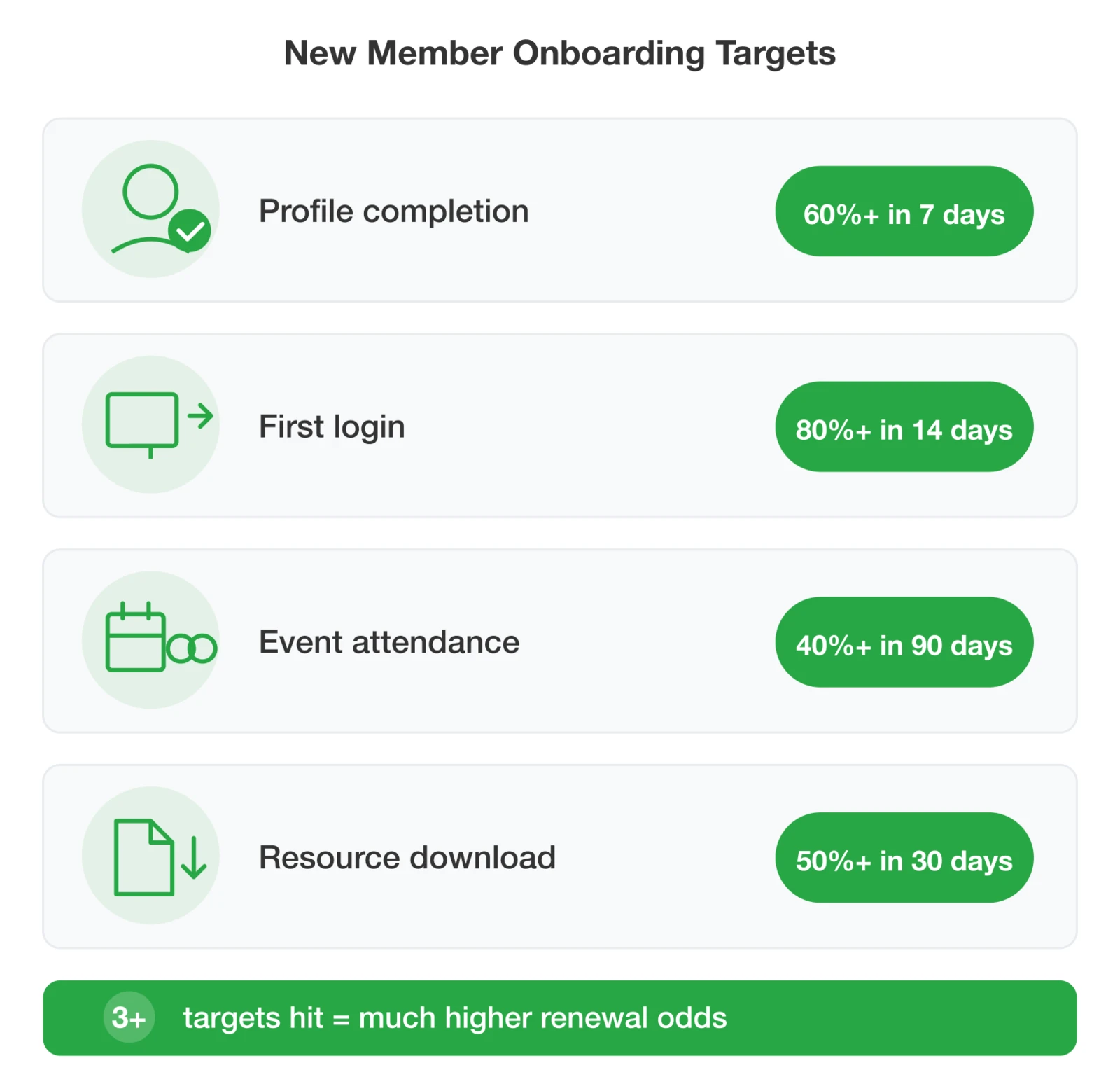
- Profile completion: 60%+ in 7 days.
- First login: 80%+ in 14 days.
- Event attendance: 40%+ in 90 days.
- Resource download: 50%+ in 30 days.
Pro tip: Alert on members missing 2+ at day 30. Send "Getting started?" nudges.
Schedule your onboarding emails in advance. i4a's email tools make it easy to set up and send targeted campaigns.
Deep Dive: New Member Onboarding: The Complete 90-Day Guide — Email templates, milestone checklists, and engagement tracking for new members.
Engagement framework for membership retention
Once members are past onboarding, the challenge shifts from "get them started" to "keep them connected." Engagement is not one big program—it is a rhythm of touchpoints that make membership feel present and valuable in the midst of busy lives. Without a framework, engagement efforts can become ad hoc, leaving some members over-served and others barely hearing from you.
This membership retention guide maps engagement as a ladder, from passive to highly involved, and shows what experiences help a member climb from one rung to the next. You also see how to use simple scoring to quantify engagement, so staff can spot members who are thriving, those who are coasting, and those quietly drifting toward the exit—turning membership retention into a proactive process.
The engagement ladder
- Passive: Receives emails (baseline retention).
- Consumer: Reads content, occasional events.
- Participant: Forums, regular attendance.
- Contributor: Content creation, mentoring.
- Leader: Committees, advocacy (highest retention).
Monthly touchpoints
- Educational content (newsletters, updates).
- Community interaction (forums, social).
- Networking (virtual coffees, meetups).
- Exclusive resources (templates, discounts).
Simple engagement scoring
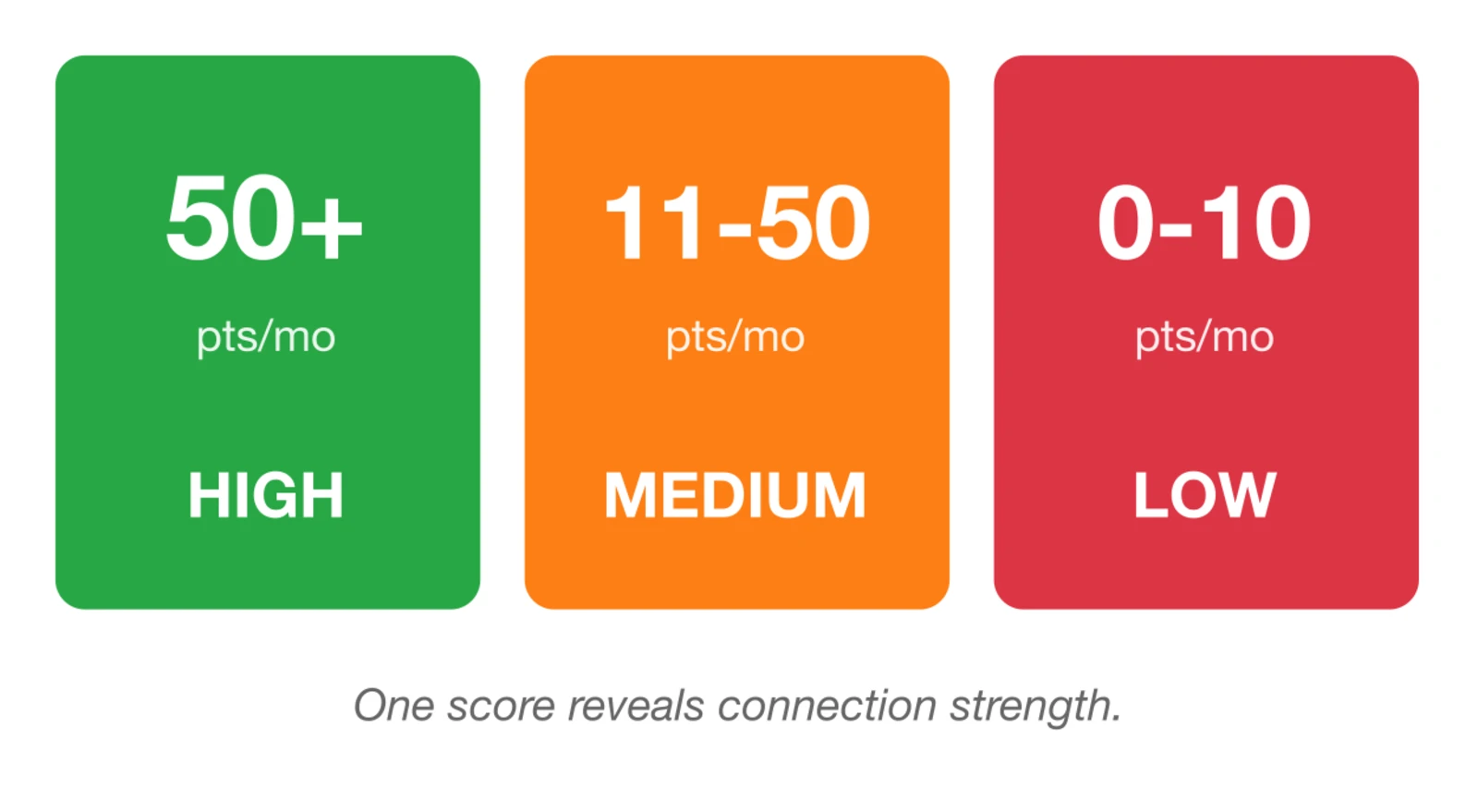
Track monthly points:
| Activity | Points |
|---|---|
| Portal login | 5 |
| Event attendance | 10 |
| Email open | 2 |
| Resource download | 5 |
| Forum post | 10 |
| Committee role | 15 |
- 0-10 pts: At risk—intervene.
- 11-25 pts: Passive—nudge.
- 26-50 pts: Engaged—maintain.
- 50+ pts: Leader potential.
Renewal automation for membership retention
Renewals are one of the most predictable processes in your association—and yet many organizations still manage them as one-off pushes that vary by staff capacity. This creates inconsistent experiences for members and constant stress for teams. A well-designed automated sequence treats renewals as a standardized, member-friendly journey that runs reliably in the background.
This membership retention guide lays out a tested timeline for renewal outreach, from the first "heads up" to the grace-period reminders. It explains what kind of message works best at each stage, how to incorporate personalization without creating manual work, and why auto-renewal—implemented transparently—can significantly reduce friction for both members and staff, boosting membership retention rates.
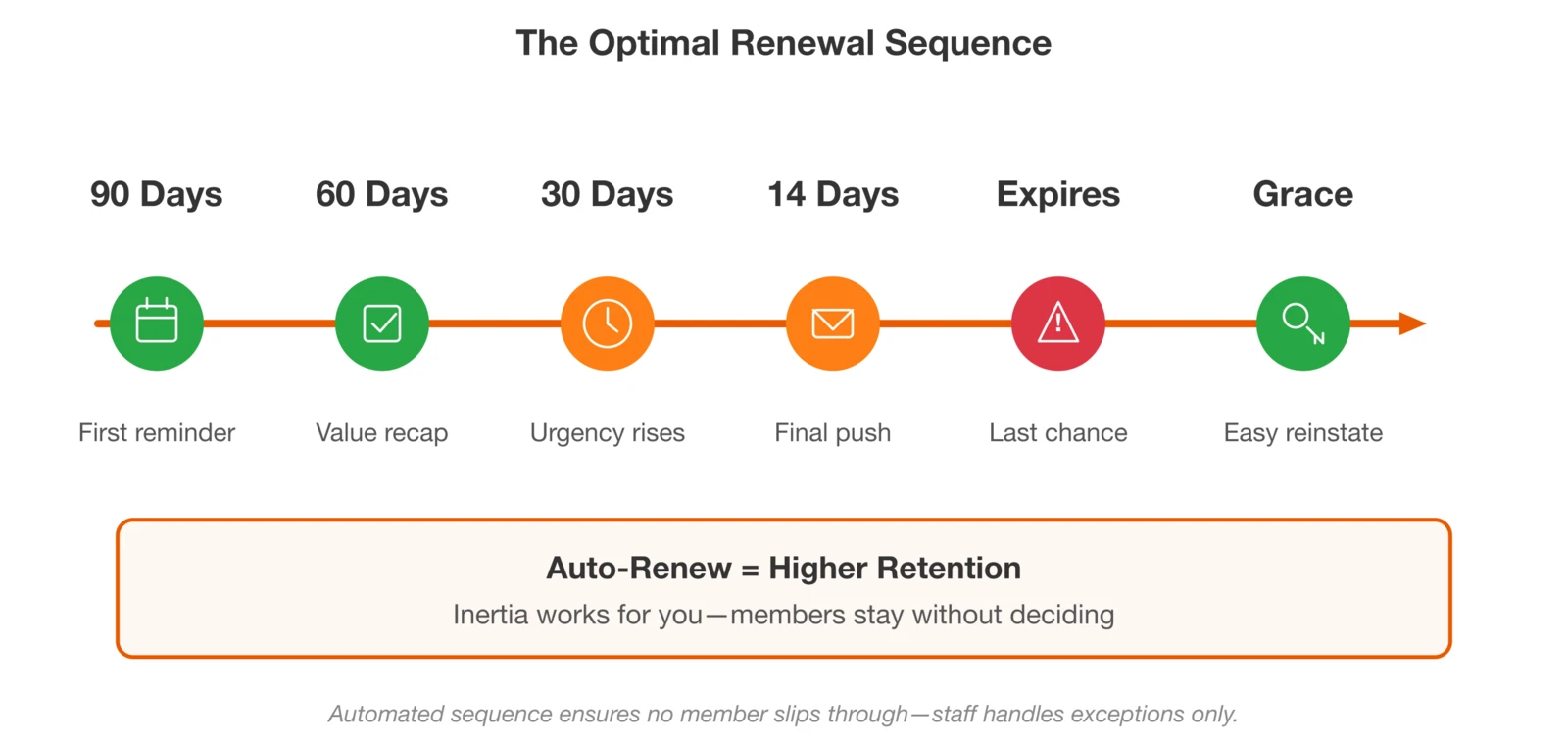
Optimal sequence
- 90 days out: Informational reminder + value recap + one-click link.
- 60 days: Personalized recap (events, resources) + incentive.
- 30 days: Urgency + loss highlights + options.
- 14 days: Direct final push (leadership signature).
- Expiration: Last chance.
- Grace (1-30 days): Easy reinstatement.
Auto-renewal best practices
Inertia boosts retention—no decision needed.
- Offer 5-10% enrollment discount.
- Easy opt-in at join/renewal.
- Pre-charge reminders (regulatory must).
- Simple cancel process.
- Monitor failed payments.
Related Articles:
- How to Automate Membership Renewals — Email templates and automation workflows
- Grace Period Best Practices — Optimize your policy for maximum recovery
- Renewal Strategies for Professional Associations — Credential-based and CE-driven tactics
- Association Automation Guide — Comprehensive guide to automating operations
Identifying at-risk members for membership retention
Most members do not wake up on renewal day and suddenly decide not to renew. Instead, their engagement fades over months: fewer logins, skipped events, emails left unopened. If you are only reacting at renewal time, you are intervening after the decision is effectively made. The earlier you notice disengagement, the more options you have to reconnect members with value.
One of the most valuable things I've learned working with hundreds of associations: the members who leave rarely surprise the staff who work with them. Someone in your organization usually knows who's drifting away—they just don't have a system to surface that knowledge and act on it. When we help associations build early warning systems, we're often just formalizing what staff already sense but can't articulate in time.
In this membership retention guide, you translate common behavioral and transactional warning signs into a practical "early warning" system. You learn what patterns to watch for, how to combine signals into an at-risk list, and how to match different levels of risk with the appropriate type of outreach—from automated check-ins to personal calls for high-value members—preserving membership retention.
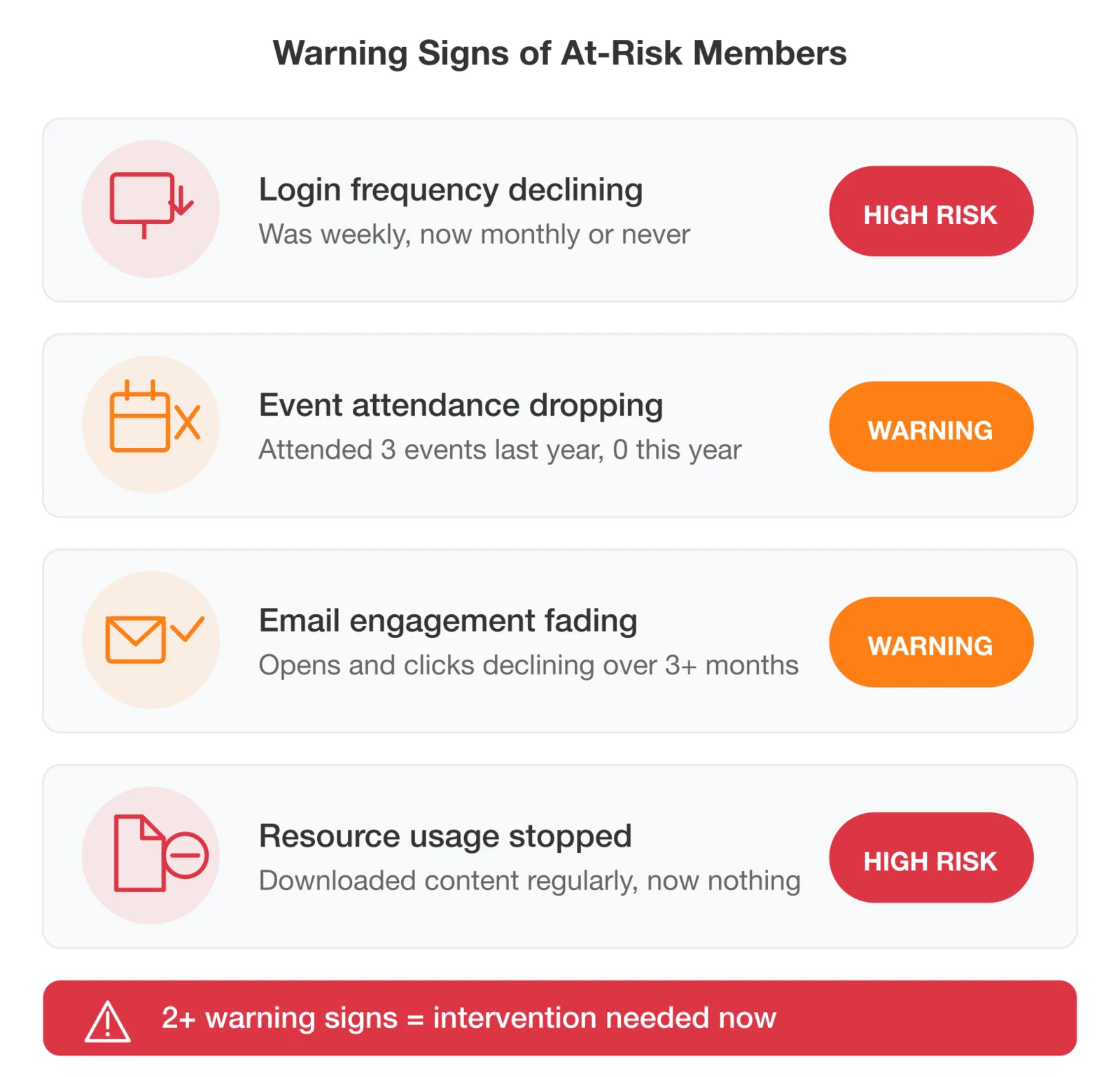
Warning signs
Behavioral:
- Login drop (weekly to none)
- Event absence (3 last year, 0 now)
- Email fade (3+ months declining)
- Resource halt
- Forum silence
Transactional:
- Auto-renew off
- Failed payments
- No 90-day response
- Reduced program spend
2+ signs? Act now.
Alert system
- Set score drop thresholds (e.g., 50% decline)
- Auto-notify staff
- Weekly watch lists (90 days to renewal)
- Assign outreach owners
Interventions
Email series: "Missed you lately" → survey → personal note.
High-value outreach: Calls, 1:1 invites from leaders.
Related Articles:
- How to Reduce Membership Churn: 10 Proven Strategies — Churn reduction framework with intervention templates
- At-Risk Member Identification — Build an early warning system to spot disengaging members
Win-back campaigns for membership retention
Even with great onboarding and strong engagement, some members will still leave. The question is whether you let that be the end of the relationship or treat it as a pause. Former members already know who you are and what you do; they often just need a clear reason—or a changed circumstance—to come back.
This membership retention guide outlines why timing is critical for win-back efforts, and how to design a simple sequence that starts as soon as someone lapses. You will see what kinds of messages resonate with former members, how to use exit survey insights to improve your offers, and when it makes sense to keep trying versus when to move someone into a lighter-touch "alumni" track—recovering lapsed members as part of your membership retention strategy.
Win-back window
- 0-30 days: Highest success.
- 31-60: Moderate.
- 61-90: Last strong chance.
- 90+: Low odds.
Sequence
- 30 days post-lapse: "We miss you" + survey + updates.
- 60 days: Rejoin offer (waived fee, discount).
- 90 days: Final urgent invite.
Exit surveys
Ask:
- Non-renewal reason.
- Used/wished-for benefits.
- Improvement ideas.
- Future interest.
Act on patterns (e.g., price fixes, benefit promotion).
Related Articles:
- Win-Back Campaigns — Complete sequences with email templates and timing strategies
- Member Satisfaction Survey Questions — Exit survey templates to understand why members leave
Measuring membership retention success
Retention work only pays off if you can see whether it is working. Tracking a handful of clear metrics—and revisiting them regularly—turns your efforts from one-time initiatives into a continuous improvement loop. Without that visibility, it is easy for good ideas to fade away or for pockets of progress to go unnoticed.
This membership retention guide introduces a simple retention dashboard and the key questions to ask every month and quarter. It helps you connect numbers like overall retention, first-year renewal, auto-renew enrollment, and win-back rates back to specific programs, so you know what to refine, what to expand, and where to experiment next in your membership retention efforts.
| Metric | Reveals | Target |
|---|---|---|
| Overall retention | Organizational health | 85%+ |
| First-year retention | Onboarding impact | Near overall |
| Auto-renew enrollment | Friction reduction | 30%+ |
| At-risk count | Intervention pipeline | Declining |
| Win-back rate | Campaign lift | Improving |
| Lifetime value | Revenue impact | Rising |
| NPS | Loyalty | 30+ |
Monthly questions
- Vs. last year?
- Segment trends?
- Intervention outcomes?
- Exit themes?
- On annual target?
Technology for membership retention
All of these strategies become much easier—and more scalable—when your technology does the heavy lifting. If your data is scattered across multiple tools, or your team spends hours exporting spreadsheets just to send basic emails, it will be hard to sustain a modern retention program.
Here you clarify which capabilities your core systems need to support: automated journeys, unified engagement history, flexible reporting, and self-service options for members. You will also see why integrations between your AMS, email, events, and accounting tools are critical, and how a unified association management software platform makes it far simpler to execute everything described in this membership retention guide.
Essential features
- Automated sequences (onboarding, renewal, alerts).
- Engagement tracking (logins, events, emails).
- Segmented reporting + at-risk ID.
- Auto-renew + payment alerts.
- Self-service portal.
Integrate email, events, and AMS. i4a's platform unifies it all.
How i4a Powers Retention
i4a's all-in-one platform includes everything you need for effective retention:
- Automated renewal sequences with customizable timing
- Custom reports to identify at-risk members
- Auto-renewal with saved payment methods
- Member self-service portal
- Integrated email with segmentation
Build your membership retention program
The associations I see succeed at retention share one trait: they start before they feel ready. They don't wait for perfect data, a bigger team, or the next software upgrade. They pick one or two strategies from this guide, implement them this month, and build from there. The associations still struggling at 70% retention are often still "planning to address retention next quarter."
Start simple, scale smart:
Quick Wins:
- 90-day onboarding automation.
- Renewal reminders (90/60/30).
- Basic engagement scoring.
- Auto-renew incentives.
Next Layer:
- Segmented reporting.
- At-risk campaigns.
- Exit surveys + action.
- Win-back sequences.
Every retention point compounds. Use our Member Growth Calculator to model impact.
Related Articles:
- Membership Pricing Strategies — How pricing structure impacts renewal decisions
- Retention Strategies for Healthcare Associations — Industry-specific tactics for medical and nursing associations
- Member Retention for Trade Associations — Corporate member retention and organizational renewal strategies
Frequently asked questions
Ready to improve your retention?
i4a provides the tools you need to execute these strategies—scheduled email campaigns, renewal sequences, and reporting. Plus unlimited members at flat-rate pricing, so growth never increases your software costs.
- Automated renewal sequences with customizable timing
- Scheduled email campaigns for onboarding
- Auto-renewal with saved payment methods
- Custom retention reporting by segment
Related articles
How to Reduce Membership Churn: 10 Proven Strategies
Detailed tactics for identifying and retaining at-risk members.
New Member Onboarding: The Complete 90-Day Guide
Transform first-time members into lifelong advocates.
How to Automate Membership Renewals
Step-by-step guide to building automated renewal workflows.
At-Risk Member Identification: Early Warning Signs
Spot warning signs that predict churn and intervene early.
Win-Back Campaigns: Re-Engage Lapsed Members
Bring former members back with targeted campaigns.
