Quick Summary: Non-Dues Revenue
- Diversification reduces risk: Top-performing associations generate 65-75% of revenue from non-dues sources—sponsorships, events, education, and digital products.
- Sell outcomes, not inventory: Sponsors want leads and brand positioning, not logo placements; design packages that deliver measurable business results.
- Certifications compound returns: Unlike events requiring annual renewal, certification programs generate recurring maintenance fees and recertification revenue for decades.
- Stop underpricing: Your targeted professional audience commands premium rates; market research typically reveals associations charge far less than commercial alternatives.
- Start before you're ready: Launch one or two strategies this quarter and iterate; a modest sponsorship program today beats a comprehensive plan still in development next year.
Introduction: Beyond membership dues
Membership dues provide a foundation, but they rarely deliver the full financial stability associations need to advance their mission, innovate programs, and serve members consistently. Top organizations counter this by building robust non-dues revenue streams—sponsorships, events, certifications, and more—that not only reduce risk but also enhance perceived member value through exclusive perks and targeted offerings.
According to Sequence Consulting's 2026 Association Trends Report, 63% of associations anticipated non-dues revenue growth in 2025, reflecting widespread recognition of this shift. Challenges persist, though: 52% point to limited staff capacity, and 51% to low member engagement as key hurdles. This guide delivers actionable strategies, pricing models, and an implementation roadmap to turn potential into sustainable results.
After 30 years helping associations build revenue programs, I've watched the conversation shift. A decade ago, non-dues revenue felt like a nice-to-have. Today, it's the difference between organizations that can invest in member value and those struggling to keep the lights on. The associations thriving right now aren't necessarily bigger or better-funded—they simply started diversifying earlier and stuck with it.
Deep Dive: 10+ Non-Dues Revenue Ideas for Associations — Quick-start strategies to diversify beyond membership dues.
Why revenue diversification matters
In an era of volatile retention and shifting member expectations, leaning too heavily on dues exposes associations to unnecessary risk—flat or declining renewals can quickly strain budgets and limit growth. Diversification spreads that risk across multiple streams like events, sponsorships, and education, creating resilience while freeing resources for high-impact initiatives that retain and attract members.
Here's the thing: most associations understand this intellectually, but they struggle to act on it. The daily demands of member service, event planning, and board meetings consume staff bandwidth. Revenue diversification becomes a "someday" project that never gets priority. Meanwhile, dues-dependent organizations remain vulnerable to every economic downturn, industry disruption, or competitor that offers a shinier value proposition.
Sequence Consulting's 2026 Association Trends Report notes 55% of associations face flat or declining retention, while MGI's 2025 Association Outlook Report reveals 41% of lapsed members cite insufficient value. Healthy associations target lower dues dependency to thrive amid these pressures.
The organizations that weather these challenges share a common trait: they built revenue diversity before they needed it. They didn't wait for a membership crisis to start selling sponsorships or developing certification programs. They invested incrementally, learned what worked for their audience, and refined their approach over years—not months.
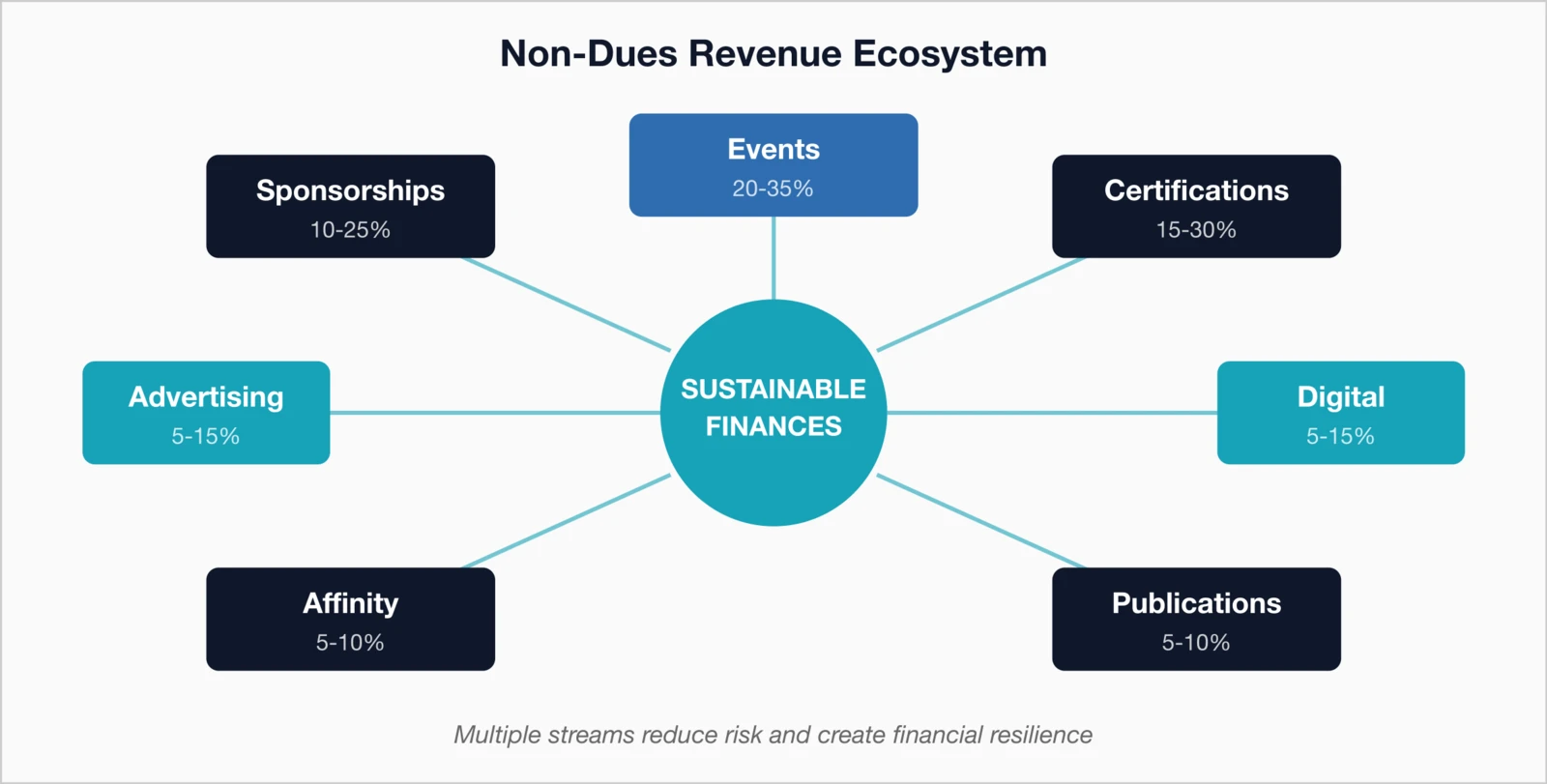
Benefits of diversification
- Financial stability from buffered income streams
- Investment capacity for innovation and services
- Dues flexibility to avoid annual increases
- Direct member value through revenue programs
- Mission advancement via expanded advocacy
Assess your position with the Dues Dependency Analyzer and Association Budget Planner. Trade associations often excel in sponsorships and ads, professional societies in certifications, and nonprofits in blended fundraising.
Revenue mix benchmarks
Estimated ranges based on industry experience—actual mix varies widely by organization type and size.
| Revenue Source | Typical Range | Top Performers |
|---|---|---|
| Membership Dues | 30-50% | 25-35% |
| Events & Conferences | 15-30% | 20-35% |
| Education & Certifications | 10-25% | 15-30% |
| Sponsorships & Advertising | 10-20% | 15-25% |
| Publications & Products | 5-15% | 5-10% |
| Affinity & Partnerships | 2-8% | 5-10% |
Sponsorship programs
Sponsorships stand out as high-potential non-dues revenue because they leverage your association's trusted audience and events to deliver measurable ROI for corporate partners—turning one-off deals into recurring partnerships that fund operations without member costs.
Most associations approach sponsorships backwards. They create a menu of logo placements and booth options, then wonder why companies aren't lining up to buy. The problem? They're selling inventory instead of outcomes. Sponsors don't want their logo on a lanyard—they want access to decision-makers, qualified leads, and brand positioning that moves their business forward.
The associations generating serious sponsorship revenue think like marketing agencies. They understand their sponsors' business objectives, then design packages that deliver measurable results against those goals. They track and report on impressions, leads, and engagement. They build relationships that span multiple years, not single transactions.
Building a tiered sponsorship program
Sample Tier Structure
Bronze
Silver
Gold
Platinum
High-value sponsorship opportunities
- Annual conference: Title sponsor, track sponsors, networking events
- Educational programs: Webinar series, certification programs, scholarships
- Digital properties: Website sections, newsletter sponsorships, podcast sponsors
- Awards programs: Industry recognition awards, scholarships
- Research initiatives: Industry studies, benchmark reports, white papers
- Community platforms: Online community sponsors, forum categories
Sponsorship sales best practices
Here's the thing: associations routinely leave money on the table by treating sponsorships as transactions rather than partnerships. The organizations generating six figures in sponsorship revenue don't have magic audiences—they invest time in understanding what sponsors actually need, then deliver measurable results. That creates renewals, referrals, and the kind of predictable revenue that makes budgeting easier.
- Develop a compelling prospectus: Include audience demographics, reach metrics, and ROI data
- Quantify member access: Email list size, event attendance, website traffic
- Create custom packages: Be willing to bundle benefits based on sponsor goals
- Provide post-event reports: Document leads generated, impressions delivered, engagement metrics
- Build multi-year relationships: Offer discounts for 2-3 year commitments
Deep Dive: Association Sponsorship Packages That Sell — Proven structures, pricing strategies, and sales tactics.
Event revenue optimization
Events drive the largest non-dues revenue for most associations, but optimization unlocks far more than registrations—through smart pricing, exhibitors, and add-ons, they become profit centers that also boost engagement and sponsor interest.
Too many associations treat events as cost centers that happen to generate some revenue. They focus on logistics—booking venues, managing speakers, printing badges—while leaving significant money on the table. The shift from "event planner" to "revenue strategist" changes everything. Every touchpoint becomes an opportunity: the registration form, the mobile app, the exhibit hall layout, the networking reception, the session recordings.
The associations maximizing event revenue don't just raise prices—they create more value at every tier. They develop VIP experiences that command premium pricing. They build year-round engagement that makes the annual conference feel like the culmination of an ongoing relationship, not a standalone transaction. And they treat exhibitors and sponsors as partners whose success directly impacts renewal rates.
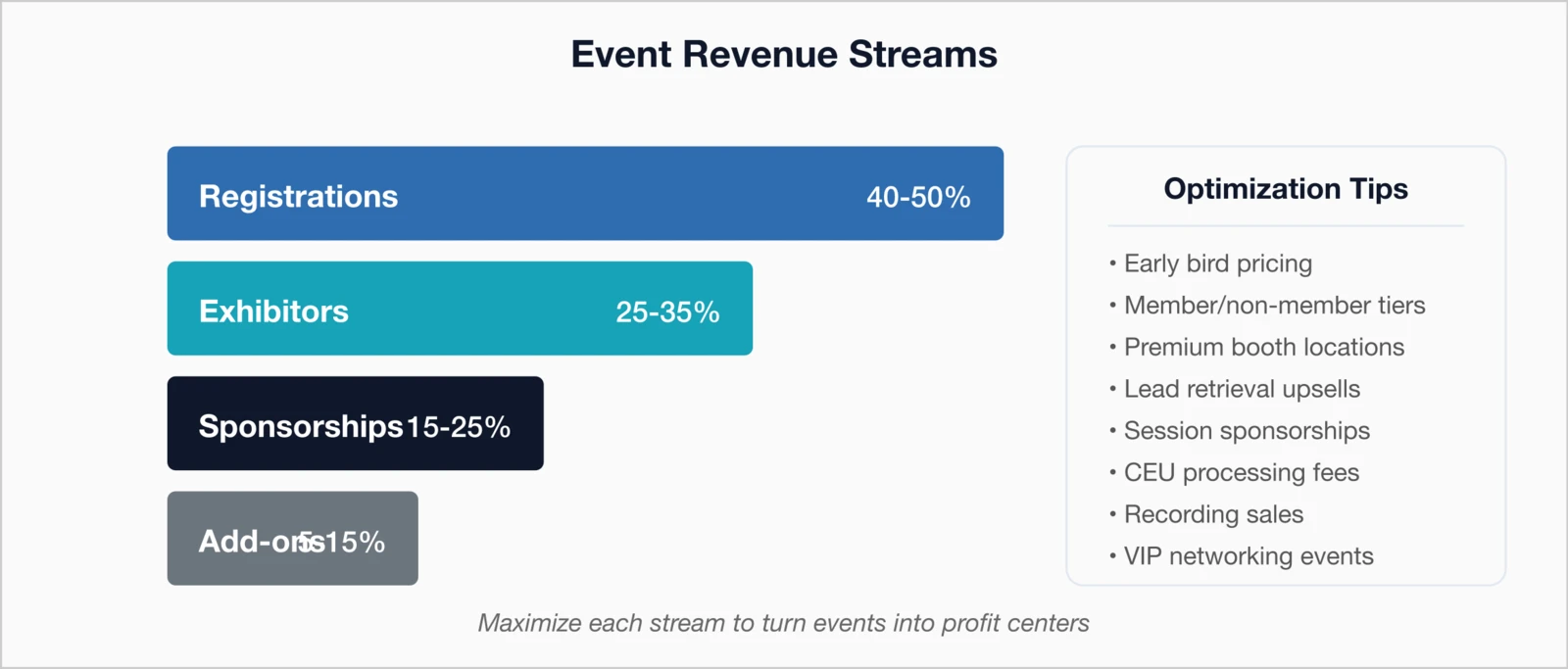
Registration revenue strategies
- Early bird pricing: 15-20% discount for registrations 60+ days out
- Member vs. non-member pricing: Non-member premium of 30-50%
- Group discounts: 10-15% for 3+ registrations from same organization
- Add-on sessions: Premium workshops, certifications, networking events
- Virtual attendance tiers: Full access vs. session-specific passes
Beyond registration: Ancillary revenue
- Tiered booth pricing by size and location
- Lead retrieval device rentals
- Enhanced exhibitor listings in app
- Exhibitor showcase sessions
- Post-event attendee list access
- Session recordings for purchase
- CEU/certificate processing fees
- Networking event tickets
- Conference merchandise
- Childcare services
Certifications & education programs
Certifications and education programs shine as top earners due to recurring demand, high margins, and career value—they position your association as an indispensable credentialing authority while generating steady income through exams, renewals, and bundles.
Unlike sponsorships or events that require constant renewal and renegotiation, a well-designed certification program generates predictable, recurring revenue for decades. Each certified professional represents a stream of maintenance fees, recertification exams, and continuing education purchases. The investment is front-loaded—developing the curriculum, validating the exam, building the infrastructure—but the returns compound year after year.
The associations that succeed with certifications understand they're not just selling credentials—they're selling career advancement. Professionals invest in certifications because they believe the designation will lead to promotions, salary increases, or new opportunities. Your job is to ensure that belief is justified, then communicate that value proposition clearly to prospective candidates. When certified professionals earn more and advance faster than their non-certified peers, your program sells itself through word of mouth and employer mandates.
Certification revenue model
Example pricing ranges—actual fees vary by industry and credential complexity.
| Revenue Component | Typical Range | Frequency |
|---|---|---|
| Application fee | $50-200 | One-time |
| Exam fee | $200-800 | Per attempt |
| Prep courses | $300-2,000 | One-time |
| Study materials | $50-300 | Per purchase |
| Annual maintenance | $100-300 | Annual |
| Recertification | $150-400 | Every 2-5 years |
Education program revenue streams
Example price points—adjust based on your audience and content value.
- Webinars: Live sessions ($25-75), recorded access ($15-50)
- Online courses: Self-paced modules ($100-500), cohort-based ($300-1,500)
- In-person workshops: Half-day ($150-300), full-day ($300-600)
- Certificate programs: Multi-course series ($500-3,000)
- Corporate training: Custom programs ($5,000-50,000+)
Related Articles:
- Certification & Credentialing Revenue — Build sustainable revenue from professional credentials
- Online Learning Revenue Strategies — Maximize returns from educational programs
Advertising revenue
Your association's niche, engaged audience commands premium ad rates—far above general web averages—making digital and print inventory a reliable, low-effort revenue stream that scales with your existing channels.
Advertisers pay a premium to reach targeted professional audiences, and your association delivers exactly that. Unlike general consumer media where advertisers spray messages at millions of loosely-defined viewers, your channels reach verified professionals in a specific industry or discipline. That targeting justifies rates that would seem outrageous in other contexts. A newsletter going to 5,000 purchasing managers is worth far more than one going to 50,000 random consumers.
The key is understanding and communicating your audience's value. How many of your members are decision-makers? What's their average purchasing authority? What percentage open your emails, visit your website, attend your events? These metrics become the foundation of your rate card and sales conversations. Advertisers who understand your audience's quality will pay accordingly—but you have to make the case with data, not assumptions.
Digital advertising inventory
- Website display ads: Banner ads, sidebar placements, interstitials
- Newsletter sponsorships: Dedicated sends, featured placements, banner ads
- Job board: Featured listings, employer branding, resume database access
- Member directory: Enhanced listings, sponsored categories
- Mobile app: In-app advertising, push notification sponsors
Print & publication advertising
- Magazine/journal ads: Full page, half page, quarter page placements
- Buyer's guide listings: Enhanced directory presence
- Special supplements: Sponsored content sections
- Annual report: Corporate recognition placements
Pricing benchmarks
Example ranges based on industry experience.
- Website CPMs: $15-50
- Newsletter CPMs: $50-150
- Job postings: $200-500 per 30-day listing
- Print full-page: $2,000-10,000
Related Articles:
- Advertising Revenue for Associations — Maximize ad inventory value
- Association Job Board Revenue Strategies — Turn your career center into a profit center
Affinity & partnership programs
Affinity programs create passive income by pairing vetted partners with your members—offering discounts on insurance, services, and more while earning royalties, turning everyday needs into a steady, hands-off revenue flow.
The appeal of affinity programs is obvious: revenue that flows in without constant staff attention. Once you've negotiated the partnership and promoted it to members, the partner handles sales, fulfillment, and customer service. Your association collects royalty checks based on member participation. For under-resourced associations, this "set it and forget it" model can be especially attractive.
But there's a catch. Affinity programs only work when they deliver genuine value to members. A discount that sounds impressive in a press release but doesn't beat what members can find on their own will sit unused—and unused programs don't generate royalties. The best affinity partnerships solve real problems your members face, offer meaningfully better terms than they could negotiate individually, and align with your association's values and reputation.
Common affinity program categories
Insurance Programs
- Professional liability/E&O insurance
- Health insurance (where legal)
- Life and disability insurance
- Cyber liability coverage
Financial Services
- Association credit cards (royalty per transaction)
- Payment processing discounts
- Retirement planning services
- Business lending programs
Business Services
- Office supplies discounts
- Shipping and logistics
- Technology and software
- Travel and car rental programs
Professional Development
- Online learning platform discounts
- Book and publication discounts
- Conference registration discounts
- Career coaching services
Structuring partner agreements
Typical revenue arrangements include:
- Royalty payments: 5-15% of sales generated through association
- Flat annual fees: $5,000-50,000 for exclusive access to membership
- Per-transaction fees: Fixed amount per purchase or signup
- Revenue minimums: Guaranteed minimum payment regardless of volume
Deep Dive: Affinity & Member Benefits Partnerships — Structure win-win partner agreements.
Digital revenue streams
Digital products boast high margins post-development, scaling effortlessly to serve broader audiences—ideal for associations repurposing content into reports, tools, and subscriptions that deliver ongoing value.
The economics of digital products are fundamentally different from physical ones. Once you've created a research report, an online course, or a template library, the marginal cost of each additional sale approaches zero. There's no printing, no shipping, no inventory to manage. A product that took significant effort to develop can generate returns for years with minimal ongoing investment.
Many associations are sitting on untapped digital assets without realizing it. Conference recordings collect dust on servers. Industry data gets compiled for internal reports but never packaged for sale. Staff expertise that could be turned into courses or toolkits stays locked in individual heads. The first step toward digital revenue is often an inventory exercise: what content, data, and expertise does your association already possess that others would pay to access?
High-margin digital products
- Industry research reports: Annual surveys, benchmark studies ($100-2,000)
- Template libraries: Documents, spreadsheets, presentations ($50-500)
- Online tools: Calculators, assessments, generators (subscription or per-use)
- Video content: Training series, conference recordings ($25-500)
- Podcasts: Sponsorship revenue plus premium content tiers
- Mobile apps: Premium features, in-app purchases
- Online store: Publications, merchandise, and member resources with automatic member pricing
Subscription revenue models
Recurring revenue provides financial predictability:
- Premium content tier: Enhanced member benefits for additional fee
- All-access passes: Unlimited education access for annual fee
- Data subscriptions: Ongoing access to industry databases
- Community memberships: Premium online community features
Related Articles:
- Association Online Store Guide — Launch and grow e-commerce revenue
- Publication & Content Monetization — Turn content into revenue
- Integrated E-Commerce: Streamline Member Payments — Technical setup and best practices
Strategic pricing approaches
Pricing psychology drives association revenue by spotlighting value, urgency, and member exclusivity—proven techniques that lift conversions while making membership the clear economic win.
Many associations leave money on the table through chronic underpricing, often stemming from nonprofit humility, fears of member backlash, or skipped competitive benchmarks. Underpricing doesn't just erode income; it signals low quality—prospects question a certification exam priced half of competitors'.
Smart pricing aligns rates with delivered value and offers segmented options. Budget buyers grab basics; premium seekers pay for extras—capturing both while positioning membership as the savvy choice.
Pricing psychology tactics
- Anchor: Full price before discounts
- Bundles: Combined for higher value
- Tiers: Good-better-best
- Urgency: Early bird/deadlines
- Value-based: Tied to delivered impact
Member vs. non-member premiums
| Product Type | Recommended Premium |
|---|---|
| Conference registration | 40-60% non-member premium |
| Webinars/education | 50-100% non-member premium |
| Certification exams | 25-40% non-member premium |
| Publications/reports | 50-100% non-member premium |
| Job postings | 25-50% non-member premium |
Implementation roadmap
Systematic phasing ensures quick wins build momentum toward scaled growth—starting with audits and low-lift tactics before investing in high-potential programs like certifications.
The associations that succeed with revenue diversification don't try to launch everything at once. They start with one or two initiatives that match their current capabilities, prove the model works, then expand. This phased approach builds organizational confidence, develops staff skills, and—critically—generates early wins that justify further investment to skeptical boards or executives.
What constitutes a "quick win" varies by organization. For some, it's raising sponsorship prices to match market rates. For others, it's finally charging for webinar recordings that have been given away for free. The point is to identify changes that require minimal investment, carry low risk, and demonstrate that revenue growth is possible. Once the organization sees tangible results, appetite for larger initiatives grows.
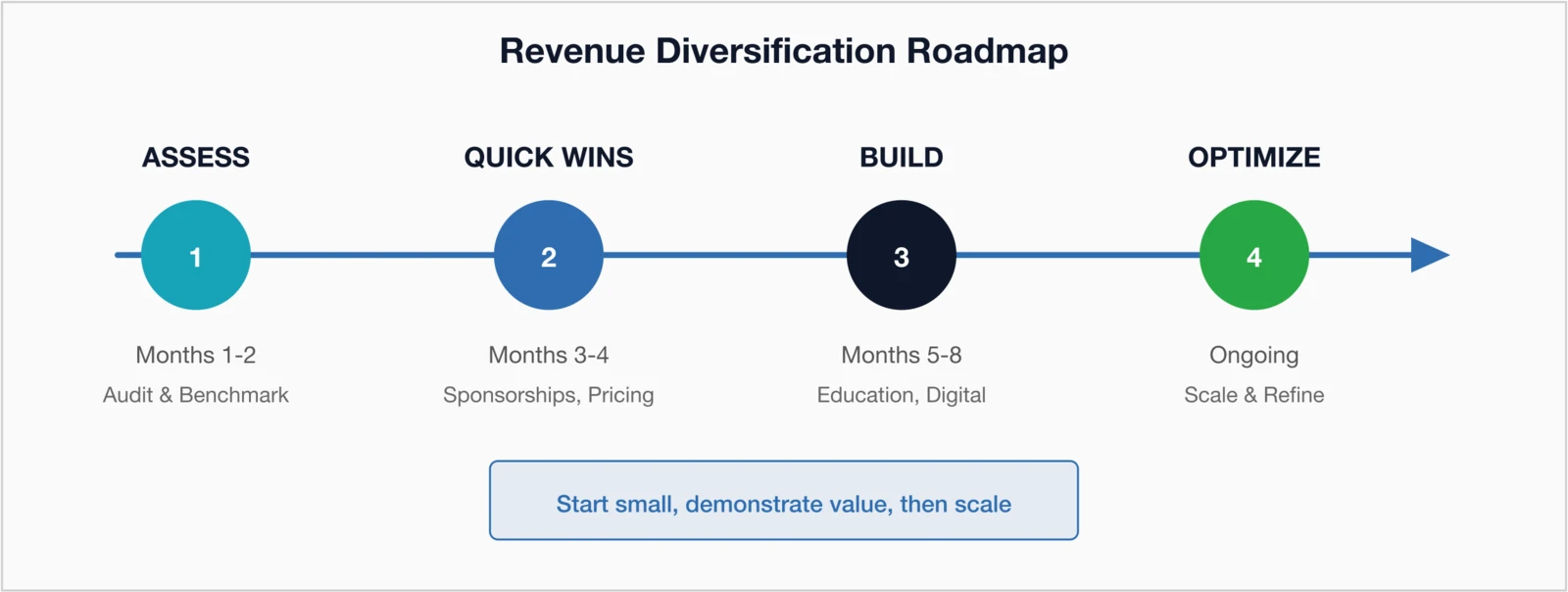
Phase 1: Assessment (months 1-2)
- Audit streams, benchmark peers
- Member surveys, staff/tech evaluation
Phase 2: Quick wins (months 3-4)
- Sponsorship expansion
- Pricing differentials, ad inventory
- Basic affinities
Phase 3: Program development (months 5-8)
- Education/certifications
- Digital products, corporate training
Phase 4: Optimization (ongoing)
- Performance analysis, A/B pricing
- Scale successes, sunset failures
Frequently asked questions
Building sustainable financial health
Non-dues revenue builds the foundation for innovation, member service, and mission impact—transforming associations from dues-dependent to resilient leaders.
The associations I work with that succeed at diversification share one trait: they start before they feel ready. They pick one or two strategies from this guide, implement them this quarter, and build from there. Perfection is the enemy of progress here. A modest sponsorship program launched today beats a comprehensive strategy still in planning next year.
Prioritize your mix, launch value-aligned programs, and watch dues dependency drop in 2-3 years.
Explore: All Non-Dues Revenue Articles — Full library of revenue strategies.
Ready to scale?
i4a's AMS streamlines event registrations, e-commerce, and reporting—so your team can focus on growing revenue, not managing systems.
Schedule a Free DemoRelated resources
Association Management Platform
Explore how an integrated platform streamlines revenue operations.
Protect your dues revenue with proven retention strategies.
Association Event Management Guide
Maximize event revenue through strategic planning and promotion.
