Quick Summary: Conference Planning Timeline
- Start 12 months out: Venue and dates come first—everything else builds on these critical early decisions.
- Six phases cover everything: Foundation, Build-out, Promotion, Final Prep, Event Week, and Post-Event follow-through.
- Early bird drives registrations: The early bird deadline is your most powerful marketing moment for creating urgency.
- Lock logistics 2 weeks out: All vendor orders, catering counts, and materials should be finalized by then.
Part of our Comprehensive Association Event Management Guide
A conference planning timeline keeps your team from scrambling and missing deadlines. This 6-phase, 12-month checklist covers venues, speakers, registration, marketing, logistics, and post-event follow-up—so nothing falls through the cracks.
The stakes are high. According to Sequence Consulting's 2026 Association Trends Report, events remain the primary driver of member engagement and non-dues revenue for most associations.
Over the years, I've watched associations turn chaotic, last-minute planning into smooth, repeatable systems. The difference almost always comes down to one thing: a clear, shared timeline. When your team knows exactly what's due and when, you can focus on delivering an exceptional experience instead of scrambling to fix what was overlooked.
This 12-month framework works for conferences of any size—from 200-person regional summits to 2,000-person annual meetings. Follow these phases and milestones—alongside a robust event management software platform—and you'll deliver a successful conference without the last-minute chaos.
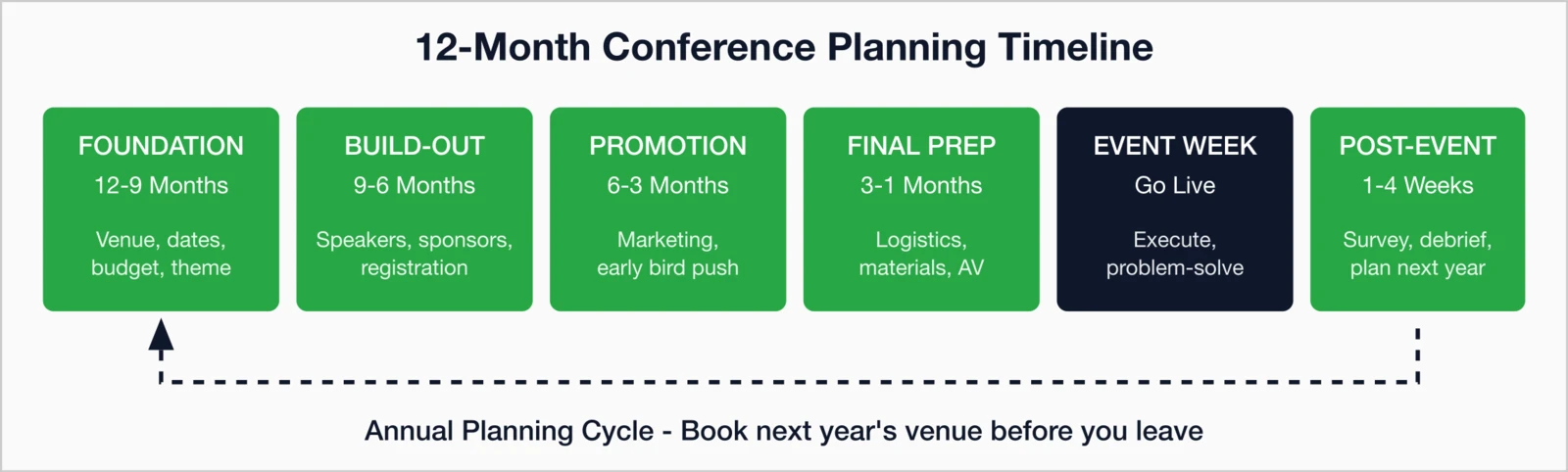
Phase 1: Foundation (12-9 months out)
This phase anchors your entire project. Strong early decisions about venue, timing, and budget will make or break your conference's success.

Venue and date selection
Your venue choice affects everything—from AV setup to attendee satisfaction. A site that looks ideal on paper can quickly become a headache if wireless access, catering, or room flow don't match your needs.
- Confirm dates: Check for conflicts with holidays, industry events, and competitor conferences
- Do a site visit: Never book without walking the rooms you'll actually use
- Negotiate room blocks: Secure hotel rooms with a fair cutoff date
- Check accessibility: Ensure ADA compliance and attendee ease of movement
A deeper look: Venue contract negotiation
Venue contracts are often where associations lose money or assume unnecessary risk. Everything is negotiable, and first drafts always favor the venue.
Attrition clauses are among the most common sources of post-event disputes. Match contracted room blocks to your actual historical pickup rates to avoid penalty fees. Many associations get burned by optimistically projecting attendance, then facing significant attrition fees when reality doesn't match.
Food and beverage minimums can be equally treacherous. Don't assume "free meeting space" is a deal—calculate your per-attendee spend. If your event is primarily sessions with a single lunch, you may be better off paying for meeting space outright.
A few other contract items worth negotiating:
- Cancellation tiers: Push for a sliding scale rather than a flat penalty
- Force majeure language: Post-2020, ensure it covers pandemics, travel bans, and local restrictions
- Wi-Fi and AV costs: Confirm bandwidth guarantees; "complimentary" often means slow
- Comp room ratios: Push for better ratios when you have leverage
- Early departure fees: Negotiate these down or out entirely
The best time to negotiate? When you still have options. Solicit two or three proposals and let venues know you're comparing offers.
Budget development
Realistic financial planning is essential. Most associations build in a 10-15% contingency for unexpected costs.
- Revenue: Registration, sponsorship, exhibitor, and advertising income
- Fixed costs: Venue, catering, AV, and deposits
- Variable costs: Meals, materials, badges, and on-site expenses
- Benchmarks: Review historical data for reliable baselines
Theme and program framework
- Conference theme: Choose something memorable that ties sessions together
- Content structure: Define tracks based on your members' interests
- Session types: Include variety—keynotes, breakouts, workshops, and networking
- Call for proposals: Launch early if your program draws from member submissions
Pro Tip: If you're locked into a seasonal schedule or popular destination, book your venue 18+ months ahead. Prime dates disappear fast.
Phase 2: Build-out (9-6 months out)
With your foundation set, shift focus to the conference elements that make it compelling—content, sponsorships, and registration.

Speaker recruitment
Secure your keynote speakers early; they book months in advance.
- Keynotes and sessions: Invite or review submissions for relevant expertise
- Agreements: Clarify deliverables, AV needs, and compensation
- Marketing materials: Collect headshots, bios, and finalized session descriptions
Sponsorships and exhibits
Sponsors need time to plan and allocate budgets, so start outreach early.
- Prospectus: Clearly outline sponsorship tiers and booth options
- Layout: Finalize exhibit hall maps and booth allocations
- Outreach: Start with past sponsors before targeting new leads
- Contracts: Lock in commitments with signed agreements and deposits
Registration setup
A clear registration process sets the tone for professionalism.
- Pricing: Define early bird, regular, and late rates
- Membership value: Offer clear price advantages for members
- Form design: Capture only essential attendee details
- Session selection: If attendees choose sessions, build that into registration
- Payment and confirmation: Set up automated receipts and event reminders
Using an integrated event management platform streamlines the entire process—registration data flows directly into your member database without manual re-entry.
Phase 3: Promotion (6-3 months out)
Now it's time to drive registrations and build excitement. The early bird phase is your most powerful momentum point.

Marketing campaign launch
A multi-channel approach works best:
- Email: Announce "save the date," open registration, reminders, and deadline alerts (see our event promotion email templates)
- Website: Include agenda, speaker details, and registration links
- Social media: Highlight sessions, speakers, and testimonials
- Direct outreach: Personal invitations to key members and past attendees
- Partnerships: Encourage sponsors and exhibitors to promote through their networks
Industry benchmarking data confirms email remains the most effective channel for driving event registrations, outperforming social media and paid advertising.
Early bird push
The early bird deadline is one of your most powerful marketing moments. Expect registration spikes in the days leading up to the deadline.
- Countdown messaging: "Only 7 days left for early bird pricing"
- Value reinforcement: Remind them what they'll miss by not attending
- Social proof: "Join 400+ colleagues who have already registered"
- Boss letter templates: Help attendees justify the expense to supervisors
A deeper look: The psychology behind early bird pricing
Early bird pricing isn't just about giving a discount—it's about understanding how your members make decisions. Most people need external deadlines to take action. Without urgency, conference registration gets pushed to "later," and later often becomes never.
The most effective early bird campaigns create what behavioral economists call "loss aversion." Losing $100 in savings feels more significant than gaining $100 in value, even though they're mathematically equivalent. Framing the deadline as "Save $100 before March 15" creates urgency and prompts action.
Timing your early bird deadline matters more than most associations realize. Set it too early (5+ months out) and people haven't started thinking about their conference schedule yet. Set it too late (less than 6 weeks out) and you compress your marketing window. The sweet spot for most associations is 3-4 months before the event—close enough to feel real, far enough to allow planning.
A typical registration push sequence looks like:
- 30 days out: Announce key sessions and speakers
- 14 days out: Use social proof (e.g., "250 members already registered")
- 7 days out: Bold reminders emphasizing savings
- 2-3 days out: "Last chance" messaging with testimonials
- Deadline day: Final-hours reminder, ideally sent twice
Consider extending early bird pricing by 48 hours for those who click but don't complete registration—most modern systems can automate this follow-up. This personal touch can recover a meaningful portion of those abandoned registrations.
Finally, make sure your pricing tiers tell a story. If regular pricing is only $25 more than early bird, there's no urgency. A meaningful gap gives people a real reason to act now.
Program finalization
Lock in the details for the attendee experience.
- Agenda: Finalize sessions, times, and room assignments
- Program guide: Begin design or launch a digital version
- Mobile app: Load speaker bios and schedules
- Continuing education: Submit CEU/CME applications early
Phase 4: Final preparation (3-1 months out)
This phase shifts from strategy to execution. Details, communication, and teamwork keep everything on track.

Vendor coordination
Confirm every order, service, and setup requirement.
- AV and catering: Test-run technical setups; confirm menu counts
- Decor and signage: Order sponsor banners and directional signs
- Photography: Share key shot lists and event highlights
- Transportation: Arrange shuttles if needed
Materials and communications
Prepare physical and digital materials in advance:
- Badges and name tents: Design and prepare for printing
- Program books: Printed or digital schedules
- Sponsor recognition: Logos and signage placement
- Pre-event emails: What to expect, what to bring, logistics
- Mobile app reminders: Push attendees to download
Staff and volunteer prep
- Assign roles and shifts: Who's responsible for what on-site
- Host a walkthrough: Pre-event briefing for logistics
- Share contact lists: Emergency contacts for rapid communication
- Recruit volunteers: Session monitors, registration help, greeters
Two Weeks Out: Lock all orders and counts. Post-deadline changes often incur rush fees or limited availability. Get final registration numbers to the venue for catering guarantees.
Phase 5: Event week
Execution replaces planning. Your goal: smooth operations and quick problem-solving.

Day before: Setup
- Walk through every room: Confirm AV setups and room configurations
- Prepare check-in stations: Badges organized and ready (see our badge printing and check-in guide)
- Place signage: Directional signs and sponsor materials
- Hold a final team briefing: Walk through the schedule with staff
During the event
Stay flexible and visible.
- Manage check-ins: Handle registrations and walk-ups
- Support speakers: Ensure rooms are ready and troubleshoot issues
- Monitor sessions: Track attendee flow and room capacity
- Coordinate staff: Use radios or group chat for real-time communication
- Engage on social media: Post highlights for real-time amplification
Modern registration systems handle walk-ups, payment processing, and badge printing on the spot—eliminating long lines and frustrated attendees.
Event wrap-up
Immediately after the event:
- Handle lost and found: Collect and catalog items
- Review invoices: Settle vendor accounts and note any issues
- Collect materials: Gather leftover badges, programs, supplies
- Take quick debrief notes: Capture details while they're fresh
Phase 6: Post-event (1-4 weeks after)
Follow-through completes your event and sets up future success.

Week 1: Follow-up
- Send thank-you emails: Attendees, sponsors, speakers, and volunteers
- Distribute post-event surveys: Send promptly while the experience is fresh
- Share event photos or recordings: Post to your website and social channels
- Issue CEU/CME certificates: If applicable
Weeks 2-3: Analysis
- Review feedback: Compile and analyze survey data
- Finalize event financials: Revenue and expense accounting
- Produce sponsor reports: Deliver promised metrics and exposure data
- Conduct staff debrief: Document lessons learned
Week 4: Future planning
- Record lessons learned: Key takeaways for next year
- Evaluate venue performance: Decide if you'll return or look elsewhere
- Secure next year's date and space: Book early for recurring events
- Celebrate your team: Acknowledge staff and volunteer contributions
Measure What Matters: Track metrics year over year—attendance, satisfaction, revenue, and sponsor renewals—to measure progress and improvement.
Common pitfalls and how to avoid them
| Pitfall | Why It Happens | How to Avoid It |
|---|---|---|
| Starting too late | Underestimating lead times | Begin 12-18 months out |
| Scope creep | Adding without budget updates | Freeze scope four months before |
| Weak promotion | Assuming members will register | Plan at least 10 touchpoints |
| AV surprises | Skipping technical surveys | Test everything the day before |
| Food count errors | Flawed registration data | Track dietary needs carefully |
| Staff burnout | Poor workload balance | Recruit and train volunteers early |
| No follow-up | Team exhaustion | Pre-schedule emails and surveys |
Technology that simplifies planning
An integrated event management solution eliminates manual processes and errors. Look for tools that include:
- Unified registration and payment processing: One system for sign-ups, sessions, and payments
- Automated email sequences: Pre-event reminders, confirmations, and follow-ups
- Real-time dashboards: Registrations and revenue without spreadsheet work
- Walk-up registration: Handle day-of registrations seamlessly
- Member database integration: Seamless data flow into member records
i4a's platform includes all these features—with unlimited events and no per-attendee fees—making costs predictable regardless of event size.
Printable timeline checklist
Use this checklist to ensure nothing falls through the cracks. Print it, share it with your planning committee at your first meeting, assign owners to each phase, and review progress at regular check-ins.
Phase 1: Foundation (12-9 Months Out)
- Confirm event dates (check for conflicts with holidays and competing events)
- Research and visit potential venues
- Negotiate and sign venue contract
- Secure hotel room blocks
- Develop preliminary budget
- Define conference theme and content tracks
- Launch call for proposals (if applicable)
Phase 2: Build-Out (9-6 Months Out)
- Invite and confirm keynote speakers
- Review and select session proposals
- Collect speaker bios, headshots, and session descriptions
- Create sponsorship prospectus and begin outreach
- Finalize exhibit hall layout and booth assignments
- Set up registration system with pricing tiers
- Launch registration with early bird pricing
Phase 3: Promotion (6-3 Months Out)
- Launch email marketing campaign
- Publish event website with full agenda and speaker details
- Promote on social media channels
- Send early bird deadline reminders
- Finalize session schedule and room assignments
- Submit CEU/CME applications (if applicable)
- Begin program guide design
Phase 4: Final Preparation (3-1 Months Out)
- Confirm all AV and catering orders
- Order signage, banners, and printed materials
- Prepare attendee badges and name tents
- Send pre-event emails with logistics and schedules
- Assign staff roles and create shift schedules
- Brief volunteers and conduct training
- Finalize catering counts (2 weeks out)
- Confirm transportation and shuttle arrangements
Phase 5: Event Week
- Walk through all rooms and verify AV setups
- Set up registration and check-in stations
- Place directional signage and sponsor materials
- Hold final staff briefing
- Manage on-site check-ins and walk-up registrations
- Monitor sessions and troubleshoot issues
- Post real-time updates on social media
- Collect lost and found items
Phase 6: Post-Event (1-4 Weeks After)
- Send thank-you emails to attendees, speakers, and sponsors
- Distribute post-event survey
- Share event photos and session recordings
- Issue CEU/CME certificates
- Compile and analyze survey feedback
- Finalize event financials
- Deliver sponsor reports and metrics
- Conduct staff debrief and document lessons learned
- Secure next year's venue and dates
Your conference planning roadmap
Successful conferences don't happen by chance—they're built on systems. This timeline equips your team to:
- Secure venues and dates before they disappear
- Confirm speakers and sponsors with time to prepare
- Build sustained marketing momentum
- Eliminate last-minute stress
- Capture insights that raise the bar each year
The best event planners treat every conference as a learning cycle, documenting wins, misses, and improvements. Over time, this discipline turns good events into great ones.
For more detailed guidance on specific topics, explore our full Association Event Management Guide.
Key takeaways
- Start planning 12 months out: Venue and dates come first—everything else builds on these
- Open registration 6 months early: Compelling early bird pricing creates urgency and aids cash flow
- Confirm speakers 4 months before: Finalize your program before promoting specific content
- Lock logistics and orders 2 weeks out: All vendor details and materials should be set
- Follow up within 2 weeks: Survey and debrief your team while the experience is fresh (see our post-event follow-up guide)
Need Help Planning Your Next Conference?
i4a's event management tools handle registration, payments, session tracking, and attendee communications—all integrated with your membership database. Let's talk about making your next event your best one yet.
Talk to Us About EventsRelated resources
Association Event Management Guide
Comprehensive guide covering registration, pricing strategies, CEU tracking, and day-of execution for association conferences.
See how i4a handles unlimited events and registrations with integrated payments and member database sync.
9 Event Registration Best Practices
Optimize your registration process to boost attendance and reduce friction.
Maximize conference revenue through sponsorships, exhibits, and premium offerings.
