Quick Summary: Event Management for Associations
- Events drive retention: Members who attend events renew at significantly higher rates—treat events as engagement infrastructure, not just revenue opportunities.
- Start 12 months out: Secure venue and set goals 12-9 months ahead; open registration 6-9 months out; finalize logistics 3 months before.
- Reduce registration friction: Pre-populate member data, offer mobile-friendly forms, use tiered early-bird pricing, and enable group registration.
- Track CEU/CME at session level: Apply for accreditation 3-6 months ahead, scan attendance per session, and automate certificate delivery post-event.
- Measure beyond revenue: Track registration conversion, attendance rate, repeat attendance, and renewal rates of attendees vs. non-attendees.
Events as member value drivers
Events aren't just dates on a calendar—they're the heartbeat of your association. They turn membership into a lived experience, connecting professionals who might otherwise only interact digitally. Well-designed events reinforce your mission, spotlight thought leadership, and generate meaningful revenue. But with attendance patterns shifting, the challenge is to make every gathering worth the trip.
The numbers tell a clear story. According to Sequence Consulting's 2026 Association Trends report, just 53% of associations saw stable or rising event attendance in 2024—down from 62% in 2023. Meanwhile, MGI's 2025 Association Outlook Report notes that more than half of associations still emphasize conferences and meetings as a top membership benefit. The gap between expectation and reality makes intentional event design more important than ever.
Members who attend events are far more likely to renew. Participation transforms casual members into engaged advocates who feel connected to peers and to your mission. In my experience working with associations over three decades, the pattern is remarkably consistent: the members who show up are the members who stay. When you treat events as engagement infrastructure rather than standalone revenue opportunities, everything shifts. The right event management platform brings order to that complexity.
Common event types
- Annual conference: The flagship event and major non-dues revenue source
- Educational seminars: Focused, topic-specific sessions with recurring cadence
- Webinars: Cost-efficient virtual learning
- Chapter meetings: Regional networking and training
- Leadership summits: Intensive board or committee development
- Certification programs: Multi-day credentialing or skills training
- Social gatherings: Networking and community-building events
This guide covers association event planning principles and event management best practices that apply across event types, with particular emphasis on conferences and professional education logistics.
Event planning timeline: 12-month checklist
Behind every smooth, well-attended conference is a long runway of planning. Securing venues, speakers, sponsors, and technology takes foresight and coordination across multiple teams. A proactive timeline not only prevents last-minute chaos but also creates room for creativity, marketing momentum, and logistical precision. This 12-month roadmap walks you through the key milestones that set your event up for success—scale it down for smaller gatherings.
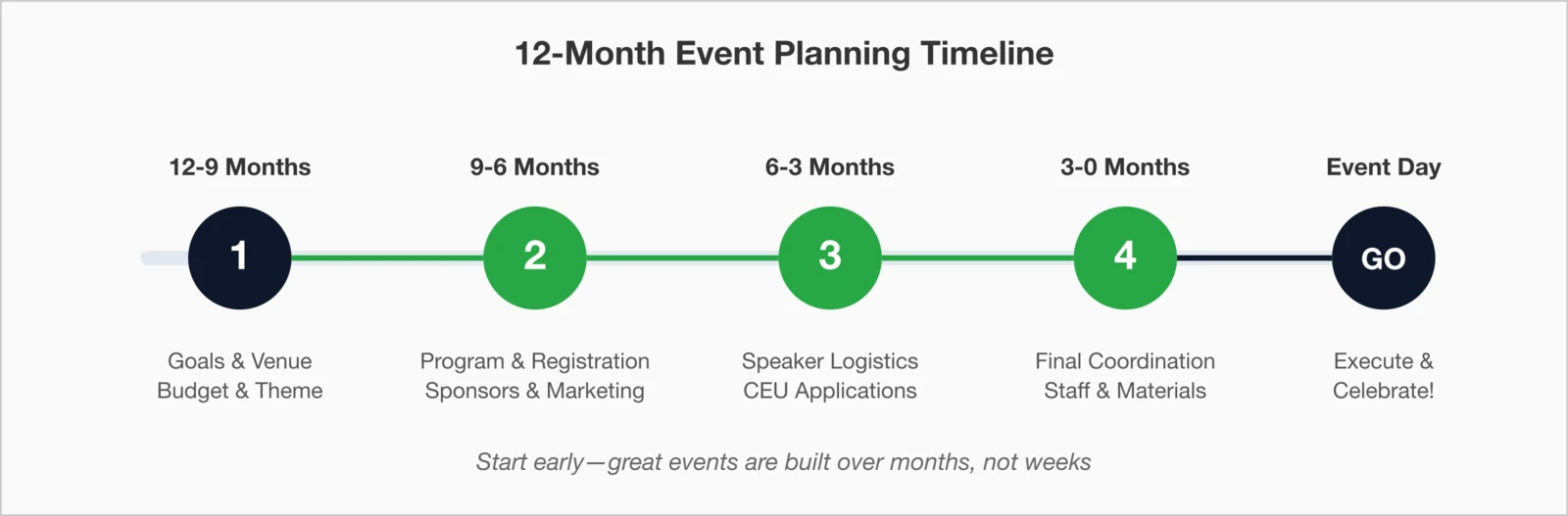
12-9 months before
- Set event goals: Attendance targets, revenue expectations, educational objectives
- Confirm date and venue: Contract negotiations, deposit payment
- Establish budget: Revenue projections, expense estimates, contingency reserve
- Theme and programming: Overall conference theme, track structure
- Call for speakers/abstracts: Open the submission process. Use abstract submission software to manage the review workflow.
9-6 months before
- Finalize program: Session selection, speaker confirmations
- Open registration: Early bird pricing, marketing launch
- Sponsor/exhibitor sales: Prospectus distribution, contract negotiations
- Marketing campaign: Develop event promotion strategies including email sequences, social media, and website updates
- Hotel room blocks: Negotiate rates, reservation system setup
6-3 months before
- Speaker logistics: AV requirements, presentation deadlines, travel arrangements
- Registration push: Targeted outreach to non-registrants
- Sponsor fulfillment: Logo collection, booth assignments, ad materials
- Mobile app setup: Content loading, schedule builder, networking features
- CEU/CME applications: Submit for credit approval
3 months to event
- Final venue coordination: Room setups, catering orders, AV specifications
- Staff assignments: Roles, schedules, training
- Signage and materials: Badges, programs, banners
- Final registration push: "Last chance" messaging
- Attendee communications: Pre-event logistics, travel tips, what-to-expect guides
Week of event
- Final confirmations: Catering counts, room setups, AV checks
- Staff briefings: Run-of-show review, emergency procedures
- On-site setup: Registration desk, signage, sponsor booths
- Speaker check-ins: Presentation uploads, AV rehearsals
Registration best practices
Your registration page is your first impression—and your first conversion test. Following event registration best practices is critical: every extra click or confusing field increases the chance an attendee gives up before completing the form. A frictionless, mobile-friendly process inspires confidence and sets the tone for a well-organized event. Below, we'll break down how to minimize roadblocks, boost conversions, and turn sign-ups into excitement.
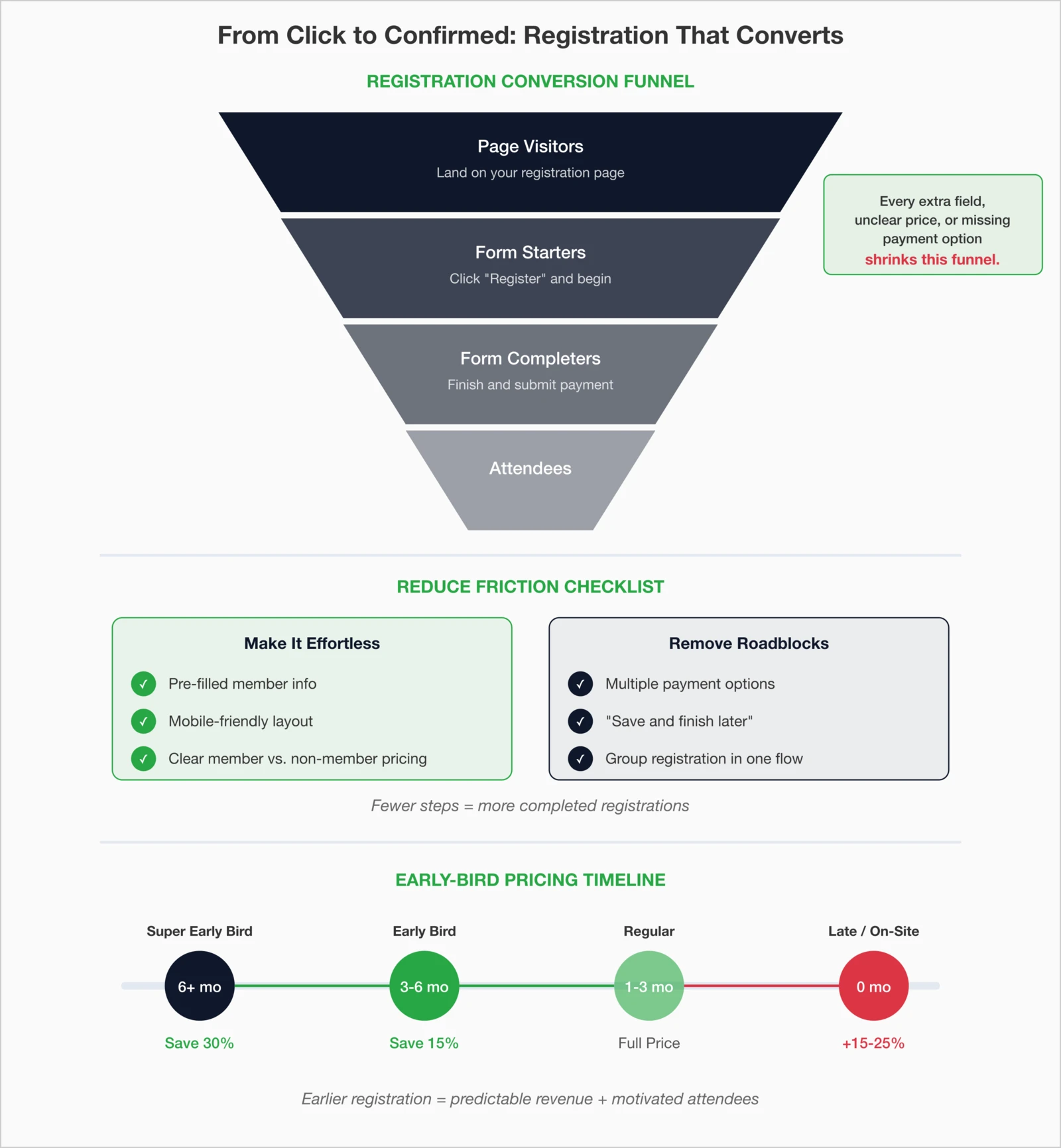
Reduce friction
- Pre-populate member data: If attendees are logged in, don't ask for information you already have—integrated membership software makes this automatic
- Mobile-friendly forms: A sizable share of registrations happen on phones
- Clear pricing: No confusion about what's included; member and non-member rates visible at a glance
- Multiple payment options: Credit card, invoice, purchase order for corporate registrants
- Save and return: Let people start registration and finish later
- Group registration: A simple process for organizations registering multiple attendees
Optimize for conversion
- Early bird deadlines: Create urgency with clear dates and savings amounts
- Countdown timers: Visual urgency on registration pages
- Social proof: "X people have already registered" messaging
- Easy session selection: Clear descriptions, no scheduling conflicts
- Confirmation clarity: Immediate confirmation email with all details
Registration timeline best practices
- Super early bird: 6+ months out—deepest discount
- Early bird: 3-6 months out—moderate discount
- Regular pricing: 1-3 months out—standard rate
- Late/on-site: Premium pricing
Event pricing strategies
Getting pricing right is a balancing act. Price too low and you risk undercutting perceived value; go too high and you alienate potential attendees. More than revenue, pricing communicates how much membership itself is worth. Well-structured tiers and thoughtful member differentials can transform registration into a recruitment tool. Here's how to strike that balance while optimizing event ROI.
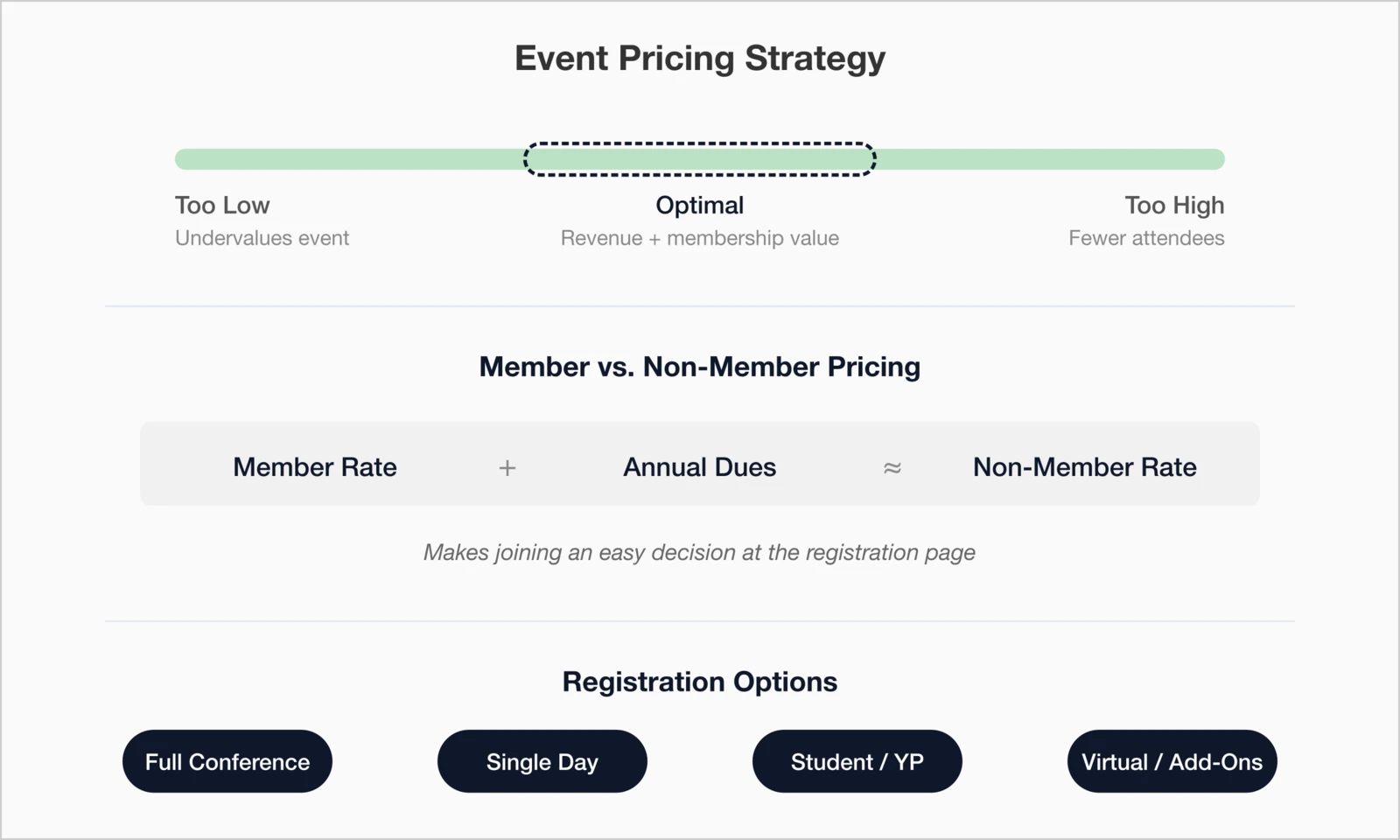
Member vs. non-member pricing
The gap between member and non-member rates signals how much membership matters:
- Too small: Little incentive to join
- Optimal range: Clear membership value while non-members can still justify attending
- Too large: Non-members priced out entirely
Best practice: Set non-member pricing so that membership dues plus the member event rate roughly equals the non-member event rate. That makes joining an easy decision.
Register and Join in One Step
i4a's event registration lets non-members join your association and register for the event in a single transaction—automatically applying member pricing. Learn more about i4a event management.
Pricing tiers
- Full conference: All sessions, meals, networking events
- Single day: For attendees unable to stay the full run
- Student/young professional: Reduced rate to encourage early-career participation
- Group discounts: Savings for organizations registering multiple attendees
- Speaker/sponsor comp: Complimentary registration for contributors
Revenue optimization
- Add-on workshops: Pre- or post-conference deep dives at additional cost
- Premium experiences: VIP dinners, executive tracks, special tours
- Recordings: Sell access to session recordings after the event
- Virtual attendance: Lower-priced option for remote participation
CEU/CME tracking for professional events
Continuing education has become a cornerstone benefit for professional associations. Members don't just attend for inspiration—they attend to maintain credentials that advance their careers. Offering recognized credits like CEUs or CMEs elevates your event and strengthens member loyalty. This section explores how to manage accreditation, track attendance accurately, and deliver a seamless credit-earning experience.
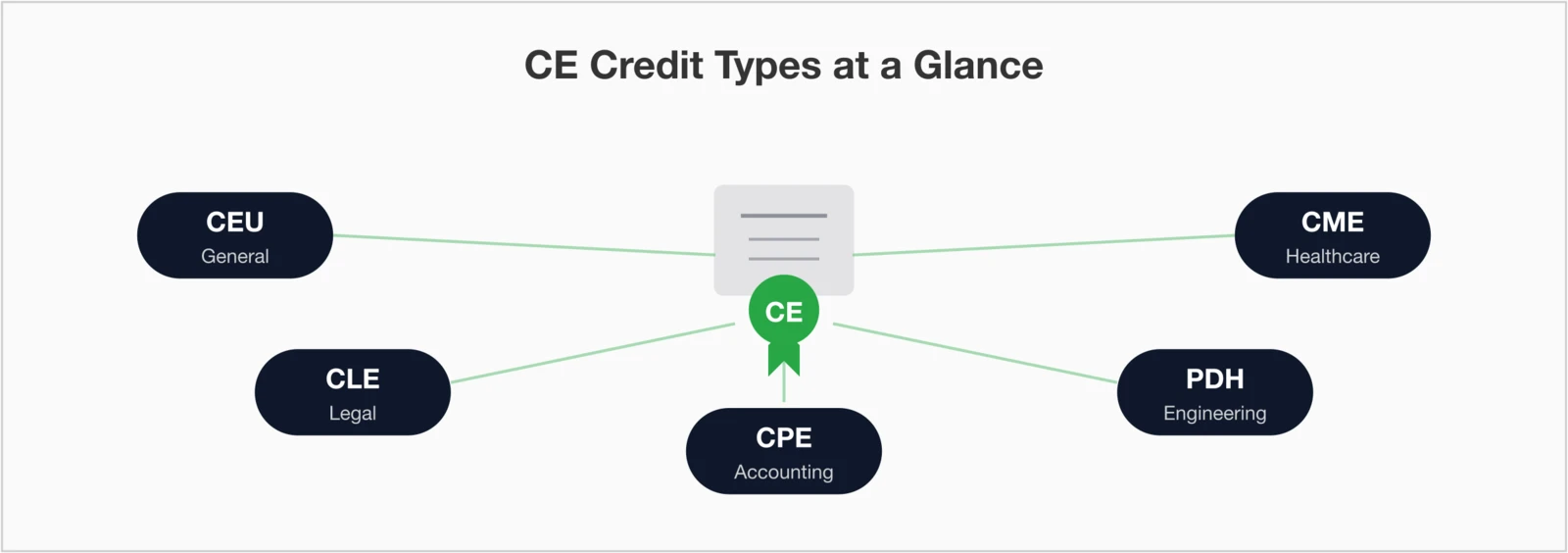
Types of continuing education
- CEU (Continuing Education Unit): General professional development
- CME (Continuing Medical Education): Healthcare professionals
- CLE (Continuing Legal Education): Attorneys
- CPE (Continuing Professional Education): Accountants
- PDH (Professional Development Hours): Engineers
Requirements vary by profession. Medical associations often need accredited CME programs with strict documentation and board reporting. Professional associations across industries use CE as both a member benefit and a retention driver. Even trade associations increasingly offer training that helps members meet compliance mandates.
Credit administration
- Apply for accreditation: Submit sessions to the approving body three to six months ahead
- Track attendance: Session scanning or sign-in sheets for verification
- Issue certificates: Automated delivery post-event with required session details
- Report to boards: Submit completion data to licensing authorities
- Maintain records: Keep attendance documentation for audit periods
Technology requirements
Effective CEU tracking requires:
- Session-level attendance tracking (not just overall event check-in)
- Integration with member records for ongoing credit accumulation
- Automated certificate generation with required information
- Reporting for both members and accrediting bodies
Day-of logistics and check-in
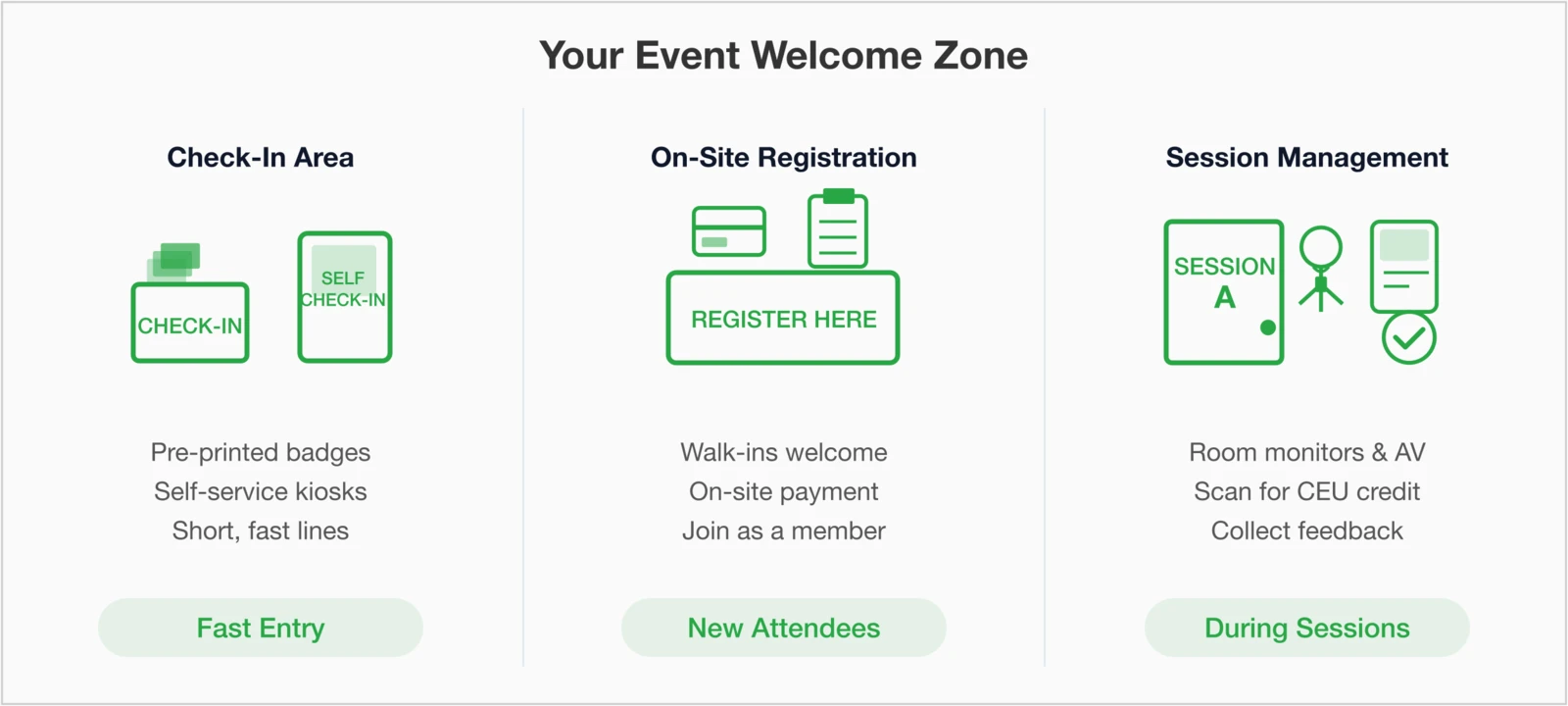
The day your event begins is when all your preparation meets reality. Every detail—from signage placement to badge printing—impacts how attendees feel about your organization's professionalism. Smooth check-in lines, confident staff, and working tech turn behind-the-scenes coordination into visible competence. Here's how to prepare your team and systems for a flawless on-site experience.
Check-in best practices
- Pre-printed badges: Have badges ready for pre-registrants to minimize lines
- Self-service kiosks: Let attendees check in and print badges themselves
- Separate lines: Pre-registered attendees versus on-site registration
- Staff training: Everyone should know how to handle common issues
- Technology backup: Have contingency plans for system outages or connectivity problems
On-site registration
- Accept walk-ins: Maintain a process for on-site sign-ups
- Payment options: Credit card processing available on the spot
- Materials availability: Sufficient badges, programs, and bags
- Membership conversion: Make it easy to join the association on-site
Session management
- Room monitors: Staff to assist speakers and manage attendee flow
- AV support: Technicians assigned per room or a quick-response team
- Attendance scanning: CEU tracking at the session level
- Evaluation collection: Feedback forms—paper or digital—distributed immediately after each session
Post-event follow-up
What happens after the closing session often matters more than what happens on stage. Effective post-event follow-up transforms short-term enthusiasm into long-term engagement. Communication, feedback loops, and personalized outreach can reignite attendees' energy and convert new prospects into loyal members.
Here is something I have seen too often: associations pour enormous energy into producing a great conference, and then go quiet. The momentum built over three days evaporates because no one planned what happens next. The organizations that get the most from their events are the ones that treat the last session as a beginning, not an ending. A thoughtful follow-up sequence can extend the impact of a single event for months—and dramatically increase the likelihood that attendees return.
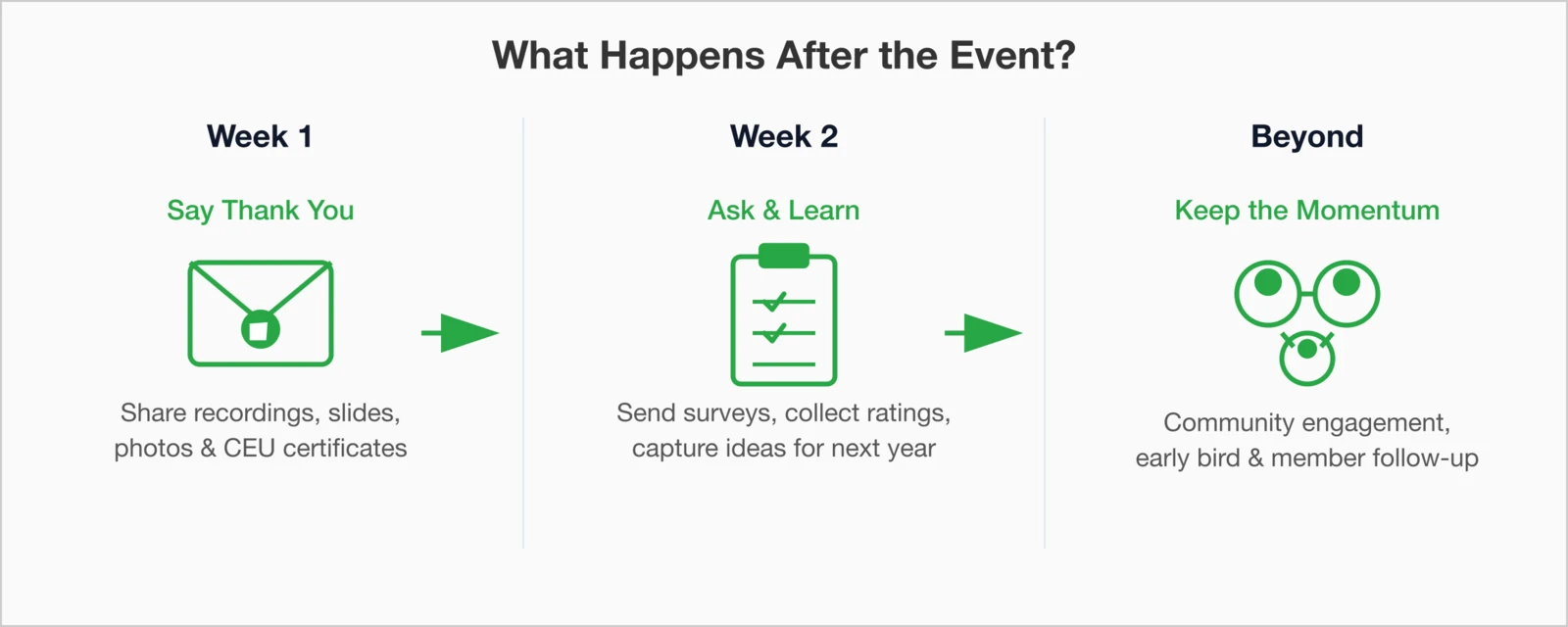
Immediate follow-up (within one week)
- Thank-you email: Express appreciation, reinforce key takeaways
- Session recordings: Provide access to recorded sessions
- Presentation materials: Share slides and handouts
- CEU certificates: Automatic delivery for attendees who earned credit
- Photo gallery: Share event photos for social engagement
Evaluation and feedback (within two weeks)
- Post-event survey: Overall satisfaction, session ratings, logistics feedback
- Session evaluations: Speaker and content ratings
- NPS question: "How likely are you to recommend this event?"
- Open feedback: What would you change? What topics interest you for next year?
Ongoing engagement
- Community continuation: Keep conversations alive in online forums or social channels
- Early bird for next year: Offer special pricing to this year's attendees
- Membership conversion: Follow up with non-member attendees about joining
- Speaker follow-up: Thank speakers and extend early invitations for next year
Measuring event ROI
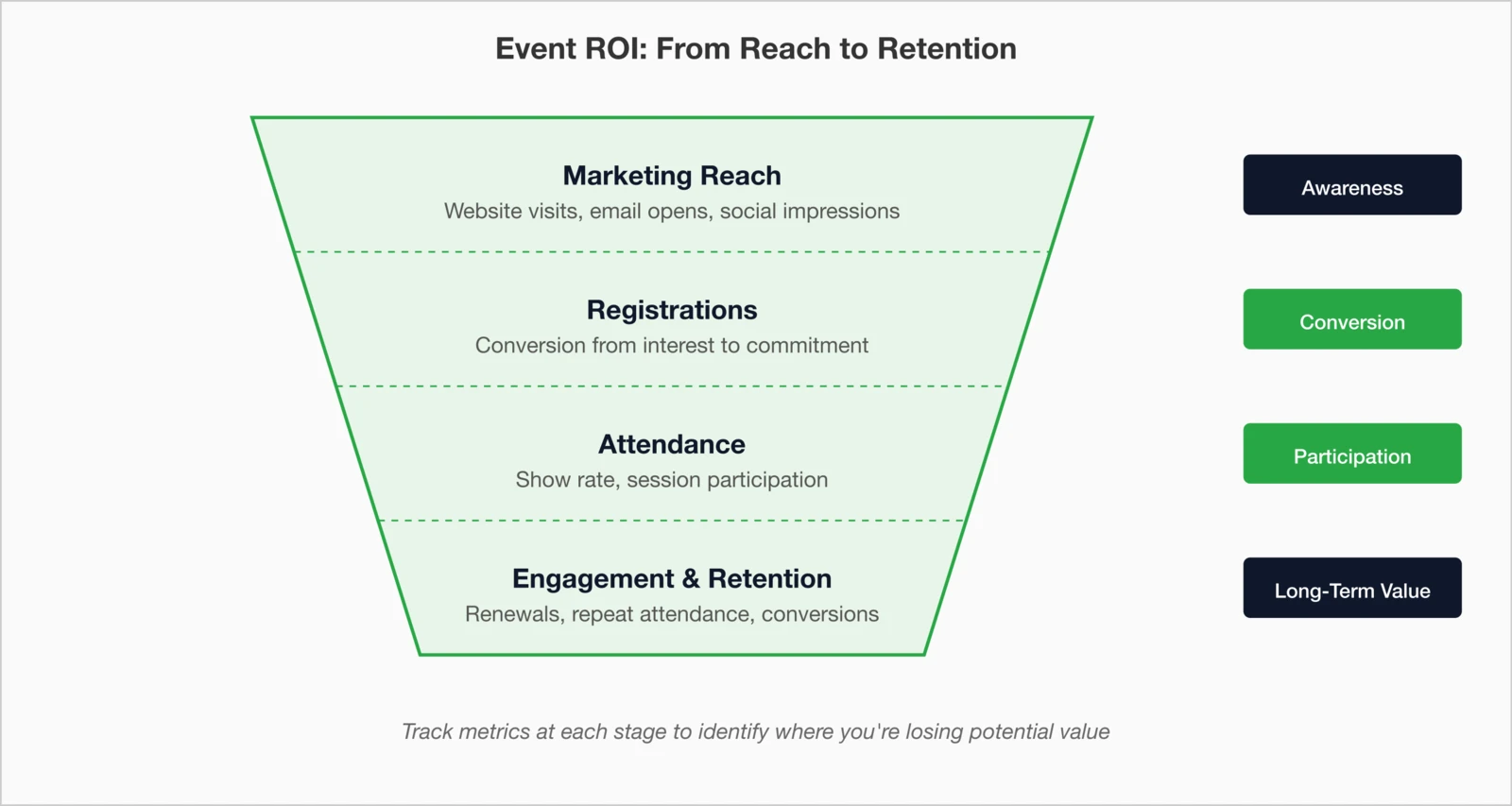
Association events are serious investments in both money and staff hours—so measurement isn't optional. Understanding financial returns, engagement metrics, and member outcomes ensures each event is smarter than the last. Beyond simple revenue reporting, ROI data helps you prove value, justify budgets, and forecast growth. Here's how to track what truly matters across every stage of your event cycle.
Financial metrics
- Revenue: Registration fees, sponsorships, exhibitors, add-ons
- Expenses: Venue, catering, AV, marketing, staff, speakers
- Net revenue: Revenue minus expenses
- Revenue per attendee: Total revenue divided by attendance
- Cost per attendee: Total expenses divided by attendance
Engagement metrics
- Registration conversion: Percentage of website visitors who register
- Attendance rate: Percentage of registrants who actually attend
- Session attendance: Average fill rate across sessions
- App engagement: Downloads, active users, feature usage
- Networking activity: Connections made, meetings scheduled
Long-term impact metrics
- Attendee retention: Renewal rate of attendees compared to non-attendees
- New member conversion: Non-member attendees who subsequently join
- Repeat attendance: Percentage returning the following year
- NPS/satisfaction: Likelihood to recommend the event
Technology for event success
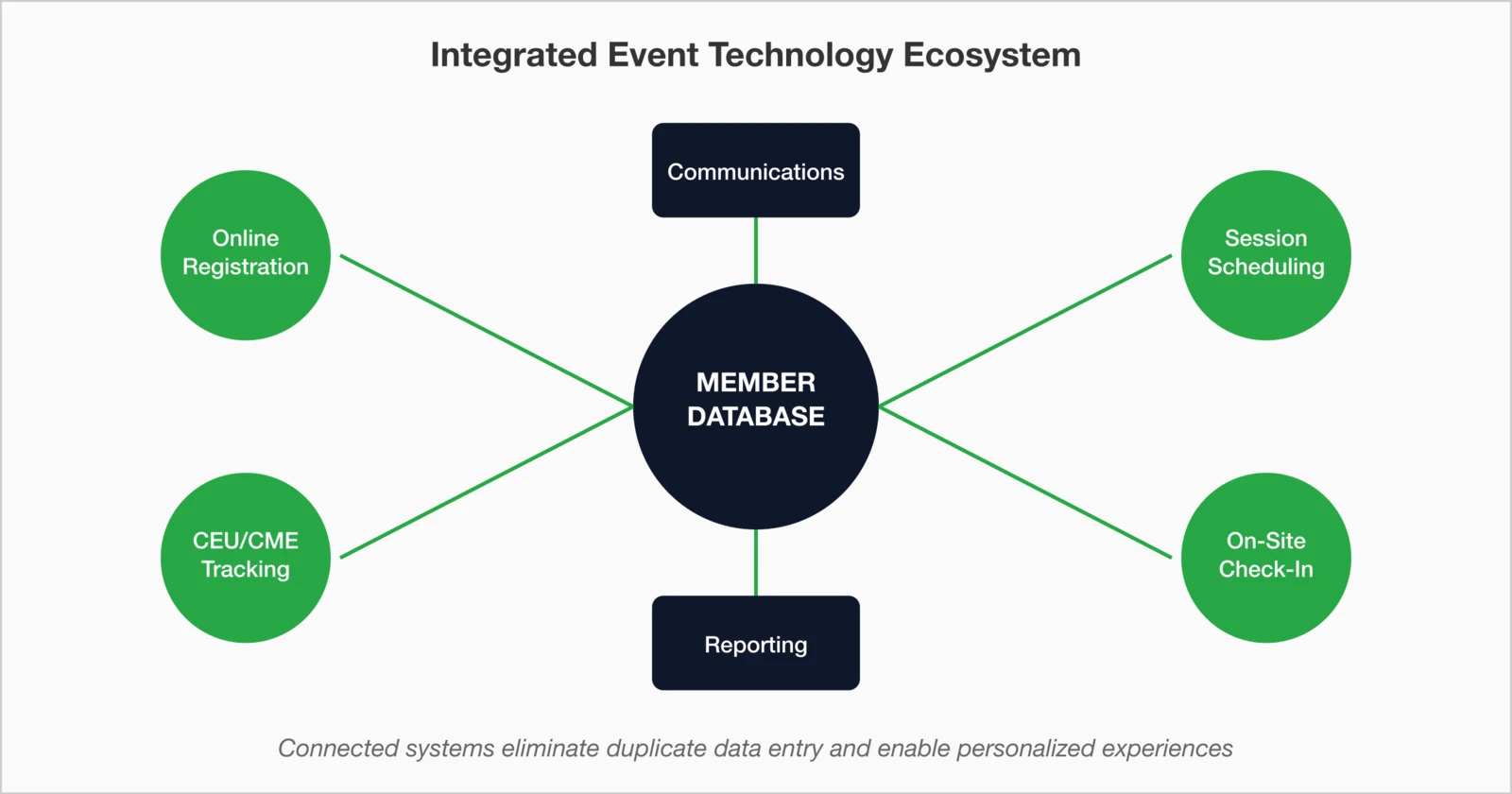
Event success today depends on more than great programming—it depends on connected systems. From registration to CE tracking, technology orchestrates every attendee interaction and fuels efficiency behind the scenes. When your tools talk to one another, staff gain time and members get a smoother, more personalized experience. This section outlines the core technologies that make that integration possible—and why it's the foundation of modern event management.
Essential event technology
- Online registration: Member-aware pricing, session selection, payment processing
- Attendee management: Registration tracking, communications, badge printing
- Session scheduling: Track selection, conflict avoidance, waitlists
- CEU tracking: Session-level attendance, certificate generation
- Mobile app: Schedule, networking, notifications, evaluations
- Check-in: On-site registration, badge printing, session scanning
Integration matters
Event technology should connect with your membership system so that:
- Member pricing is applied automatically
- Attendance history flows to member records
- CEU credits are tracked in member profiles
- Non-member attendee data is available for conversion outreach
I cannot stress this enough: disconnected systems create disconnected experiences. When your event platform does not talk to your membership database, you end up asking members for information you already have, missing opportunities to convert non-member attendees, and losing valuable engagement history. Integration is not a luxury feature—it is the foundation of efficient event operations and personalized member experiences. Every hour your staff spends manually reconciling data between systems is an hour they could have spent making your next event even better.
i4a Event Management
i4a includes integrated event management with member-aware registration, session tracking, CEU administration, and seamless connection to your member database.
Learn About Event FeaturesFrequently asked questions
It depends on your goals. Hybrid events expand reach but add complexity and cost. They work well when members genuinely cannot travel, when you want to sell recordings afterward, or when you're testing content for future virtual-only offerings. Price virtual access well below in-person to avoid cannibalizing on-site attendance.
Deep Dive: Virtual Event Platforms for Associations | Hybrid Event Strategies
Simplify your event management
i4a includes integrated event management—registration, session tracking, CEU credits, and attendee communications—all connected to your member database.
- Member-aware registration with automatic pricing
- Session selection and scheduling
- CEU/CME tracking and certificates
- Badge printing and on-site check-in
Related articles
9 Event Registration Best Practices
Maximize attendance with streamlined registration.
