Quick Summary: Member Engagement Strategies
- Build an engagement ladder: Move members from passive to consumer to participant to contributor to leader—each rung increases retention and loyalty.
- Win the first 90 days: Members who engage during onboarding are far more likely to renew; use automated sequences plus personal touches to drive early wins.
- Score and segment engagement: Assign points to activities like logins, event attendance, and forum posts to identify at-risk members before renewal notices go ignored.
- Create always-on community: Forums, directories, and interest groups fill gaps between events and give members reasons to return year-round.
- Invest in volunteers: Committee members and volunteers are your most loyal members—treat volunteer management as strategically as donor relations.
Why association member engagement strategies drive retention
Effective association member engagement strategies are what separate thriving organizations from those struggling with retention. Engaged members see ongoing value, build relationships, and are far more likely to renew, volunteer, and advocate on your behalf.
Association professionals see this pattern in their own data every day: members who attend events, participate in your online community, or take on volunteer roles renew at much higher rates than members who simply pay dues and disappear. Event attendees, online community participants, and volunteer leaders almost always show stronger loyalty and a higher likelihood of renewal as their engagement deepens. In my experience working with associations over the years, the pattern is remarkably consistent: the members who show up are the members who stay.
According to Sequence Consulting's 2026 Association Trends report, 55% of associations report flat or declining retention, while only 11% describe their value proposition as "very compelling." When engagement is not deliberately designed, many members stay passive: they join with good intentions, receive a welcome email, and then nothing meaningful happens. Newsletters go unread, benefits sit unused, and when renewal time comes, there is no clear reason to stay.
Modern membership platforms make it easier to track engagement, but technology alone does not create meaningful connection. Engagement begins with intentional design: building clear pathways that show members how to connect, participate, and find value over time. Engagement also looks different across association types: professional associations often emphasize career advancement and peer networking, trade associations focus on committees, advocacy, and organizational collaboration, and membership nonprofits frequently connect engagement to mission impact and volunteer opportunities.
Regardless of whether your organization is professional, trade, or mission-driven, one principle holds: engagement is not a single program you bolt on—it is a culture you build. In organizations with strong, consistent renewal, the emphasis is not on chasing engagement metrics, but on delivering genuine value at every touchpoint so that participation follows naturally. This guide walks through how to build the structure that supports a culture of engagement at every stage of the member lifecycle.
The engagement ladder: A core member engagement strategy
To design effective engagement pathways, it helps to recognize that not all engagement is equal. Members operate at different levels of involvement, and each level carries a different retention risk. An engagement ladder framework gives you a simple way to visualize these levels and intentionally help members climb toward deeper participation and stronger loyalty.
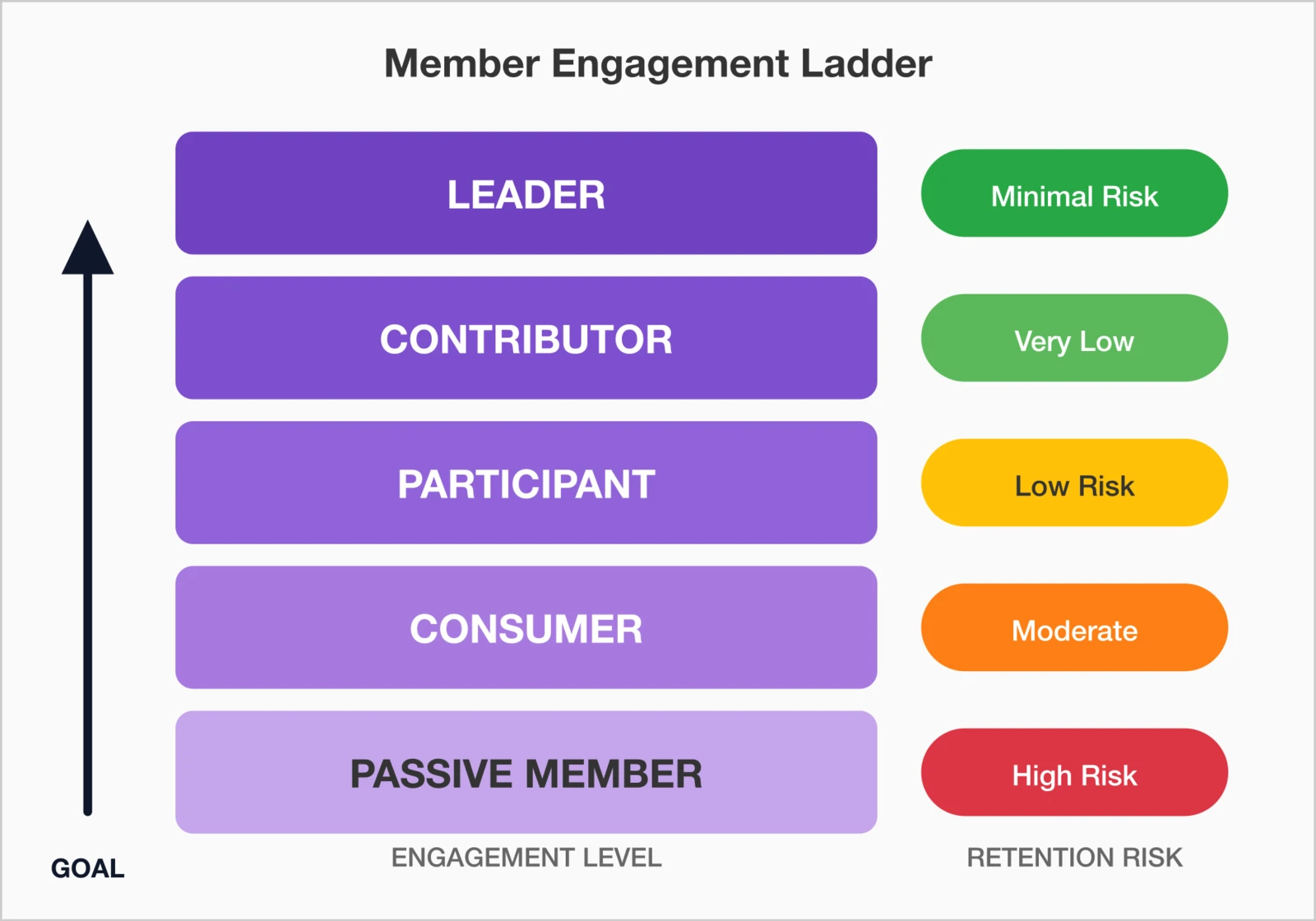
At the bottom of the ladder, passive members pay dues but rarely interact—and they represent your highest churn risk. Above them are content consumers, who read your newsletter and occasionally attend events; these members become participants when you invite them into discussions and community spaces. Participants show up regularly and ask questions, making them ideal candidates for contributor roles such as speakers, writers, or mentors. At the top are leaders who serve on committees and boards; they are deeply invested and rarely leave.
Your job is to create clear, realistic pathways from one rung to the next. The most common misstep is trying to leapfrog members from passive to leader in a single move—it almost never works. Instead, focus on the next small step: help a passive member open one email, help a consumer attend one event, then help a participant share one piece of expertise. Small, visible wins compound into long-term loyalty. Thoughtful gamification techniques can accelerate this progression by making each step on the ladder more visible, rewarding, and fun.
New member onboarding: The first 90 days
Those first 90 days after joining largely determine whether a member becomes a long-term advocate or a one-year-and-done record in your database. Members who engage in their first three months are significantly more likely to renew—yet many associations treat onboarding as a single welcome email and then hope engagement follows.
According to Marketing General's 2025 Membership Marketing Benchmarking Report, the median first-year renewal rate is just 75%, compared with 84% for members overall—a gap effective onboarding is designed to close. Strong onboarding is not about overwhelming new members with every benefit at once. It is about guiding them to early wins: specific, timely experiences that demonstrate value and connection before the novelty of membership wears off. Thoughtful benefits communication during onboarding lays the groundwork for sustained engagement.
The 90-day onboarding journey
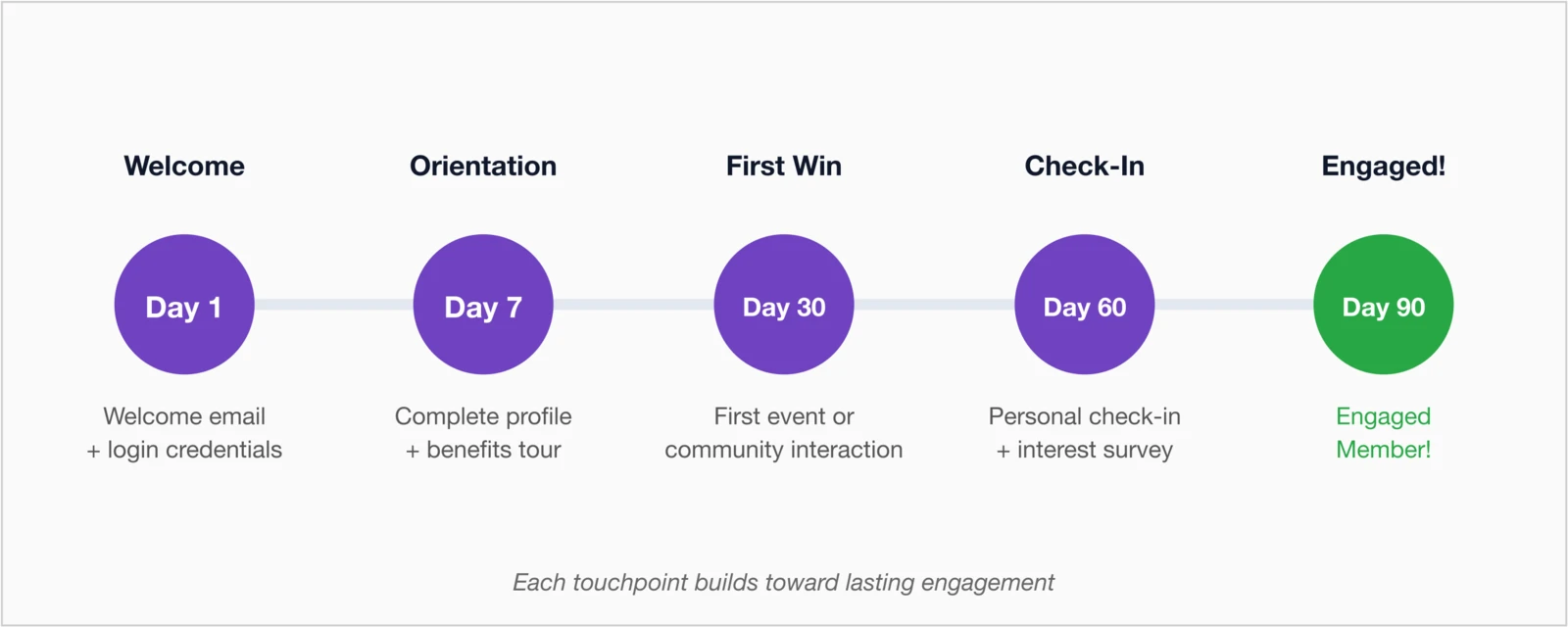
Think of onboarding as a structured journey with a few key touchpoints rather than a one-time welcome. Each step builds momentum toward an "engaged member" status.
Onboarding best practices
Automated Sequences
Use automation to deliver timely, relevant communications without overloading staff:
- Day 1: Welcome email with login credentials and "start here" guidance
- Day 7: Profile completion prompt plus a guided benefits tour or short video
- Day 30: Invitation to a first event or introduction to your online community
- Day 60: Personal check-in and interest survey to learn priorities and goals
- Day 90: Milestone message and invitation to take the "next step"
Personal Touches
Layer in human connection where it matters most:
- Personal welcome call from staff, a board member, or a volunteer ambassador
- Mentor matching for professional associations looking to support career growth
- New member cohort introductions so people join with a peer group
- Live or virtual "new member orientation" sessions
- Direct connection to a relevant SIG, section, or local chapter
Measuring onboarding success
To refine onboarding over time, track a handful of specific metrics:
- First login rate: Percentage of new members who log into the portal within 7 days.
- Profile completion: Percentage who complete their profile within 30 days.
- First engagement: Percentage who attend an event, post in a forum, or access a resource within 90 days.
- First-year renewal: The ultimate test—are onboarded members renewing at higher rates than those who are not?
Onboarding is one of the highest-ROI investments you can make in engagement. Associations have doubled first-year renewal rates simply by adding a personal welcome call within 48 hours of joining—a low-cost tactic that fundamentally changes how new members perceive the organization.
Related: You can further enhance impact with automated email marketing that tailors onboarding paths by member type, interests, and actual behavior.
Measuring engagement success
What you measure shapes what you manage. Engagement metrics help you identify at-risk members, understand which programs deliver value, and refine your strategy over time.
The goal is not to track everything; it is to focus on a small set of meaningful indicators that link activity to retention. Start simple, build discipline around data, and only then add sophistication.
Core engagement metrics
A basic engagement dashboard might include:
| Metric | What It Measures | Target Benchmark |
|---|---|---|
| Member portal logins | Basic platform engagement | 40%+ monthly active members |
| Event attendance rate | Participation in programming | 30%+ attend at least one event/year |
| Forum participation | Community contribution | 15%+ post or reply/year |
| Email engagement | Communication effectiveness | 25%+ open rate |
| Volunteer participation | Deep commitment | 10%+ serve in some capacity |
| Directory completion | Network readiness | 60%+ complete profiles |
These benchmarks will vary by organization, but they provide useful starting points for trend analysis and goal setting.
Engagement scoring
An engagement score can help you see the whole picture for each member:
- Assign points to different activities (logins, event attendance, posts, volunteer roles, purchases).
- Calculate scores monthly or quarterly at the individual member level.
- Segment members by score bands (high, medium, low, at-risk).
- Track how scores change over time and across key cohorts.
- Use score drops to trigger outreach and "save" campaigns for at-risk members.
Do not overlook qualitative data. Incorporate member survey feedback and use proven member satisfaction survey templates to understand perceived value alongside behavior. In practice, the organizations that succeed often focus on three simple questions: Did the member log in? Did they attend something? Did they connect with another member? Members who do all three are highly likely to renew; members who do none are at greatest risk.
Re-engaging lapsed and at-risk members
Even with strong engagement programs, some members will disengage. Schedules change, budgets tighten, or expectations go unmet. The important point is that disengagement is often reversible—especially if you intervene early and thoughtfully.
Understanding why members leave is essential. According to Marketing General's 2025 Membership Marketing Benchmarking Report, 52% of non-renewals cite lack of engagement with the organization as their primary reason—they simply did not use their benefits. That means the door is wide open for re-engagement strategies that make it easier and more compelling to come back.
Identifying at-risk members
The best retention strategy is proactive. Watch for early warning signs and respond before renewal dates arrive.
Warning Signs
Watch for these early indicators of disengagement:
- No portal logins for three or more months
- Stopped opening emails for three or more campaigns
- No event attendance in the past year
- Steadily declining engagement scores
- Expired certifications or credentials
- Job changes that might affect sponsorship
Intervention Triggers
When you see these patterns, consider:
- Automated outreach triggered by declining engagement
- Personal calls from staff or volunteer ambassadors
- Targeted content aligned with past interests
- Special invitations to upcoming events
- Short surveys to understand needs and barriers
- Reminders of underused or new benefits
The re-engagement playbook
A structured approach can significantly improve your ability to win back disengaged members:
- Diagnose the cause: Clarify why they disengaged—budget, time, misalignment of value, or other factors.
- Personalize outreach: Replace generic "We miss you" messages with communications that reference specific history (events attended, committees served, content accessed).
- Lead with value: Offer something concrete—a free webinar, discounted event registration, or new resource directly tied to their interests.
- Remove friction: Simplify reactivation, consider flexible payment options, or propose lower-cost membership tiers where appropriate.
- Leverage personal connection: For high-value or long-tenured members, pair outreach with a phone call from someone they know or recognize.
Win-back campaigns for lapsed members
For members who have already lapsed, time-bound campaigns can recover a meaningful percentage—often 10–20%—of past members:
| Timing | Approach | Offer |
|---|---|---|
| 30 days post-lapse | Reminder and easy renewal | Standard renewal, minimal incentives |
| 60–90 days | Personal outreach plus feedback | Short survey and small incentive to rejoin |
| 6 months | Value reminder campaign | Discounted event or bonus benefit |
| 12 months | Major "welcome back" campaign | Significant discount or rejoin package |
| 24+ months | Periodic "stay in touch" outreach | Industry news and select open-access content |
Throughout these efforts, keep the focus on relevance and ease rather than pressure. I have seen associations recover members who had been gone for years—not through aggressive sales tactics, but through a well-timed email that said, "We thought you might find this useful." Sometimes all it takes is showing a lapsed member that you remember who they are and what they cared about. That personal touch, even at scale, can reopen doors you thought were closed for good.
Related: For more ideas, explore our Membership Retention Guide, which offers additional strategies to prevent lapse and extend member lifetime value.
Driving engagement with online communities
Events create powerful moments of connection, but they happen only a few times a year. An online community fills the gaps between events, offering always-on engagement and making your association the place members go when they need answers, support, or peers who understand their challenges.
A strong online community is not a single feature—it is a set of interconnected elements that reinforce one another and drive deeper engagement than any single program could. Members might start in one area (like a directory search) and naturally branch into others (like joining a forum discussion or interest group). Over time, this web of interactions becomes a key reason they stay.
Elements of a successful online community
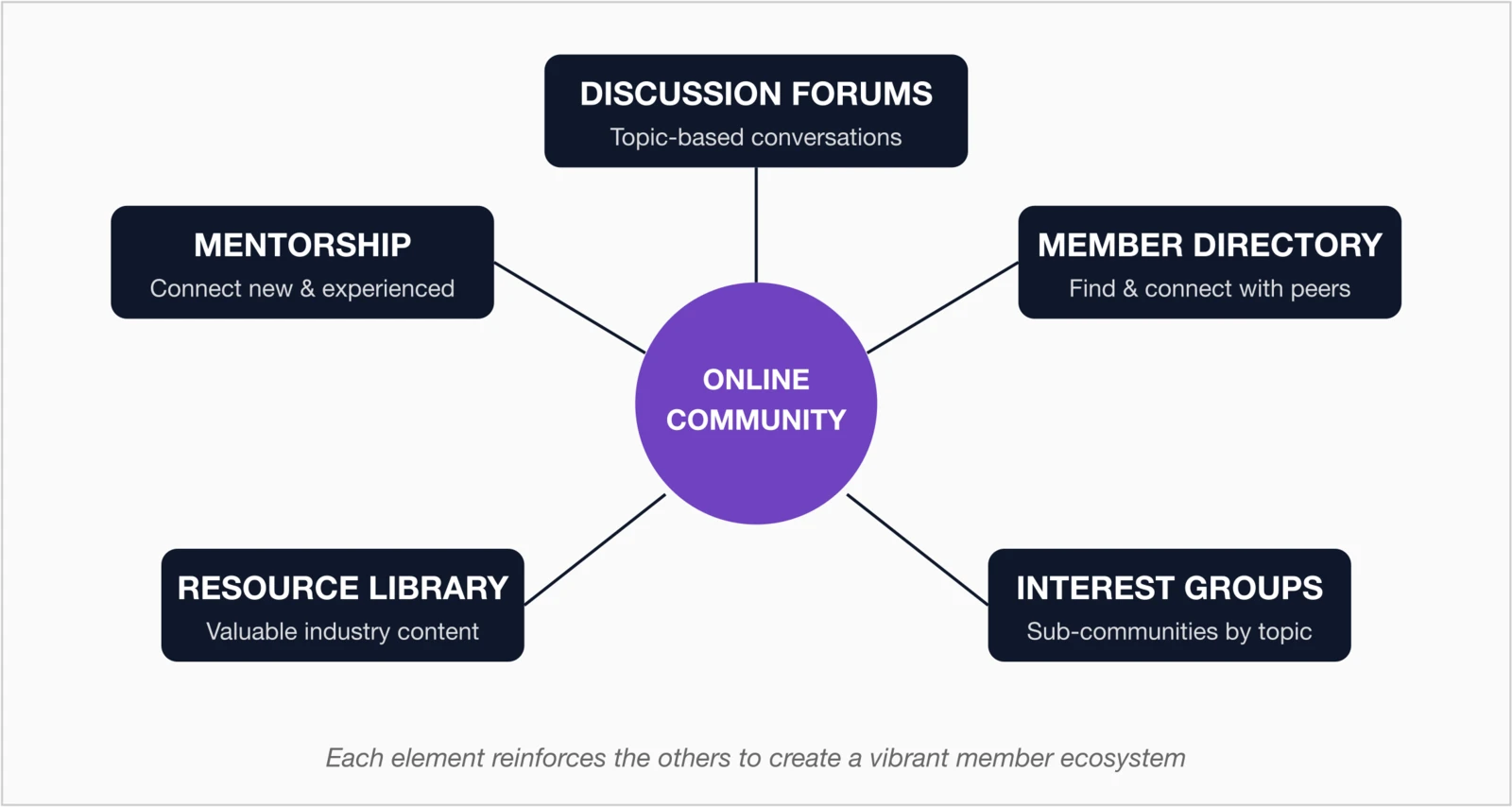
Key components of a healthy online community ecosystem include:
- Discussion forums: Topic-based spaces where members ask questions, share expertise, and troubleshoot challenges together.
- Member directory: Searchable profiles so members can find peers by role, specialty, industry, or location and build direct connections.
- Interest groups (SIGs or communities of practice): Focused sub-communities organized around topics, demographics, or career stages.
- Resource library: Central hub for curated and member-contributed content that becomes more valuable as it grows.
- Mentorship connections: Opportunities for experienced members to support newcomers or rising professionals in structured or informal ways.
These elements feed each other. A member who finds a mentor within the community might then join that mentor's interest group, start posting in related forums, and eventually contribute resources of their own. Each new interaction deepens their connection to the organization and to other members.
Community success factors
To keep your community vibrant rather than stagnant, focus on a few critical success factors:
- Critical mass: Ensure enough active participants to keep conversations going and avoid "ghost town" impressions.
- Moderation: Assign moderators to welcome newcomers, guide discussions, and handle any issues.
- Fresh content: Seed regular new discussions, questions, and resources so there is always a reason to return.
- Value density: Make sure members quickly find answers, connections, and insights when they log in.
- Mobile access: Optimize for phones so members can participate wherever they are.
Creating discussion forums that thrive
Discussion forums can be your most visible, high-engagement member benefit—or an uncomfortable reminder that no one is talking. The difference is intentional cultivation from day one.
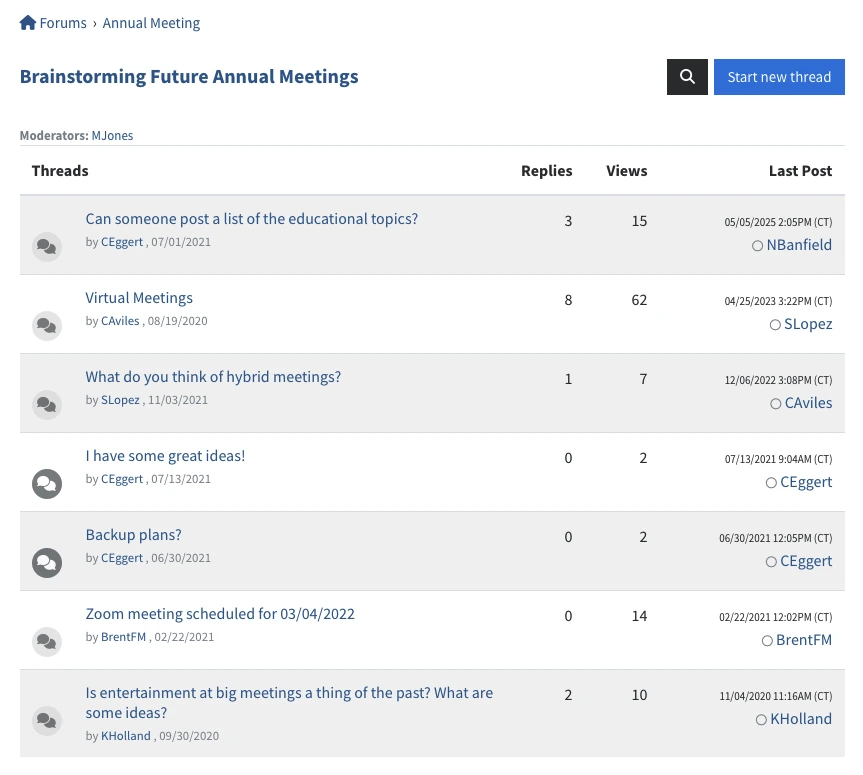
When forums are launched thoughtfully and actively supported, they become the go-to place for peer problem-solving, informal learning, and relationship building. Members who participate in forums show significantly higher engagement scores and renewal rates than those who do not.
Launching a forum successfully
Set your forum up for success before you ever send the first announcement:
- Seed with content: Never launch an empty forum. Have staff and volunteers post initial questions, case studies, and conversations.
- Recruit champions: Identify 10–20 engaged members who commit to posting and replying regularly in the early months.
- Promote heavily: Use email campaigns, event announcements, and personal invitations to drive initial traffic.
- Moderate actively: Welcome new posters, prompt responses, and highlight standout contributions to set the tone.
- Measure and adjust: Track participation, popular topics, and drop-off points, then refine categories and prompts accordingly.
Forum best practices
Once the forum is live, a few best practices help it grow and sustain momentum:
- Keep categories simple: Start with three to five clear categories to avoid fragmenting conversation.
- Encourage questions: "Ask the community" prompts lower the barrier to posting than opinion pieces.
- Highlight experts: Tag known subject-matter experts when relevant questions appear.
- Summarize for newsletters: Feature "hot topics this week" to draw in lurkers and remind members of value.
- Recognize contributors: Use badges, spotlights, and personal thank-yous to reinforce positive behavior.
Deep Dive: Online Forum Best Practices for Associations
Turning member directories into networking hubs
A member directory is more than a list—it is the engine for peer-to-peer networking, referrals, and informal mentoring. When it is easy to use and well populated, members turn to it to find colleagues, partners, and experts, reinforcing the sense that your association is the hub of the community.
A thoughtfully designed directory encourages members to present themselves clearly and helps others discover them for collaboration, hiring, speaking, or volunteering opportunities. The more complete and accurate the profiles, the more powerful the directory becomes.
Directory features that matter
To turn your directory into a core engagement asset, prioritize:
- Search and filter tools: Allow searches by location, specialty, company, skills, and interests.
- Complete profiles: Encourage photos, bios, contact information, and areas of expertise.
- Privacy controls: Let members choose what to display publicly or to members only.
- Connection requests: Provide an easy way to message or connect with other members.
- Mobile-friendly design: Make search and outreach simple on any device.
Improving member profile completion rates
Directories only deliver value when members keep their profiles up to date. To improve completion:
- Build profile completion prompts into onboarding and early communications.
- Send gentle reminders to members with incomplete profiles.
- Highlight real benefits of being listed, such as "Get found by potential clients, employers, or collaborators."
Deep Dive: Member Directory Optimization for Networking
Volunteer and committee engagement
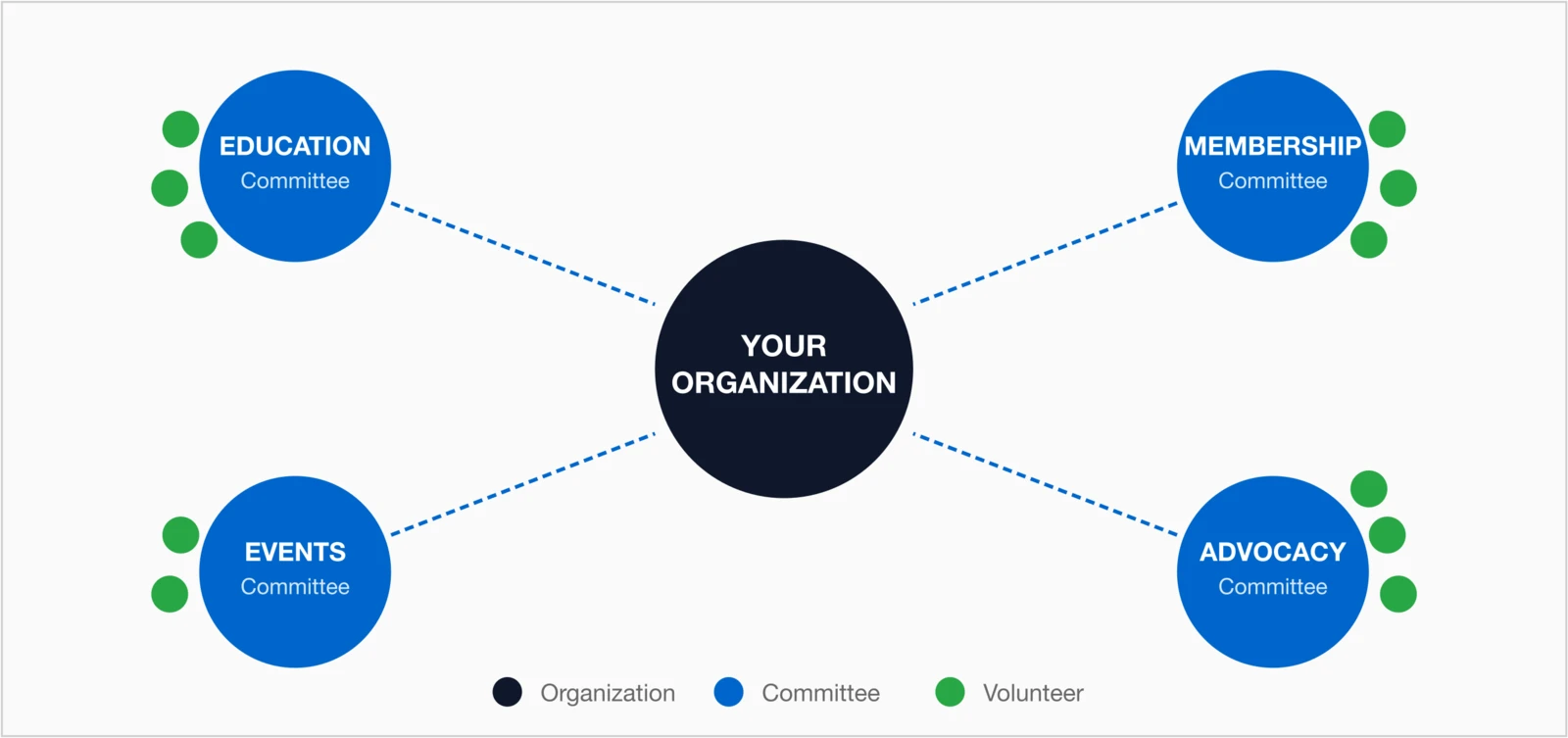
Volunteers and committee members are often your most loyal, engaged members. When members contribute their time and expertise, they build a deep sense of ownership and connection with your mission—and that shows up in retention, advocacy, and leadership pipelines.
An effective volunteer program does more than fill task lists. It creates meaningful experiences where members see the impact of their contributions, develop professionally, and form strong relationships with peers and staff. Treating volunteer engagement as strategically as donor relations pays off in long-term value.
The volunteer lifecycle: Recruit, engage, sustain
The most successful associations manage volunteer engagement as a three-phase lifecycle:
Recruit
Make it easy and appealing for the right members to say yes.
Engage
Keep volunteers energized and focused on impact.
Sustain
Build systems that preserve momentum and prevent burnout.
Your volunteers are your future board members, your strongest advocates, and your most reliable renewals. Associations that struggle with leadership pipelines are often the ones that have allowed volunteering to feel like a chore instead of an honor.
Here is something I have noticed again and again: when you ask a longtime member why they have stayed so long, the answer almost always involves a committee, a volunteer project, or a leadership role that made them feel like they mattered. That sense of contribution is incredibly powerful—and it is something you can design for.
Related Resources:
Volunteer Engagement & Management for Associations
Committee Management Best Practices
Member Recognition Programs That Drive Loyalty
Committee & Board Tracking Software — tools for managing rosters, terms, and succession planning
Special interest groups (sigs)
Special Interest Groups (SIGs) create "community within the community," giving members a way to connect around specific topics, industries, or identities. For larger associations especially, SIGs make the organization feel smaller, more relevant, and more personal.
When SIGs are well supported, they become engines for programming, peer support, and leadership development. Members who might be overwhelmed by the larger association often find a comfortable home—and a reason to stay—inside a focused group of peers.
Common sig structures
SIGs can be organized along several dimensions:
- Topic-based: Focused on specific technical, professional, or practice areas.
- Industry vertical: Centered on sectors such as healthcare, finance, or manufacturing.
- Career stage: Tailored to young professionals, mid-career members, or executives.
- Geographic: Regional or local chapters that provide face-to-face options.
- Identity-based: Communities for women in the profession, underrepresented groups, or other affinity segments.
Sig success factors
To help SIGs flourish without fragmenting your overall community, focus on:
- Volunteer leadership: Each SIG needs a committed chair or leadership team.
- Minimum viable size: Aim for at least 50–100 members to sustain activity.
- Regular programming: Offer webinars, discussions, and newsletter content at a predictable cadence.
- Autonomy with guardrails: Give SIGs room to innovate within clear organizational policies.
- Connection to the main organization: Make SIG events and content visible to the broader membership, and align priorities with your overall strategy.
Engaging young professionals
Every association faces the same concern: membership is aging, and not enough young professionals are joining or staying. According to Sequence Consulting's 2026 Association Trends report, 50% of associations fail to tailor their communications for early-career professionals—a gap that represents both a challenge and an opportunity.
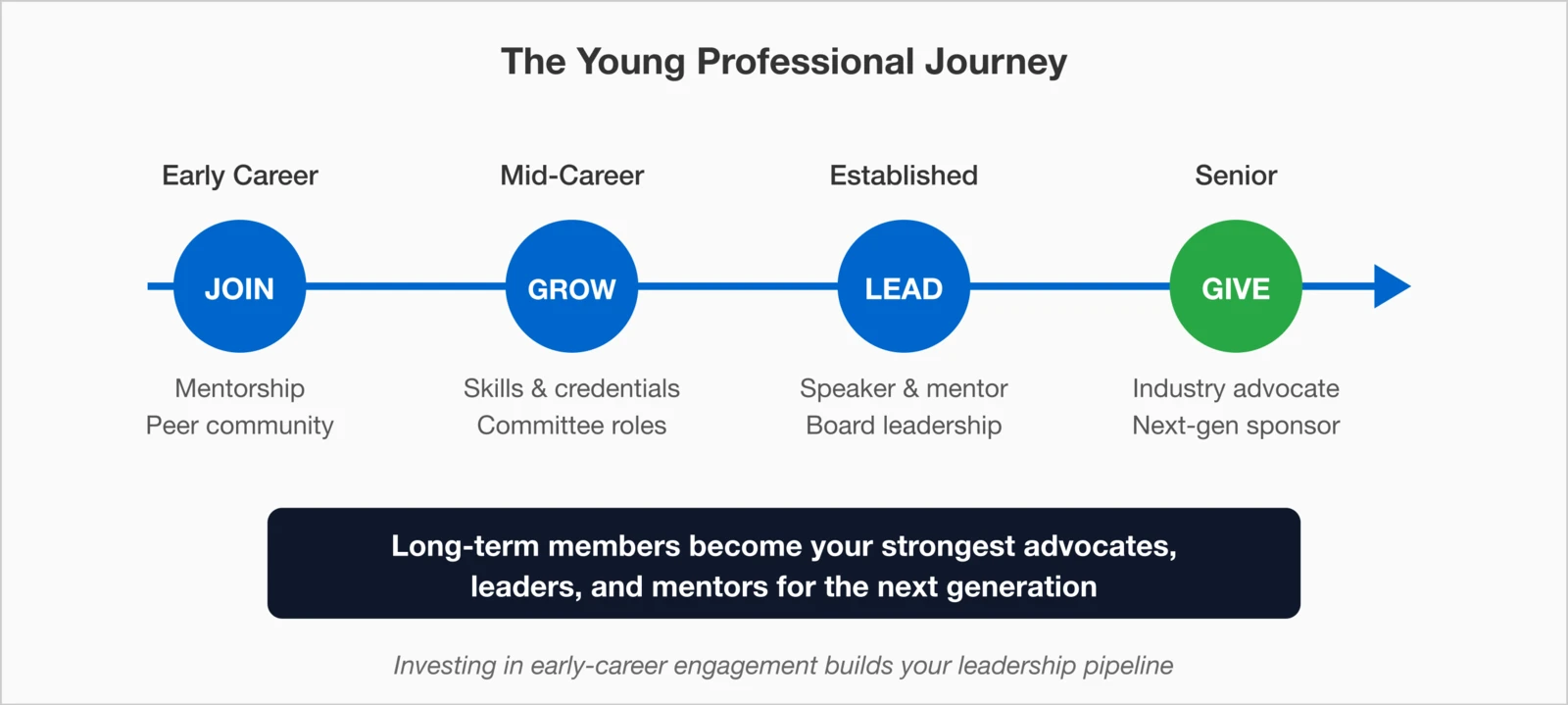
The key insight: associations that struggle with young professionals often are not failing at marketing. They are failing to deliver value that resonates with early-career needs. Young professionals want career advancement (skills, credentials, connections to mentors and hiring managers) and peer community (safe spaces to learn, relationships with others at similar career stages). Associations that succeed offer tiered pricing, mentorship programs, leadership pathways, digital-first experiences, and dedicated young professional communities.
Members who join early in their careers have the potential to become decades-long advocates, leaders, and mentors—but only if you keep them engaged through career transitions and life changes.
Deep Dive: Young Professional Member Engagement: Attract and Retain the Next Generation — generational expectations, pricing strategies, mentorship programs, leadership pathways, and metrics for measuring success
Events as engagement drivers
Events—whether in-person, virtual, or hybrid—remain some of the most powerful tools for engagement. They deliver education, create shared experiences, and spark relationships that can last for years.
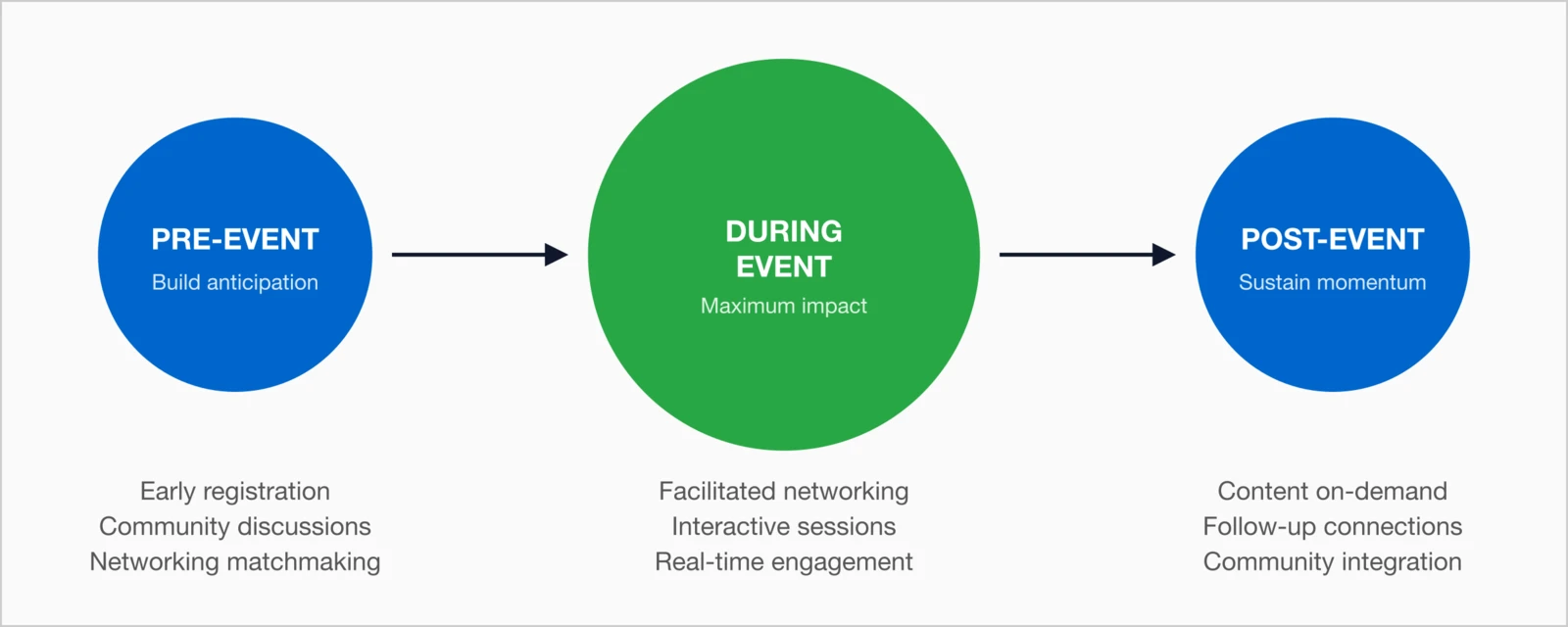
However, event attendance alone no longer guarantees loyalty. According to Sequence Consulting's 2026 Association Trends report, the share of associations reporting stable or rising event attendance fell from 62% in 2023 to just 53% in 2024. The organizations that are thriving treat events as one part of a year-round engagement strategy instead of standalone products. They use events to catalyze connections before, during, and after—and then help those connections continue in their community platforms. The most loyal members often experience 12 or more meaningful interactions per year outside of major events.
Event engagement lifecycle
Design your events with a full lifecycle in mind:
Event types and engagement impact
Different event formats drive different types of engagement:
| Event Type | Engagement Strength | Best For |
|---|---|---|
| Annual Conference | Very High | Deep relationship building, major networking |
| Regional Meetings | High | Local networking and geographic community |
| Virtual Conferences | Medium–High | Broad reach and accessible global participation |
| Webinars | Medium | Educational content and expert access |
| Workshops/Training | High | Skill building and cohort connections |
| Social/Networking Events | Very High | Pure relationship building |
Maximizing event-driven engagement
To get more long-term value from every event:
- Create pre-event community spaces so attendees can connect and plan.
- Use networking tools to match attendees by interest, goals, or role.
- Offer dedicated first-timer programs to guide new attendees.
- Prioritize interactive session formats over passive lectures.
- Continue conversations post-event in forums and groups and share recordings.
- Maintain momentum with year-round programming—webinars, regional meetings, and micro-events between annual conferences.
Deep Dive: Association Event Management Software — tools for registration, scheduling, and attendee engagement
Technology for member engagement
The right technology platform makes it easier to deliver rich engagement experiences at scale and to see what is working. When your systems are integrated, you can lower friction for members and gain a unified view of engagement across touchpoints.
Look for tools that not only manage data but actively support participation: personalized content, easy workflows for members, and visibility into the full engagement journey.
Essential engagement technology
A modern engagement stack typically includes:
- Member portal: A single, branded destination where members can access benefits, events, and community features.
- Discussion forums: Built-in spaces for topic-based conversation and peer support.
- Member directory: Searchable and filterable profiles with member-controlled visibility.
- Committee and board management: Roster tracking, terms, meetings, and documentation, supported by strong board communication practices.
- SIG/chapter support: Tools for managing sub-communities and localized or topical groups.
- Activity tracking: Centralized engagement history at the member level across events, content, and community.
- Mobile access: Responsive design or a native member app to support participation on the go.
i4a Community Features
Platforms like i4a's membership management software offer integrated community tools—forums, directories, groups, and committee tracking—all connected to the core member database. This type of integration helps you move from siloed activities to a cohesive engagement ecosystem.
Explore Community FeaturesFrequently asked questions
Build your engaged community
i4a provides the engagement tools you need—forums, directories, groups, and committees—all integrated with your membership database.
- Discussion forums with email integration
- Searchable member directory
- Committee and volunteer tracking
Related articles
Strategies for Building a Thriving Member Community
Transform your membership list into a vibrant, engaged community.
